
![[A Stunning Tropical Power Spot] Aoshima Shrine Travel Guide](https://static.gltjp.com/glt/data/article/21000/20348/20230731_111755_e41823bc_w1920.webp)
[A Stunning Tropical Power Spot] Aoshima Shrine Travel Guide
Aoshima Shrine is one of Japan’s leading power spots, set on Aoshima Island floating in the blue waters of Miyazaki.
The shrine is full of highlights, from its grounds covered in a forest of subtropical plants and the unique terrain known as “Devil’s Washboard,” to blessings for love and matchmaking and one-of-a-kind wish-making rituals.
In this article, we’ll introduce the charm of Aoshima Shrine, plus spots and ways to enjoy it that you might miss if you don’t know about them.
What is Aoshima Shrine Like?
Aoshima Shrine is a shrine enshrined on “Aoshima,” an island that floats just off the coast in the southeastern part of Miyazaki City, Miyazaki Prefecture.
It enshrines three deities—Hikohohodemi no Mikoto, Toyotamahime, and Shiotsuchi no Okami—and is said to grant blessings for love and matchmaking, safe childbirth, and safe travel, shipping, and maritime journeys.
Because Hikohohodemi no Mikoto and Toyotamahime are said to have nurtured their love here, many visitors come especially to receive blessings for matchmaking.
Since Aoshima Shrine considers the entire island of Aoshima to be its grounds, you can also enjoy Aoshima’s biggest draw: its beautiful setting.
Enjoy the sweeping views of the sea and sky from the bridge leading to Aoshima.
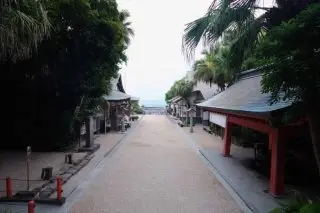
A forest of subtropical plants spreads across the island, so you can even feel like you’re in a tropical paradise while visiting the shrine.
Seeing subtropical plants growing throughout shrine grounds is a rare sight you won’t often find elsewhere.
With some of the prefecture’s best beaches nearby, summer is a great time to enjoy not only shrine visits, but also swimming and marine sports like surfing.


The Origins of Aoshima Shrine
The history of Aoshima Shrine is written in the myth of “Umisachihiko and Yamasachihiko.”
“Yamasachihiko” is another name for Hikohohodemi no Mikoto, the enshrined deity of Aoshima Shrine.
Yamasachihiko lost a fishhook he had borrowed from his older brother, Umisachihiko, at the seaside.
As he was at a loss because he couldn’t find it, Shiotsuchi no Okami appeared and advised Yamasachihiko to search for it under the sea.
There, he met Toyotamahime, the daughter of the sea god, and the two became united.
After twists and turns, he found the fishhook, and it’s said that Aoshima is where Yamasachihiko and Toyotamahime returned from the sea to the land above and lived.
Aoshima Shrine was built to enshrine the three deities—Yamasachihiko, Toyotamahime, and Shiotsuchi no Okami—on the site said to be their former residence.
Access to Aoshima Shrine
From Miyazaki Airport, which has both domestic and international flights, you can reach Aoshima Shrine by train or bus.
If you go by train, first take the JR Miyazaki Airport Line and get off one stop later at Tano Station.
Transfer at Tano Station to the JR Nichinan Line, take a train bound for the down line direction, and get off at Aoshima Station.
From there, it’s about a 10-minute walk to Aoshima Shrine.
If you take the bus, board the Miyazaki Kotsu bus bound for “Obi” at Miyazaki Airport.
Get off at the “Aoshima” bus stop, then walk for around 10 minutes to reach Aoshima Shrine.
You can get there within an hour by either train or bus.
However, both trains and buses only run around 1–2 times per hour, so be sure to check the timetable carefully before heading to Aoshima Shrine.
Aoshima Shrine Hours and Admission
Admission to Aoshima Shrine is free. Visiting hours are from 6:00am to sunset.
However, the Hyuga Mythology Hall requires the admission fees listed below.
- Adults
- 600 yen
- Middle and high school students
- 400 yen
- Elementary school students
- 300 yen
- Preschoolers
- Free
What’s the Best Season to Visit Aoshima Shrine?
The recommended season to visit Aoshima Shrine is summer.
It’s the best time to fully enjoy Aoshima’s setting, and it’s also when the “Festival Crossing the Sea,” where people carry a mikoshi across the water, is held.
It takes place on the last Saturday and Sunday of July, so if your timing works out, be sure to join in.
Another plus is being able to enjoy swimming and surfing at the nearby beaches.

Soak Up the Shrine’s Highlights! 5 Recommended Spots at Aoshima Shrine
Since the entire island of Aoshima is considered the shrine grounds, Aoshima Shrine has plenty to see.
Its excellent location is one of its charms, but here we’ll focus on carefully selected spots where you can truly enjoy the shrine’s highlights.
Be sure to visit places where you can better understand the history and legends of Miyazaki and Aoshima, a land of myth.
1. The Beautiful Vivid Vermilion “Main Hall”
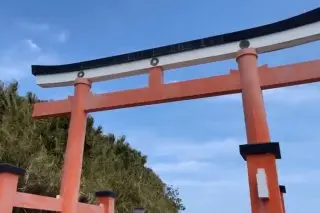
The Main Hall is striking for its vivid vermilion color, and the contrast with the blue sky is especially beautiful.
It has been rebuilt several times; after it was completely destroyed by fire in 1974, it was reconstructed into its current form.
Since the Main Hall enshrines the married couple Hikohohodemi no Mikoto and Toyotamahime, many visitors come to pray for love and matchmaking.
Benzaiten, a deity said to bring blessings for better financial luck, is also enshrined here.

2. One of the Grounds’ Top Power Spots: “HONGU”
Follow the path lined with subtropical plants that extends from beside the Main Hall, and you’ll reach Hongu, one of Aoshima Shrine’s top power spots.
This shrine building stands near the center of Aoshima and is said to have originally been built as Aoshima Shrine’s Main Hall.
Pottery believed to date to the Yayoi period has been unearthed around Hongu, making it highly likely that rituals were performed here from ancient times.
Near Motomiya is a pair of closely standing livistona trees called the “Meoto Birou Tree,” where you can try a wish-making ritual known as Musuhi Koyori.
Choose a “koyori” (a thin strip of Japanese paper twisted into a string) in the color that matches your wish, then tie it to the tree.


3. “Hyuga Mythology Hall,” Which Makes Myths Easy to Understand
Hyuga Mythology Hall vividly recreates Japanese myths in 12 scenes using 30 wax figures.
It depicts scenes from when Ninigi no Mikoto—grandchild of Japan’s highest deity, Amaterasu Omikami—descended to Miyazaki, through to the enthronement of Japan’s first emperor.
Since it also recreates the myth behind Aoshima Shrine’s origins, it’s a spot you should visit to better understand Aoshima Shrine.

4. Unique Wish-Making Rituals and Fortunes Found Only at Aoshima Shrine
Among the many wish-making rituals and fortunes at Aoshima Shrine, here are two especially unique ones.
The first is Ame no Hirakana Nage.
While softly stating your wish, you toss a small dish called a hirakana into the iwakura (a sacred place where the deity is believed to reside).
If it lands inside, your wish will come true; even if it doesn’t go in, it’s said that if the dish breaks, your luck will open up from here on.
The second is Sainome Shinji.
This ritual involves rolling a large die while chanting, “Oshietamae, michibitamae.”
The die has sides for gold, body, social ties, misfortune, learning, and relationships, and the result is said to represent what matters most to you.
When you visit Aoshima Shrine, be sure to give them a try.

5. “Devil’s Washboard,” Where You Can Feel the Workings of Nature
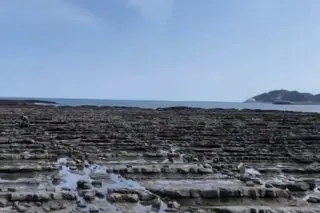
The wave-like rock formations known as “Devil’s Washboard” surrounding Aoshima are also one of Aoshima Shrine’s highlights.
They were named “Devil’s Washboard” because their jagged shape resembles an old-fashioned washboard.
Rocks uplifted Approx. 7 million years ago were eroded by waves, leaving only the harder sections behind; they then stacked like boards into the shape now known as Devil’s Washboard.
They’re hidden below the water at high tide, but appear at low tide.
The view of Aoshima Shrine’s torii gate lined up with Devil’s Washboard is a must-see.

Do Couples Break Up If They Walk Around the Island? Aoshima Shrine Superstition
There’s a superstition that if a couple walks around Aoshima together, they’ll break up.
It’s said that the female deity enshrined at the shrine becomes jealous and causes the breakup, but this is just a rumor.
For shrines known for matchmaking blessings, it’s often said they “connect you with the right person.”
In other words, it can also mean that “ties with someone who isn’t right for you will be cut.”
That’s why many matchmaking shrines are said to have a superstition that couples who visit together will break up.
3 Miyazaki Shrines to Visit to Experience the Land of Myth
If you’ve come all the way to Miyazaki, a land of myth, be sure to visit shrines beyond Aoshima Shrine as well.
The three shrines introduced below have plenty to see, so consider adding them to your travel plan.
1. Udo Jingu Shrine
A rare shrine located inside a cave on seaside cliffs.
It’s said to grant blessings for safe childbirth, childrearing, love and matchmaking, fishing, and safe voyages.
The wider Udo area centered on Udo Jingu Shrine is designated as a National Place of Scenic Beauty.
To worship, you need to descend an Approx. 800-meter stone staircase built into the cliff.
The cave is Approx. 1,000 square meters in size and is said to be the place where Toyotamahime, a goddess in Japanese mythology, built a birthing hut to give birth.
There is also Omichi Iwa, where Toyotamahime is said to have pressed her breast to a rock for her child when she returned to the Sea Palace, and it’s said that licking “Ochi Ame” candy made from water dripping from the rock helps increase breast milk.

2. Miyazaki Jingu Shrine
Miyazaki Shrine is one of the most important Shinto shrines in Miyazaki, dedicated to Emperor Jimmu, the first emperor of Japan.
Also enshrined here are his parents, Ugayafukiaezu no Mikoto and Tamayorihime no Mikoto. The shrine is widely known for blessings related to harmonious marriages, safe childbirth, fertility, victory in competitions, and success in exams.
Locally, the shrine is affectionately known as “Jimmu-sama,” especially during its grand festival held in October, when it attracts large numbers of worshippers and visitors.
According to historical records, the shrine was originally established by Takeiwatatsu no Mikoto, a grandson of Emperor Jimmu, when he was appointed as a regional ruler of Kyushu. The shrine buildings were later constructed during the reigns of Emperor Sujin (the 10th emperor) and Emperor Keiko (the 12th emperor).

3. Kunimigaoka
A hill tied to a legend in which Emperor Jimmu’s grandson, Tateiwatatsu no Mikoto, stopped by here and surveyed the land while governing Kyushu.
At 513 m above sea level, it’s known for its incredible sea of clouds views from the observatory in autumn. The sea of clouds that forms like it’s filling the Takachiho Basin, surrounded by mountains such as Mount Aso and the Sobo-Katamuki Range, is a breathtaking sight you’ll want to photograph even if you’re not a professional.
The sea of clouds is said to be visible in the early morning from mid-September to late November, forming when conditions such as high humidity and sufficient radiative cooling come together.

Reviews
4.03
Some reviews are AI-translated.
-
The scenery around the shrine, with its emerald-green sea and towering rocks, creates a beautiful contrast with the shrine's simple elegance. It feels peaceful and sacred.
-
Aoshima Shrine is mainly known for prayers about relationships. The charms are different for men and women, which is pretty unique.
-
The coastline here is really unique. Besides people playing in the water, you'll also see surfers catching waves.
FAQ about Aoshima Shrine
Q
Which deities are enshrined at Aoshima Shrine?
A
Three deities are enshrined here: Hikohohodemi no Mikoto, Toyotamahime no Mikoto, and Shiotsuchi no Okami.
Q
What blessings is Aoshima Shrine known for?
A
It’s said to grant blessings for love and matchmaking, safe childbirth, and safe travel and maritime journeys.
Q
Tell me the superstition about Aoshima Shrine.
A
There’s a superstition that if a couple walks around Aoshima together, they’ll break up.
Summary
At Aoshima Shrine, you can not only enjoy Aoshima’s beautiful setting, but also receive blessings for love and matchmaking, try unique wish-making rituals and fortunes, and visit a mythology hall that explains the legends in an easy-to-understand way—there are many ways to enjoy your time here.
As you visit the spots introduced in this article where you can fully enjoy the shrine’s highlights, be sure to take in the beautiful location as well.
If you want to fully enjoy Aoshima, one of Kyushu’s top resort areas, also check out the sample itinerary introduced in the article below.