
![[Hitachi Seaside Park Travel Guide] Stunning Colorful Views and So Much to Do!](https://static.gltjp.com/glt/data/article/21000/20377/20230822_111453_1df5b4e1_w1920.webp)
[Hitachi Seaside Park Travel Guide] Stunning Colorful Views and So Much to Do!
Hitachi Seaside Park is known for its breathtaking view of hills blanketed in nemophila.
And it’s not just nemophila—depending on the season, you can see a variety of spectacular scenery.
Beyond that, there are many ways to enjoy the park, including leisure activities and sports, nature observation, and hands-on learning experiences.
With its vast grounds packed with attractions and scenic spots, you’ll probably wonder how to make the most of it.
But don’t worry.
By reading this article, you’ll get a clear picture of what areas and facilities Hitachi Seaside Park has, plus the highlights and must-visit spots.
It’s no exaggeration to say this is a must-read before visiting Hitachi Seaside Park.
What is Hitachi Seaside Park Like?
Hitachi Seaside Park in Hitachinaka City, Ibaraki Prefecture, is a vast park facing the Pacific Ocean.
Its total area is 350 hectares—seven times the size of Tokyo Disneyland.
Even the area actually used as a park spans 215 hectares.
Across its huge grounds are many facilities, including an amusement park with rides, BBQ areas, places to see seasonal flowers and nature, and a spot lined with traditional old houses.
There are also areas like the Rock Garden and Sand Garden where you can enjoy a relaxed stroll.
Don’t miss the cafes and restaurants with ocean views, as well as souvenir shops selling Ibaraki specialties.
If you use the hop-on, hop-off “Seaside Train” or rent a bicycle, you can get around the large park efficiently—highly recommended.

Access to Hitachi Seaside Park
Here’s how to get from Narita International Airport to Hitachi Seaside Park.
Getting there by train is complicated, so traveling by bus is recommended.
- Route
-
1. Take the airport bus “Ibaraki Kotsu Bus” and get off at “Katsuta Station West Exit”
2. Move to “Katsuta Station East Exit,” take the local bus (bound for Kaihin Koen), get off at “Kaihin Koen West Gate,” then walk 10 minutes from the bus stop - Time Required
- Approx. 3 hours
Hitachi Seaside Park Hours and Admission
We’ve summarized Hitachi Seaside Park hours and admission in the table below—please use it as a reference.
Hours
Hours vary by season, so please keep that in mind.
The park is closed every Tuesday, December 31–January 1, and from the first Monday through Friday in February.
- March 1–July 20
- 9:30am–5:00pm
- July 21–August 31
- 9:30am–6:00pm
- September 1–October 31
- 9:30am–5:00pm
- November 1–End of February
- 9:30am–4:30pm
Admission
Some facilities require an additional fee beyond admission.
- Adults (high school students and up)
- 450 yen
- Ages 65 and up
-
210 yen
*Free for junior high school students and younger
In spring (April–May) and fall (October), an additional seasonal fee of 350 yen applies.
During these periods, the total cost is the admission fee plus the seasonal fee.
The Charm of Each Area in Hitachi Seaside Park
Hitachi Seaside Park is divided into seven areas.
Since it’s hard to visit every area in one day, use the information below to narrow down where you want to go.
Seasonal Flowers Spreading Across a Countryside Setting: “Miharashi Area”
The “Miharashi Area” features the highest hill in Hitachinaka City and a countryside landscape.
Take in the flowers blooming across the hillside and feel the season.
The combination of field flowers like rapeseed and Chinese milk vetch with traditional old houses is also soothing.
In the old houses used in the Edo period, you can sense what life was like back then.

Observe Plants and Wildlife in a Satoyama Woodland: “Forest Area”
Located on the west side of the park, this area features maintained forests and spring-fed wetlands.
It’s a satoyama landscape with rows of pine trees and naturally growing moss.
It’s also home to creatures such as Oze damselflies and hotokedojo loaches, so be sure to look for them.
There are facilities where you can learn about plant and animal habitats, and on weekends from April–November, the “Sawada Spring Water Area Guided Tour” is held.

Perfect for a Relaxing Day with the Family: “Grassland Area”
The “Grassland Area” features an Approx. 8-hectare lawn, BBQ areas, the Great Grassland Flower Garden, a disc golf course, and athletic playground equipment.
From late May you can enjoy poppies and linaria, and from mid-September, yellow cosmos. In October, red, white, and pink cosmos bloom.
It’s also a great photo spot where you can shoot with the giant Ferris wheel in the background.

Panoramic Views of Sand Dunes and the Pacific: “Sand Dune Area”
The “Sand Dune Area” includes sand dunes overlooking Ajigaura Beach, walking paths where you can observe coastal plants, and five gardens.
There’s also a facility with materials on plants and animals, so you can look up anything that catches your interest.
There’s also a pottery experience facility, so give it a try if you’re interested.
At the glass-walled cafe, you can enjoy Ibaraki-only drinks and sweets like “Ibaraki Fruit Japanese Black Tea,” “Sashima Japanese Pu-erh Tea,” and “Okukuji Egg Chiffon Cake,” all while gazing out at the Pacific.

A Hub of Facilities like Cafes and Walking Paths: “West Gate Area”
The “West Gate Area” has walking paths planted with bulb plants and perennials, a cafe dappled with sunlight through the trees, and an outdoor stage that can hold 10,000 people.
Here, try limited-quantity “cold brew coffee,” “Hitachi Oimo TO soft serve,” and the “maze-maze shake” topped with fruit sauce made from Ibaraki produce.
You can also rent tandem bikes and electric-assist bicycles.
There’s also Nishi Pond with a cycling course, plus a trampoline for kids and a history gallery you can stop by.

Plenty of Walking Paths and Plazas for Seasonal Flowers: “South Gate Area”
The “South Gate Area” connects the “Sand Dune Area” and the “Pleasure Garden Area.”
The Fountain Plaza, the metasequoia-lined avenue, and the small hill where you can observe seasonal flowers are wonderful.
In spring you can see himezu i and fire bellflowers, in summer roses, and in fall Mexican bush sage. There’s also a cycle center, so rent a bike and head out on a route that passes through the woods.

An Amusement-Park-Like Area Packed with Attractions: “Pleasure Garden Area”
The “Pleasure Garden Area” is an active, amusement-park-style zone.
In addition to the Ferris wheel and carousel, various attractions are scattered throughout.
There are also rides like the “Balloon Race” and “Ashibura Rumba Tower” that even toddlers can enjoy with a parent or guardian.
Food options like a crepe specialty shop and fast-food restaurants are also gathered here, so you can grab a bite when you need a break.

Enjoy Scenic Views and Adventure Play, Too! 5 Must-Visit Spots in Hitachi Seaside Park
Now that you know the charm of each area, here are five especially must-visit spots, carefully selected from the park’s many highlights.
If you visit these five spots, you’ll be able to fully enjoy Hitachi Seaside Park.
1. Breathtaking Views of Seasonal Flowers Across the Hillside: “Miharashi Hill”
“Miharashi Hill” is where you can enjoy flowers throughout the seasons.
The breathtaking view of nemophila spreading across the entire hill is so famous it’s practically synonymous with Hitachi Seaside Park.
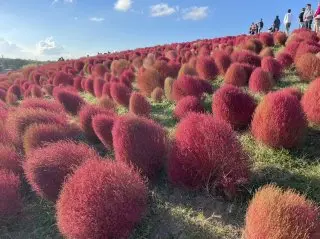
Starting with nemophila in April, the flowers on “Miharashi Hill” shift to kochia and cosmos.
It varies by season, but the sight of seasonal blooms covering the whole hill is not to be missed.


2. A Storybook-Like View: “Egg Forest Flower Garden”
In April, the “Egg Forest Flower Garden” is filled with Approx. 250,000 tulips and daffodils across around 200 varieties.
There are also nine egg-themed playground structures and a windmill, creating a fairytale-like scene.
When people think of Hitachi Seaside Park’s best scenic spots, “Miharashi Hill” is the famous one—but don’t miss the breathtaking views at the “Egg Forest Flower Garden,” either.

3. Summer Scenery in Full Bloom: “Fountain Plaza Flower Garden”
If the “Egg Forest Flower Garden” is the spring scenic spot, then the “Fountain Plaza Flower Garden” is the summer one.
In early summer you can see cornflowers and calendula, and in peak summer, sunflowers.
The flowers planted change by year, so the flower-field scenery isn’t always the same every year.
It’s a summer scenic spot where you can take great, social-media-worthy photos.

4. The Place to Let Kids Play to the Fullest: “Woodland Athletic Playground”
The “Woodland Athletic Playground” is located south of the BBQ area.
It features 15 types of athletic play equipment, including “Crossing the Dinosaur’s Back” and “Tarzan Fortress.”
It’s designed for lower elementary school grades, but it’s likely fun regardless of age.
A perfect spot for anyone who wants to play hard with their kids.

5. Stroll Through Classic Japanese Countryside Scenery: “Hitachinaka Nature Forest”
“Hitachinaka Nature Forest” offers a satoyama landscape often seen as classic Japanese countryside scenery.
Stroll through the woods centered on Japanese red pine and Japanese black pine, and around ponds where kingfishers and waterbirds visit, and you’ll be able to observe a wide variety of plants and animals.
The near-threatened “Oo-umegasasou” grows here naturally, so you can also see rare plants.

Hitachi Seaside Park Highlights by Season
The recommended sightseeing season for Hitachi Seaside Park is spring, when nemophila is at its best.
That said, flowers bloom in every season, and there are many different ways to enjoy the park.
Below, we’ll introduce the highlights for each season, so please use it as a reference.
Spring Highlights
The spring highlight is, of course, the nemophila flower fields.
There are Approx. 5.3 million flowers.
The pale blue “carpet” stretching as far as the eye can see leaves visitors feeling happy.
It’s a view you won’t find elsewhere, so it’s well worth a visit.

Summer Highlights
Lavender and zinnias in peak season are a must-see, and you also can’t miss the vivid green kochia.
There are also many summer-only hands-on events, like bamboo-copter making and haniwa making.
Create summer memories with seasonal scenery and summer-only experience events.


Fall Highlights
In fall, the leaves turn on Approx. 33,000 kochia plants.
After sunset, the red kochia is illuminated, and stage shows are held where you can enjoy music and dance.
There are also events where you can try local foods from food trucks, including “niku-maki onigiri,” “thick-cut beef tongue,” “Ibaraki dog,” and “salt-grilled ayu.”


Winter Highlights
Winter-only events are also packed in, including giant zodiac ground art, New Year’s events at traditional old houses, and taiko drums and lion dances.
It’s also a delight that events are held where you can feel Japanese traditional culture.
Don’t miss winter-blooming flowers like wintersweet, fukujusou, ice tulips, and plum blossoms.

3 Tourist Spots in Ibaraki Where You Can Enjoy Beautiful Scenery
Beyond Hitachi Seaside Park, Ibaraki has plenty of places where you can enjoy beautiful and powerful scenery.
The spots below are just as impressive as Hitachi Seaside Park, offering surprise and inspiration—so be sure to visit.
1. Ushiku Daibutsu
Ushiku Daibutsu is a giant statue of Amida Nyorai completed in Heisei 4 (1992), and its official name is Ushiku Amida Daibutsu.
At 120 m tall (including a 20 m base), it is the world’s tallest bronze Buddha statue, registered in Guinness World Records.
Shinran Shonin (1173–1262), the founder of Jodo Shinshu, used Hitachi Province (present-day Ibaraki) as his base while spreading his teachings across the Kanto region.
Since Ibaraki is associated with Shinran Shonin, the Great Buddha was built here by Jodo Shinshu Higashi Honganji-ha, Head Temple Higashi Honganji.
Its overwhelming scale includes a total weight of 4,000 tons, a left palm of 18 m, a face length of 20 m, eyes 2.5 m long, a mouth 4 m long, a nose height of 1.2 m, ears 10 m long, and an index finger 7 m long.

2. Kairakuen Garden
Created by Tokugawa Nariaki, the ninth lord of the historic Mito Domain.
Along with Kenrokuen in Kanazawa and Korakuen in Okayama, it’s counted among Japan’s Three Great Gardens.
The grounds cover Approx. 13 hectares and are full of sights throughout.
What you’ll see ahead after entering from the east gate is Kobuntei, a wooden building with two stories and three levels.
Built as Lord Nariaki’s villa, its simple yet refined appearance—made up of two structures with shingle and thatched roofs—has an elegant charm.
Seni-dai, lined with stone boards for Go and Shogi and table stones, sits at the southern end of a hill, offering wonderful natural scenery below, including Lake Senba.

3. Hitachi Station
Hitachi Station is the central station in Hitachi City, on the JR East Joban Line, facing the Pacific Ocean.
Completed in 2011, the current station building is striking for its beautiful, all-glass design.
The design was supervised by Hitachi City–born architect Kazuyo Sejima, a recipient of the “Pritzker Prize,” often called the Nobel Prize of architecture.
It won the Good Design Award in 2012, and in 2014 received an excellence award in the “Brunel Awards,” an international design competition specializing in railway-related design.

Reviews of Hitachi Seaside Park
4.21
Some reviews are AI-translated.
-
It's even more impressive in person than in photos! The park is huge, so I definitely recommend wearing comfortable shoes—otherwise, your feet will be dead by the end 😂 You can also rent a bike and enjoy the scenery as you ride around, which is super relaxing.
Besides the flower fields, there are also amusement areas and food stalls, so the whole vibe is really laid-back. On a nice day, it's honestly as beautiful as a postcard. Totally worth visiting at least once! -
This is one of the most famous spots in Ibaraki. In autumn, the hills are covered with kochia, and there's always something to see here no matter the season.


FAQ about Hitachi Seaside Park
Q
How much is admission to Hitachi Seaside Park?
A
It’s 450 yen for high school students and up, and 210 yen for those aged 65 and up.
Q
What kinds of facilities are at Hitachi Seaside Park?
A
It’s packed with places to enjoy spectacular seasonal scenery and facilities for active fun.
Q
When are nemophila and kochia at their best at Hitachi Seaside Park?
A
Nemophila is best from mid-April to early May, and kochia autumn colors are best in October.
Summary
Hitachi Seaside Park offers spectacular scenery created by nature.
Beyond the views, another highlight is the variety of ways to enjoy it—an amusement park and athletic playgrounds for kids, plus cultural experiences that can make you love Japan even more.
Ibaraki has many other appealing sightseeing spots and great local food besides Hitachi Seaside Park.
If you’re not sure where to go next, be sure to check out this article too.