

22 Must-Visit Sightseeing Spots in Hakodate, a City Where an Exotic Port Town Atmosphere and Nature Live in Harmony
Hakodate is packed with things to see, from its atmospheric streets with an exotic feel and beautiful scenery in every season to sightseeing spots rich in history.
Among them, Onuma Quasi-National Park and Goryokaku Park, where you can enjoy stunning natural landscapes, are especially popular attractions.
There are also many other ways to enjoy the city, including the night view from Mount Hakodate, counted among the world's top three night views.
Here are some of the must-visit spots in Hakodate, along with recommended local food and places to stay.
What is Hakodate Like?
Hakodate is located at the southern tip of Hokkaido.
Japan remained under a national isolation policy until the 19th century, and Hakodate opened its port as the country opened up in the mid-19th century.
As trade with countries around the world, especially in Europe and the United States, began, Western culture flowed rapidly into Hakodate, giving rise to a unique blend of Japanese and Western historic architecture and food culture.
In Hakodate, which developed in its own way as a trading city, you can enjoy the atmospheric scenery of an international port town, beautiful night views, and distinctive local cuisine shaped by cultures from around the world.

What Is the Best Season for Sightseeing in Hakodate?
Hakodate can be enjoyed year-round, but winter is especially recommended for its snow-covered streetscape.
Be sure to take in the city’s scenery as retro spots like the Kanemori Red Brick Warehouse and the Churches are gently blanketed in snow.
What to Wear in Hakodate by Season
- Spring (March - May): Long-sleeved shirts, coats
- Summer (June - August): Light clothing, short sleeves
- Fall (September - November): Light jackets, coats
- Winter (December - February): Coats, down jackets, thick sweaters or jackets
How to Get to Hakodate
Hakodate has Hakodate Airport, so you can get there in Approx. 1.5 hours from Tokyo, Osaka, and Nagoya, which also have airports.
With international flights as well, it is also easy to access from overseas.
Main Transportation Options for Sightseeing in Hakodate
Hakodate has an extensive network of local buses and streetcars.
Since the city’s sightseeing spots are compactly grouped together, using local buses and streetcars should let you visit major attractions in a short time.

Enjoy Natural Scenery and Exotic Atmosphere! 22 Carefully Selected Sightseeing Spots
Hakodate is a city where you can enjoy both exotic streetscapes and natural scenery that changes with the seasons.
Hakodate is home to many popular sightseeing spots, including Goryokaku Park, a Special Historic Site of Japan, and the Kanemori Red Brick Warehouse, where warehouses built in the Meiji era still stand in a row.
Among the many attractions in the city, here are the sightseeing spots you should definitely visit.

1. Goryokaku Park
Goryokaku is a Western-style fortress built in 1866.
Until it was taken over by the new Meiji government, it served as the political center of Ezochi.
Later, in 1914, it was opened to the public as Goryokaku Park, and it came to attract visitors as both a tourist destination and a Special Historic Site of Japan.

2. Kanemori Red Brick Warehouse
Kanemori Red Brick Warehouse is a landmark in Hakodate’s bay area made up of seven warehouses.
With rows of red brick buildings and a romantic atmosphere, it’s easy to see why this charming spot is so popular not only with locals and tourists, but also with couples.

3. Hachimanzaka Slope
Hachimanzaka Slope was named after the former Hakodate Hachimangu Shrine that once stood at the top of the hill. This beautiful stone-paved road stretches straight toward the sea, lined with neatly maintained trees on both sides, and offers a view of Hakodate Bay and the moored and preserved Seikan Ferry Memorial Ship Mashu-maru at the same time.

4. Goryokaku Tower
Built next to Goryokaku Park, Goryokaku Tower offers a bird’s-eye view of the Goryokaku Ruins, a nationally designated Special Historic Site, from a height of 295 feet above the ground, and is loved by both locals and tourists as one of Hakodate’s landmarks.
Its 360° panorama is a special draw, looking out over the seasonal scenery of Goryokaku Park, including cherry blossoms, autumn leaves, fresh greenery, and snowy landscapes, as well as famous sights such as Mount Hakodate, the Tsugaru Strait, and Hakodate Bay.

5. Mount Hakodate Ropeway
Mount Hakodate Ropeway features a large gondola, built using both Japanese and international technology, with a capacity of 125 passengers.
Connecting the foot and summit of Mount Hakodate, it reaches the top in Approx. 3 minutes at a speed of 23 feet per second.
The current gondola is the fifth generation. While the first one could carry only 30 passengers, improvements over time have made it possible to accommodate much larger groups.

6. Motomachi Park
At the foot of Mount Hakodate, this park offers stunning views right out over Hakodate Port.
Its history dates back to 1982, and the grounds are dotted with cultural properties such as the Former Hokkaido Government Hakodate Branch Office, the Former Kaitakushi Hakodate Branch Office Book Repository, and the Former Hakodate Ward Public Hall, which is designated as an Important Cultural Property of Japan.
This is also a historic site said to be the origin of the name Hakodate, which came from the box-shaped mansion built near the park by Tsugaru clan leader Masamichi Kono and known as “Hakodate.”

7. Old Public Hall of Hakodate Ward
The Former Hakodate Ward Public Hall is a Western-style building constructed in 1910.
Its colonial-style design is defined by a symmetrical front facade, decorative gables on both sides, and supporting round columns.
The striking contrast between vivid yellow and calm light blue gives the exterior an elegant and refined appearance.

8. Hakodate City Former British Consulate
The former British Consulate was first built in 1859, when Hakodate opened as an international trading port.
After being damaged by fire and rebuilt several times, the current building, completed in 1913, is now open to the public as the Port Opening Memorial Hall.
In 2009, marking the 150th anniversary of the port’s opening, the exhibits were completely renewed, and it has since become a symbol of Hakodate as a port city.

9. Hakodate Tropical Botanical Garden
Hakodate Tropical Botanical Garden is home to Approx. 300 species and 3,000 tropical trees and flowers. Tropical plants are grown in the greenhouse, where you can admire tropical fruits such as bananas, flowering trees, and cacti, and see aquatic creatures such as piranhas and tropical fish.
It stays warm year-round regardless of Hokkaido’s climate, so it’s also recommended for those who don’t do well in the cold.

10. Onuma Quasi-National Park
Onuma Quasi-National Park was designated in July 1958 as the 13th quasi-national park in Japan and the only one in southern Hokkaido.
Located in the central part of the Oshima Peninsula, Approx. 20 minutes by car from Shin-Hakodate-Hokuto Station on the Hokkaido Shinkansen, the park covers a wide area of lush greenery surrounding the active volcano Mt. Komagatake and many lakes and marshes formed by eruptions, including Onuma, Konuma, and Junsainuma.

11. Yunokawa Onsen
Yunokawa Onsen, visited by 1.35 million people each year, is one of Hokkaido’s three major hot spring areas.
It is said to have originated in 1653, when hot spring therapy completely cured a serious illness suffered by Takahiro, the ninth lord of the Matsumae Domain.
It is also said that during the Battle of Hakodate, Takeaki Enomoto of the former shogunate forces bathed here for hot spring therapy, and many people still visit in search of its reputed healing effects.

12. Motomachi Catholic Church
Motomachi Catholic Church was rebuilt in 1910 on the site of a building originally constructed when French missionary Mermet de Cachon arrived in Hakodate in 1859. Built in the 12th-century Gothic architectural style, it is known for its pointed roof and large bell tower rising 33 m high. Along with the Catholic churches built in Yokohama and Nagasaki, it has one of the longest histories in Japan.

13. Mt. Hakodate Observatory
Mt. Hakodate Observatory is located at the final stop of the Mt. Hakodate Ropeway. On the 1st floor are an indoor lounge and Isaribi Park, a hidden night view spot also popular with locals. The 2nd floor has the summit shop selling original Mt. Hakodate goods, along with a restaurant. The 3rd floor features a tea lounge, and the 4th floor opens onto an observation lounge.

14. Hakodate Meijikan
The bay area is one of Hakodate’s most popular sightseeing districts. Located in one corner of it, Hakodate Meijikan is a shopping complex filled with stores offering perfect Hakodate souvenirs.
The striking building, with its stately red-brick exterior and ivy stretching across the walls, is a reuse of the former Hakodate Post Office building, originally built in 1911.

15. Yukura Shrine
Yukura Shrine is located in Yunokawa, a hot spring area in Hakodate, Hokkaido. It is said to have many legends of people recovering from serious illnesses through hot spring therapy, and is especially known for blessings related to hot springs and medicine. The shrine is believed to grant blessings for health and longevity, marital harmony, and safe childbirth, and is also worshipped as a deity of abundant harvests, business prosperity, matchmaking, and child-rearing.

16. Hakodate Orthodox Church
Standing out with striking beauty in the middle of a residential neighborhood, Hakodate Orthodox Church belongs to the Japanese Orthodox Church, which traces its roots to the Russian Orthodox tradition.
The crosses lined up on the roof and upper part of the building are not standard crosses, but Russian crosses with a total of three crossbars, two horizontal and one diagonal. Beneath them are cupolas (domes), a distinctive decorative feature seen in Orthodox church architecture. With its arched windows and hemispherical roofs, the church is full of the charm of Eastern Orthodox architecture. Some areas allow photography, so be sure to capture its beautiful appearance.

17. Funadama Shrine
Funadama Shrine, said to be the oldest shrine in Hokkaido, stands at the foot of Mount Hakodate as if watching over Tomoe Port. It enshrines deities of the tides and the sea, and is believed to bring blessings for sea routes and road safety. Because of its association with safe journeys by sea, students preparing for entrance exams or job hunting also come here to pray for guidance in life.

18. Takuboku Park
Takuboku Park is located on Omorihama Beach in Hakodate City, where you can enjoy views of the sea and Mount Hakodate. Though small, it is a scenic spot for watching the sunset and fishing lights, and a beautiful park where rugosa roses bloom in abundance.
The park is named after Ishikawa Takuboku, a poet who represents modern Japanese literature. When he left his hometown and lived in Hakodate, Omorihama was one of his favorite places to walk, and he also wrote poems about its sandy beach and rugosa roses.

19. Tachimachi Cape
Tachimachi Cape juts out to the southeast of Mount Hakodate and faces the Tsugaru Strait. Surrounded by the sea, its dramatic cliffs rise Approx. 30 meters above sea level, creating a powerful landscape well worth seeing. On clear days, you may even be able to see the Shimokita Peninsula across the strait, and the site also offers a sweeping view of Hakodate’s cityscape.

20. Hakodate Park Children's Land
Located in one corner of spacious Hakodate Park Children's Land is a small amusement park with a long history dating back to 1956. It features classic rides such as airplanes, a Ferris wheel, a merry-go-round, and a haunted house, all available for 300 yen per ride. It’s a great place to enjoy a retro atmosphere or spend a relaxing time with small children and family.

21. Hakodate Station
Hakodate Station renovated its commercial zone in 2016 alongside the opening of the Hokkaido Shinkansen.
On the first floor, Hokkaido Shikisaikan JR Hakodate Store offers local specialties and famous products. The second floor has restaurants and an observation deck called Rotonda Deck, where you can take photos of trains arriving at and departing from the platforms.

22. Hakodate Port (Tsugaru Kaikyo Ferry Hakodate Terminal)
Since opening as a port in 1859, Hakodate Port has been at the center of Hakodate’s development. It was one of the first ports in Japan to open to international trade, and it has also greatly contributed to Hakodate’s growth as a tourist city.
With its deep bay, the dramatic scenery of Mount Hakodate, and a streetscape filled with 19th-century charm and an exotic atmosphere, it’s photogenic from every angle!

Enjoy Hakodate’s Signature Food! 3 Popular Restaurants in Hakodate
When it comes to Hakodate, known for its abundant seafood, seafood rice bowls are a must.
There are also many other local specialties unique to Hakodate, so be sure to enjoy a good meal while sightseeing.
This time, we’ve carefully selected and introduced popular restaurants in Hakodate that are well worth a visit.
1. Lucky Pierrot Hakodate Ekimae Branch
Lucky Pierrot’s hamburgers are popular menu items that have even won first place among local specialty burgers across Japan.
The most popular item is the Chinese Chicken Burger.
At 14 cm tall and 11 cm wide, it is generously sized. This exquisite burger combines fried chicken and a hamburger, inspired by a chicken dish that the founder’s mother once served to guests as hospitality.
The best way to enjoy it is to take a big, hearty bite.

2. Sabo Kyuchayatei
Sabo Kyuchayatei preserves and restores a late Meiji-era seafood merchant’s shop and residence, designated as a traditional building. It also recreates a Taisho Roman-style salon said to have been a relaxing stop for foreign visitors of the time.

3. Ajidokoro Kikuyo Shokudo Main Store
At Kikuyo Shokudo, the biggest point of pride is its rice, cooked in a charcoal-fired steaming kamado stove.
The menu centers on seafood rice bowls, with set meals, sashimi, grilled dishes, and more.
The most popular seafood bowl is the "Original Hakodate Tomoe-don."
Topped generously with fresh local sea urchin, salmon roe, and scallops, this signature dish is as beautiful to look at as it is delicious to eat.

3 Carefully Selected Shopping Areas in Hakodate for Great Food and Atmosphere!
Hakodate is home to many shopping spots and shopping areas.
Among them, we’ve carefully selected some of the most appealing ones, including a morning market packed with Hakodate gourmet food and a multi-use complex where you can enjoy a space inspired by the streetscapes of the Showa era.
1. Hakodate Morning Market
Hakodate Morning Market is a huge market covering Approx. 10,000 tsubo.
About 250 shops, including Approx. 150 stores belonging to the association and another 100 stores, sell Hokkaido ingredients and serve food.

2. Share Star Hakodate
This shopping center is appealing for its compact collection of modern and stylish stores.
The basement floor is MUJI’s “food specialty floor,” offering not only frozen foods and retort-pouch meals from the MUJI brand, but also independent sections featuring distinctive products from the Hakodate area and across Hokkaido, making it a perfect place to shop for souvenirs from your Hokkaido trip.

3. HAKOVIVA
HAKOVIVA is a multi-use commercial complex that opened in front of JR Hakodate Station in 2019.
In addition to the signature Hakodate Ekimae Yokocho, it brings together a gym, convenience store, restaurants, and more.
At the entrance are a large gate and lanterns bearing the character “Makoto,” associated with Toshizo Hijikata, a historical figure connected to Hakodate, and the site is also expected to become a new meeting spot.

Relax with Hakodate’s Spectacular Views and Hot Springs! 3 Places to Stay
If you’re staying in Hakodate, make the most of it with a hotel where you can enjoy hot springs and scenic views.
These featured accommodations let you take in Hakodate’s beautiful scenery to the fullest.
1. La Vista Hakodate Bay
La Vista Hakodate Bay is a hotel in the cosmopolitan city of Hakodate, designed with the romantic spirit of the Taisho era in mind.
From the interior spaces to the guest rooms, the hotel features classical decor, creating an elegant and tranquil atmosphere that suits Hakodate perfectly.
The open-air bath on the top floor offers a panoramic view of Hakodate’s famous nightscape! You can soak at your leisure while gazing out over the beautiful lights of the city.

2. Hakodate Yunokawa Onsen Umi to Akari
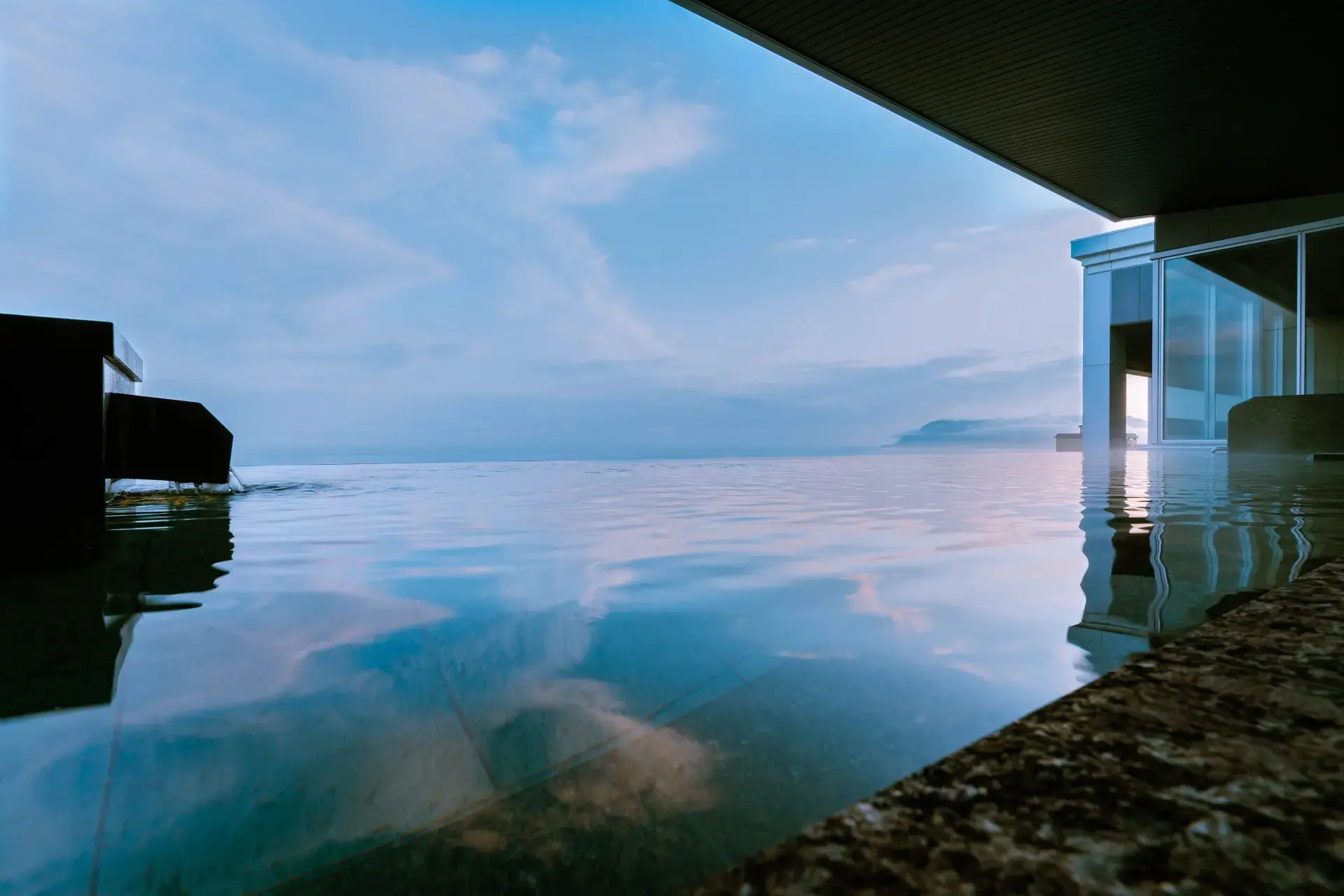
This hot spring resort is located in Yunokawa Onsen, one of Hokkaido’s three major hot spring areas. On the rooftop floor, an infinity open-air bath looks out over the Tsugaru Strait and the sky as one, creating a refreshing sense of openness as the water seems to blend into the sea. At night, the moon over the Tsugaru Strait and the lights of fishing boats, which inspired the hotel’s name, Umi to Akari, spread out before you. Enjoying moon viewing with local Hakodate sake is another special pleasure found only here.
3. Hakodate Kokusai Hotel
This city hotel has 435 guest rooms and features one of the largest banquet halls in the Hakodate area, along with three restaurants and a modern tea lounge. It offers a wide variety of room types, including the Standard Queen, where one or two guests can relax with a 160 cm-wide queen-size bed; the Deluxe Family Room, which can accommodate up to four guests; and the Imperial Suite, featuring elegant interiors and beds in a spacious 120-square-meter setting.

Summary
We’ve introduced spots, restaurants, and places to stay that showcase the many charms of Hakodate, from its exotic cityscape and beautiful natural surroundings to fresh seafood and other local flavors.
If you want to make the most of all the different ways to enjoy Hakodate, use this article as a guide to plan your trip.
After enjoying Hakodate, why not head to Aomori as well?
A great way to get there is by large ferry from Hakodate Port, where you can enjoy a cruise with spectacular views of the Tsugaru Strait along the way.
Be sure to also visit Aomori, where you can explore sightseeing spots that reflect traditional Japanese culture and enjoy traditional festivals.