

Nagoya’s Top Power Spot Where a Sacred Sword Rests: Atsuta Jingu Travel Guide
Atsuta Jingu is Nagoya’s premier power spot.
It’s a prestigious shrine, often compared to Ise Jingu—considered exceptional among Japan’s many shrines—and it safeguards a treasured national relic.
That’s why there’s so much to see here, and it’s a place where you can truly feel Japan’s history and culture.
Let’s dive into everything Atsuta Jingu has to offer, from its highlights to its history and cultural significance.
What is Atsuta Jingu Like?
Atsuta Jingu is located in Atsuta Ward, Nagoya City, Aichi Prefecture.
It was founded in 113, giving it a history of over 1,900 years.
It’s considered one of Nagoya’s leading power spots, and is said to have been deeply revered by Sengoku warlords, including Oda Nobunaga.
It enshrines six deities, including Atsuta Okami, Amaterasu Omikami, and Yamato Takeru no Mikoto.
It’s also famous for enshrining the Kusanagi-no-Tsurugi, one of the Three Sacred Treasures passed down through the Imperial Family.
Blessings are said to include household safety, good health, matchmaking, career success, and good fortune.
The grounds cover Approx. 190,000 m², and with the main sanctuary plus subsidiary shrines, there are as many as 45 shrines in total. There’s also a treasure museum that houses valuable cultural artifacts and materials.
The shrine grounds are rich in nature, and simply strolling the approach can feel calming.
Among the many omamori (amulets) available at Atsuta Jingu, one to look out for is the Katsumamori (Victory Amulet).
It comes as a set: an amulet designed with a bugaku costume pattern and a victory cord like a bracelet, and it’s believed to help bring victory.
Just as Oda Nobunaga prayed here for victory before the Battle of Okehazama—and went on to win—if you have a big challenge ahead or something new you want to take on, why not recharge your energy at Atsuta Jingu?

The Origins of Atsuta Jingu
The history of Atsuta Jingu began in 113, when the hero Yamato Takeru, son of the emperor at the time, passed away. His wife, Miyasu-hime no Mikoto, enshrined the Kusanagi-no-Tsurugi here.
The Kusanagi-no-Tsurugi is a sacred sword that appears in Japanese mythology, and is said to have been used by Yamato Takeru in his campaigns across the land.
In 1560, Oda Nobunaga donated an earthen wall in gratitude after praying here for victory; it still remains today as the “Nobunaga-bei” (Nobunaga Wall).
Although the shrine was burned down in 1945 during wartime air raids, it was rebuilt in 1955.

Access to Atsuta Jingu
Here’s how to get there from Nagoya Station, the main hub for getting around Nagoya.
Take the Meitetsu Nagoya Main Line and get off at Meitetsu Jingu-mae Station.
Turn left at the exit and walk 100 m to reach the East Gate. Travel time is Approx. 10 minutes.
However, this is not the main front approach, so if you want to start from the First Torii Gate, head to the South Gate.
Atsuta Jingu Hours and Admission
Atsuta Jingu is free to visit and open 24 hours.
The Hours and Admission for the Treasure Museum on the grounds are as follows.
- Hours
- 9:00am–4:30pm
- Admission
-
Adults: 500 yen
Elementary and junior high school students: 200 yen
What’s the Best Season to Visit Atsuta Jingu?
The best season to visit Atsuta Jingu is summer.
At the Atsuta Festival, held in early June, martial arts and traditional performing arts are dedicated within the shrine grounds.
It’s a great chance to see Japanese traditions like kyudo (Japanese archery), sumo, tea ceremony, and haiku up close.
In the evening, the “kentou makiwara,” a hemispherical structure hung with many lanterns, is lit up, creating a beautifully atmospheric scene.
Approx. 1,000 fireworks are also launched from nearby Atsuta Jingu Park, so you can experience both summer ambiance and traditional culture at once.

6 Must-See Highlights at Atsuta Jingu: History, Culture, and Legends
Atsuta Jingu is one of Nagoya’s signature power spots, with a long history.
With that history comes many spots around the grounds tied to legends and old tales.
There are also many shrine buildings within the grounds (shrines enshrined separately from the main sanctuary), so there’s plenty to explore.
Use the six highlights below as your guide, and take your time on a relaxed walk through the grounds.
1. See Treasures That Tell Japan’s History and Culture: Atsuta Jingu Treasure Museum
The Atsuta Jingu Treasure Museum houses 6,000 items, including ancient sacred treasures, swords, Japanese mirrors, bugaku masks, and old documents, donated by the Imperial Household, shogun families, feudal lords, the shrine itself, and everyday worshippers.
As many as 180 items are designated as National Treasures, Important Cultural Properties, or Aichi Prefecture Cultural Properties.
Don’t miss rare pieces you can’t easily see elsewhere, such as the National Treasure tanto “Rai Kunitoshi,” the Important Cultural Property “Kiku Maki-e Tebako” (lacquered box), and the wooden bugaku mask “Ryo-o.”
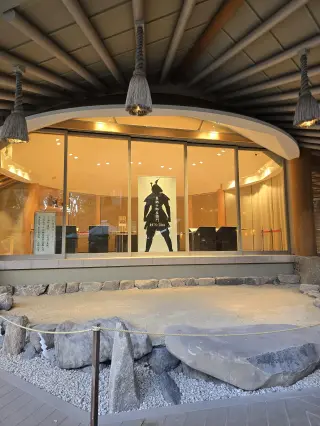
Because the Kusanagi-no-Tsurugi is enshrined here, many swords have been dedicated over time, and in 2021 the “Kusanagi-kan” was newly established to exhibit precious swords.
Since the Kusanagi-kan is located across from the Atsuta Jingu Treasure Museum, be sure to visit both.


2. The Place to Pray for Business Prosperity in Nagoya: Kamichikama Shrine
Kamichikama Shrine is on the left as you face the main sanctuary, next to the First Torii Gate.
It’s a small shrine within Atsuta Jingu, enshrining the Owari no Kuni-no-Miyatsuko.
Blessings are said to include business prosperity, household safety, success in exams, and good fortune.
Hatsu Ebisu, held every year on January 5, is a Shinto ritual to pray for business success.
Many people visit to seek the “Ichiban-fuda,” a talisman given only on that day.
It’s said that after receiving the Ichiban-fuda, if you go home without speaking to anyone so you don’t let fortune escape, you will receive good luck.

3. The Historic Earthen Wall Dedicated by Oda Nobunaga: Nobunaga Wall
The Nobunaga Wall is an earthen wall stretching 120 m, made by layering roof tiles with a binder created by kneading soil and lime with oil.
It was dedicated in gratitude by Oda Nobunaga after he won the Battle of Okehazama, for which he prayed at Atsuta Jingu.
It was once 400 m long, but today only about one-third remains.
It’s also counted as one of Japan’s three great earthen walls.

4. The Sacred Main Sanctuary Where a National Treasure Is Safeguarded
This is the shrine building that enshrines Atsuta Okami, the main deity of Atsuta Jingu, and it’s also where the Kusanagi-no-Tsurugi is safeguarded.
In 1893, it was remodeled in the traditional “Shinmei-zukuri” architectural style—the same style as Ise Jingu, considered exceptional among shrines.
Of course, that’s because the Kusanagi-no-Tsurugi is kept here.
The role of the main sanctuary is to protect the Kusanagi-no-Tsurugi, and this has been carried out for generations.
The building is solemn and beautiful, but visitors can only access the worship hall and cannot enter the interior.
Even so, it’s well worth visiting to feel the sacred atmosphere in the air.

5. Meet the White Snake Said to Bring Good Fortune: O-Kusu (Giant Camphor Tree)
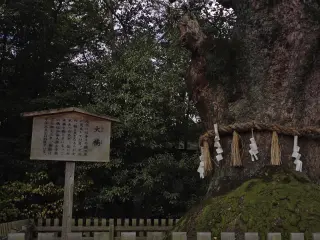
The O-Kusu (Giant Camphor Tree), said to be over 1,000 years old, is on the left as you head toward the main sanctuary, beyond the Second Torii Gate. It stands 20 m tall with a trunk circumference of 7.7 m.
It’s said that a white snake lives in the tree, and eggs are offered there every day.
Because encountering a white snake is believed to bring a boost in financial luck, take a look around when you visit the O-Kusu.
Within the grounds are seven massive camphor trees known as the “Seven Kusu,” and the O-Kusu is one of them.
Unfortunately, visitors can view only three of the seven, including the O-Kusu.
As you stroll the grounds, be sure to pay attention not only to the O-Kusu, but to the other giant camphor trees as well.

6. Shimizu Shrine, with Many Legends and Blessings
Shimizu Shrine is located along the “Kokoro no Komichi” pathway beside the main sanctuary.
It enshrines Mizuhanome-no-Kami, a water deity said to appear as a beautiful woman.
Behind it flows a spring known as “Oshimizu-sama,” and there’s a tale that washing your eyes with this water cured eye diseases.
Not only that, it’s also said that washing your skin with the spring water helps make it more beautiful.
In the center of the spring area is a stone monument said to be part of a stone used to memorialize Yang Guifei, famed as a great beauty. It’s said that if you pour water on the monument three times and pray, your wish will come true.


Enjoy Nagoya’s Local Specialties! 3 Popular Restaurants Near Atsuta Jingu
Around Atsuta Jingu, you’ll find many well-known spots where you can enjoy Nagoya’s local specialties.
Hitsumabushi is especially famous, and some people pair their shrine visit with a bowl of hitsumabushi.
Here are popular restaurants where you can try not only top hitsumabushi, but other Nagoya specialties too.
1. Atsuta Horaiken (Main Branch)
Founded in 1873 in the shrine’s gate town, this is the birthplace of Nagoya’s famous eel dish, hitsumabushi.
Hitsumabushi is grilled eel (kabayaki) chopped into small pieces and placed over rice served in a container called an ohitsu, and the name is a registered trademark of Atsuta Horaiken.
Fresh eel is grilled over binchotan charcoal for crispy skin and tender, fluffy meat.

2. Miya Kishimen (Jingu Branch)
In 2021, “Kusanagi Hiroba” opened near the Second Torii Gate in the central area of Atsuta Jingu’s grounds.
With walking paths developed around a pond, it has become a popular place for visitors to relax and unwind.
Miya Kishimen (Jingu Branch), which originated at Atsuta Jingu and had long operated within the grounds, was also renovated to coincide with the plaza’s completion.
In a refreshing setting surrounded by deep greenery, you can fully enjoy the flavors of this long-established shop.
In a clean, covered open-air space, you can choose from a wide range of kishimen dishes, including the classic “Miya Kishimen.”

3. Kiyome Saryo Jingu-mae
A sweets café located right by the west exit of Meitetsu Jingu-mae Station, the gateway to Atsuta Jingu.
It’s a directly operated shop of the long-established Japanese confectioner Kiyome Mochi Sohonke, with nearly 90 years of history since opening in 1935. The retro interior is always lively with locals and worshippers.
The specialty is “Kiyome Mochi,” known by phrases like “Kiyome Mochi for an Atsuta visit” and “Kiyome Mochi as a Nagoya souvenir.”

3 Tourist Spots to Visit Along with Atsuta Jingu
There are many places around Atsuta Jingu where you can feel Japan’s history and culture.
Here are a few carefully selected tourist spots that are especially worth extending your trip to after your visit.
1. Shirotori Garden
A strolling Japanese garden with a pond, designed with the geography of the Chubu region in mind.
Covering 3.7 ha, it’s one of the largest gardens in the Tokai region.
With a built-up hill representing Mt. Ontake, it depicts the Kiso River flowing from its source down to the gorge at Nezame-no-Toko, capturing the natural beauty of the Chubu region.
The scenery where the Kiso River becomes calm and branches into the Ibi River and Nagara River is expansive, and it’s fun to stroll the garden while letting your imagination run.

2. Nagoya Castle
One of Japan’s largest castles, built in the early Edo period by order of Tokugawa Ieyasu, who founded the Edo shogunate.
At the top of the castle keep, two golden shachihoko (mythical tiger-fish) shine, making it a symbol of Nagoya.
The Honmaru Palace, built in 1615 as the lord’s residence and a place of government, is also well worth seeing.
At its predecessor, Nagono Castle, Oda Nobunaga is said to have spent his childhood.

3. Shirotorizuka Kofun
One of the kofun (ancient burial mounds) designated as a National Historic Site within the “Shidami Kofun Group,” located at the easternmost edge of Nagoya City, Aichi Prefecture.
Built in the early 4th century using the edge of a river terrace along the Shonai River, it’s one of the oldest keyhole-shaped kofun in the prefecture.
It measures Approx. 115 m in length, with a rear circular portion Approx. 75 m in diameter and a front portion Approx. 43 m long, making it the third-largest keyhole-shaped kofun in the prefecture.

3 Recommended Places to Stay Near Atsuta Jingu
As one of Nagoya’s signature power spots, Atsuta Jingu is a highlight of sightseeing in the city.
A convenient area to stay after your visit is around Nagoya Station, known for excellent transportation access.
From here, we’ll introduce carefully selected accommodations in the Nagoya Station area that are convenient for both sightseeing and dining.
1. Nagoya Prince Hotel Sky Tower
A hotel directly connected to Sasashima-raibu Station, one stop from Nagoya Station on the Nagoya Rinkai Rapid Railway Aonami Line.
With the concept of a “floating sky boat,” all guest rooms are on the high floors from the 32nd to 36th, offering panoramic views of Nagoya’s night scenery. Watching trains depart and arrive at Nagoya Station from above can feel like looking at a diorama.

2. Nagoya Marriott Associa Hotel
A hotel located in JR Central Towers.
From the guest rooms and restaurants on floors 15–52, you can take in sweeping views of Nagoya’s cityscape.
It offers a variety of room types, including a concierge floor and suites for a premium stay, as well as family rooms for groups of 3–4.
All rooms feature spacious layouts with a strong sense of luxury.

3. The Strings Hotel Nagoya
A refined hotel with a resort-like, getaway feel, despite being within walking distance of JR Nagoya Station and Approx. a 3-minute walk from Sasashima-raibu Station on the Aonami Line.
In the “Cabana Garden” courtyard overlooking a grand cathedral, you can spend open, relaxing time by the water while enjoying a pleasant breeze.
In the sophisticated guest rooms, thoughtfully chosen facilities and amenities—such as nano water, rain showers, and down comforters—promise a comfortable stay.

Reviews
4.43
Some reviews are AI-translated.
-
On our self-guided trip in Nagoya, we took the train to Atsuta Jingu Nishi Station.
The shrine grounds are very spacious, surrounded by greenery, and incredibly peaceful.
They also sell all kinds of omamori, where you can pray for safety and good luck. It’s a great place for tourists to visit, pay their respects, and take photos. -
When you enter Atsuta Shrine, you can really feel a strong spiritual energy. It fills you with a sense of awe and peace.
-
The forest coverage here is impressive. This is the place where one of Japan's Three Sacred Treasures, the Kusanagi Sword, is enshrined. The shrine holds a highly respected status, second only to Ise Jingu.
FAQ about Atsuta Jingu
Q
Which deities are enshrined at Atsuta Jingu?
A
Six deities are enshrined here: Atsuta Okami, Amaterasu Omikami, Yamato Takeru no Mikoto, Miyasu-hime no Mikoto, Susanoo no Mikoto, and Takeinadane no Mikoto.
Q
What blessings can you pray for at Atsuta Jingu?
A
Household safety, good health, matchmaking, career success and good fortune, business prosperity, and success in exams.
Q
Can I get a goshuin at Atsuta Jingu?
A
Yes. Head to the amulet and seal office next to the main sanctuary.
Summary
Atsuta Jingu is packed with highlights, from power spots where you can receive blessings to places where you can feel history and culture.
Use this article as your guide, experience Japan’s history and culture firsthand, and receive powerful blessings.
Nagoya has plenty more than historical and cultural sites—there are also lots of leisure attractions and great food spots.
If you want to make the most of sightseeing in Nagoya, be sure to check out this article too.