

Chase Stunning Spring Views: 17 Popular Cherry Blossom Spots in Fukuoka
Fukuoka is easy to access from Japan and abroad, and it offers local cuisine, a wide variety of sightseeing spots, and plenty of commercial facilities.
Though it’s a major city, it’s blessed with the sea, mountains, and rivers, and has many famous cherry blossom locations scattered around.
If you visit Fukuoka in spring, we hope you’ll fully enjoy hanami, not just the food and sightseeing.
Use the popular sakura spots introduced in this article to plan your spring sightseeing in Fukuoka.
Fukuoka Cherry Blossom Forecast
For the best time to see cherry blossoms in Fukuoka, refer to the table below. Since these are the usual peak dates, expect some variation year to year.
Peak timing also varies by location, so for details, refer to the typical peak period listed for each spot introduced below.
- Bloom Date
- March 22
- Full Bloom Date
- March 31
Source: Japan Meteorological Agency: Cherry Blossom Bloom Status
Source: Japan Meteorological Agency: Cherry Blossom Full Bloom Status
[2026] Fukuoka Cherry Blossom Forecast
Here are the 2026 bloom and full-bloom forecast dates, announced by a weather information company on March 30, 2026 via “Sakura Navi.”
The peak viewing period is expected to be around March 31 to April 8.
- Bloom Date
- March 24
- Full Bloom Date
- April 2
- Best Viewing
- March 31 - April 8

17 Must-Visit Hanami and Cherry Blossom Spots in Fukuoka
Among Fukuoka’s many cherry blossom spots, here are some of the most popular, along with their typical peak seasons.
From historic castles and shrines framed by sakura to massive trees blending into the surrounding scenery and parks bursting with blooms, enjoy a wide range of unforgettable spring views.
1. Fukuoka Castle Ruins
Built by the father-and-son duo Kuroda Yoshitaka (Kanbei) and Nagamasa, construction began in 1601 and took seven years.
Known as the residence of the Kuroda clan of the Fukuoka Domain throughout the Edo period, it is also called “Maizuru Castle.”
It is said to have been one of the largest castles in Kyushu, with large, medium, and small tenshudai (main keep foundations) and 47 turrets.
The area from the Honmaru to the Sannomaru is now Maizuru Park, and the former outer moat has been developed into Ohori Park. Ohori Park is popular as a place to relax, attracting people who enjoy running and walking.
Maizuru Park is also known as a cherry blossom spot, and at peak season, around 1,000 trees across 19 varieties color the historic site. After sunset, the area is illuminated, and some buildings are specially opened at night.
-

A historic site adorned by around 1,000 cherry trees
-

The illuminated blossoms reflected in the moat are also beautiful
- Best time for cherry blossoms (average year)
- Late March – early April
2. Kitakyushu Shiranoe Botanical Garden
A beloved local retreat spread across a gentle hill, with nearly 80 years of history as a botanical garden where you can enjoy nature’s scenery throughout the year.
From spring cherry blossoms to peonies, hydrangeas, lotus flowers, autumn wild plants, and fall foliage, you can take in seasonal landscapes year-round, with a distinctly Japanese atmosphere throughout the grounds.
Its cherry blossom collection is among the best in Kyushu, with over 700 trees across 60 varieties.
Don’t miss the “Shiranoe no Satozakura” in the entrance plaza, designated a Natural Monument of Fukuoka Prefecture.

- Best time for cherry blossoms (average year)
- Mid-March – early April
3. Amagi Park
A 31.7-hectare park in Asakura City, Fukuoka Prefecture, also known as “Maruyama Park.”
Surrounded by rich nature, it features a lawn plaza, playground area, and barbecue area,
and is cherished as a place to relax.
At the center is the gourd-shaped “Maruyama Pond,” encircled by 4,000 cherry trees including Somei Yoshino, Yamazakura, and Yaezakura, creating a spectacular spring scene.
During peak season, the blossoms are illuminated from sunset until 10pm, and you can also enjoy fountain illuminations.
-

The blossoms in full bloom along the pond are exceptionally beautiful
-

Maruyama Park offers a magical view after sunset
- Best time for cherry blossoms (average year)
- Late March – early April
4. Kokura Castle
Built by Hosokawa Tadaoki, who entered the region for his achievements in the Battle of Sekigahara, construction began in 1602 and took seven years.
Later it became the residence of the Ogasawara clan, but in 1866 it burned down, leaving only the stone walls. After the war, the keep was rebuilt at the strong request of local residents.
In spring, around 300 cherry trees bloom around Kokura Castle, creating a scene where sakura frame Fukuoka’s only castle keep.
The majestic view of the illuminated keep and blossoms after sunset is also a must-see.
Every year from late March to early April, the “Kokura Castle Sakura Festival” is held, with rows of food stalls.
It’s also recommended to take your time enjoying the blossoms while tasting the food you pick up at the stalls.
-

The castle keep surrounded by cherry blossoms
-

Illuminated blossoms and the keep look very different from daytime
- Best time for cherry blossoms (average year)
- Late March – early April
5. Habu Park
Habu Park is the largest urban park in Nakama City, Fukuoka Prefecture.
Its nature-rich grounds include the Fukuoka Prefecture-designated historic site “Habu Rakan Hyakuana,” a cluster of horizontal cave tombs, and the historic “Hanyu Shrine,” offering a chance to experience nature and history as you stroll.
With large playground equipment and a display of a steam locomotive (SL), it’s a popular spot for all ages.
It’s also known as a cherry blossom spot, and at peak season, around 1,000 trees including Somei Yoshino bloom around “Habu Pond.”
Enjoy hanami in many ways, such as walking through a tunnel of blossoms or viewing them from a boat.
One of the city’s three major festivals, the “Chikuzen Nakama Sakura Festival,” is also held, where you can enjoy dreamy nighttime cherry blossoms lit by lanterns and bamboo lights.

- Best time for cherry blossoms (average year)
- Late March – early April
6. Hyugami Dam
Hyugami Dam is located in Yame City, Fukuoka Prefecture. Around “Hyugami Lake,” an artificial lake created when the dam was built, you’ll find distinctive giant rock formations such as “Hyugami Gorge,” “Heart Rock,” and “Kehogi Rock.”
In spring, around 1,000 cherry trees bloom around the dam, creating a fantastical scene of blossoms reflected on the lake alongside towering rocks.
Seeing this beautiful landscape, you’ll understand the legend that “the gods of Hyuga were drawn to its beauty and came here.”
Set out on a trip around the dam and lake to discover many different springtime views.

- Best time for cherry blossoms (average year)
- Late March – early April
7. Homangu Kamado Shrine
Kamado Shrine has over 1,350 years of history. It enshrines Tamayorihime-no-Mikoto and has long been worshiped as a deity of matchmaking. It has also been revered as a deity for protection from misfortune and warding off evil.
At the summit of Mt. Homan (829 meters) is the shrine’s upper sanctuary. The hike to the upper sanctuary takes Approx. two hours one way, and the mountain is popular with many hikers.
Long known as a cherry blossom spot, it still draws many visitors during peak season.
Even the shrine’s crest being a cherry blossom gives a sense of its long history.
The solemn grounds, beautifully colored by white and pink Somei Yoshino and Yamazakura, are a must-see.
During peak season, a “Sakura Festival” is held on the grounds, with mini concerts and stalls.
Don’t miss the mystical scenery created by illuminated blossoms and the shrine grounds after sunset.

- Best time for cherry blossoms (average year)
- Late March – late April
8. Nomiyama Kannonji Temple
A special head temple of the Koyasan Shingon sect, affectionately known as “Nomiyama-san,” and the 16th stop of the Chikuzen Sasaguri 88-Temple Pilgrimage together with its sub-temple Tennoin. Known as a temple with renowned blessings for fulfilling wishes and warding off misfortune, it welcomes over one million visitors each year.
The grounds, centered around the main hall enshrining the principal image of Senju Sen-Gen Kannon Bosatsu (Thousand-Armed, Thousand-Eyed Kannon), are located in the mountains at an elevation of 450 m.
In spring, look for the cherry variety called “Fukujuzakura,” which blooms beside the main hall and Amida Hall.
Estimated to be around 100 years old, this cherry tree is a rare variety seen only at Nomiyama Kannonji Temple.
With large, layered petals, Fukujuzakura shows a beautiful contrast of pale pink new buds and white petals.

- Best time for cherry blossoms (average year)
- Late March – early April
9. Asai no Ipponzakura (Asai’s Lone Cherry Tree)
Asai no Ipponzakura, surrounded by rich nature, is located in Kurume City, Fukuoka Prefecture. This impressive tree is Approx. 120 years old, Approx. 18 m tall, and has a trunk circumference of 4.3 m, blooming magnificently every year.
Its commanding presence captivates all who see it.
The scenery harmonizing with the surrounding nature is also beautiful, especially the “upside-down sakura” reflected in the nearby reservoir.
During peak season it is lit up, creating a dreamy atmosphere different from daytime.
It’s a bit inconvenient to access since it’s away from the city center, but it’s still a famous cherry tree well worth the visit.
-

A beautiful scene in harmony with the surrounding nature
-

The fantastically illuminated Asai no Ipponzakura
- Best time for cherry blossoms (average year)
- Late March – early April
10. Akizuki Suginobaba
Akizuki in Asakura City, Fukuoka Prefecture is blessed not only with mountains and rivers but also with an old-fashioned townscape, and once flourished so much it was called “Little Kyoto of Kyushu.”
Akizuki Suginobaba is a tree-lined road stretching Approx. 500 m leading to the Akizuki Castle Ruins in Akizuki, which is designated as a Nationally Important Preservation District for Groups of Traditional Buildings.
With around 200 cherry trees lining both sides, it becomes a tunnel of blossoms at peak bloom.
Walking along the road lined with atmospheric buildings and cherry blossoms may feel like stepping back in time.

- Best time for cherry blossoms (average year)
- Late March – late April
11. ABURAYAMA FUKUOKA
Approx. a 30-minute drive from central Fukuoka City, Aburayama Farm and Shimin-no-Mori (Citizens’ Forest) is surrounded by lush nature that feels far from the city.
Renovated in 2023 as “ABURAYAMA FUKUOKA,” this area offers an integrated nature experience combining forest, farm, and campground.
Across its vast grounds are walking paths and observation decks where you can feel the changing seasons, a nature observation center for birdwatching and learning about plants, and a farm where you can interact with animals—so both adults and kids can enjoy their time in their own way.
In spring, around 2,000 cherry trees, including Somei Yoshino and Yamazakura, bloom throughout the area.
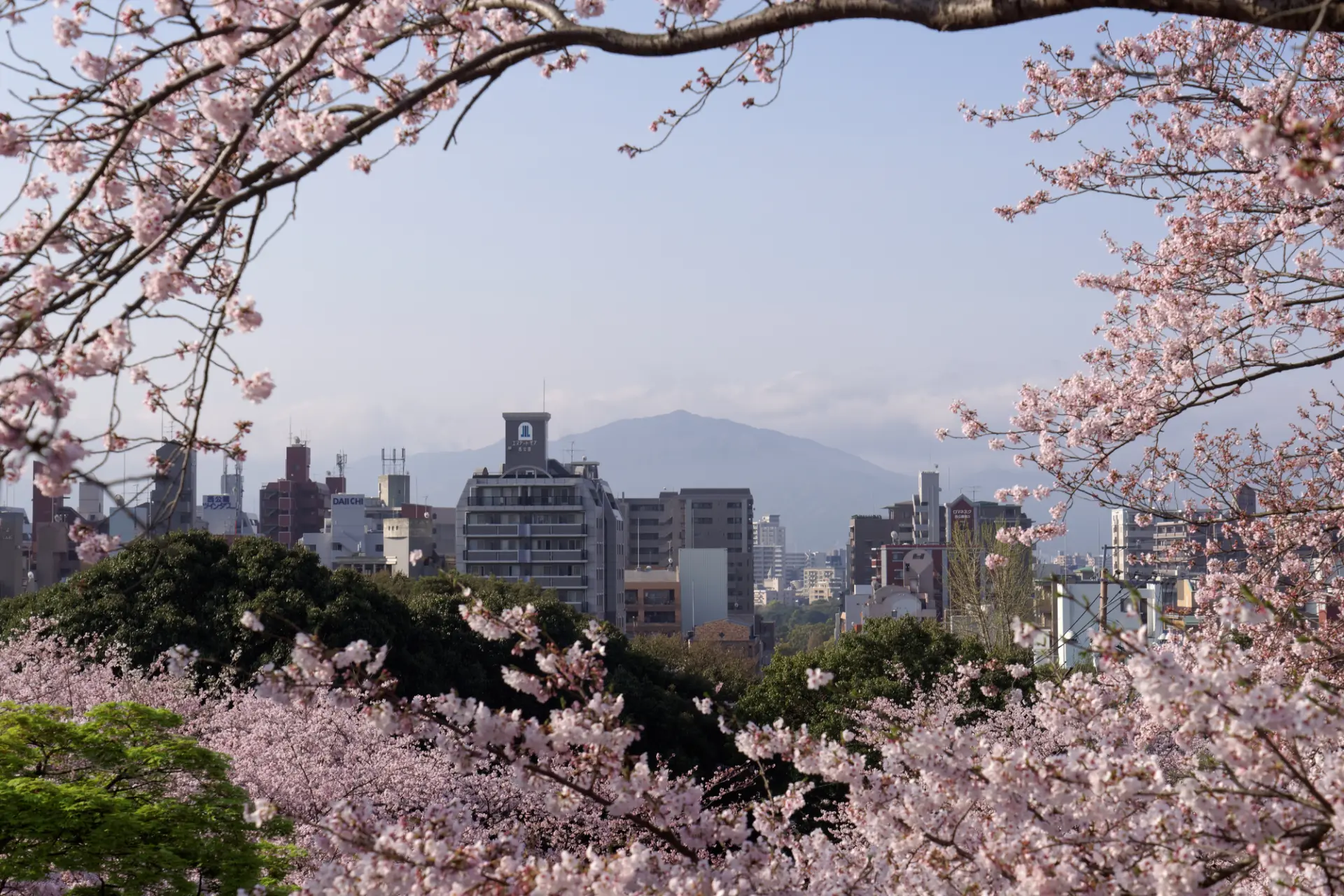
Scattered around are spots where you can fully enjoy the charm of cherry blossoms, such as an observation deck overlooking Fukuoka City through the blossoms and areas where you can barbecue while enjoying hanami.
- Best time for cherry blossoms (average year)
- Late March – mid-April
12. Shioji Forest Road & Iwaya Castle Ruins
Mt. Shioji, spanning Dazaifu City, Onojo City, and Umi Town in Fukuoka Prefecture, is dotted with many historic sites, including the Special Historic Site Ono Castle Ruins.
The Iwaya Castle Ruins along the Shioji Forest Road that runs through the center of the mountain are remains of a mountain castle built during the Sengoku period (1467–1615) and are known as a cherry blossom spot.
From here you can take in a panoramic view of Dazaifu City, and the spectacular scenery spreading beyond the spring blossoms is exceptional.
Along the forest road, around 300 cherry trees also bloom, letting you enjoy hiking or a drive through a beautiful tunnel of blossoms.

- Best time for cherry blossoms (average year)
- Late March – early April
13. Dazaifu Government Office Ruins
Located in Dazaifu, Fukuoka Prefecture, the Dazaifu Government Office Ruins are the remains of “Dazaifu,” which functioned as the political and diplomatic center of all Kyushu from the Nara period (710–794) through the Heian period (794–1185).
Today, while the government buildings are gone, foundation stones indicating the original bases remain and the site has been maintained in a way that evokes its former appearance.
At the Dazaifu Exhibition Hall on the grounds, you can explore the history and culture of Dazaifu, the “capital of the west,” through displays of archaeological materials.
The surrounding area is rich in nature, and in spring around 100 cherry trees bloom, creating an atmospheric scene where historic ruins and blossoms come together.

- Best time for cherry blossoms (average year)
- Late March – early April
14. Nishi Park
Nishi Park, where you can see around 1,300 cherry trees, is a hilly area of Approx. 170,000 m².
Though it’s in the urban area of Chuo Ward, Fukuoka City, it’s a place where plenty of beautiful nature remains.
From the observation deck, you can look out over the city as well as beautiful views of Hakata Bay and Shikanoshima Island.
The walking paths are well maintained, making it easy to stroll despite the park’s size.
It’s the only place in Fukuoka Prefecture selected for Japan’s “Top 100 Cherry Blossom Spots,” and you can see blossoms throughout the park. In particular, the harmony between the view from the observation deck and the cherry blossoms is outstanding.
After dark, you can also enjoy illuminated nighttime blossoms. Be sure to take in the blossoms’ radiance under the lights, which feels different from daytime.

- Best time for cherry blossoms (average year)
- Late March – early April
15. Kurume Castle Ruins & Sasayama Shrine
The former castle site of the Arima clan, who served as lords of the Kurume Domain for around 250 years during the Edo period.
A hirayamajiro (castle built on a hill in a plain) constructed on a small hill along the Chikugo River, it still features impressive stone walls and an inner moat at the former Honmaru site, evoking its past.
Today it is the grounds of Sasayama Shrine, which enshrines Toyouji Arima, the first lord of the Kurume Domain, and later lords such as Yorisada, the seventh lord. The Arima Memorial Museum on-site exhibits and displays items connected to the Arima family, including arms and craftworks.
It’s also known as a cherry blossom spot, with around 50 cherry trees such as Somei Yoshino and Yamazakura blooming around the moat.
The atmospheric view created by historic stone walls and beautiful blossoms is also exceptional.

- Best time for cherry blossoms (average year)
- Late March – early April
16. Hosshin Park
Hosshin Park is located in Kurume City, Fukuoka Prefecture, Approx. a 20-minute walk from Chikugo-Kusano Station on the JR Kyudai Main Line.
Surrounded by the nature of the Minoh foothills, it offers beautiful scenery.
In summer, enjoy the coolness of the lush green mountains and the Hosshin River, and in autumn, take in fall foliage in Momiji Valley. It’s a park full of seasonal charm.
Above all, the beautiful spring view of around 170 Somei Yoshino and Yamazakura trees in bloom is exceptional.
It’s said that the Meiji-era literary figure Natsume Soseki also visited this place and wrote, “Matsu o mote kakohishi tani no sakura kana,” praising the beauty of cherry blossoms blooming in a valley surrounded by pine trees.

- Best time for cherry blossoms (average year)
- Late March – early April
17. Kusaba River Cherry Blossom Trees
Along the Kusaba River flowing through Chikuzen Town, a cherry tree-lined path with 258 trees stretches for Approx. 2.2 km, making it a famous cherry blossom spot.
Rapeseed flowers also bloom on the embankment, creating a stunning spring scene with a pink-and-yellow contrast.
The atmospheric rows of cherry trees against the backdrop of the sunset, viewed from the levee, are also beautiful.
After sunset, the area is illuminated so you can enjoy dreamy nighttime blossoms.
Since it’s relatively quiet and less crowded, it’s also recommended to take a leisurely stroll while enjoying the night blossoms.
-

Also enjoy the pairing of rapeseed flowers and cherry blossoms
-

A beautiful view of illuminated cherry blossoms lined up in a row
- Best time for cherry blossoms (average year)
- Mid-March – early April
Kyushu Has Plenty of Cherry Blossom Spots Beyond Fukuoka
The Kyushu region, including Fukuoka, has many famous cherry blossom spots.
Kumamoto, Saga, and Nagasaki are close enough for a day trip, so it’s also recommended to venture a little farther.
We’ve summarized especially popular cherry blossom spots and highlights in Kumamoto, Saga, and Nagasaki in the table below, so please use it as a reference.
- Kumamoto Prefecture
- It offers a wide variety of hanami spots, including locations filled with classic Japanese charm, rows of cherry trees set against plum blossoms, and places where as many as 10,000 cherry trees bloom in full glory.
- Nagasaki Prefecture
- Spots where you can enjoy both the ocean and cherry blossoms, such as Saikaibashi Park and Oyama Park in Nagasaki, are especially popular.
- Saga Prefecture
-
Among the many cherry blossom spots, Mifuneyama Rakuen and Kagamiyama are especially popular.
Enjoy cherry blossoms blooming amid spectacular scenery shaped by nature.
FAQ about Fukuoka’s Cherry Blossom Spots
Q
When is the best time to see cherry blossoms in Fukuoka?
A
It depends on the spot, but the typical peak season is from late March to early April.
Q
Which areas in Fukuoka have lots of hanami spots?
A
Chuo Ward in Fukuoka City and the Kokura area of Kitakyushu City are areas with many famous cherry blossom spots.
Summary
We’ve introduced must-visit cherry blossom spots in Fukuoka in spring, along with their typical peak seasons.
To enjoy a range of spring views—historic sites, shrines and temples, and nature-filled parks colored by blossoms—be sure to visit the spots introduced here.
Also check out this article introducing popular restaurants and shopping spots, centered around Fukuoka’s top sightseeing destinations.