

A Tōdai-ji Travel Guide to Timeless History and Culture
Tōdai-ji is famous for the “Great Buddha of Nara.”
In addition to its many historic structures designated as National Treasures and Important Cultural Properties, it also offers easy-to-join Buddhist experiences like sutra copying and Buddha image tracing that help calm the mind.
Don’t miss the daily “Eleven-Faced Goma Fire Ritual Prayer” and the Tōdai-ji Museum, where you can learn about its history.
Here, we’ll introduce the history and must-see spots you’ll want to know to fully enjoy Tōdai-ji, packed with highlights.
What is Tōdai-ji Like?
Tōdai-ji is located in Nara City, Nara Prefecture, within Nara Park, which spans 660 hectares.
It’s one of Nara’s signature temples and was registered as a UNESCO World Heritage Site in 1998 as part of the Historic Monuments of Ancient Nara.
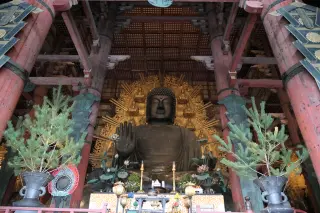
The biggest highlight is, of course, that it enshrines the Rushana Buddha (Seated Statue), known as the “Great Buddha of Nara.”
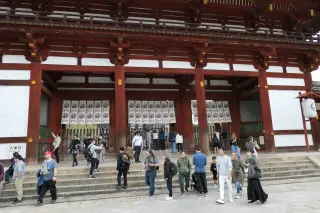
You’ll also find many historic structures designated as National Treasures and Important Cultural Properties, including Hokke-dō (also known as Sangatsu-dō), the Great Buddha Hall (Daibutsu-den), and the Great South Gate (Nandaimon).
Don’t miss the Shōsō-in storehouse built in azekura style, the bell tower that suspends a temple bell weighing Approx. 26 tons, and the Nembutsu-dō with its shikoro-style roof.
The Great Buddha Hall is also packed with popular souvenirs for visitors.
From bath salts blended with eight medicinal herbs and tenugui towels to clear files and “long-life” chopsticks featuring Great Buddha designs, be sure not to miss these Tōdai-ji-only items.

The History and Origins of Tōdai-ji
In 728, “Kinshōzan-ji” was built to pray for the soul of Prince Motoi (the crown prince of Emperor Shōmu).
During Emperor Shōmu’s reign, many disasters struck, including famines and epidemics. Believing that “the power of the Buddha could protect the nation,” Emperor Shōmu ordered the construction of temples.
Under that order, “Kinshōzan-ji” was elevated to a provincial temple (a temple built under imperial command), renamed “Konkōmyō-ji.” “Konkōmyō-ji” is the predecessor of today’s “Tōdai-ji.”
In 743, wishing for peace in the country, Emperor Shōmu ordered the creation of a Great Buddha.
The Great Buddha made under that order is the “Rushana Buddha” enshrined at Tōdai-ji today.
After that, various buildings were constructed, completing “Tōdai-ji,” where prayers for peace are offered.
However, in 855, a major earthquake and a lightning strike caused buildings such as the Lecture Hall and the Great South Gate to collapse.
In 1180, an attack by Taira no Shigehira burned down the Great Buddha Hall as well.
The Great Buddha Hall was rebuilt in 1190, but during the Warring States period, multiple buildings were caught in the flames of war and destroyed by fire.
In the Edo period, repairs were approved, and the restoration of lost structures was also achieved.
Since the Meiji era, renovations and repairs have been repeated, leading to the present day.

Access to Tōdai-ji
Here’s how to get there from Kintetsu Kyoto Station and JR Nara Station, which serve as convenient bases for sightseeing around Kyoto and Nara.
| Transportation | Route | Travel Time |
|---|---|---|
| Train | Take the limited express from Kintetsu Kyoto Line “Kyoto Station” and get off at Kintetsu Nara Line “Nara Station.” Then walk 20 minutes from “Nara Station.” | Approx. 1 hour |
| Bus | From “JR Nara Station,” take the city loop bus, get off at “Tōdaiji Daibutsuden/Kasuga Taisha-mae,” then walk 5 minutes. | Approx. 15 minutes |
Kintetsu Kyoto Station is next to JR Kyoto Station and can be reached on foot for transfers.
After getting off at Kintetsu Nara Line “Nara Station,” you’ll walk Approx. 1.4 km, so comfortable, broken-in shoes are recommended.
Tōdai-ji Admission and Hours
Nara Park, where Tōdai-ji is located, is open 24 hours and has no entrance fee.
However, Tōdai-ji has limited Hours, and some facilities require Admission, so please use the information below as a reference.
Tōdai-ji Hours
The Hours for the Great Buddha Hall and the Tōdai-ji Museum vary by season, so please keep this in mind when visiting.
- Great Buddha Hall
-
・April–October 7:30am–5:30pm
・November–March 8:00am–5:00pm - Hokke-dō (Sangatsu-dō) / Kaidan-in Senju-dō
- 8:30am–4:00pm
- Tōdai-ji Museum
-
・April–October 9:30am–5:30pm (Last admission at 5:00pm)
・November–March 9:30am–5:00pm (Last admission at 4:30pm)
Tōdai-ji Admission
The four facilities—the Great Buddha Hall, Hokke-dō, Senju-dō, and the Tōdai-ji Museum—each require the Admission fees below.
Payment is cash only, so be sure to come prepared.
- Middle school students and up
- 800 yen
- Elementary school students
- 400 yen
What’s the Best Season to Visit Tōdai-ji?
The best times to visit Tōdai-ji are spring and fall.
In spring, Nigatsu-dō hosts Shuni-e, a ceremony that has continued for over 1,250 years.
The most impressive highlight is Omizutori, where huge torches are swung on the balcony stage.
The blazing torches against the pitch-black night are stunningly dreamlike and beautiful.
It’s said that being showered by sparks wards off bad luck, but be careful to avoid burns.
In fall, you can enjoy the autumn leaves throughout the temple grounds.
The view of Kagami-ike Pond alongside the Great Buddha Hall, framed by maples and ginkgo trees, looks like a painting.
If you visit in fall, take your time strolling the atmospheric grounds.


5 Must-Visit Spots at Tōdai-ji
Tōdai-ji is home to many historic structures of high value, designated as National Treasures and Important Cultural Properties.
Buildings essential to Buddhist architecture, including the Great Buddha Hall and the Great South Gate, are also key highlights.
Among the many attractions at Tōdai-ji, here are five spots you absolutely shouldn’t miss.
1. The world’s largest-class wooden building, the Great Buddha Hall
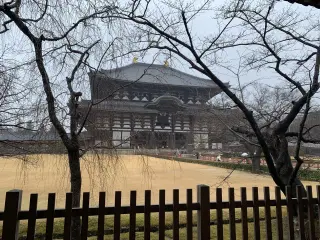
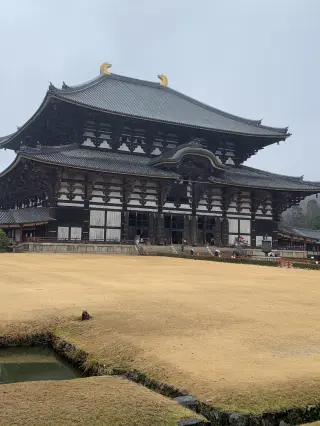
The Great Buddha Hall, Tōdai-ji’s main hall, is Approx. 48 m tall and 57 m wide, making it one of the world’s largest wooden buildings. In 1952, it was designated a National Treasure.
The current building was rebuilt in the Edo period, but the original Great Buddha Hall at the time of its founding is said to have been about 1.5 times wider than today’s.
Inside the Great Buddha Hall is the Rushana Buddha (Seated Statue), beloved as the “Great Buddha of Nara,” with an overwhelming presence at Approx. 15 m tall and weighing 250 tons.
There is also a pillar with a hole said to be the same size as the Great Buddha’s nostril; it’s believed that passing through it brings blessings of good health and fulfilled wishes.


2. A highlight-packed Great South Gate
One of Japan’s largest two-story gates.
With its complex structure as an irimoya-style, five-bay, three-door, two-story gate, it’s also designated a National Treasure.
Eighteen large round pillars, each 21 m tall, are built in, and the gate reaches Approx. 25 m in height including the base.
Inside the gate, the Agyō Kongō Rikishi (Niō) statue is placed on the west side, and the Ungyō statue on the east side.
Like the Great South Gate, the Kongō Rikishi statues are also designated National Treasures and are always featured in Japanese history textbooks.
It’s astonishing to hear they were completed in just 69 days in 1203 by Buddhist sculptors of the time.
In summer, it’s lit up along with the Great Buddha Hall and the Middle Gate corridor.
The light and shadow become more defined, making the beauty of the carvings stand out even more.
On the back side, you’ll find stone lion statues, Important Cultural Properties said to be Japan’s oldest komainu.


3. Nigatsu-dō, where the spring tradition Shuni-e is held
Its name, Nigatsu-dō, comes from the Buddhist service held in the hall in the second month of the lunar calendar.
It burned down in a fire in 1667 and was rebuilt two years later in 1669.
With its yosemune-style roof and butai-zukuri structure, it’s designated a National Treasure.
Butai-zukuri is an architectural style in which flooring is set using the natural terrain.
On the southern stone steps leading to the building, patterns are engraved on the first through third steps.
Don’t miss the beautiful motifs carved by craftsmen of the time, such as arabesque patterns, seigaiha waves, and ajiro lattice.

4. Kaidan-in Kaidan-dō, home to National Treasures
In 754, the Tang-dynasty monk Ganjin Wajō visited Japan, and the emperor at the time became a Buddhist.
Kaidan-in Kaidan-dō was built at the place where the emperor received and vowed to uphold Buddhist precepts.
Though it was destroyed in the 1180 fire, it was rebuilt in 1732.
Kaidan-in Kaidan-dō itself is designated a prefectural Important Cultural Property, and it also enshrines the National Treasure “Four Heavenly Kings” statues: Tamonten, Kōmokuten, Zōchōten, and Jikokuten.
From July 1, 2020 until fall 2023, visits have been temporarily suspended due to repairs and seismic retrofitting. Instead, Kaidan-in Senju-dō is being opened to the public as a special exhibition.
It is scheduled to reopen in fall 2023.

5. Hokke-dō (Sangatsu-dō), Tōdai-ji’s oldest structure
Tōdai-ji’s oldest building, said to have been founded sometime between 733 and 747.
From the beginning, it used a twin-hall layout with a main hall and a worship hall, but the worship hall was newly built in 1199 by the monk Chōgen.
It is considered one of the buildings of “Kinshōzan-ji,” the predecessor of “Tōdai-ji,” and is also where the Kegon Sutra was first lectured on in Japan.
Hokke-dō is also designated a National Treasure.

3 Tourist Spots Near Tōdai-ji
Nara Park has a long history, and many cultural assets remain beyond Tōdai-ji.
Experience shrines, temples, and rich nature up close, and make your time in Nara a lasting memory.
Here are a few spots you should definitely stop by along with your visit to Tōdai-ji.
1. Kōfuku-ji Temple
It began when it was built as Yamashina-dera, the private temple at the residence of Fujiwara no Kamatari, in Yamashina Suehara, Yamashiro Province. In Wadō 3 (710), with the transfer of the capital to Heijō-kyō, it was moved to its current location under a plan by Fujiwara no Fuhito and renamed “Kōfuku-ji.”
It flourished as one of the “Four Great Temples” in the Nara period and one of the “Seven Great Temples” in the Heian period, but most of it was burned down in the 1180 Nanto arson attack by Taira no Shigehira.
It was restored in the Kamakura period, but afterward it repeatedly suffered damage and rebuilding, and in Kyōhō 2 (1717) in the Edo period, a fire burned down the central temple complex except for the Hokuendō, Tōkondō, Five-story Pagoda, Three-story Pagoda, and Jikidō (refectory).
After that, restoration gradually progressed, and in 2018, the Chū-kondō was reconstructed for the first time in about 300 years.

2. Kasuga Taisha Shrine
At the beginning of the Nara period, it is said that Takemikazuchi-no-Mikoto came from Kashima in Ibaraki Prefecture riding a sacred deer and descended upon Mount Mikasa to protect Heijō-kyō and ensure the nation’s prosperity. In 768, the main sanctuary was built at the foot of Mount Mikasa, enshrining four deities—Takemikazuchi-no-Mikoto, Futsunushi-no-Mikoto, Ame-no-Koyane-no-Mikoto, and Himegami—which is considered its beginning.
Even today, as many as 2,200 Shinto rituals are held each year, and the Kasuga Festival held on March 13 has continued for over 1,200 years and is one of Japan’s three major imperial festivals.
Mount Mikasa (Mount Kasuga) is a sacred mountain believed since ancient times to be a holy place where deities reside.
Because hunting and logging were prohibited in the Heian period, the primeval forest remains today and is designated a Special Natural Monument of Japan.
In 1998, Kasuga Taisha Shrine and the Kasugayama Primeval Forest were registered as part of the UNESCO World Heritage Site “Historic Monuments of Ancient Nara.”

3. Yugayama Park (Former Yamaguchi Family Nanto Villa Garden)
A park area spanning Approx. 1.3 ha, located at the southern end of Nara Park, south of Ukimi-dō Pavilion and Sagi Pond.
As a spectacular scenic spot where Yugayama and Sagi Pond form a unified landscape, it received an additional designation in 1927 as part of the nationally designated cultural property “Scenic Site: Nara Park.”
This area was once the site of a villa owned by Mr. Kichirōbei Yamaguchi, who was active in Osaka’s business world from the Meiji through Taishō periods, and historical records remain that literati and artists once gathered here to socialize.
The garden within the park is a representative modern garden of Nara Park, and after restoration and improvement by the prefecture, it began opening to the public in 2020.
The garden features paths that make use of Yugayama’s rises and dips, letting you enjoy a relaxed stroll through its varied elevations.

3 Popular Restaurants Near Tōdai-ji
After visiting Tōdai-ji, a symbol of Nara, you’ll want to take a break at a charming restaurant that blends into the historic streetscape.
From here, we’ve carefully selected places that are easy to stop by between sightseeing, each with its own unique appeal.
Try savoring the afterglow of your trip at a cafe in a calm old house setting or a traditional Japanese restaurant.
1. Kōjō-ato Jimushitsu
A wooden building tucked away near the west side of the Tōdai-ji grounds.
In the past, a lactic acid bacteria drink called “Futorumin” was researched, produced, and sold here.
After it closed in 1980, about 30 years later, the owner—who is the great-grandchild of the business founder—opened the former office section as a cafe in 2009. That cafe is “Kōjō-ato Jimushitsu.”

2. Kamameshi Shizuka (Park Location)
For over 60 years since opening in 1959, the long-established kamameshi specialty restaurant “Kamameshi Shizuka” has operated two locations in Nara City.
Even now that it has become a famous spot that always comes up when people think of kamameshi in Nara, it still sticks to its style of carefully cooking each pot over an open flame only after an order is placed.
“Shizuka” kamameshi is the kind you’ll happily wait in line for.

3. Kitsune
A sukiyaki restaurant located on the first floor of the “Shikazarukitsune Building,” a notable spot by Nara’s long-established Nakagawa Masashichi Shoten, known for craftsmanship rooted in Japanese craft.
Owner-chef Shusaku Toba of the restaurant “sio,” which earned one Michelin star for three consecutive years starting with the MICHELIN Guide Tokyo 2020, presents a new way to enjoy sukiyaki through innovative menus centered on sukiyaki.

3 Recommended Places to Stay Near Tōdai-ji
Centered around the UNESCO World Heritage Site Tōdai-ji, this area lets you feel the nature and history of Nara Park.
Being able to stroll in the quiet early morning or at dusk is another pleasure that comes from staying nearby.
Here are a few accommodations we recommend for travelers seeking a calm stay where you can savor Nara’s atmosphere.
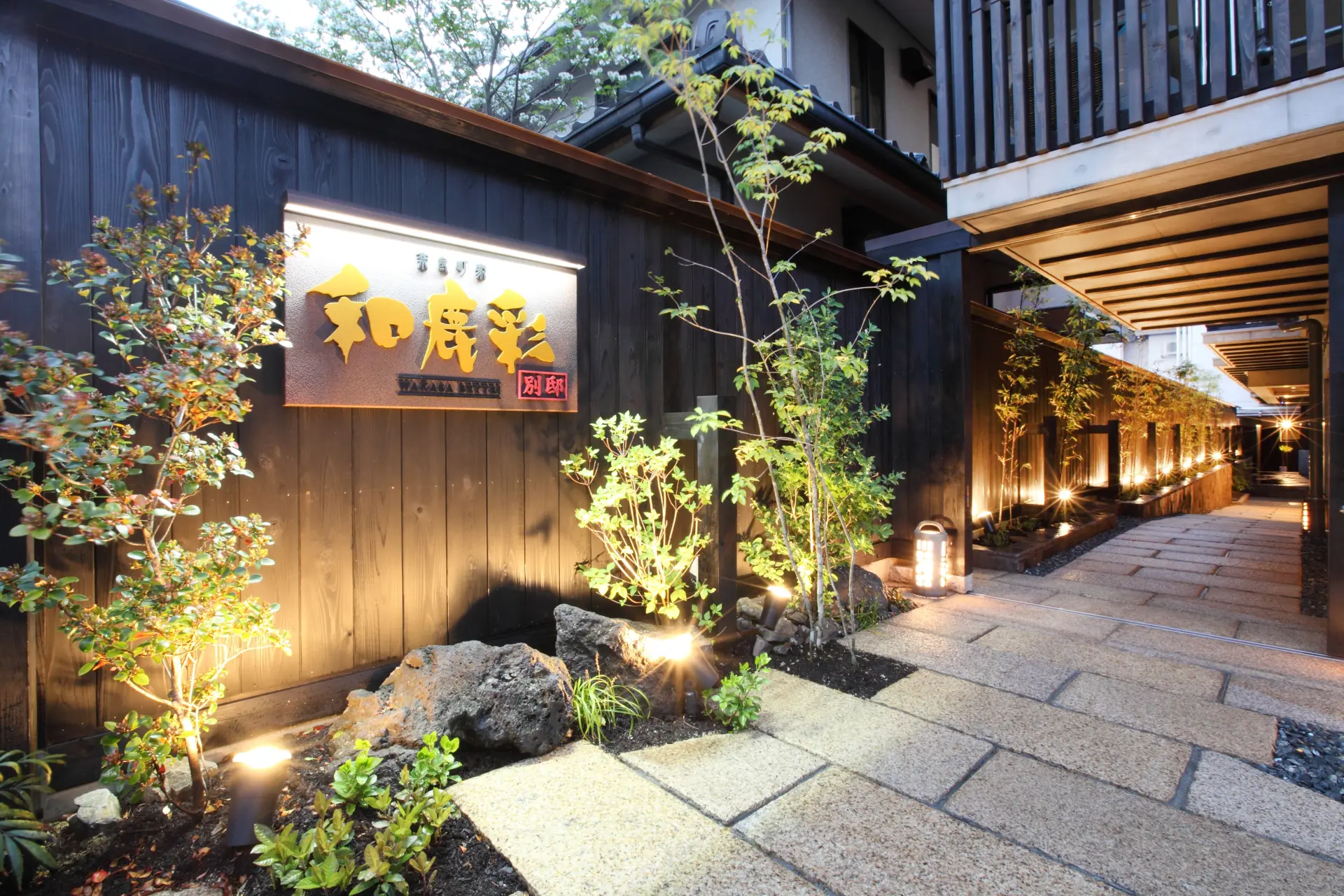
1. Naramachiya Wakasa Bettei
A small culinary inn that evokes the charm of a classic Nara machiya townhouse, located on the far northern edge of Nara Park, near where the Great Buddha Hall stands.
Pass through the entrance of stone paving sprinkled with water, and you’ll be welcomed by a distinctive building featuring spaces with earthen floors and an open atrium ceiling.
Each of the 12 guest rooms has its own character and design, offering a range of types, mainly Japanese-style tatami rooms with the scent of igusa, as well as Japanese-western rooms with beds.
2. ANDO HOTEL Nara Wakakusayama
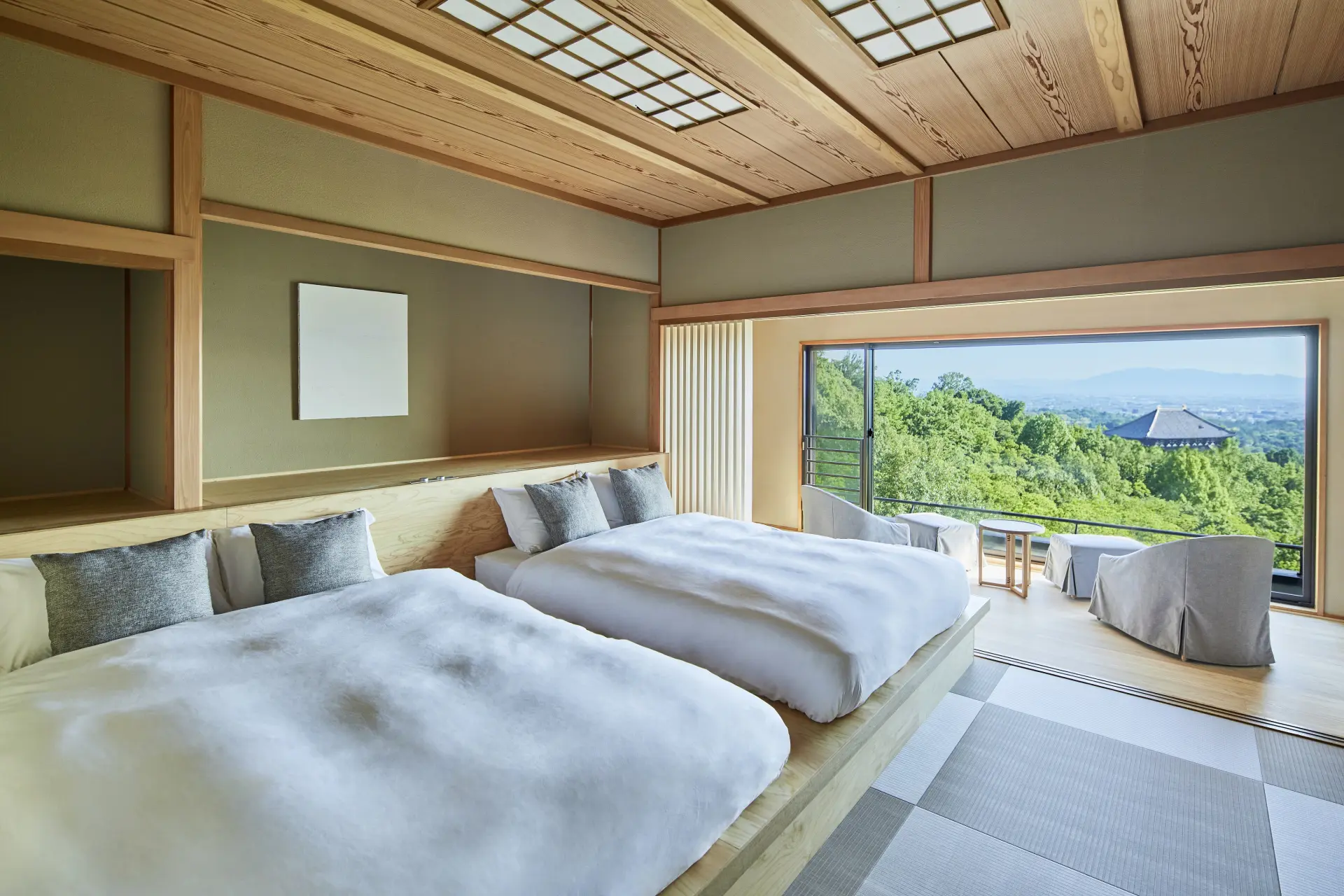
A Japanese cuisine auberge on the hillside of Mount Wakakusa, grand-opened in July 2020 after renovating an inn that had been loved for over half a century.
The concept is “peace of mind” born from “harmony with nature” and “connection with the local community.”
Its pride is, above all, the view of the ancient capital of Nara from the mountainside. From various points throughout the property—such as the newly added open-air bath on the rooftop, the penthouse suite, the lobby, and most guest rooms—you can take in sweeping views of the Great Buddha Hall of Tōdai-ji, the five-story pagoda of Kōfuku-ji, and Nara’s city area.
3. MIROKU Nara by THE SHARE HOTELS
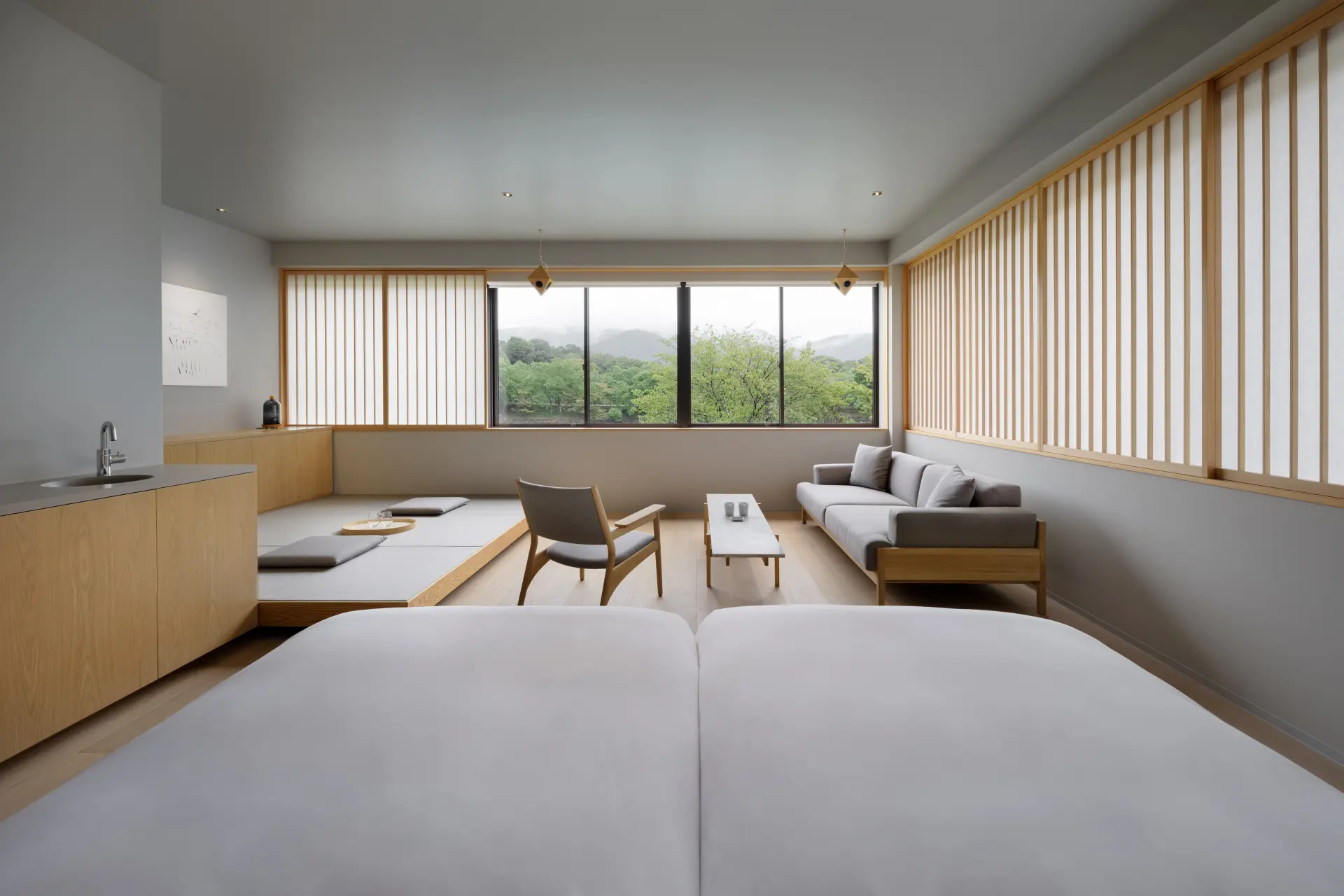
In September 2021, the 9th location of the lifestyle hotel brand “THE SHARE HOTELS” opened by Araike Pond at the southern end of Nara Park. The name “MIROKU” comes from Nara’s beautiful foothills and deer (“Mi” for beauty + “Roku” for foothills/deer) and from Miroku Bosatsu (Maitreya Bodhisattva), a Buddha who is said to save people in the next world.
With Nara Park to the north and Naramachi to the west, the location—where nature and city come together in ancient Nara—is superb. The Nara-like views, overlooking the UNESCO-listed five-story pagoda of Kōfuku-ji and the Kasugayama Primeval Forest, are also exceptional.
Reviews of Tōdai-ji
4.67
Some reviews are AI-translated.
-
Nara is such a charming, old-world city.
Beyond the huge number of deer in Nara Park that totally captivated me,
there’s also Todaiji Temple—a solemn, awe-inspiring wooden structure with over 700 years of history.
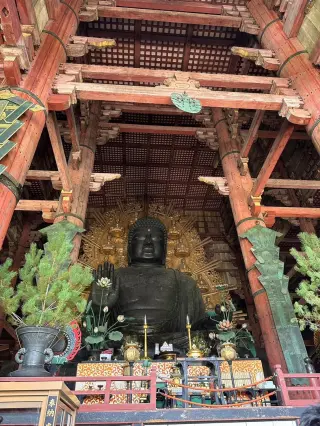
Every time I step into the Great Buddha Hall, it feels like I’m being embraced by Vairocana Buddha, as if I’m protected and watched over, and it brings this deep sense of peace.
In front of the Buddha, I feel as tiny as a single drop in the ocean. -
When people talk about Nara, Todai-ji always comes to mind. I visited Nara years ago but, for some reason, didn’t get to go inside. This trip finally made up for that regret.
The moment I stepped into the Daibutsuden (Great Buddha Hall), the Great Buddha instantly grabbed my attention. Tourists from all over the world were gathered in front of it, all hoping to see it up close.
With such a solemn expression, it felt like it could embrace everything. I couldn’t help but bow in respect. -
The building’s colors feel calm and grounded, and it’s easy to appreciate the more you look at it.

FAQ about Tōdai-ji
Q
What are the highlights of Tōdai-ji?
A
The Great Buddha Hall, Great South Gate, Nigatsu-dō, Kaidan-in Kaidan-dō, and Hokke-dō.
Q
Who built Tōdai-ji, and why?
A
It was proposed by Emperor Shōmu to stabilize the nation through the Buddha’s protection.
Q
Who made the Great Buddha of Nara?
A
It was Gyōki, a monk active from the Asuka to Nara periods.
Summary
Tōdai-ji offers countless highlights, from historic structures designated as National Treasures and Important Cultural Properties to much more.
As you stroll the grounds and take in its timeless history and culture, you’ll be met with one moment of awe after another.
If you’re traveling around Nara, which is full of places where you can feel history and culture beyond Tōdai-ji, be sure to check out this article too.