

A Travel Guide to Himeji Castle, a UNESCO World Heritage Site with Unmatched Beauty
Himeji Castle was among the first in Japan to be registered as a UNESCO World Cultural Heritage Site, and it’s highly regarded worldwide as a masterpiece of wooden architecture.
Many of its surviving buildings are designated National Treasures or Important Cultural Properties, making it one of Japan’s most popular landmark castles.
Also known as “White Heron Castle (Shirasagi-jo),” its dignified white appearance continues to captivate visitors.
In this article, we’ll introduce the charms of Himeji Castle, focusing on recommended highlights so even first-time visitors can enjoy their trip.
What is Himeji Castle Like?
Himeji Castle, located in Himeji City, Hyogo Prefecture, is famous as one of Japan’s finest castles.
Often called a masterpiece of wooden architecture, Himeji Castle has its main keep complex and other structures preserved in excellent condition, and it’s also internationally recognized for conveying Japan’s unique castle design.
Its historical and artistic value was recognized, and in 1993 it became one of Japan’s first World Heritage Sites, registered alongside Horyu-ji Temple.
Because its elegant shape resembles a white heron spreading its wings, Himeji Castle is also affectionately known as “White Heron Castle.”
With over 400 years of history, the main keep is the tallest among Japan’s 12 original keeps (12 keeps built before the Edo period that still remain today), standing at Approx. 31.5 m.
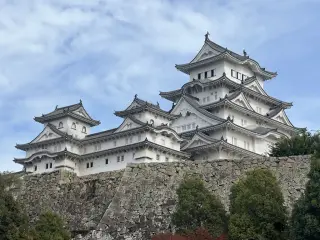
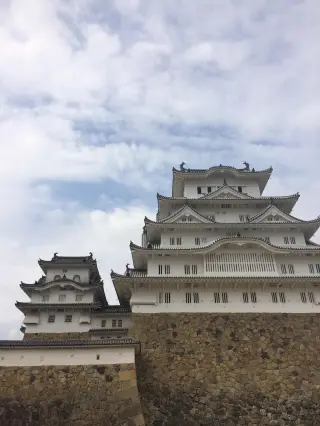
The keep complex features a “linked keep” style, with the large main keep (five roofs and six floors) connected by corridors (watari-yagura) to three smaller keeps (East, West, and Northwest).
The main keep, the smaller keeps, and the connecting corridors are all designated National Treasures.
Of course, the keep is a must, but be sure to also notice the highly decorative gables (noki-karahafu) and the beautiful design of the castle walls finished in white.
The History of Himeji Castle
Himeji Castle traces its origins to Himeyama Castle, built in 1346 by Sadanori Akamatsu.
It was small at first, but as time passed it was expanded as an important strategic base for governing western Japan.
When Toyotomi Hideyoshi entered the castle in 1580, he carried out major renovations including the construction of a three-story keep, and renamed it “Himeji Castle.”
In 1617, after the era of warfare had settled down, the lord Tadamasa Honda carried out further improvements and expansions, shaping the overall form of Himeji Castle as we see it today.
Since then, it has avoided major war damage, and nearly 100 buildings still remain.

Access to Himeji Castle
Here’s how to get there from Kobe Station, a common starting point and travel hub for sightseeing in Hyogo.
- Route
-
1. From “JR Kobe Station,” take the Special Rapid Service bound for Himeji and get off at “Himeji Station”
2. From the North Exit of “Himeji Station,” take the Shinki Bus and get off at “Otemon-mae” bus stop
3. It’s Approx. a 5-minute walk from “Otemon-mae”
※You can also walk from the North Exit of Himeji Station (Approx. 20 minutes) - Time Required
- Approx. 50 minutes (Approx. 1 hour if walking from Himeji Station)
Himeji Castle Hours and Admission
For Himeji Castle Hours and Admission, please refer to the table below.
You must exit by 5:00 pm, so reception and other services begin closing from 4:30 pm. Be sure to allow enough time.
- Hours
- 9:00 am-5:00 pm (gates close at 4:00 pm)
- Closed on
- December 29 and 30
- Admission
-
Adults (ages 18+) 2,500 yen
Ages 17 and under free (ID required)
What’s the Best Season to Visit Himeji Castle?
If you’re sightseeing at Himeji Castle, spring or fall is recommended.
Himeji Castle is known as a top spot for cherry blossoms and autumn leaves, and the views are sure to amaze you.
If you can choose your timing, we recommend visiting in one of these seasons.
Spring at Himeji Castle: The White Heron Tinted by Cherry Blossoms
Himeji Castle is selected as one of Japan’s “Top 100 Cherry Blossom Spots.”
From late March to early April, around 1,000 cherry trees, including Somei Yoshino and weeping cherry trees, bloom across the grounds.
The contrast between the castle’s white walls and the fully bloomed cherry blossoms is exceptionally beautiful.
Don’t miss the dreamy scene of petals drifting through the air with the main keep and white walls in the background.
From sunset to 12:00 am, the cherry blossoms are illuminated, letting you enjoy the night-time colors and the shadows of blossoms cast on the walls and stone ramparts.


Fall at Himeji Castle: A Sea of Colorful Autumn Leaves
At peak foliage, Himeji Castle creates a striking contrast between its white keep and walls and the vivid red and yellow leaves, offering beautiful scenery.
There are also many famous foliage spots nearby, and among them, we especially recommend visiting Koko-en (Himeji Castle Nishi-Oyashiki-ato Garden), designed with Himeji Castle as its backdrop.
In the fall foliage season (mid-November to late November), maple trees planted across the garden’s nine sections turn brilliantly colored, and the scenery is spectacular.


Don’t Miss These! 5 Must-See Highlights at Himeji Castle
Himeji Castle is not only a World Heritage Site, but also listed among Japan’s Top 100 Castles and the “Five National Treasure Castles.”
Its National Treasure and Important Cultural Property buildings are not only beautiful, but also designed for defense, with many ingenious features throughout.
Among the endless charms of Himeji Castle, here are five can’t-miss highlights.
1. The Keep: Beautiful and Powerful
The symbol of Himeji Castle is its keep.
It features the distinctive “linked keep” style, where the National Treasure main keep is connected by corridors (watari-yagura) to three smaller keeps (East, West, and Northwest).
The keep complex, with four roofs layered in a three-dimensional form, looks different depending on the angle, which makes it fun to view.
It’s the largest and tallest among Japan’s 12 original keeps, with a presence worthy of its World Heritage status.
The main keep was built in 1609 by Terumasa Ikeda and has survived wars and disasters to this day.
After the five-year main keep preservation and repair project that began in 2009 (commonly known as the “Heisei Restoration”), it became even more brilliantly white than before.

2. The Otemon Gate, Built with Care Down to the Details
Serving as Himeji Castle’s main entrance is the Otemon Gate, built in the Korai-mon style (a gate designed to strengthen defenses) and made on a grand scale.
In the past, it consisted of three gates and played an important role as the castle’s most prestigious and heavily guarded entrance.
It was known not only for its strong defense against enemy attacks, but also for its beautiful appearance, including turrets and stone walls.
Unfortunately, the Otemon Gate was dismantled in the Meiji era, and the current gate is a newer structure built in 1938.
While it differs from the original location and design, today’s Otemon Gate was also built with careful attention to its design, so you’ll enjoy it even more if you take a closer look at the details.

3. “Wabune” Boat Cruise: Take in the Views from the Water
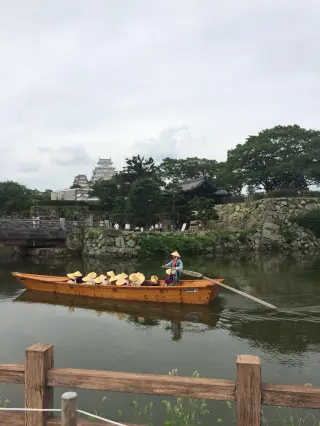
A popular activity where you ride a traditional wooden Japanese boat and make one loop around Himeji Castle’s inner moat.
While listening to the boatman—wearing a classic straw hat—you can enjoy an elegant Approx. 30-minute cruise.
The keep and castle walls seen from the water are breathtaking, letting you experience Himeji Castle from a different perspective.
Enjoy thrills like passing just under the Sakuramon Bridge, and the seasonal colors of nature—experiences you can only have from the boat.
Please note that the sightseeing boat operates for a limited period and requires an on-site reservation.

4. A Perfect Photo Spot: Shiromidai Park
Shiromidai Park is located Approx. a 5-minute walk from the Otemon Gate.
A hidden sightseeing gem, it’s selected as one of the “Top 10 Scenic Views of UNESCO World Heritage Himeji Castle,” known as a great viewpoint where Himeji Castle looks especially beautiful.
Shiromidai Park’s signature feature is its Approx. 2 m shachigawara (ornamental roof tile) monument.
Himeji Castle set against the blue sky as seen from the shachigawara is spectacular, and the spot is also popular for commemorative photos.
This area has fewer tourists and is recommended for a relaxed break.

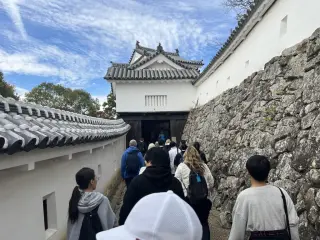
5. Hishinomon Gate, with an Elegant Atmosphere
Hishinomon Gate is the largest gate at Himeji Castle and is designated an Important Cultural Property.
In the past, it played an important role as a defensive stronghold to prevent enemy intrusion.
It uses a masugata-koguchi (a square-shaped entrance designed to lure enemies in from multiple directions) structure, and has an unusual form with a stone wall only on the left side of the gate.
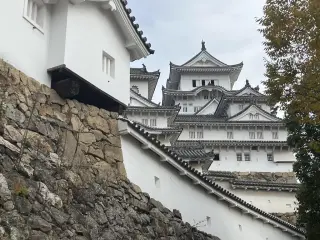
Its defining feature is its dignified exterior, built in shinkabe-zukuri (a style where the pillars and building materials remain visible) and fully coated in white plaster (shiro-shikkui so-nurikome, where all exposed parts except the roof are finished in white).
These refined construction techniques evoke the elegant atmosphere of the Momoyama period.

Make Your Visit Even More Fun: Legends and Tales of Himeji Castle
Many legends and stories have been passed down at Himeji Castle.
In this article, we’ll introduce three of them.
If you visit Himeji Castle after learning these tales, your trip is sure to be even more enjoyable.
1. Banshu Sarayashiki
Aoyama Tessan, a retainer of Himeji Castle’s lord Norimoto Kodera, was plotting to seize the castle.
Sensing this, Norimoto Kodera’s loyal vassal Motonobu Kinugasa sent his mistress, Okiku, into the Aoyama household to stop the plan before it happened.
Okiku was discovered as a traitor by Machitsubo Danshiro, a retainer of Aoyama Tessan, who demanded that she marry him in exchange for sparing her, but Okiku refused.
Enraged, Danshiro hid one of the family’s ten treasured plates and framed Okiku for the loss.
In the end, he tortured her to death and threw her into a well.
It’s said that ever since, a voice counting plates—“one, two...” can be heard from the well every night.
The well Okiku was thrown into still remains in the Honmaru (main enclosure) of Himeji Castle and is known as the “Okiku Well.”

2. The Legend of Osakabehime
Osakabehime is a yokai said to live hidden in the keep of Himeji Castle.
According to legend, only once a year was the castle lord allowed to meet her, and she would foretell the castle’s fate.
She appears in various legends and tales passed down at Himeji Castle, and depending on the story, her true identity may be a yokai or a deity.
Her appearance also varies—sometimes told as an old woman, and other times as a beautiful woman.

3. Miyamoto Musashi’s Yokai Exorcism
The master swordsman Miyamoto Musashi, who was serving as a foot soldier under a hidden name, was ordered to exorcise a yokai that appeared in the Himeji Castle keep.
Carrying a single light, Musashi climbed the keep, and as he reached the stairs to the third floor, fierce flames engulfed the area and an earthquake struck.
But when Musashi placed his hand on the sword at his waist, the disturbance stopped and quiet returned, so he continued to the top floor and waited for the yokai.
At dawn, a beautiful princess appeared, spoke to Musashi as follows, and then vanished:
“I am Osakabe Myojin, the guardian deity of Himeji Castle. Thanks to you coming here, the yokai fled. As a reward, I will grant you this treasured sword.”
Before Musashi was left a famous blade by Yoshihiro Go, placed in a white wooden box.
Even today, on the top floor of the Himeji Castle keep, there is an Osakabe Shrine that enshrines Osakabe Myojin.

Enjoy Local Specialties and Japanese Food: 3 Popular Restaurants Near Himeji Castle
After enjoying Himeji Castle, try local specialties and Japanese food at nearby restaurants.
We’ve carefully selected popular spots from the many options, so be sure to stop by.
1. Tamagoya
A specialty restaurant for tamago kake gohan (rice topped with raw egg), located right by the gates of the UNESCO World Heritage Site Himeji Castle.
Opened in 2009 by an egg farm founded in 1925, it was created with the wish for guests to “enjoy the true taste of eggs.” Using not only eggs but also their own rice and other local ingredients, you can enjoy food that’s safe, reliable, and wholesome.
What you can try here is “Tama-kake Meshi,” made with “Yume-sodachi” eggs carefully raised on their own farm.

2. Restaurant Katsuiken
A restaurant inside Koko-en, a Japanese garden designed with the UNESCO World Heritage Site Himeji Castle as its borrowed scenery.
In Koko-en’s largest garden—“Oyashiki no Niwa,” a stroll-style pond garden—you can enjoy a meal while taking in the view.
Meals here include set menus such as the limited-quantity “Hime Gozen” and “Kanbei Gozen.”
In particular, the conger eel dishes are popular, and we highly recommend trying a set meal featuring items like anago don (conger eel rice bowl) or anago tempura served with udon or soba.

3. Shusentei Nadagiku Kappatei
Shusentei Nadagiku Kappatei is an izakaya directly run by a Himeji sake brewery.
A favorite among locals, you can enjoy Nadagiku sake along with a la carte dishes such as Himeji’s specialty “Himeji oden.”
The signature dish is Himeji oden, a beloved B-class local gourmet. The oden is simmered in a dashi broth passed down for 50 years, and enjoyed Himeji-style by dipping it in ginger soy sauce. A standout is Nadagiku’s original extra-large skewer of white oden.

4 Tourist Spots Near Himeji Castle
Around Himeji Castle you’ll find many charming attractions that have been used as filming locations for numerous movies and TV dramas.
There are also spots that families can enjoy, so it’ll be fun no matter who you visit with.
We highly recommend sightseeing at these four spots along with Himeji Castle.
1. Himeji Castle Nishi-Oyashiki-ato Garden Koko-en
A large stroll-style pond Japanese garden developed on the southwest side of the castle, using the UNESCO World Heritage Site Himeji Castle as borrowed scenery. It covers Approx. 3,300 m² and consists of nine distinct gardens, including the Oyashiki Garden.
It’s popular for offering a taste of the Edo period (1603–1868), and is also known as a filming location for period dramas, movies, and TV shows.
The beautiful gardens are a highlight year-round, with seasonal scenery to enjoy.
From spring when cherry blossoms tint the garden pink, to summer with bright fresh greenery, to fall when fiery foliage colors the grounds red, and winter when pure white snow decorates the garden, it’s also a draw how the atmosphere changes with the seasons.

2. Himeji City Zoo
A “zoo inside the castle,” located within the grounds of the UNESCO World Heritage Site Himeji Castle, next to Sannomaru Square.
If you walk straight after entering, you’ll come to the red Shiromi Bridge, where you can enjoy a view of Himeji Castle beyond the moat; from the west side of the former elephant house, you can also see the main keep reflected in the moat, creating an “upside-down” view. It’s also known as a great viewpoint for Himeji Castle.
As you stroll around the zoo, you’ll encounter Approx. 92 species and 375 animals: around 30 species and 150 mammals such as giraffes and hippos, around 60 species and 200 birds such as penguins and owls, and around 10 species and 30 reptiles such as snakes and turtles.

3. Hyogo Prefectural Museum of History
A history museum located northeast of the UNESCO World Heritage Site Himeji Castle, opened in 1983 as a museum where visitors can learn about local history. A major renovation began in 2021, and it reopened after renewal in 2023.
The building, designed by architect Kenzo Tange, is inspired by Himeji Castle—also known as “White Heron Castle”—with features such as stone-wall-like surfaces and ventilation openings that resemble arrow slits.
Himeji Castle reflected in the museum’s glass is also known as a great photo spot.

4. Himeji City Museum of Art
An art museum that repurposes a former army red-brick warehouse registered as a Tangible Cultural Property, located right next to the east side of the UNESCO World Heritage Site Himeji Castle. It houses around 5,000 works, including modern and contemporary art from Japan and abroad, as well as art related to the local area.
The retro red-brick building offers an excellent setting with views of Himeji Castle behind it. At night, the building is illuminated, revealing a beautiful look different from the daytime.

Reviews
4.74
Some reviews are AI-translated.
-
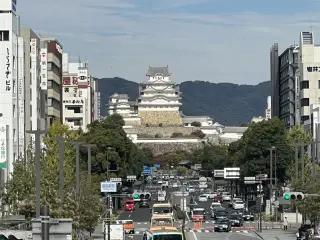
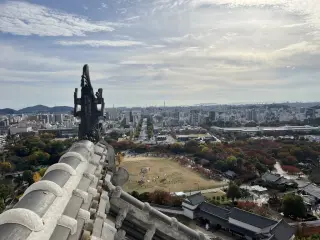
Himeji Castle’s white walls look like a white egret spreading its wings, which is why it’s also called the “White Egret Castle.” It has a long history and is beautifully preserved. The connected cluster of keeps has an elegant style, earning it the reputation of being Japan’s finest castle. The cherry trees were still in bud, but I imagine the spring cherry blossom views here must be absolutely beautiful 🌸.
-
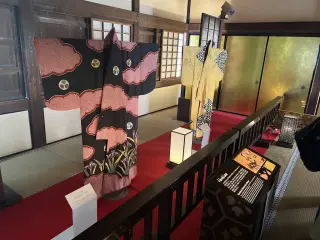
It was even bigger than I imagined! Totally feels like a fortress!
It takes about 3 hours to walk around, so plan your meal time before you go in.
You’ll be amazed nonstop inside—guaranteed! -
This gorgeous castle, also known as White Heron Castle, is absolutely worth seeing!
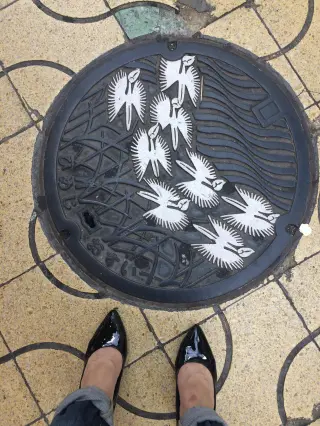
They even have manhole covers with designs inspired by the castle and the egret orchid (the flower of Himeji City), so keep an eye on the ground too.
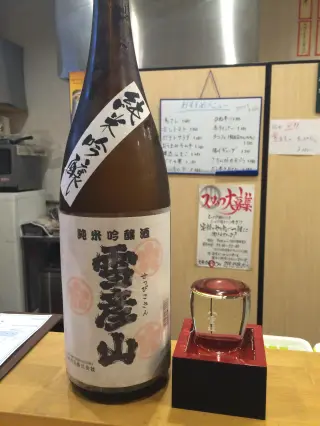
In the bar district near the station, I tried the local sake Yukihikoyama.
It’s always fun to taste the local booze when you travel, right? It was delicious.


FAQ about Himeji Castle
Q
Who built Himeji Castle, and when?
A
It’s said to have been built in 1346 by Sadanori Akamatsu.
Q
What makes Himeji Castle special?
A
Its refined, beautiful exterior and the dignified presence created by its unique castle structure.
Summary
We’ve introduced the charms of Himeji Castle, known for unmatched beauty among Japan’s surviving castles—what did you think?
With both exceptional beauty and commanding presence, plus a long history and deep ties to Japanese culture, it’s well worth visiting at least once.
Beyond Himeji Castle and its surroundings, Hyogo has many other wonderful places to explore.
Use this article, which carefully selects Hyogo’s top sightseeing spots and local food, as a reference and enjoy your trip around Hyogo.