An ama hut is a setting where divers wash their gear after taking the day's catch to market and rest with friends while warming themselves after a long day of hard work fishing.
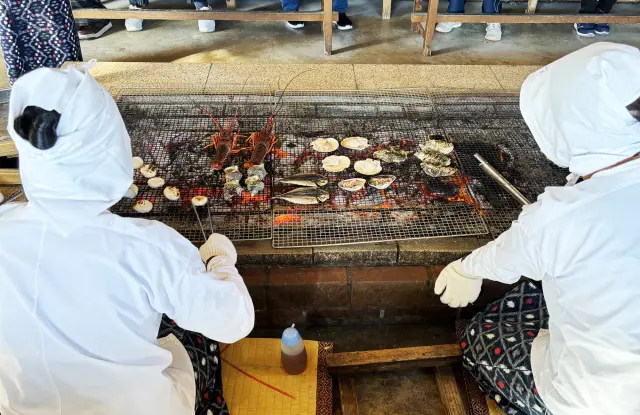
In the ama hut, visitors can chat with ama divers while eating freshly caught clams and turban shells grilled over a charcoal fire.
Ama divers are free divers, who enter the sea without oxygen tanks to collect abalone, turban shells, sea urchins, and other shellfish, as well as seaweed such as wakame and hijiki. The history of ama divers is long and is said to date back 3,000 to 5,000 years; their own customs and rituals have been preserved. For example, star-shaped marks (seman) and plaid patterns marks (doman) are believed to ward off evil and seal out danger.
Today's divers wear masks and wetsuits and use a spatula-like tool called a “nomi” to get abalone and turban shells off the rocks. There are fewer and fewer ama divers every year. But they are trying to preserve this special "ama culture," including their outstanding skills of free diving, their ability to detect fishing grounds, and their relationship with the Ise Jingu, which has continued from ancient times.
Satoumian is able to accommodate 77 people in three huts, which allows the ama divers to serve each group separately instead of mixing groups together.
Highlights
-
Taste fresh seafood caught in the local sea.
-
You can talk with Ama divers and learn about them.
-
Arrange the date and plan in advance.