

Besides getting rid of bad luck, you can also pray for good relationships here. Most of the visitors are young women.
Jishu Jinja (Kyoto, Kiyomizu) | Review by 簡福


Other Reviews by 簡福
-

Former Osaka Shosen Building
Built in 1917 as the Moji branch of the shipping company Osaka Shosen, this Western-style building once served as a vital terminal when Moji Port was a key hub for continental routes during the Taisho era. The first floor functioned as a waiting room, while the second floor housed offices, making it an important gateway connecting the port with overseas destinations.
It’s now an arts and culture space, and sometimes there are exhibitions or events. Walking around inside feels really relaxing, and you can take lots of great photos.
If you’re into old buildings and that vintage vibe, this spot is definitely worth a visit! -

Kodai-ji Temple
A Zen temple of the Kennin-ji school of Rinzai Buddhism, located at the foot of Kyoto’s Higashiyama mountains northeast of Hokan-ji Temple, known for the Yasaka Pagoda. After Toyotomi Hideyoshi’s death, his wife Nene (Kita no Mandokoro) moved from Osaka to Kyoto and became a Buddhist nun. In 1606 (Keicho 11), she founded Kodai-ji Temple (formally known as Kodai-ji Jusho Zen Temple), one of the most renowned temples in the Higashiyama area, to pray for Hideyoshi’s soul and serve as her own burial place.
The reflection of the autumn leaves on the lake at night looks just like a mirror. The garden is pretty dim, but luckily you can just follow the crowd.
-
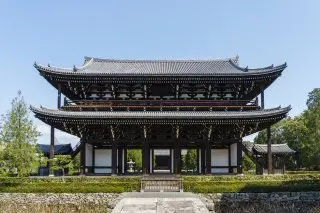
Tofukuji Temple
The head temple of the Tofukuji school of Rinzai Zen Buddhism. Regent Kujo Michiie commissioned the temple as a family temple, appointing Shoichi Kokushi as its founding priest. Construction began in 1236, and the seven-hall temple complex was completed 19 years later in 1255. It is also one of Kyoto’s Five Great Zen Temples.
If you're in Kyoto for fall foliage, Tofukuji Temple is a must-visit. The night illumination is also a highlight, but make sure to book online in advance.