
![[Complete Guide to Kumihimo] The World of Kumihimo, Filled with Japanese Aesthetics](https://static.gltjp.com/glt/data/article/22000/21036/20250604_022824_88fde273_w1920.webp)
[Complete Guide to Kumihimo] The World of Kumihimo, Filled with Japanese Aesthetics
In the 2016 anime film “Your Name.”, kumihimo appears as an important motif, used for the heroine’s hair cord and the protagonist’s bracelet. Right after the film was released, kumihimo bracelets became a huge trend in Japan, and demand grew so quickly that production centers struggled to keep up.
There are several kinds of cord-like items made by “braiding.” Rope and cord are “twisted cords,” made by twisting together two or more bundles of thread. Sanada-himo is a “woven cord,” made by weaving warp and weft threads. Rilian is a “knitted cord,” made by hooking and knotting thread, much like knitting.
Among them, kumihimo developed in a unique way in Japan together with the culture of each era. Made by braiding threads together, kumihimo is more than a practical item, it also reflects the Japanese sense of beauty.
In this article, we’ll introduce the delicate and beautiful world of kumihimo.
What Is Kumihimo?
Kumihimo is one of Japan’s traditional crafts. Rather than being knitted or woven, it is made by crossing multiple threads according to specific patterns and braiding them into a single cord with a three-dimensional structure.
Even something simply called a “cord” can have many different structures depending on the number of threads and the braiding method.
It is believed to have been used in Japan since ancient times, for religious purposes and for arms and armor.
Then, from the Edo period onward, kumihimo came to be used as decorative items such as obijime and obidome, adding more elegance and individuality to kimono.

The History of Kumihimo
The Origins of Kumihimo
The exact origins of kumihimo are unknown. As for cords in general, when did humans first begin using them? In Japan, it is said to date back to the Jomon period. At first, cords were used to tie wood and stone together as tools for catching prey. Whenever people made a new tool, cords were essential, and they were indispensable for the development of tools. However, from a functional standpoint, cords did not develop dramatically after that. As decoration, though, they underwent various changes. The earliest use of cords as decoration is thought to have been in the Jomon period (Approx. 13,000 to Approx. 2,300 years ago). It is believed to have begun with rope made from two bundles of thread, used to create patterns on Jomon pottery. Haniwa clay figures from the Kofun period are decorated with what appear to be simple kumihimo-like ornaments on their clothing. From this, it can be inferred that ancient people likely incorporated kumihimo into clothing decoration. Looking around the world, traces of cord use have also been found in the Inca Empire.
Introduced Along with Buddhism
In the Asuka and Nara periods, complex and advanced kumihimo techniques were introduced from continental China along with Buddhism. In portraits of Prince Shotoku from the Asuka period, kumihimo is depicted as the cord used to hang a sword from the waist. It seems that threads dyed in red, purple, yellow-green, light brown, dark brown, and navy were braided in a plain-weave-like structure to create symmetrical patterns. Because it was incorporated into the decoration of men’s accessories, kumihimo became highly valued in many settings during this period when Buddhist culture flourished, from tying sutra scrolls to adorning Buddhist ritual objects. Kumihimo from this period is thought to have had strong religious significance. This is because kumihimo used in Buddhist culture carried the meaning of “tying and protecting sacred things.”
The Development of Kumihimo
In the Heian period, as court culture flourished, the kumihimo techniques brought from the continent were refined with a uniquely Japanese elegance. More complex braiding methods were developed, auspicious patterns were created, and multicolored dyed cords appeared. Aristocrats used kumihimo chosen for its braiding styles and colors to decorate crowns and garments. It was also used as decorative cord for furnishings.
From the Kamakura period onward, when samurai ruled the country, kumihimo became inseparable from arms and armor. Because it offered excellent elasticity and durability, it spread widely and was put to practical use. For example, it was used for tsukamaki, wrapping the sword hilt with kumihimo to improve grip and secure armor, and for sageo, the cord used to keep the sword from slipping out. It was also used as odoshi, connecting different parts of armor while allowing movement. In this way, it became mainly an accessory for arms and armor, and its colors also became more subdued.
Today, there are around 100 types of designs for hand-braided kumihimo, known as tegumi, but the basic structures that form the foundation of these techniques were already completed by the Muromachi period, and kumihimo is still made based on those techniques today.
By the late Edo period, Japanese-style obi belts had taken on their current form, and kumihimo came to be used as obijime and obidome. It spread not only among samurai but also among common people. In other words, it became part of everyday clothing. Specialized kumihimo artisans also appeared, and distinctive local styles of kumihimo were born in different regions.
Today, while the tradition continues to be passed down as a traditional craft, kumihimo is used not only for obijime and obidome but also for fashion accessories such as straps and bracelets. Even now, new designs are being pursued while carrying on tradition.
Kumihimo Developed in Different Production Areas
The kumihimo traditions that developed in different regions during the Edo period still remain today as production areas.
- Kyoto: Kyoto City, Uji City, and other areas. These regions produce craft kumihimo for Japanese dress accessories such as obijime and obidome, retaining the elegance of Heian aristocratic culture.
- Tokyo: Taito City, Suginami City, Kita City, and other areas. Influenced by samurai society and merchant culture, many styles are subdued and refined, evoking wabi-sabi. Products range from obijime and netsuke cords to neckties and straps, made from raw silk, silk thread, and gold and silver thread.
- Mie Prefecture: Iga City, Nabari City, and other areas. Made with silk thread and gold and silver thread, these cords are vividly colored and are indispensable for items such as obijime and haori jacket cords.
“Kyo Kumihimo,” Developed in the Elegant City of Kyoto
Uji in Kyoto is one of Japan’s major kumihimo production areas. Located in the southern part of Kyoto Prefecture, it is home to World Heritage sites such as Ujigami Shrine and Byodoin Temple, and it is also known as the setting of The Tale of Genji, Japan’s oldest full-length novel. The streets are lined with shops selling the famous Uji tea, giving the town a strong sense of history.
In this town of Uji, Showen Kumihimo has been manufacturing, wholesaling, and selling Kyo kumihimo for about 80 years. We visited this company, founded in 1948. It began as a workshop making obijime and hair ornaments. The founding couple had a home in Uji, which is why they set up their factory here.
Inside the shop, kumihimo-made goods line the shelves. You can also buy kumihimo accessories here as souvenirs. From kanzashi and straps to watch buckles and glasses cords, Approx. 53 kinds of products were on display. Among them, straps are especially popular.
How Kumihimo Is Made
We were immediately shown how kumihimo is made. There are two ways to turn thread into cord. One is “hand braiding” (tegumi), in which each strand is braided by hand, and the other is “machine braiding,” done using a braiding machine called a seichuki.
At Showen Kumihimo, all production was done by hand when the company was founded, but braiding machines were introduced around 60 years ago. Today, they make kumihimo using both hand braiding and machine braiding. There are many steps before the finished cord is complete.
For hand braiding
Thread dyeing → reeling → heijaku → attaching tama bobbins → hand braiding
For machine braiding
Thread dyeing → reeling → heijaku → twisting → winding onto wooden bobbins → attaching tama bobbins → braiding
As you can see, the steps differ slightly between hand braiding and machine braiding.
Here is an introduction to what is done in each process.
Making Kumihimo by Hand
1. Thread Dyeing
Silk thread is dyed in bundles using acid dyes, and the color is fixed with acetic acid.
At Showen Kumihimo, 14 dye colors are currently used to create many different shades.
The dyes are dissolved precisely, and careful attention is paid to the amount and timing of the acetic acid to produce clean, even color with minimal unevenness.
-

Thread dyeing
-

Thread dyeing
-

Thread dyeing
2. Reeling
After dyeing, the silk thread cannot go directly to the next process, heijaku, while still in bundle form, so it must first be wound onto wooden bobbins or frames by machine or by hand reeling. During this reeling process, care is taken to prevent tangling and thread breakage while winding.
-

Reeling
-

Reeling
3. Heijaku
Heijaku, the process of bundling threads, is the most crucial step in making beautiful kumihimo.
In this process, the number and length of the bundled threads, as well as the colors and the number of frames used for winding, are adjusted according to the type of cord being made.
They say that whether the thread can be bundled smoothly without fraying at this stage greatly affects whether the finished kumihimo will be beautiful.
-

Heijaku
-

Heijaku
4. Twisting
Twisting is the process of applying twist to the threads that have gone through heijaku.
By twisting the threads, slackness and irregularity are removed, the strength is increased, and the finished cord gains firm tension.
-

Twisting
-

Twisting
5. Winding onto Wooden Bobbins
The twisted bundles of thread are wound onto bobbins.
For machine braiding, the bobbins must match each specific machine, so they are wound by hand one by one.
-

Winding onto wooden bobbins
-

Winding onto wooden bobbins
6. Attaching Tama Bobbins
A bobbin is also called a tama, and this is the process of setting those tama onto the machine.
-

Attaching tama bobbins
-

Attaching tama bobbins
7. Braiding
The threads are braided into kumihimo.

Making Kumihimo with Braiding Machines
1. About Braiding Machines
Today, machine-made kumihimo is produced using around 60 iron braiding machines.
Basically, each machine can braid only one type of cord structure.

At the time, introducing machines made mass production of kumihimo possible. Although the machines do the braiding, the artisans working in the machine workshop continue to value the skills and knowledge of hand braiding, refining their techniques every day in pursuit of even higher-quality cords.
The braiding machines come in a variety of sizes.
The machines owned here range from those using the smallest unit of three bobbins for mitsugumi to those using up to 56 bobbins for hirahimo.

Those bobbins move automatically along rails to braid the kumihimo.
If you look closely, you’ll notice that the bobbin movements differ from machine to machine. That makes sense.
The rail design is different for each machine.

Which machine is used depends on the braiding method and the product being made.
The automatic clattering movement made the bobbins look as if they were dancing, and it was fascinating enough to watch for hours.
2. Types of Kumihimo That Can Be Made with Braiding Machines
There are many types that can be made with braiding machines. Here are just a few examples.
| Name | Number of Bobbins | Features |
|---|---|---|
| Edo-uchi | Eight tama | A representative type of kumihimo. Up to eight colors can be mixed. |
| Yotsugumi | Four tama |
A simple structure made with four tama. The quality is easily affected by balance and the degree of twist. Used for netsuke cords and haori jacket cords. |
| Kara-uchi | Sixteen tama |
A finer cord than Edo-uchi. It can be braided more firmly and is stronger than Edo-himo. It is often used in knots for shrines and temples, and as the core cord for prayer beads. |
| Kakusugi | Twenty-four tama | Characterized by smooth intersections between threads and a sleek, glossy appearance. |
| Kongo-gumi | Twenty-four tama |
A round tubular cord braided in a very dense structure, so it has little surface unevenness and is highly durable. |
-

Machine-braided eight-strand cord (Edo-uchi)
-

Machine-braided yotsugumi
-

Machine-braided kara-uchi
-

Machine-braided kakusugi
-

Machine-braided kongo-gumi
The Beauty of Hand-Braided Kumihimo
When making hand-braided kumihimo, artisans use a stand called a kumidai.
The finished design and shape vary depending on the type of stand.
1. Braiding Stands Used for Hand Braiding
Kakudai
This is the braiding stand used in the kumihimo experience described later. Because the cord is braided upward, you can check the braided section with your own eyes as you work. It is also suitable for beginners.
-

Kakudai
-

Kakudai
Marudai
This braiding stand lets the cord braid downward through a hole in the center of the stand. It can be used to make flat cords and round cords. Larger stands can also make cords with around 30 tama.
-

Marudai
-

Marudai
Ayatakedai
Most kumihimo is braided so that the threads are intertwined in a spiral structure, but kumihimo made with an ayatakedai has a structure similar to woven fabric, with threads corresponding to warp and weft. Because the warp threads run firmly through the structure, the resulting kumihimo has less elasticity than many other types.
The firmness of the cord can be adjusted by tightening the supplementary threads that act as the weft.
-

Ayatakedai
-

Ayatakedai
Takadai
The artisan sits in the center of this braiding stand, which is about 1 meter square, and braids the threads spread out to the left and right into a cord.
The number of tama used for braiding ranges from several dozen to over 100, creating very fine braid patterns.
This stand can produce a wide variety of patterns with complex two-layer and three-layer structures.
-

Takadai
-

Takadai
2. Designs Possible with Each Braiding Stand
Kakudai
- Marukara
- The cord is braided while bringing the thread crossings to the outside. This is a durable braiding method.
- Chikura
- Characterized by a complex braid pattern. Because of the movement of the threads being braided inward, this kumihimo has striking depth and shadow.
-

Marukara
-

Chikura
Marudai
- Marugenji
- Its distinctive feature is the alternating incorporation of arrow-feather patterns in different colors. Various patterns can be expressed depending on the color combination. It is also durable and was used as a cord for armor and helmets during the Muromachi period.
- Yurugi
- Twenty-four tama. Because it is braided in a way that traps air inside the cord, its greatest feature is its elasticity. It is widely used as an obijime and can be used with everything from everyday kimono such as tsumugi and komon to formal wear.
- Karagumi
- An appealing cord with a surface texture that is very strongly emphasized.
-

Marugenji
-

Yurugi
-

Karagumi
Ayatakedai
- Yoroi-gumi
- Characterized by dense and complex patterns. It is strong.

Takadai
- Kikukara-gumi
- A braiding style inspired by chrysanthemum flowers. It is characterized by a three-dimensional look and an elegant, lively feel.
- Ten-gasuri
- A single-layer cord. The front and back have the same pattern, and it is one of the kumihimo styles with a charming accent color within its delicate braid pattern.
-

Kikukara-gumi
-

Ten-gasuri
“Tying” Kumihimo
Kumihimo can be used by tying the cord and shaping it into different forms. In Japan, techniques of musubi, or decorative tying, have developed since ancient times. The meaning contained in this idea of “tying” also strongly reflects Japanese spirituality. The origin of the word musubi comes from musuhi, meaning “the birth of a soul.”
One of the gods that appears in the Nihon Shoki, one of Japan’s oldest historical chronicles, is Katamusuhi-no-kami, a deity associated with the creation of all things and one of the most important gods in Japanese mythology. Since ancient times in Japan, people believed that new energy is created through tying. In fact, this word musuhi appears often in Japanese daily life.
The words musuko and musume, referring to children born from the union of people, are said to derive from musubihiko and musubihime. This reflects the Japanese spirit of valuing ties and bonds between people.
Kumihimo has also been used as a symbol of forming bonds and inviting good fortune through tying.
Each tying style also carries its own meaning. Here are a few examples.
Ume-musubi
This knot is inspired by the plum blossom.
It evokes the firm shape of a plum flower, and once tied, it does not easily come undone.
For that reason, it symbolizes a strong bond.
Because plum blossoms bloom after enduring the harsh cold of winter, it also carries the meaning of improving one’s fate.
In addition, plum is believed to have protective power against evil, so this knot also has the meaning of warding off evil.
It is used for many kinds of celebrations, such as weddings, job celebrations, and housewarmings.

Shogon-musubi
This is one of the knots used to decorate Buddhist altars in a solemn way. It is often seen in temples.
It is considered an auspicious knot.

Awaji-musubi
This is one of the knots known as musubikiri, knots that are difficult to undo once tied, and it is often used for occasions one hopes will not be repeated, such as weddings and celebrations for recovery from illness.
It is said to have been given this name because the loops on both ends of the knot resemble an abalone.
Also, because pulling both ends tightens the knot firmly, it carries the meaning of wishing that the bond will last for a long time.

Kiku-musubi
It was named because the shape of the knot resembles a chrysanthemum flower.
This auspicious decorative knot carries the meaning of long life and longevity.
It is often used as a decorative tassel for kimono jackets, sashes, swords, and bows.

Kuni-musubi
This knot was given its name because it resembles the kanji character for “country.”
With its complex knot structure, it carries meanings such as peace and good fortune. In China, it is called “soui-musubi.”

Kanau-musubi
This is one of the auspicious knots made with the wish that one’s hopes will come true.
When viewed from the front, the knot looks like the character for “mouth,” and from the back, it looks like the character for “ten.”
That is why it came to be called kanau-musubi, using the character 叶. It is used for knots on amulets and wooden prayer tags received at shrines and temples.

Kame-musubi
This knot was named because it resembles the shape of a turtle’s shell.
Since ancient times, turtles have been symbols of longevity. For that reason, this knot carries meanings such as wishing for long life and hoping things will continue for a long time. At New Year, it is used to decorate kadomatsu and kagami mochi.

Keman-musubi
This knot was introduced to Japan along with Buddhism. It is said to lead all things to happiness through the power of the Buddha.
It is used decoratively for ornaments on keman Buddhist fittings and for cords on the chest area of dolls.
It also carries meanings such as tying the bond between husband and wife and forming connections.

Age-maki-musubi
This is one of the decorative knots handed down since ancient times. Its meaning changes depending on the shape of the knot.
- “Human shape”: carries meanings of warding off evil and protecting against misfortune, and was used on the arms and armor of samurai heading into battle.
- “Entrance shape”: carries the meaning of inviting good fortune, and is used for furnishings and tassels for rolling up bamboo blinds.
It is also sometimes used for wedding celebrations.

Kesa-musubi
This knot is used for the decorative tassels on the kesa robes worn by Buddhist monks.
It carries the meaning of tying and securing something in order to carefully protect sacred sutras.
It also has an auspicious meaning, such as strengthening bonds.

Artisans’ Hands
At Showen Kumihimo, tied kumihimo items are sold as products.
All of this knotting work is done entirely by hand by artisans.

There are said to be around 10 artisans in charge of in-house finishing, and that number alone is not enough to keep up with producing thousands or tens of thousands of items a year.
So since the company’s founding, around 60 artisans in Uji alone have done kumihimo knotting work from home as subcontracted piecework.
The entire town of Uji helps make these handmade products possible, and thanks to this production system, they are able to achieve high-quality manufacturing even in small lots.
Knowing that each item is handmade makes you feel even more attached to the products.
You can also buy just the kumihimo cord itself and tie it into any form you like to make something of your own.
Try Braiding Kumihimo Yourself!
At “Showen Kumihimo Uji Main Store,” you can try hand-braiding kumihimo if you make a reservation at least one week before the experience date.
Even complete beginners can join without any problem. You can experience the “braiding” process, from thread to cord, while being directly guided by an artisan.
When making your reservation, you first choose the color you want to use. There are six options: peacock, matcha green, red, wisteria purple, dark navy, and yellow.

On the day of the experience, you use a kakudai to braid with a total of eight threads: four red and four white.
One red and one white thread hang from each of the four sides of the kakudai.

The wooden tama act as weights, so the threads are pulled taut. You braid by crossing those threads left and right.
When taking the thread farther from your body, you use your thumb, and when taking the thread closer to your body, you hook it from below with your four fingers. Until you get used to it, it can be confusing to remember which direction to move and how to position your hands, but the artisan kindly teaches you, so you can braid with confidence.
-
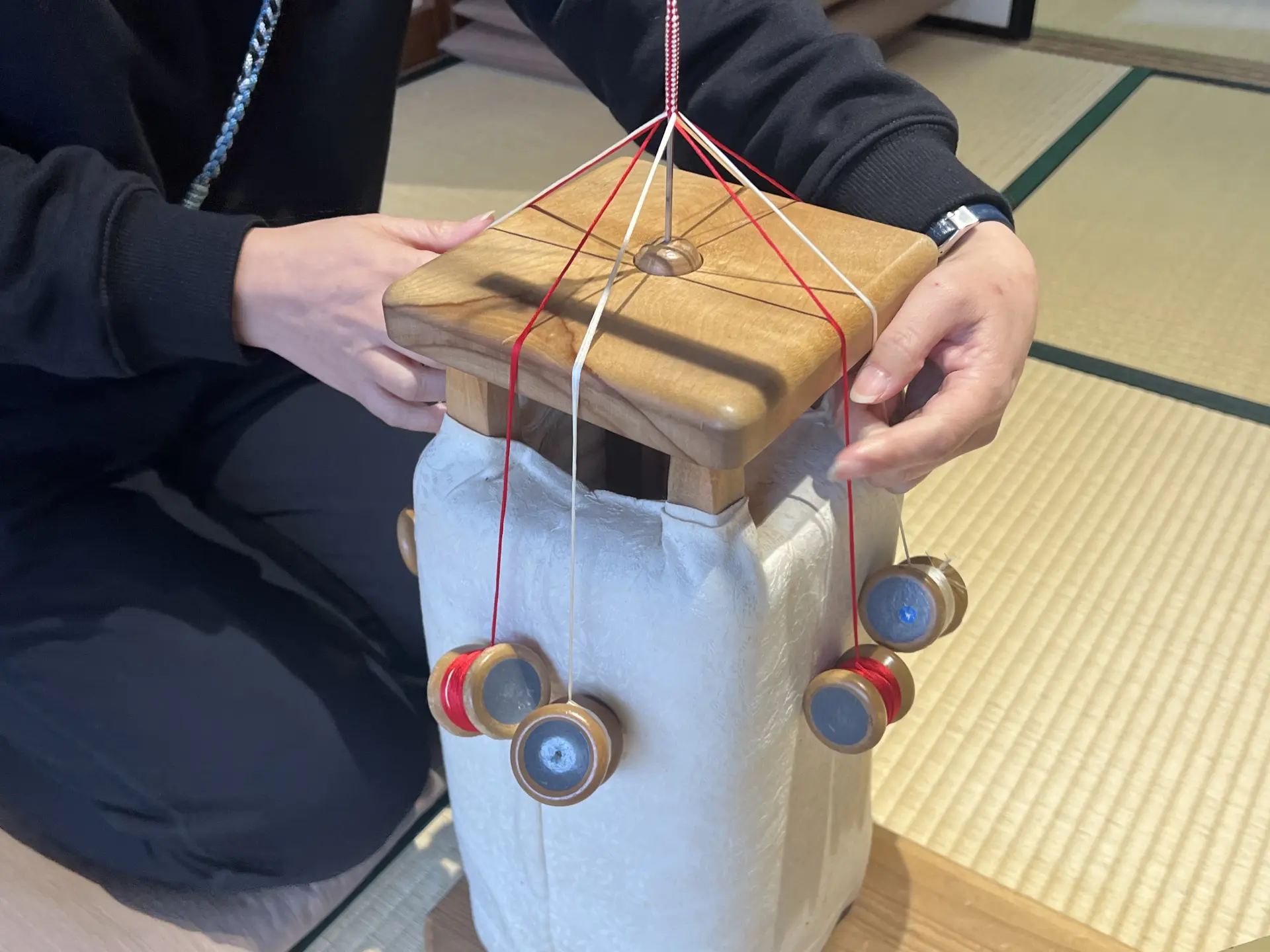
Braiding by crossing the threads left and right
-

Braiding by crossing the threads left and right
Even if you make a mistake in the left-right order, it’s not a problem.
The artisan will undo it and carefully return it exactly to the point where it was correctly braided.
Once you start getting used to it, the weighted wooden tama tap against one another with a pleasant clicking sound as you braid. Naturally, you become focused as you use your hands to cross the threads and build up the braid.

Watching it gradually take shape was fun, and it became a meditative experience. It takes about 30 to 45 minutes to finish.
Once your cord is complete, you can choose two items from a strap, bag charm, and bracelet, and an artisan will finish them for you on the spot.

The warm sound of the wooden tama striking each other echoed through the room, creating a calm and relaxing atmosphere.
Reservations are required, so be sure to book in advance before visiting.
Experience Overview
- Location
- Showen Kumihimo Uji Main Store
- Phone
- 0774-66-3535
- Capacity
- Up to 4 people per session (for 5th grade elementary school students and older)
- Reservation required
- At least 1 week in advance (for the next 2 months)
- Cost
- 3,850 yen per person (tax included)
- Start times
- 11:00am, 1:30pm (2 times a day)
- Duration
- Approx. 1 hour
- Details
- You will braid an eight-strand Edo-himo using a kakudai
- Official website
- Official website (Japanese)
How to Make a Reservation
If you would like to participate, you need to make a reservation at least one week in advance through the inquiry form on the official experience website above.
After your application details are confirmed, the shop will reply by email.
Kumihimo Accessories as Souvenirs
At Showen Kumihimo, you can also buy accessories and goods made with kumihimo.
Pure Silk Straps
These pure silk straps come in a variety of colors and designs.
Especially popular as souvenirs, they can be called one of Showen Kumihimo’s signature accessories. They can be used not only as decorations for mobile phones, but also for bags, canes, keys, USB drives, and more. Available in 10 design types, including natural dye, amulet, chirimen, Edo-uchi, yagasuri, silk gloss, ayakourai, cubic, yotsugumi, and urakin, and in 5 to 11 colors for each style, these straps are distinguished by the gorgeous luxury of silk.

Glasses Cords
This is another very popular item. Making the most of the qualities of cord, these products are characterized by the luster and lightness unique to silk. Because they are made of silk, they feel soft and gentle against the skin when worn around the neck, reducing unnecessary strain on the shoulders and neck.
They are made in four braiding styles, kakuhachi, yattsugumi, kara-uchi, and yotsugumi, and are available in 3 to 6 colors.

Shoelaces
These shoelaces made from kumihimo are recommended for anyone who wants to make their favorite sneakers more stylish. They were developed into a product after more than a year of repeated trial and error, experimenting with adding texture to the cord, making it softer, and changing its width. They also make a great gift for people who are particular about their shoes.

Pure Silk Card Case
This card case is based on the traditional and elegant Japanese color-layering culture known as kasane no irome, created by Heian aristocrats. Artisans carefully handcraft each one by sewing together glossy kumihimo called yamato-gumi. With its rich three-dimensional texture, it is an item that feels wonderfully warm and substantial.

The items introduced here are just a few examples, and there are many more attractive kumihimo accessories to discover.
After trying the kumihimo-making experience, be sure to do some shopping for yourself or for souvenirs for family and friends!
Showen Kumihimo Uji Main Store
- Address
- 146-2 Myoraku, Uji, Uji City, Kyoto 611-0021
- Hours
- 10:00am - 5:00pm
- Closed on
- None (summer and winter holidays apply)
- Phone Number
- 0744-66-3535
- Access
-
1) 8-minute walk from Uji Station on the JR Nara Line
2) 12-minute walk from Uji Station on the Keihan Uji Line - Official website
- Official website (Japanese)
Summary
By “tying” a single cord, kumihimo has also tied together bonds between people. Designs established long ago have been carefully handed down through the generations. Even though these braiding methods were created in ancient times, their refined designs still feel timeless today, showing the high level of aesthetic sensibility held by people in Japan long ago. We hope kumihimo helps create new connections in your life as well.

Author
Freelance Announcer
Sayaka Motomura
Focused on sharing insights related to traditional culture, performing arts, and history.