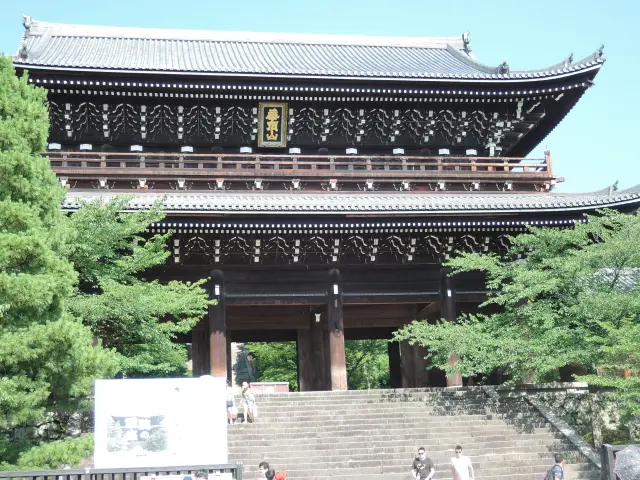
When you arrive at the entrance to Chion-in, the first thing you have to tackle is a staircase as tall as a one-story building. As you make your way up, the magnificent Sanmon Gate rises right in front of you. So impressive!
Directly above the gate hangs a black plaque with gold lettering, “Kachozan,” bestowed by Emperor Reigen. It feels बेहद solemn and grand.
Chion-in / Yuzen-en | Review by 周黛西
Other Reviews by 周黛西
-
Nachi-san Seiganto-ji Temple
With over 1,600 years of history, Seiganto-ji Temple on Mt. Nachi is a Tendai Buddhist temple that flourished as a center for syncretic practices blending Shinto and Buddhism. Known as the first stop of the Saigoku 33 Kannon Pilgrimage, it draws numerous visitors each year and is recognized as part of the UNESCO World Heritage Site "Sacred Sites and Pilgrimage Routes in the Kii Mountain Range”.
Nachi-san Seiganto-ji Temple, the first stop on the Saigoku 33 Kannon Pilgrimage, is most memorable for the classic view of its vermilion three-story pagoda framed by Nachi Falls. The pagoda stands against the mountainside, with the waterfall plunging down the cliffs behind it. The interplay of red, green, and white creates a striking cultural landscape. Admission is required to enter the pagoda. You can take an elevator to the upper level for a close-up view of Nachi Falls, then descend the stairs to see the statue of Amida Buddha enshrined inside, along with colorful paintings covering the walls and ceiling. A visit here is more than just a pilgrimage—it is a visual experience where nature and culture come together.
-
-
Kumano-Nachi Taisha
In 662 BC, Kamuyamato-iware-hikonomikoto (became Emperor Jinmu) dedicated Nachi Waterfall as a god in this shrine. It is the head shrine of Kumano Shrines all over in Japan, known as one of the three major Kumano Shrines. It has another name, “Musubi no Miya” which means the shrine to bring a marriage and wishes to come true.
Kumano Nachi Taisha—vermilion faith between the mountains and the sea. Located halfway up Mount Nachi at an elevation of about 350 meters, Kumano Nachi Taisha is one of the Kumano Sanzan and an important sacred site of the Kumano faith. After climbing about 470 steps to the shrine, the bright vermilion buildings stand out vividly against the lush forest. The faith here originated from the worship of Nachi Falls as part of nature, and you can still sense the ancient belief in coexistence between people and nature. The grounds also feature a huge camphor tree said to be over 800 years old. You can walk through a hollow in the trunk while making a wish, which is quite interesting. From the shrine, the forest, ocean, and waterfall come together to create a magnificent view, combining a solemn atmosphere with the refreshing beauty of nature.
-
-
Sandanbeki Rock Cliff
Sandanbeki is a 2-km long craggy rock cliff that towers 50 meters above the sea. In the past, fishermen would call this place “midan”, a lookout point for passing ships and schools of fish, but the point has gradually become known as “Sandanbeki” over time. The rockface is pummeled by the Kuroshio Current, creating for a view that’s bound to impress you.
Sandanbeki is the oldest scenic attraction in Nanki-Shirahama. Legend has it that during the reign of Emperor Kanmu, Sandanbeki Cave served as a refuge for local fishermen hiding from pirates while at sea. By the Heian period, it had become an important base for the Kumano Navy. Today, it is one of Shirahama's most iconic historic attractions.
Sandanbeki in Shirahama, Wakayama Prefecture, is part of Yoshino-Kumano National Park. It is a famous Shirahama attraction and is also designated a sacred place for lovers. Sandanbeki Cave lies 36 meters underground. After taking the elevator down, the cave adventure begins, with many spectacular natural wonders to see. From the observation deck inside, you can see Juzo-iwa Rock, an unusual formation that appeared after a typhoon. In the cave, you can experience up close the powerful sight of waves crashing against the rock walls and surging inside. The huge waves are truly imposing, and both the sound and sight are striking. One unusual feature is that the purification basin uses hot spring water. Card-shaped ema plaques can be used to pray for health, wealth, academic success, love, and traffic safety. Some areas recreate Kumano Navy guard huts, old passageways, and other scenes. Being there feels like falling through a time tunnel and returning to the historic setting of the Genpei War.
This attraction, where history and nature come together, is worth including in a trip to Nanki. Being inside the cave feels completely different from seeing it in photos. You have to be there to experience its impact. I recommend arriving around high tide, when the crashing waves are at their most dramatic! -