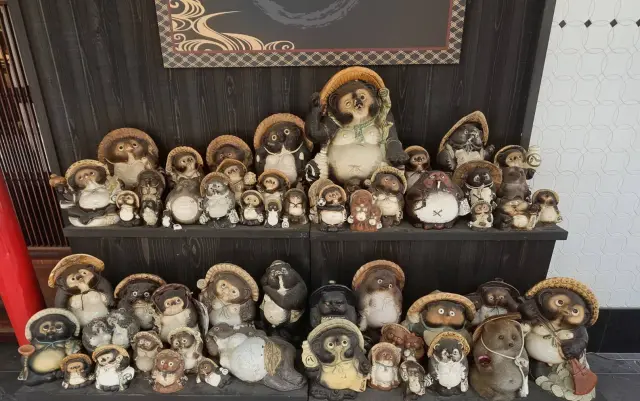
When I arrived in the Shigaraki area of Shiga Prefecture, my first thought was, “Are there way too many tanuki here?”
Along the roads, in front of shops, and in gardens, you can spot Shigaraki ware tanuki everywhere, each with a charming, goofy expression, almost like they’re greeting travelers.
Shigaraki ware is one of Japan’s six ancient kilns and has a long history of pottery. The area is built into the mountains, and old climbing kilns and cave kilns are still preserved today. Walking through this little mountain village, the air feels simple, quiet, and full of earthy clay.
The cutest part is definitely the round little tanuki ceramic figures!
Some are holding sake bottles, others are holding account books, and each one has a slightly different expression. The more you look, the more soothing they feel.
In Japan, tanuki are also seen as lucky charms that bring good fortune and business success, so it’s no wonder so many shops have one out front.
Shigaraki Toen Tanuki Mura | Review by 王小鈞
Other Reviews by 王小鈞
-
Okayama Station
JR Okayama Station is a major terminal in the Chugoku and Shikoku area, served by the Sanyo Shinkansen and several JR lines. The Sanyo Line, Hakubi Line, Tsuyama Line, Ako Line, and Uno Minato Line all run through the station, making it a convenient transportation hub for destinations in and beyond Okayama Prefecture, including Kurashiki, Korakuen Garden, Okayama Castle, Uno Port, and Naoshima.
Okayama Station is a major transportation hub that is very convenient for traveling around the Chugoku and Shikoku regions. The Sanyo Shinkansen and various JR lines meet here, making it easy to travel to both the San'in and Shikoku regions. There is also plenty to explore around the station, with lots of restaurants, souvenirs, and shops at Sansute Okayama and Okayama Ichibangai. From here, you can take the streetcar to Okayama Castle and Korakuen Garden. For a nearby excursion, you can also take a JR train to the Kurashiki Bikan Historical Quarter. If this is your first time in Okayama, it's very convenient to use the station as your starting point!
-
-
Okayama Castle
This castle was created by Warlord Hideie Ukita in 1597. The main castle was built on top of a hill named Okayama, and the Tensyu (castle tower), was built in front of the Asahikawa River. The adjacent castle town was created with merchants and craftsmen.
Okayama Castle is one of Japan's 100 Famous Castles. Its distinctive black exterior has earned it the nickname “Crow Castle.” I highly recommend adding it to your itinerary when visiting Okayama. Take the streetcar to Shiroshita Station, then walk a short distance to the castle. I recommend buying the Okayama Castle and Korakuen Garden combination ticket, which costs just JPY 800. There is an elevator inside the castle tower, so you can take it to the upper floors first and then make your way down. The second floor has a drink shop, a samurai sword experience, and other facilities. The first floor has the ticket counter and a souvenir shop, and you can also collect a commemorative stamp nearby. Overall, it's very easy to explore.
-
-
Ouchijuku Misawaya
A soba restaurant in Ouchijuku, a nationally designated Preservation District for Groups of Traditional Buildings, where around 40 thatched-roof houses line the old highway. Set inside a restored traditional home, the calm, classic Japanese interior features a pendulum clock and an irori hearth with charcoal fire in winter. Don’t miss the rows of soba cups displayed on the wall. A must-try at Misawaya is the signature “Takato Soba,” said to have been loved by the Aizu domain lord.
Misawaya in Ouchijuku—when visiting this post town that preserves its Edo-period streetscape, of course you have to try the very distinctive “Takato Soba”! It was my first time seeing soba eaten with a green onion instead of chopsticks, and it was really unique. The cold soba had a lot of grated daikon, and the spiciness became quite noticeable toward the end; the other bowl of soba in hot broth was nice and warming. Personally, I thought the portions were a little large, but the vegetable tempura was delicious, and there was also a very unusual fried red bean bun that wasn’t greasy or too sweet. Overall, it was a very distinctive experience, and I recommend giving it a try when you visit Ouchijuku!
-