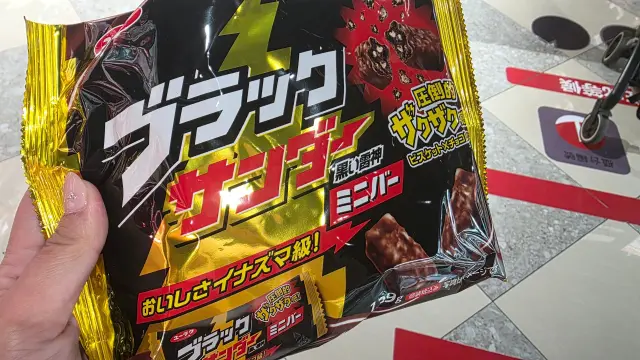
Japan’s super popular Black Thunder chocolate!
The name sounds intense, and eating it feels like getting struck by lightning from all the sweetness.
Every time I go to Japan, someone in my family always asks, “Can you bring back some Black Thunder?”
Personally, I think the sweetness is off the charts, and after one bar I want a cup of unsweetened tea. But my family just keeps eating one after another and can’t stop!
Crispy biscuits mixed with rich chocolate, tasty and budget-friendly. No wonder it’s been popular in Japan for so many years. You can often spot it in supermarkets and convenience stores.
For me, it’s a “sweetness overload alert.”
For my family, it’s “the No. 1 must-buy item in Japan” 😂
Black Thunder | Review by 王小鈞
Other Reviews by 王小鈞
-
Pabron
The “Pabron” brand of medicine, produced by Taisho Pharmaceuticals, is one of Japan’s most common cold medicines.
Every time I go to Japan, my family almost always asks me to bring back a box of “Taisho Pabron.” It’s a classic household cold medicine in Japan and has long been trusted by many Japanese families. On this trip to Japan, I discovered that the familiar packaging had gotten a makeover! The newly upgraded PRU version has a more modern package, but it’s still the same familiar brand.
For us, it’s not just medicine—it’s more like a “go-to souvenir” we bring home whenever we visit Japan. -
-
Tochoji Temple (Fukuoka)
Tochoji Temple, located in Hakata Ward, Fukuoka City, is a Shingon Sect temple said to have been first opened by the famous monk Kukai (Kobo Daishi) upon his return to Japan after completing his training in the Tang Dynasty. The official name of the temple is "Tochoji Temple," which was named by Kukai with the meaning "so that esoteric Buddhism may be transmitted eastward for a long time”.
When visiting Hakata, besides shopping and enjoying the food, I also highly recommend visiting these two historic temples and shrines.
The most impressive feature of Tochoji Temple is the Fukuoka Daibutsu. Admission to the Great Buddha Hall is JPY 100. The 10.8-meter-tall wooden statue of Shakyamuni Buddha is solemn and magnificent, and looking up at it from close range is truly awe-inspiring. Photography is not allowed inside the hall, so you can only admire it quietly, which makes the peaceful atmosphere even more noticeable.
Behind the Great Buddha Hall is a special “Hell and Paradise Pilgrimage.” You go from a bright area into a dark passageway, with scenes of hell depicted on the walls. Walking the entire route feels very immersive.
After visiting Tochoji Temple, walk to Kushida Shrine in Hakata Gion to experience the history of Hakata’s guardian shrine and its traditional festival culture. The two attractions are not far apart, making them perfect for a leisurely visit on the same day while taking in Hakata’s historic charm. -
-
Lake Ikeda
Located in the southeastern part of the Satsuma Peninsula, Lake Ikeda is the largest lake in Kyushu, boasting a circumference of 15 km and a depth of 233 meters. Formed over 5,000 years ago through volcanic activity, it took shape after six major eruptions in the surrounding area, eventually becoming the caldera lake it is today.
This time, I visited Kyushu's famous caldera lake. The lake is vast, surrounded by mountains and natural scenery, and looks magnificent even from a distance.
The lake was formed by a volcanic eruption about 5,700 years ago. It has a circumference of about 15 kilometers and reaches a maximum depth of 233 meters, making it one of Kyushu's most iconic lakes.
What surprised me most was that we arrived just in time for sunset. As the sun slowly set over the lake, the entire surface turned golden. It was so beautiful that I couldn't stop taking pictures. -