

The view is fantastic here. You can see everything all around you.
Biwako Hakodateyama | Review by 張志祥


Other Reviews by 張志祥
-

Hitachi Seaside Park
Hitachi Seaside Park is a large park that spans an area of about 215 hectares. During springtime, daffodils, tulips, and nemophila bloom. In early summer, there are roses, and in summer, there are zinnias and sunflowers. Autumn brings forth kochia and cosmos. During winter ice tulips, plum blossoms, and other seasonal flowers bloom. In particular, the nemophilia that bloom from mid-April through early May are lauded for their gorgeous blue color, blending the sky, sea, and flowers together into a vast expanse of blue.
This is one of the most famous spots in Ibaraki. In autumn, the hills are covered with kochia, and there's always something to see here no matter the season.
-
-

Shirakawa-go (Gassho-Zukuri Village)
Shirakawa-go is a picturesque area where Japan’s traditional rural landscape remains intact. It has the largest concentration of gassho-zukuri buildings, with more than 100 structures of various sizes as of 2016. As Japan’s largest gassho-zukuri village, it has been designated a National Preservation District for Groups of Traditional Buildings.
Shirakawa-go in winter is just magical. The heavy snow covering the gassho-style houses gives the whole village a unique and beautiful vibe.
-
-
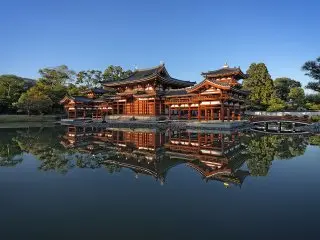
Byodoin Temple
The site was originally used as a villa by Fujiwara no Michinaga, a powerful figure during the Heian period. His son, Yorimichi, inherited the property and converted it into a temple in 1052. It was registered as a World Heritage Site in 1994. Following renovations completed in 2014, it is said to have regained an appearance closer to its original form. The Amida Hall, which houses the principal image of Amida Buddha, is a highlight. Its magnificent symmetry is sure to captivate visitors.
Different temple buildings are scattered throughout the area. The most famous is the Phoenix Hall, with a pair of golden bronze phoenix statues on the roof. You can even compare them to the JPY 10,000 bill and 10 yen coin—the designs come from here.
-


