
Ikebana: The Japanese Tradition of Honoring and Bringing Out the Life in Flowers
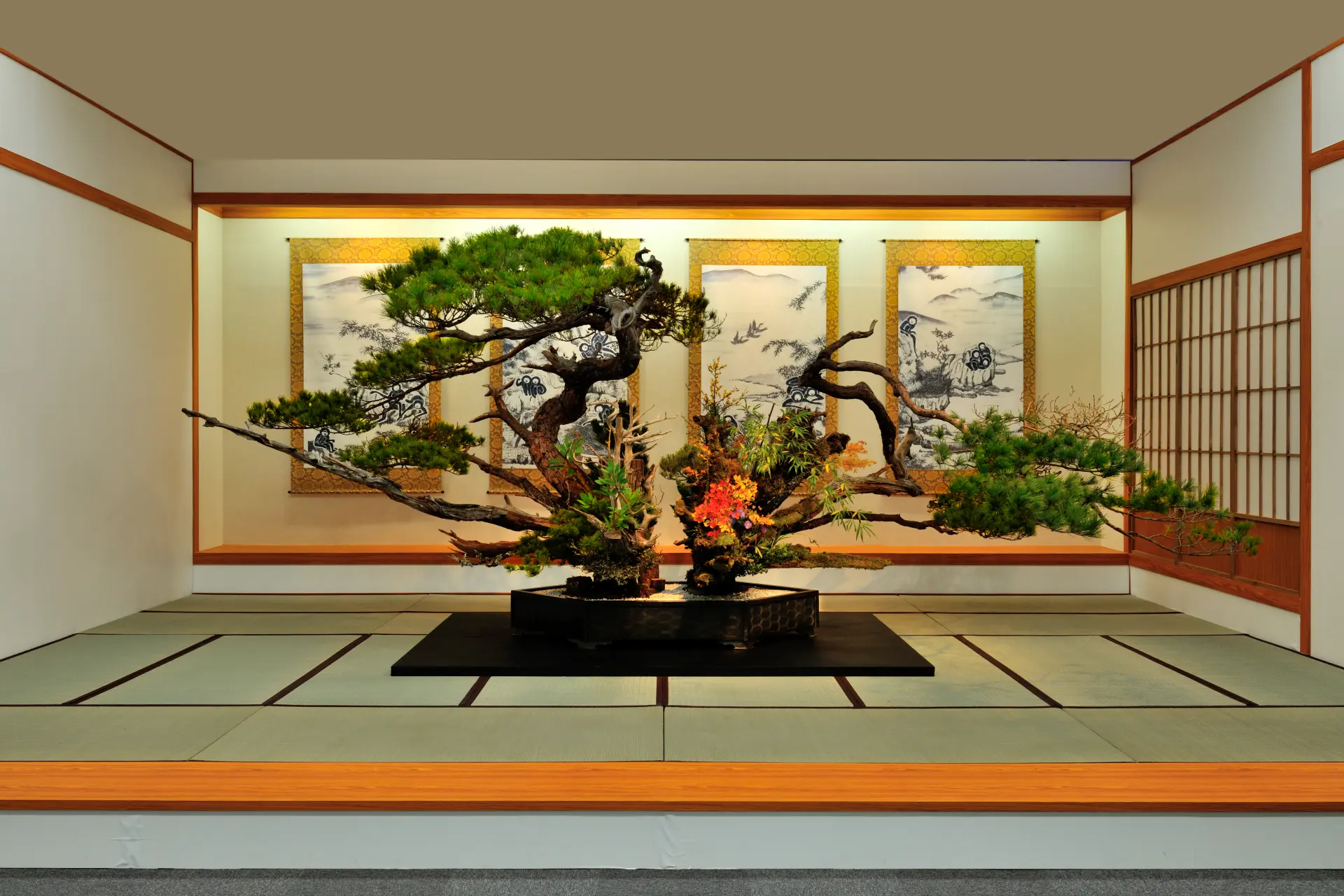
Ikebana is a traditional Japanese art that expresses beauty by arranging flowers and plants in vessels. More than decoration, it reflects the preciousness of life even in buds and withered flowers and embodies the spirit of wabi-sabi. This article explores the birthplace of ikebana, its leading school, Ikenobo, its history and diverse styles, and the basics of floral materials and tools, offering insight into the Japanese aesthetic passed down since ancient times.
Introduction
What Is Ikebana?
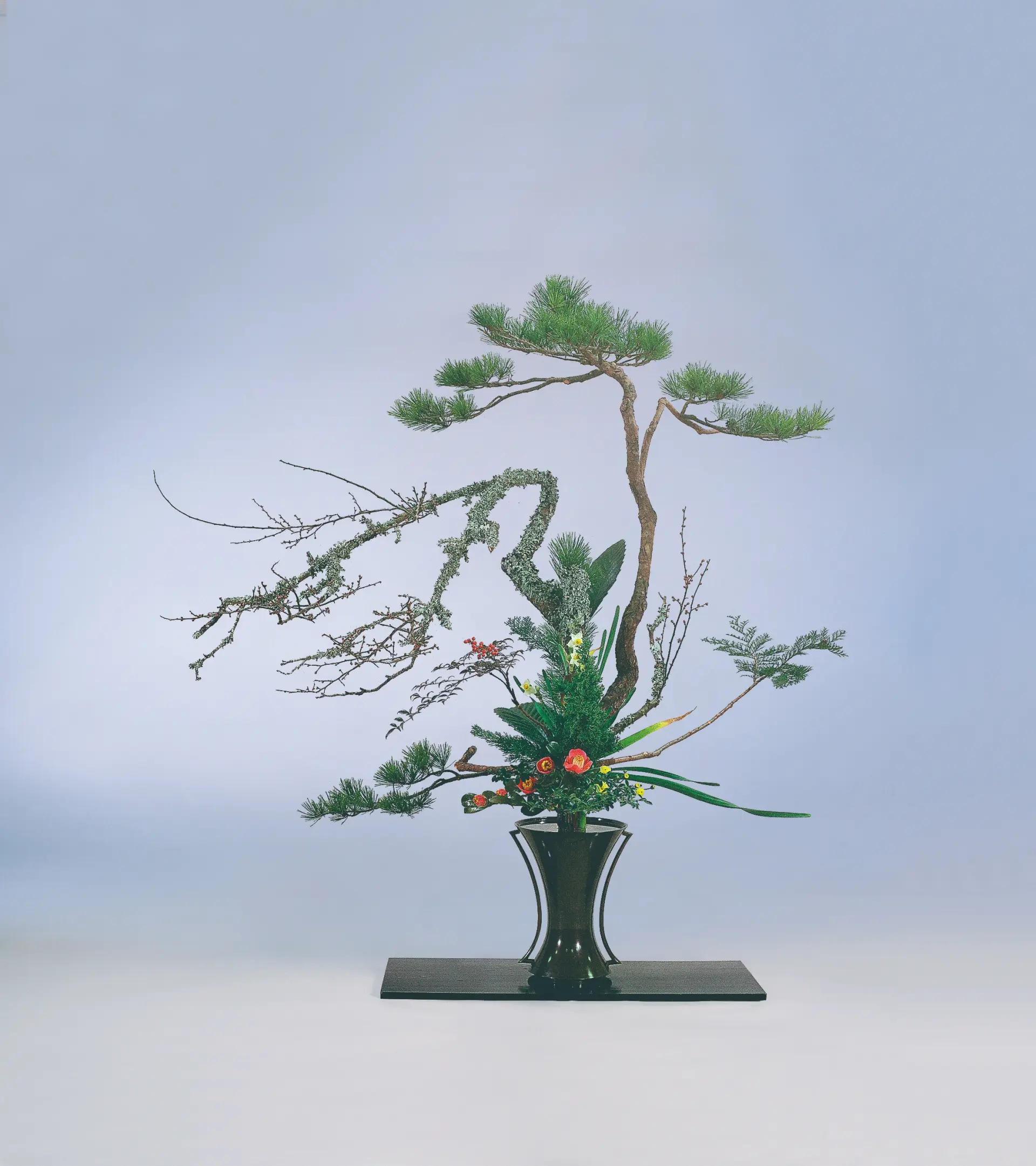
When ikebana is regarded as a disciplined “way,” like the tea ceremony or the way of incense, it is called kado, the “way of flowers.” Put simply, ikebana is a traditional Japanese art in which several flowers and plants are arranged in a vessel to create a work of art. It also embodies a spirituality connected to the distinctly Japanese concept of wabi-sabi. Rather than simply admiring beautiful flowers, it views a bud as something that will bloom in the future and a withered flower as something that has passed through the process of living. Ikebana observes life and brings it to its fullest expression. Its spirit lies in finding beauty in every stage of a plant’s existence.
In 2024, kado was registered as an Intangible Cultural Property of Japan, defined as something of high historical or artistic value to the country.
The Birthplace of Ikebana
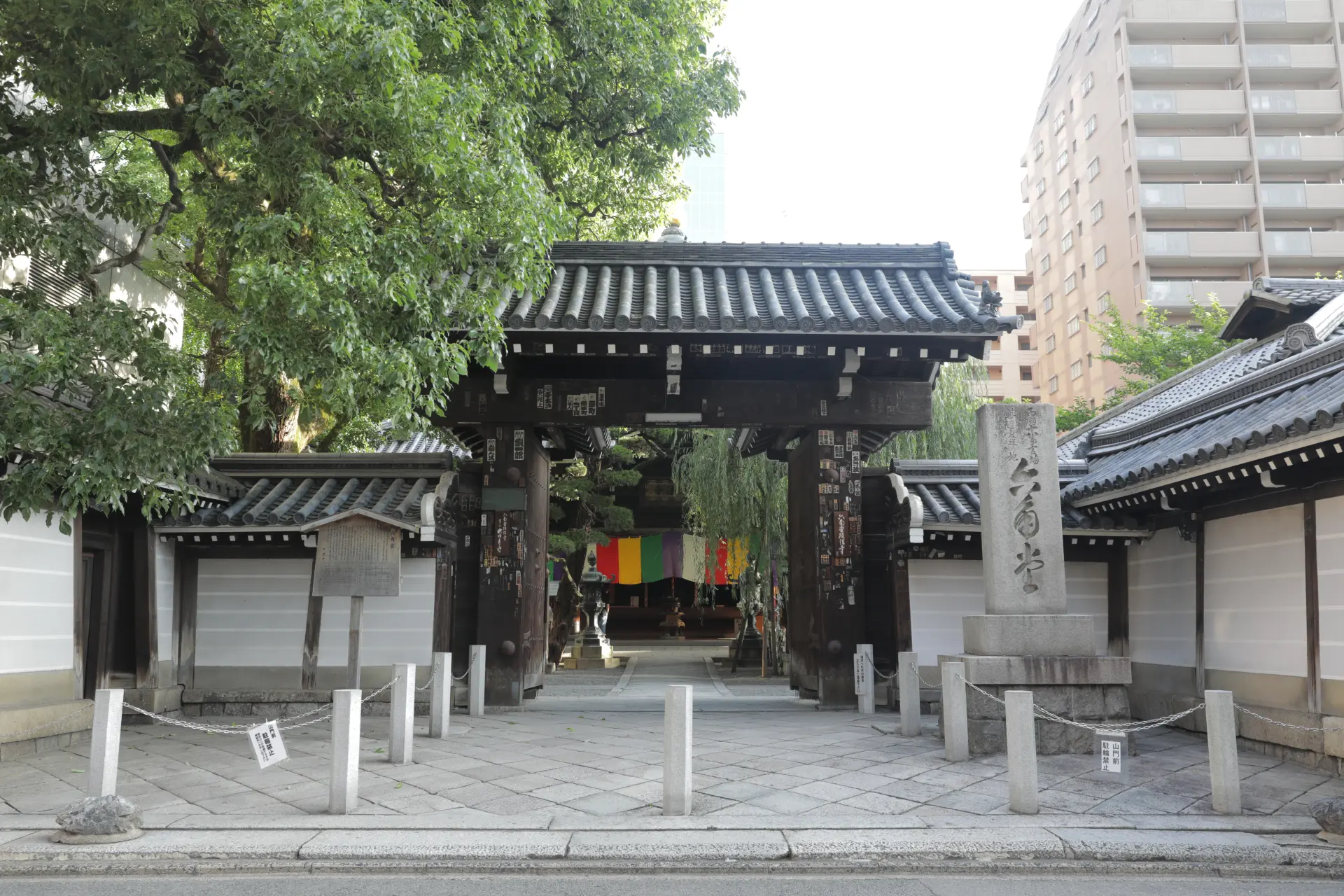
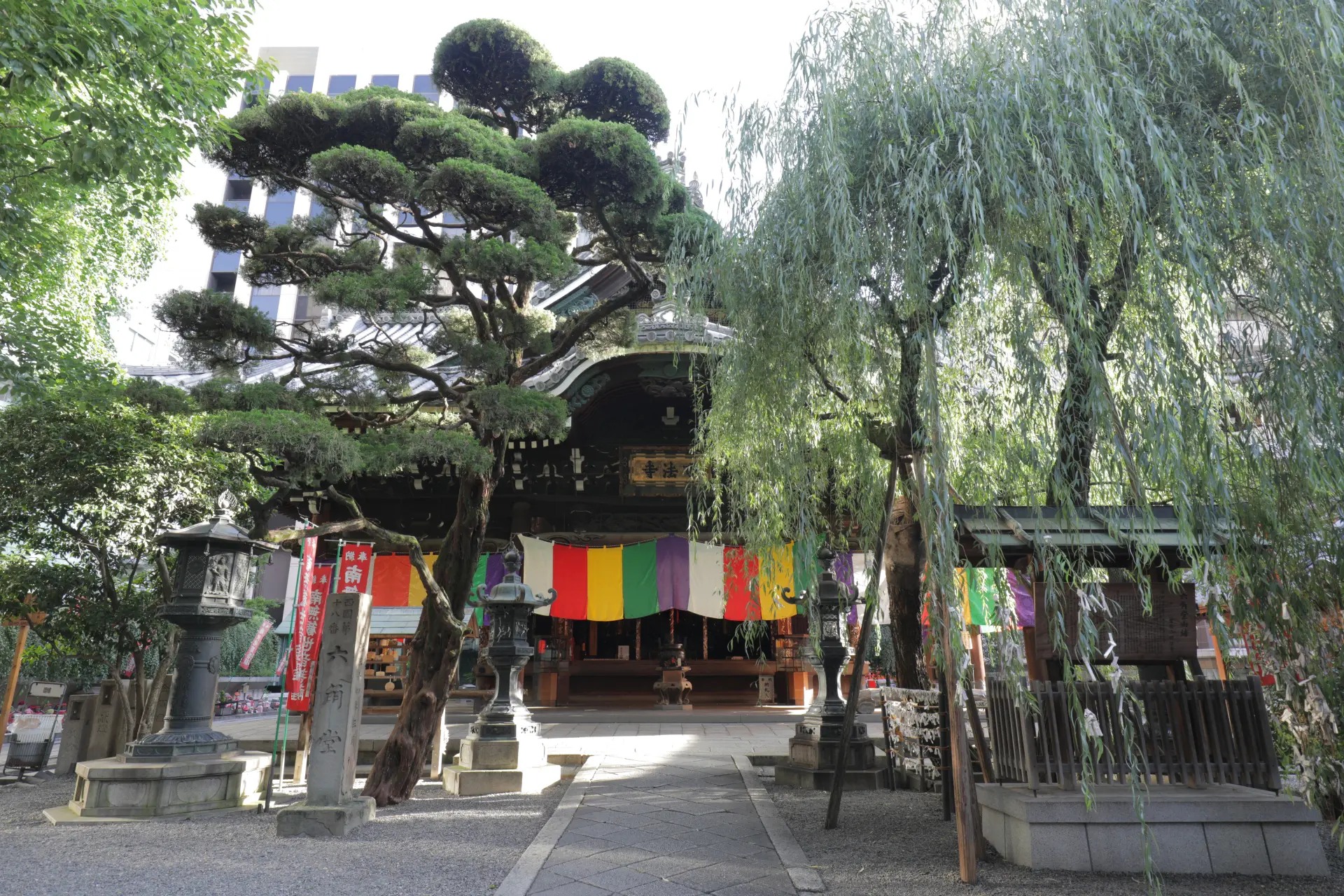
Shiunzan Chohoji Temple, commonly known as Rokkakudo, stands in central Kyoto.
Tradition holds that Prince Shotoku founded it in 587, during the second year of Emperor Yomei’s reign, and that Ono no Imoko, an envoy to China’s Sui dynasty, became its first head priest. Successive head priests lived beside a pond where Prince Shotoku was said to have bathed, and they came to be known as “Ikenobo,” meaning “priests’ quarters by the pond.” At the time, Buddhist monks offered flowers before the Buddha each morning and evening. This is believed to have been the origin of ikebana.
During the Muromachi period, changes in architectural styles led flowers to develop into decorations for reception rooms. Ikenobo Senno, who was active at the time, established the principle that arranging flowers could lead to enlightenment, marking the beginning of kado. In other words, ikebana began with Ikenobo, and the tradition continues today through Ikenobo, the head school of ikebana.
-
Rokkakudo
-
Rokkakudo
-
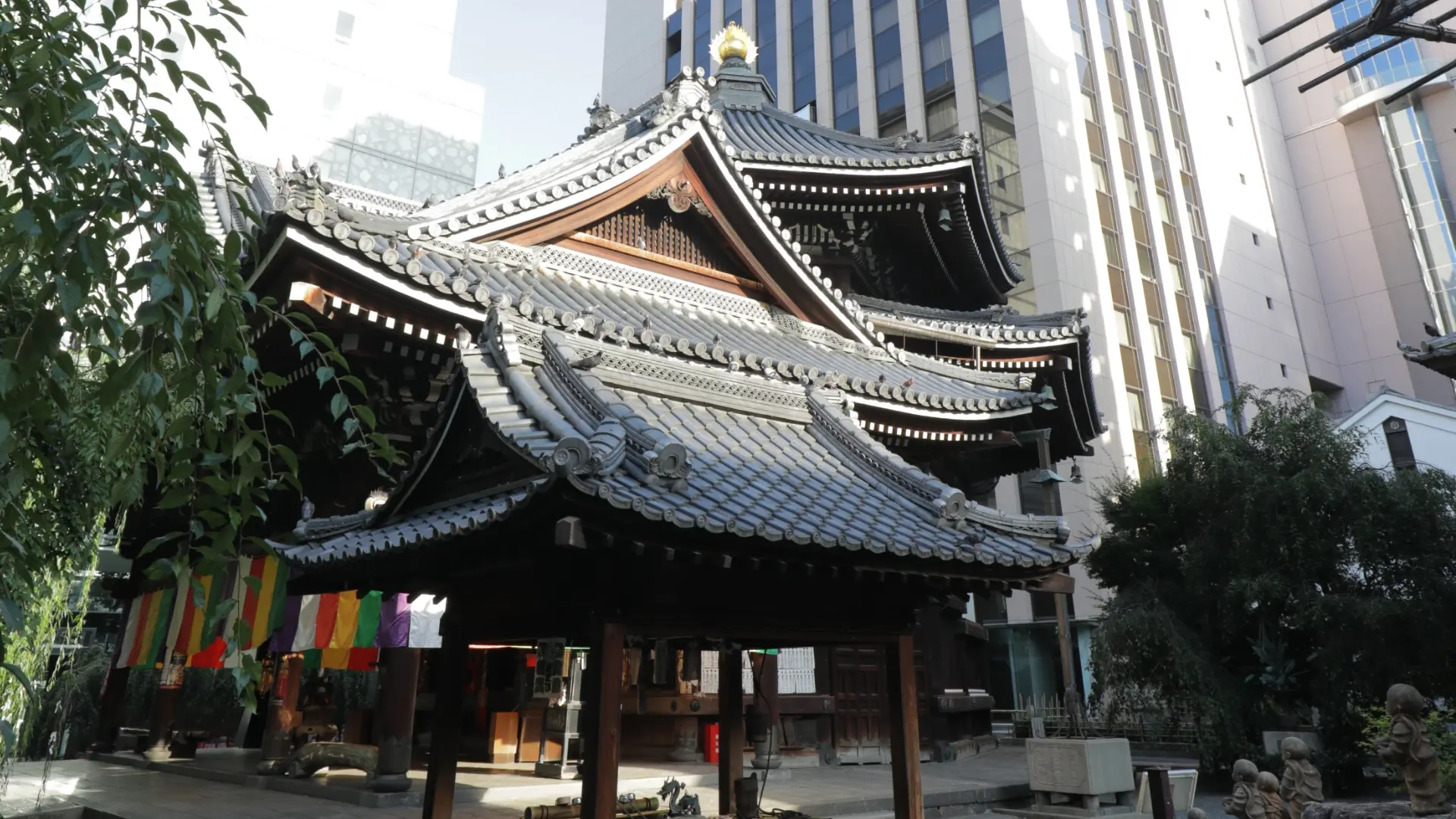
Rokkakudo
Ikenobo, the Head School of Ikebana
Japan has many schools of ikebana, but Ikenobo established its guiding philosophy and has passed it down continuously to the present day.
Ikenobo has branches throughout Japan and in 120 locations worldwide, where students hone their skills and engage with ikebana every day.
Ikenobo is next to Rokkakudo, the birthplace of ikebana. The building houses the Ikenobo Headquarters, the Ikenobo Ikebana Society Foundation, Nihon Kadosha Co., Ltd., and classrooms for the Ikenobo Central Training Institute.
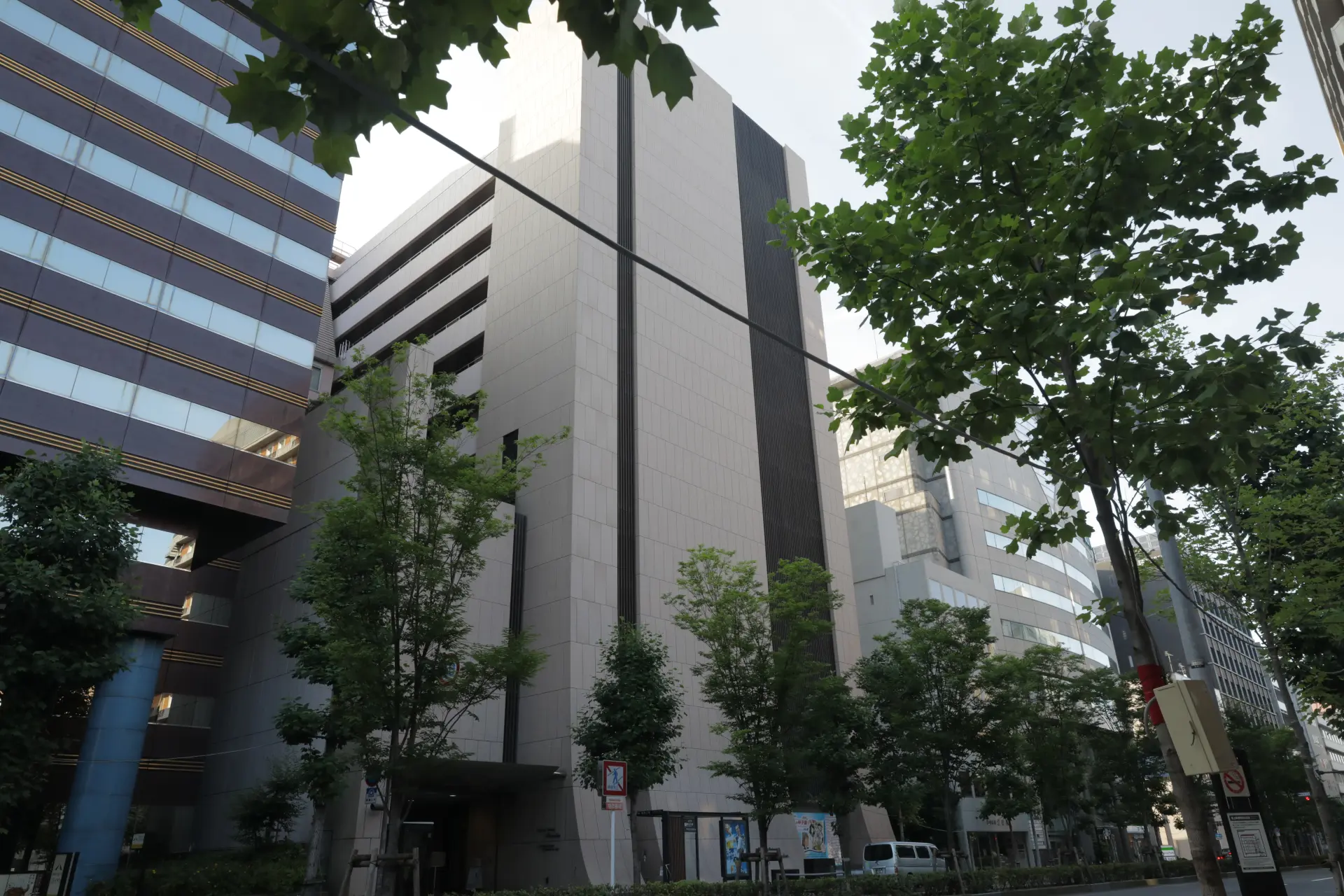
Ikebana Experiences for International Visitors
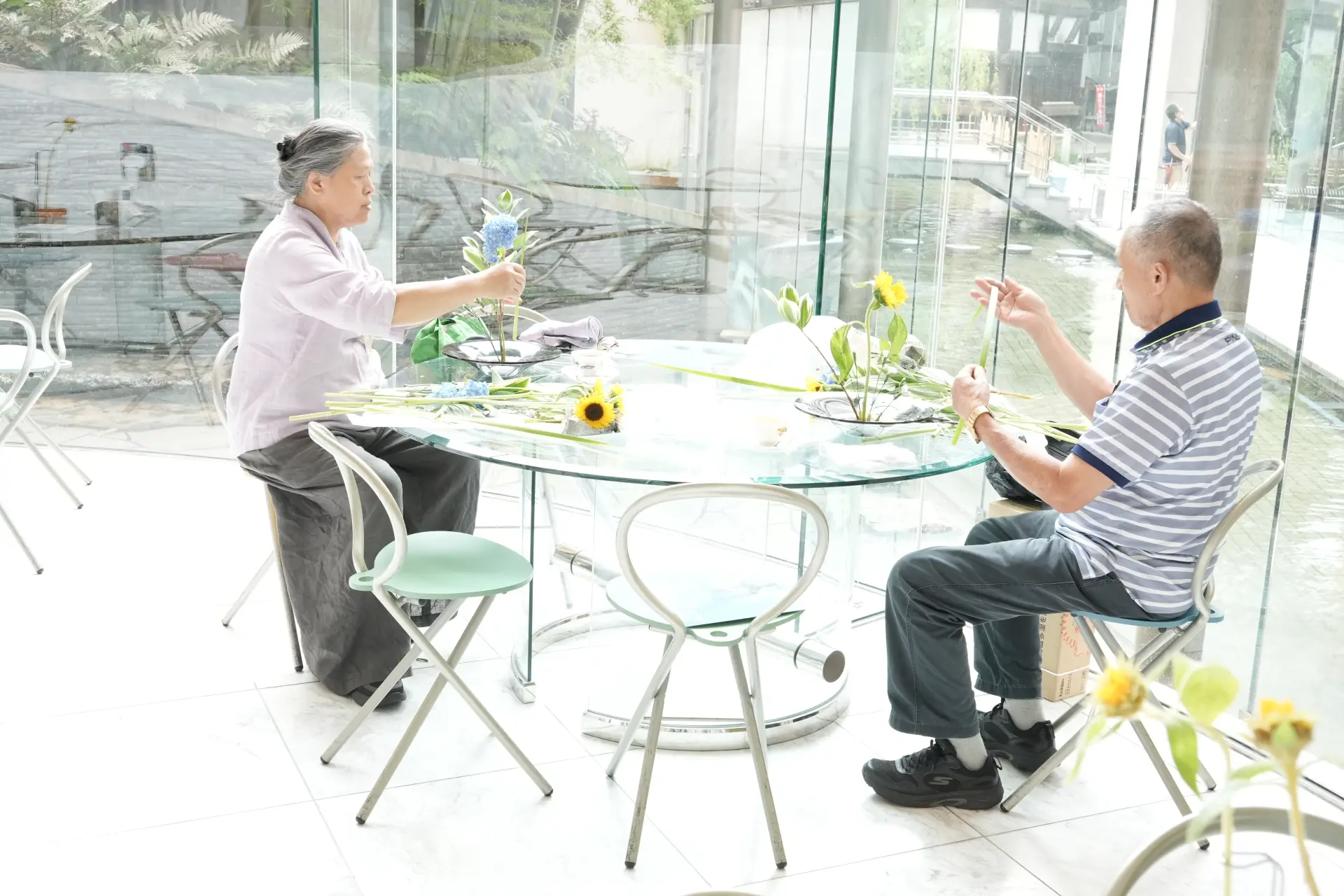
For approximately the past five years, Ikenobo has offered workshops for visitors who would like to try ikebana.
-
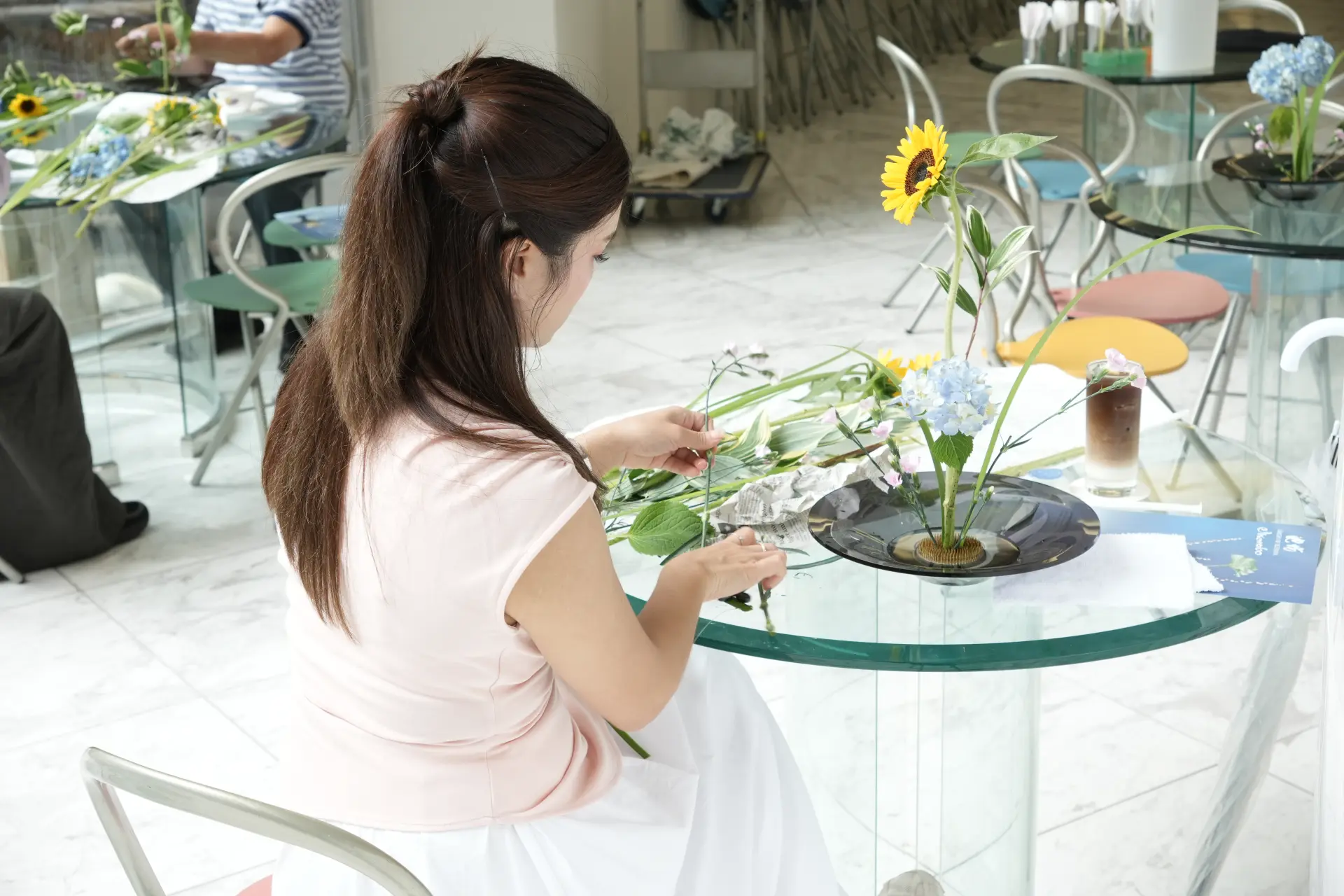
During the workshop
-
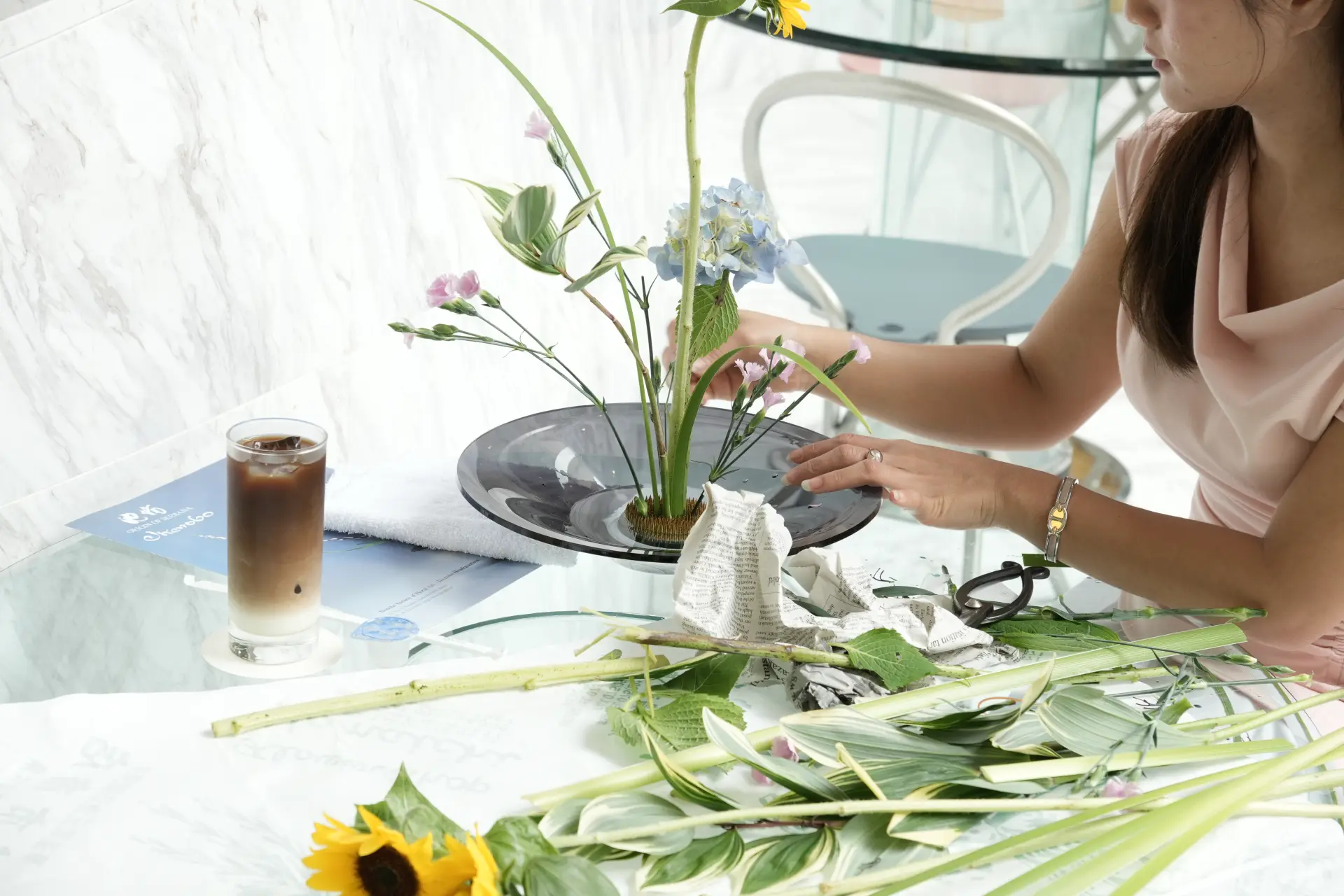
During the workshop
-
During the workshop
- Schedule
-
Thursdays, 1:30 p.m. - 3:30 p.m.
*Workshops are not held every week. Check the official website for available dates. - Fee
- JPY 7,000
- Reservations
- ikebanalesson@ikenobo.jp (*English and Chinese support available)
- Important Information
-
Advance reservations are required. Please contact Ikenobo by email.
Be sure to include:
1. Participant names
2. Preferred date
3. Contact telephone number or another means of contact
4. Preferred payment method:
① Advance credit card payment when booking (Visa or Mastercard)
② Credit card payment on the day (Visa, Mastercard, Saison, JCB, American Express, Diners Club, or Discover) or payment via WeChat Pay
③ Cash payment in Japanese yen on the day
*Several rules apply to the workshop. Be sure to check the official website before visiting.
After meeting at the Rokkakudo temple gate, participants receive a guided tour of Rokkakudo, the birthplace of ikebana. The workshop then takes place in the Ikenobo headquarters building.
Vessels and floral scissors are provided, so anyone can participate. During the workshop, participants create a Jiyuka, or free-style, arrangement. In addition to practical arranging techniques, they learn about the spiritual principles behind kado and ikebana.
Participants may take their floral materials home. The tour and workshop last approximately 1.5 to 2 hours and are conducted in English and Chinese.
Ikebana Museum
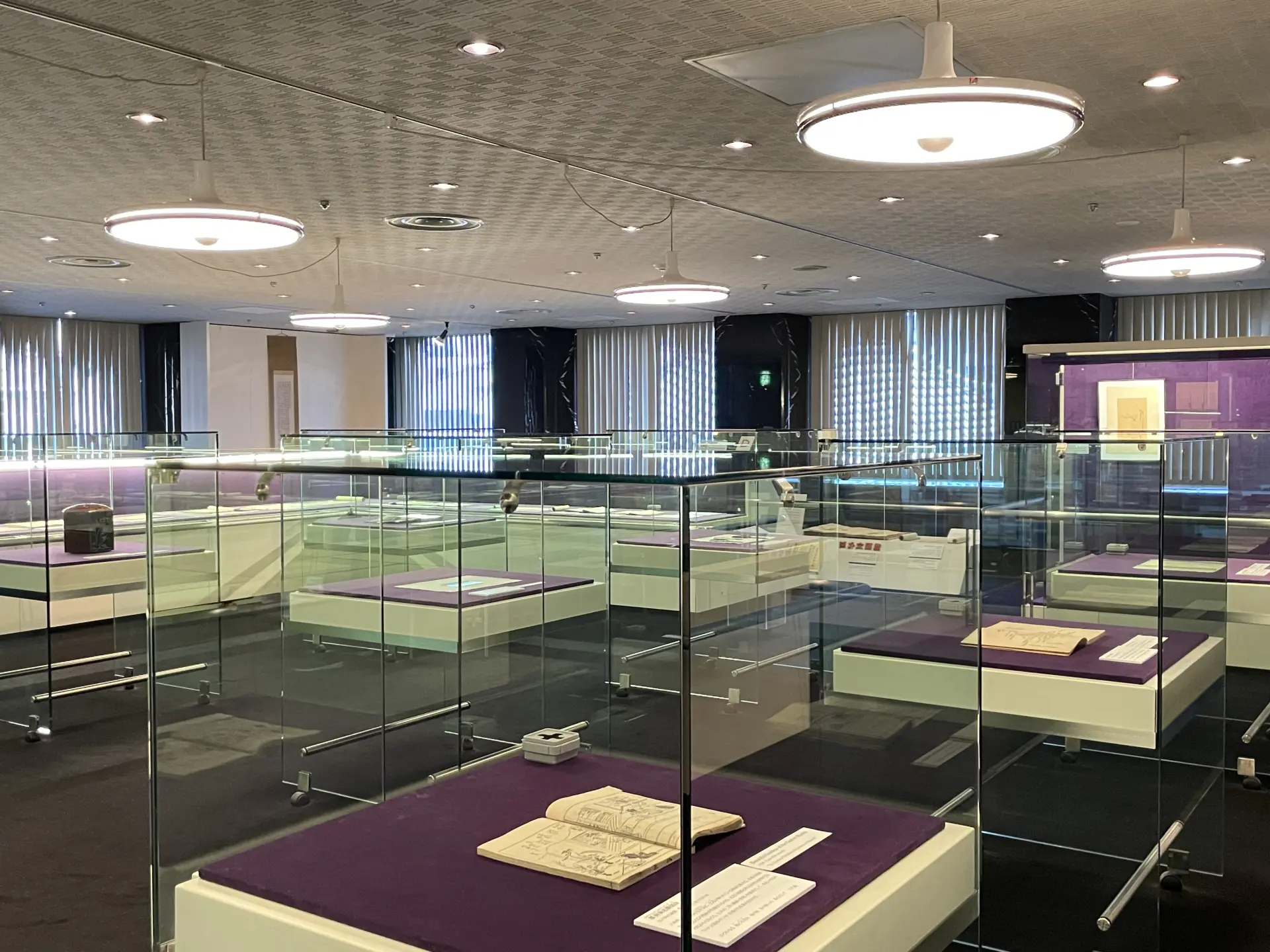
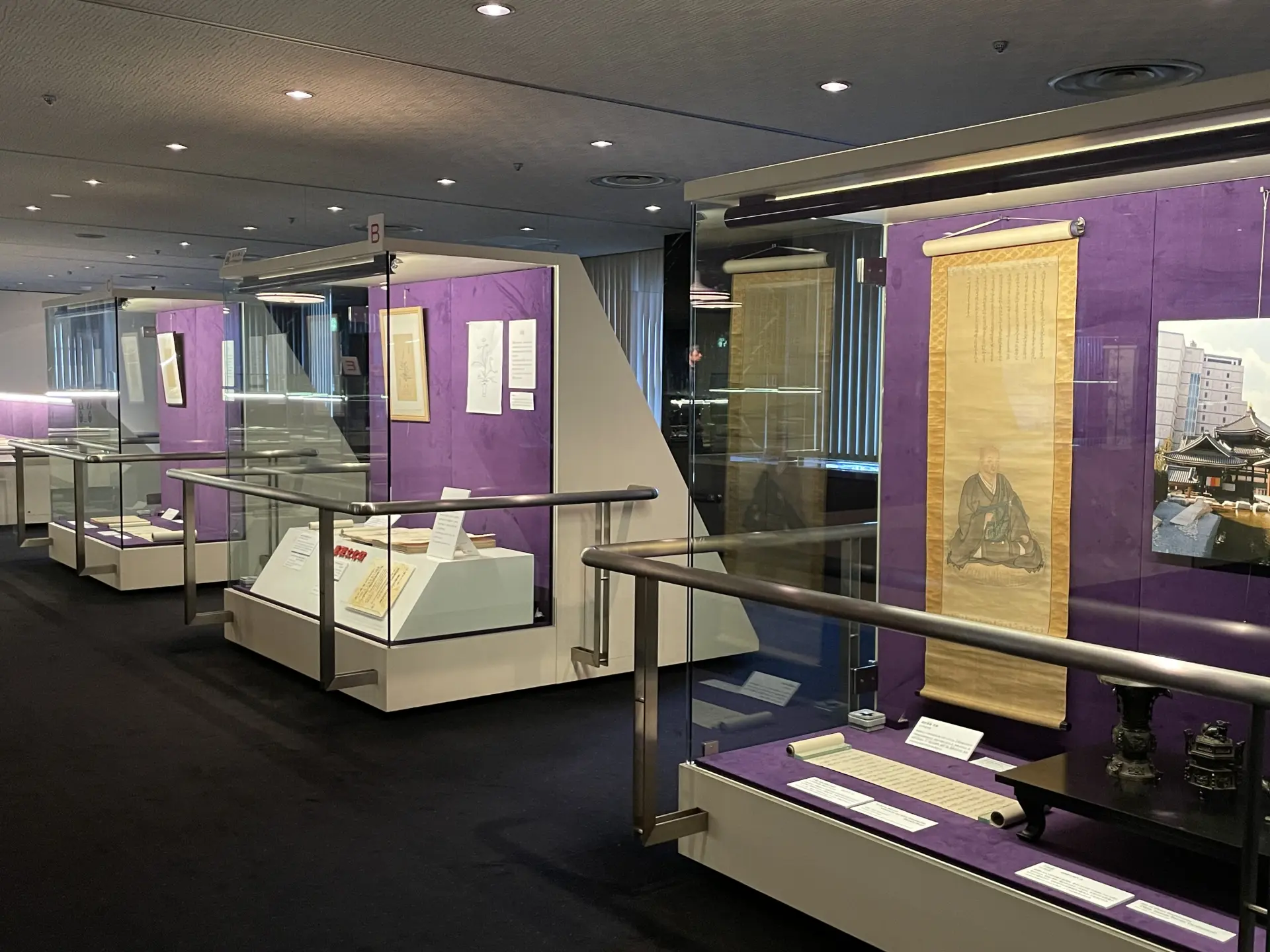
Located on the third floor, the Ikebana Museum exhibits valuable historical materials related to ikebana, including traditional manuals, vessels, and illustrations of arrangements. It also presents chronological displays and exhibitions based on specific themes. Advance reservations by email are required.
-
Ikebana Museum
-
Ikebana Museum
- Hours
- 9:00 a.m. - 4:00 p.m.
- Closed on
- Saturdays, Sundays, public holidays, the year-end and New Year holidays, the summer closure period, and periods between exhibitions
- Admission
-
Free
*An admission fee is charged during events. - Tour Reservations
-
Reserve by email, preferably at least one week in advance.
Email: kengaku@ikenobo.jp - Important Information
-
Include the group representative’s name, country, number of visitors, preferred date and time, and mobile phone number.
*English is recommended for inquiries in languages other than Japanese.
Ikenobo Shop
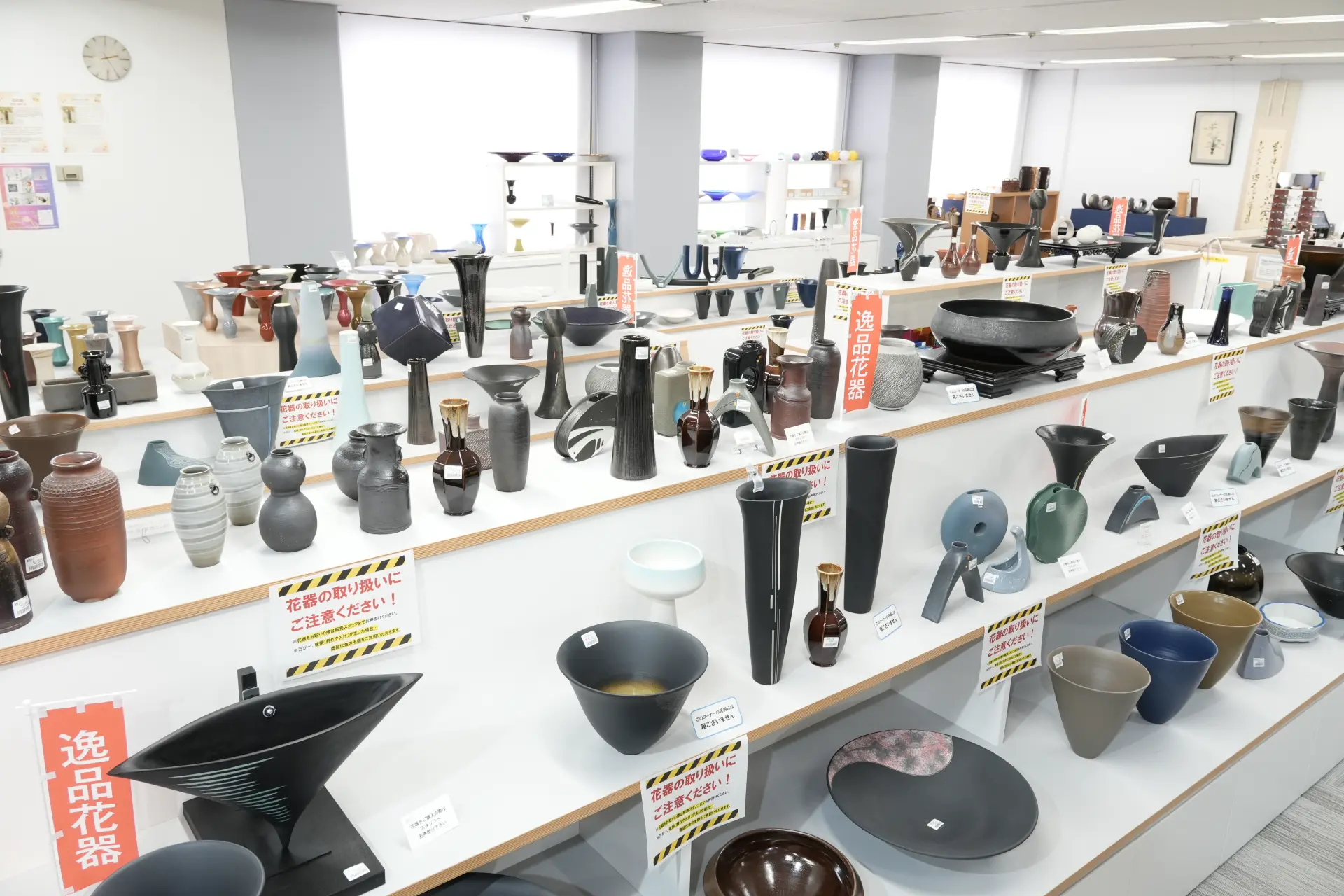
There is also a shop on the eighth floor where anyone can stop by to purchase ikebana vessels, miscellaneous goods, books, and more.
Products can also be ordered from overseas.
-
Shop
-
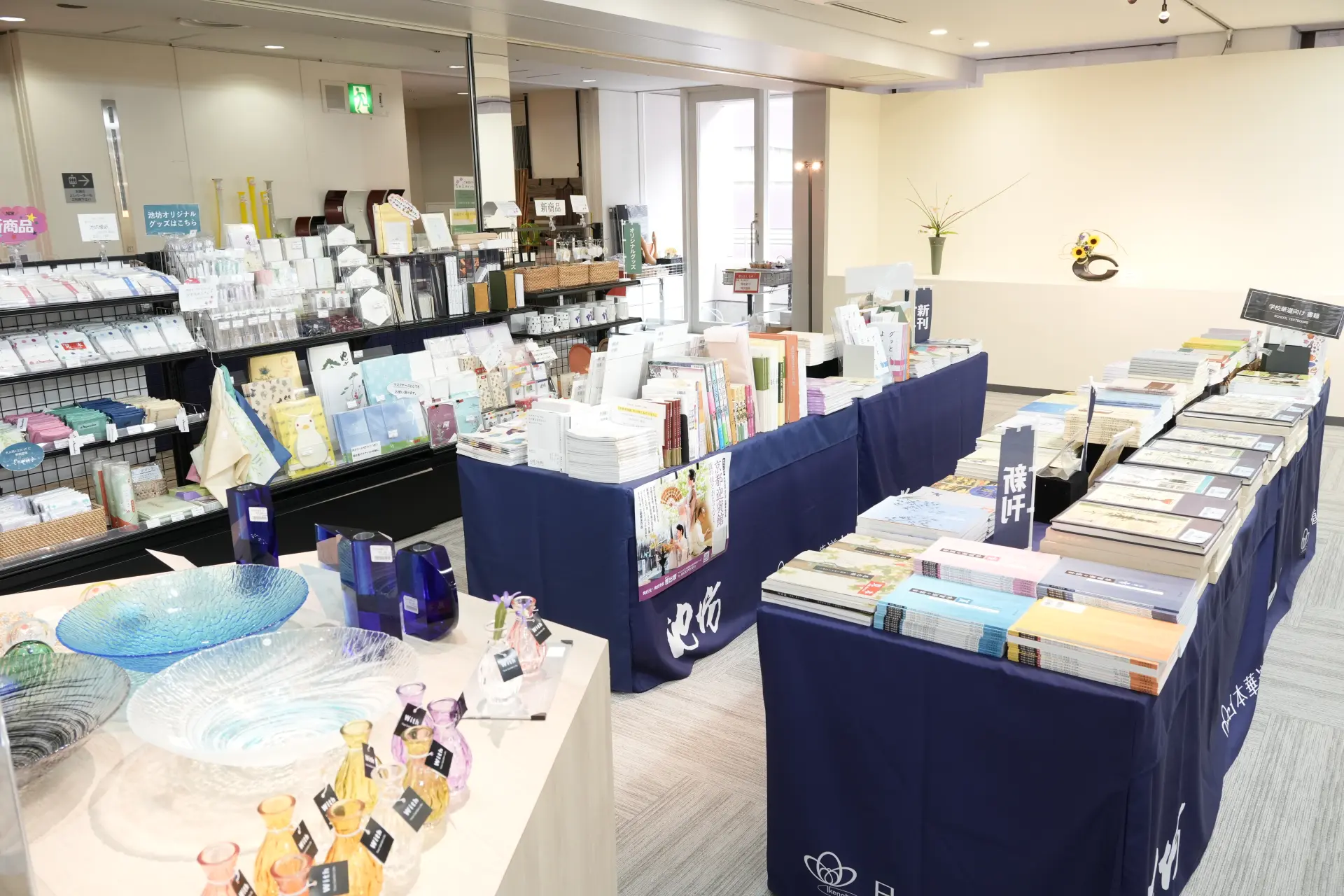
Shop
-
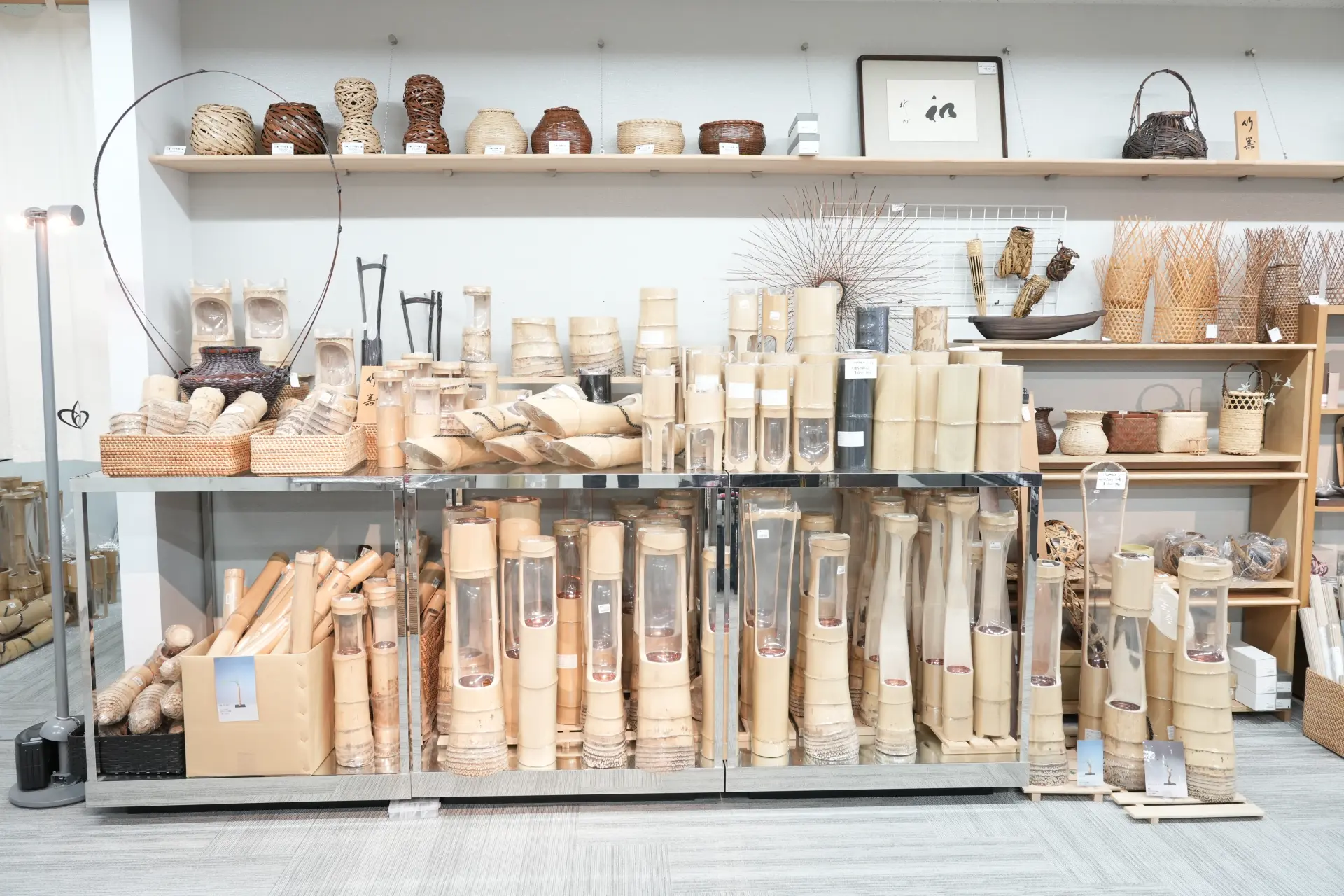
Shop
- Address
- 248 Donomaecho, Nakagyo Ward, Kyoto City, Kyoto 604-8134
- Access
-
1) 3-minute walk from Exit 5 of Karasuma Oike Station on the Karasuma and Tozai subway lines
2) 5-minute walk from Karasuma Station on the Hankyu Railway or Shijo Station on the subway
3) 1-minute walk from the Karasuma Sanjo city bus stop
The Three Ikenobo Styles
Ikenobo ikebana has three main styles:
Rikka, Shoka, and Jiyuka.
Rikka
Since ancient times, flowers have been offered to deities and Buddhas. This practice gave rise to tatehana, an arrangement composed of a central upright branch and lower foliage. Tatehana later came to be used in spaces where guests were entertained, including tea gatherings, and developed into Rikka in the late Muromachi period.
Rikka uses a diverse range of plants to portray the scenery of the natural world. Its teachings emphasize understanding the character of plants, presenting natural scenes of mountains, fields, and watersides, and valuing the individual expressions of flowers and leaves.
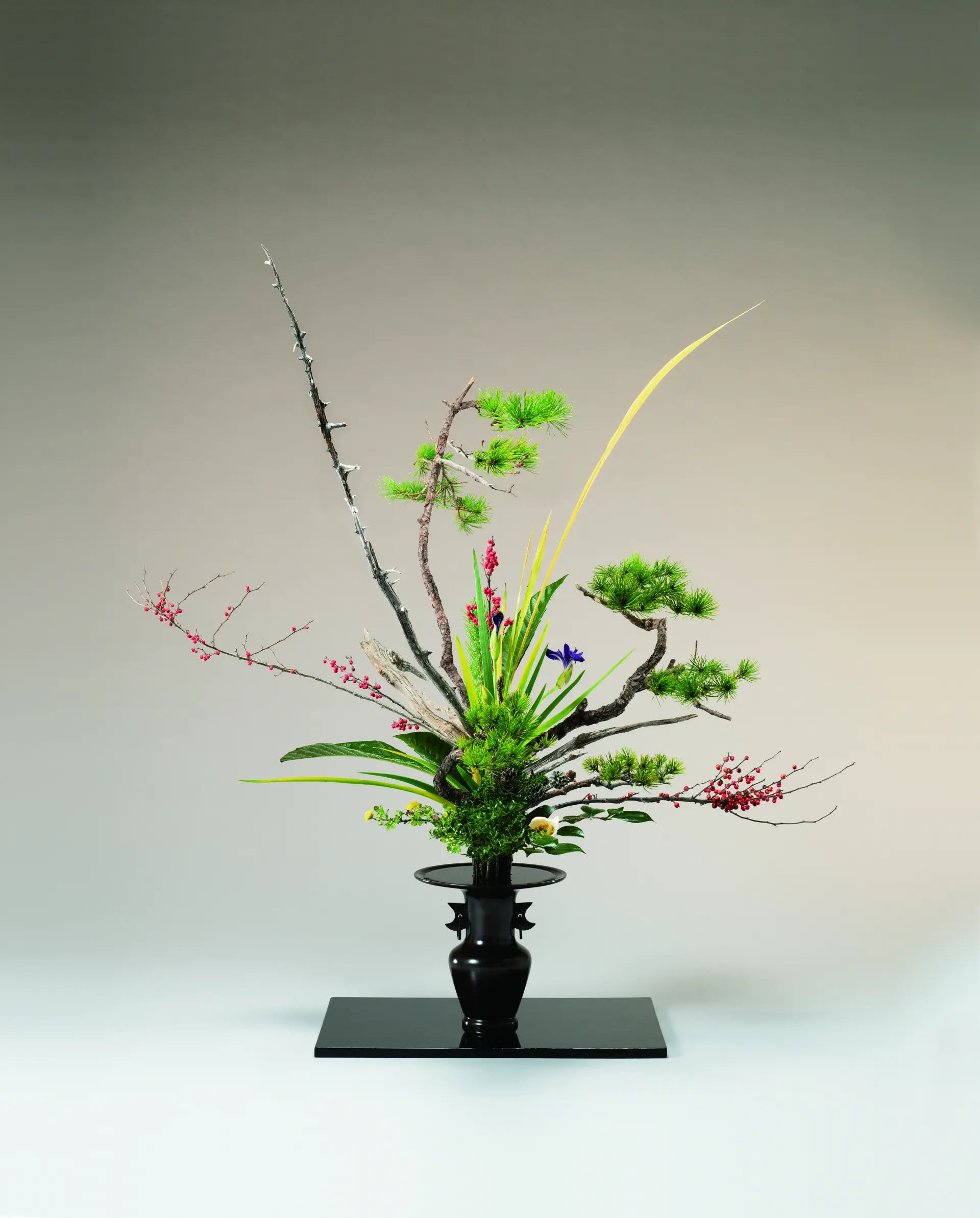
Traditional Rikka Shofutai has nine principal branches that form the arrangement’s framework, each with a prescribed function and insertion point.
| Name | Reading | Function |
|---|---|---|
| Shin | shin |
The central branch of the arrangement, standing straight upward. It determines the overall height. |
| Soe | soe |
Enhances Shin and extends diagonally upward from it. It flows either to the left or right. |
| Uke | uke | Extends opposite Soe as its counterpart, adding width to the composition. |
| Hikae | hikae | Fills the space beneath Soe, adding depth and visual weight. |
| Nagashi | nagashi |
Balances Uke and Hikae and sweeps broadly to the side. It expresses movement in nature. |
| Mikoshi | mikoshi | Represents a distant view and adds depth. |
| Shoshin | shoshin | Marks the central axis at the heart of the arrangement. |
| Do | do | Draws the entire composition together. |
| Maeoki | maeoki | Supports and stabilizes the entire arrangement from below. |
Rikka Shimputai, introduced in 1999 by the current headmaster, Ikenobo Sen’ei, is a form of Rikka suited to contemporary spaces. Rather than following a fixed pattern, it builds its composition around the natural movement of plants.
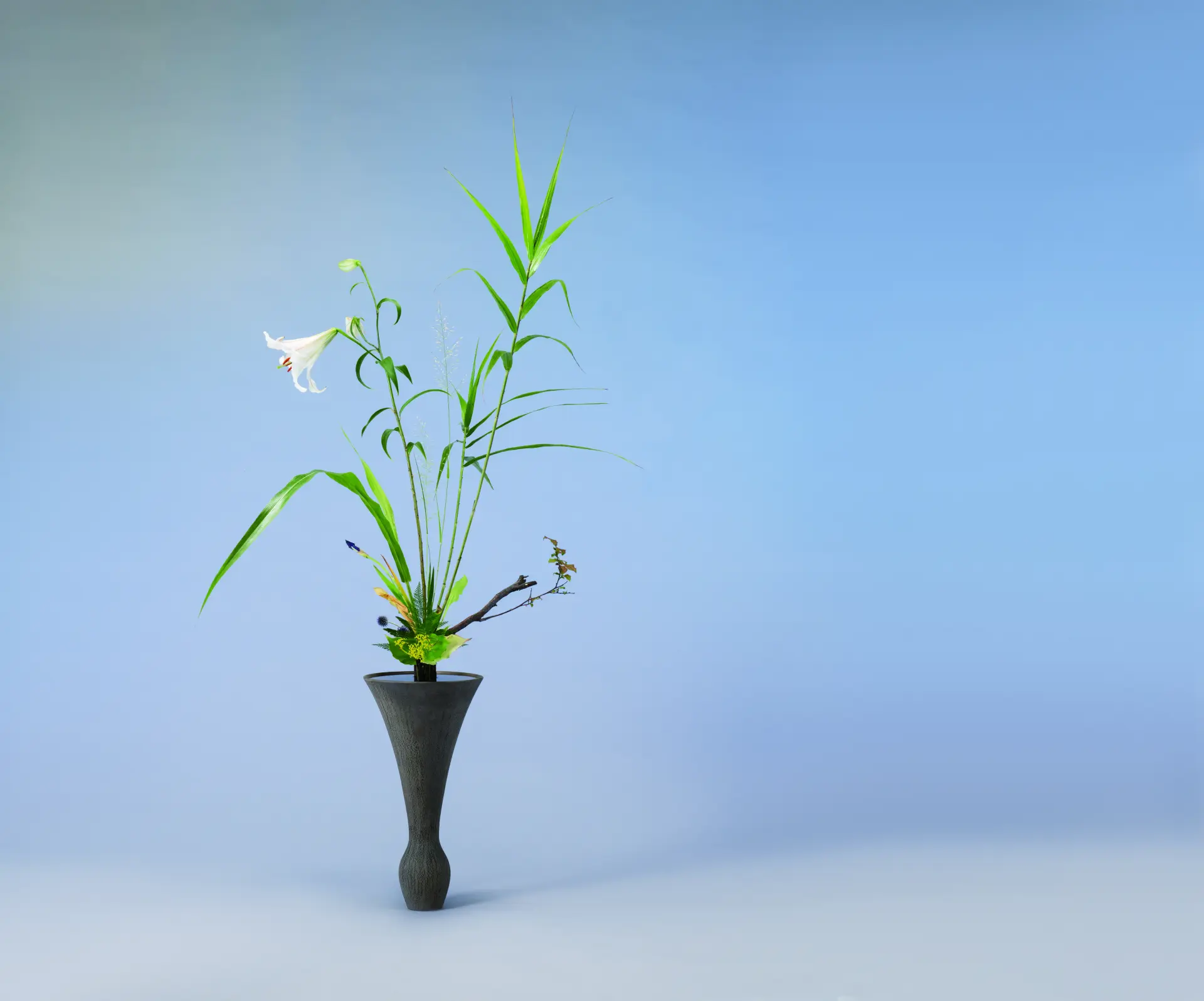
Unlike Rikka Shofutai, which pursues the beauty of form, this newer style of Rikka emphasizes expressive content. While preserving traditional aesthetic principles and structure, it highlights the expansive, fresh, and vibrant qualities of its floral materials. By combining a variety of materials in unexpected or contrasting ways, it expresses qualities such as brightness, sharpness, and distinction.
Shoka
While Rikka was used in formal public spaces such as large reception rooms, ikehana and nageire arrangements were simpler, informal flowers arranged in private spaces without fixed forms. As smaller reception rooms became widespread, dignified arrangements were needed for their compact alcoves. Shoka was therefore established in the mid-Edo period.
Shoka uses one to three types of floral material and expresses the way plants take root and live in the earth. While Rikka seeks beauty in the harmony of plants, Shoka focuses on the beauty of shussho, the inherent character through which a plant’s life reveals itself. Shussho refers to the distinctive characteristics of each plant. The beauty of shussho lies in finding beauty in the many ways plants strive to live. Based on this principle, Shoka seeks to express the life of plants with dignity in a single vessel.
| Name | Reading | Function |
|---|---|---|
| Shin | shin |
The principal branch of the arrangement. It extends diagonally from the waterline, curves, and returns to stand along the central axis. |
| Soe | soe | It begins alongside Shin, then separates below the point where Shin returns to the central axis and extends diagonally backward. |
| Tai | tai | It begins alongside Shin at the waterline, then extends diagonally forward in the direction opposite Soe. |
Shoka includes Shoka Shofutai, which follows a traditional form, and Shoka Shimputai, which has no established form.
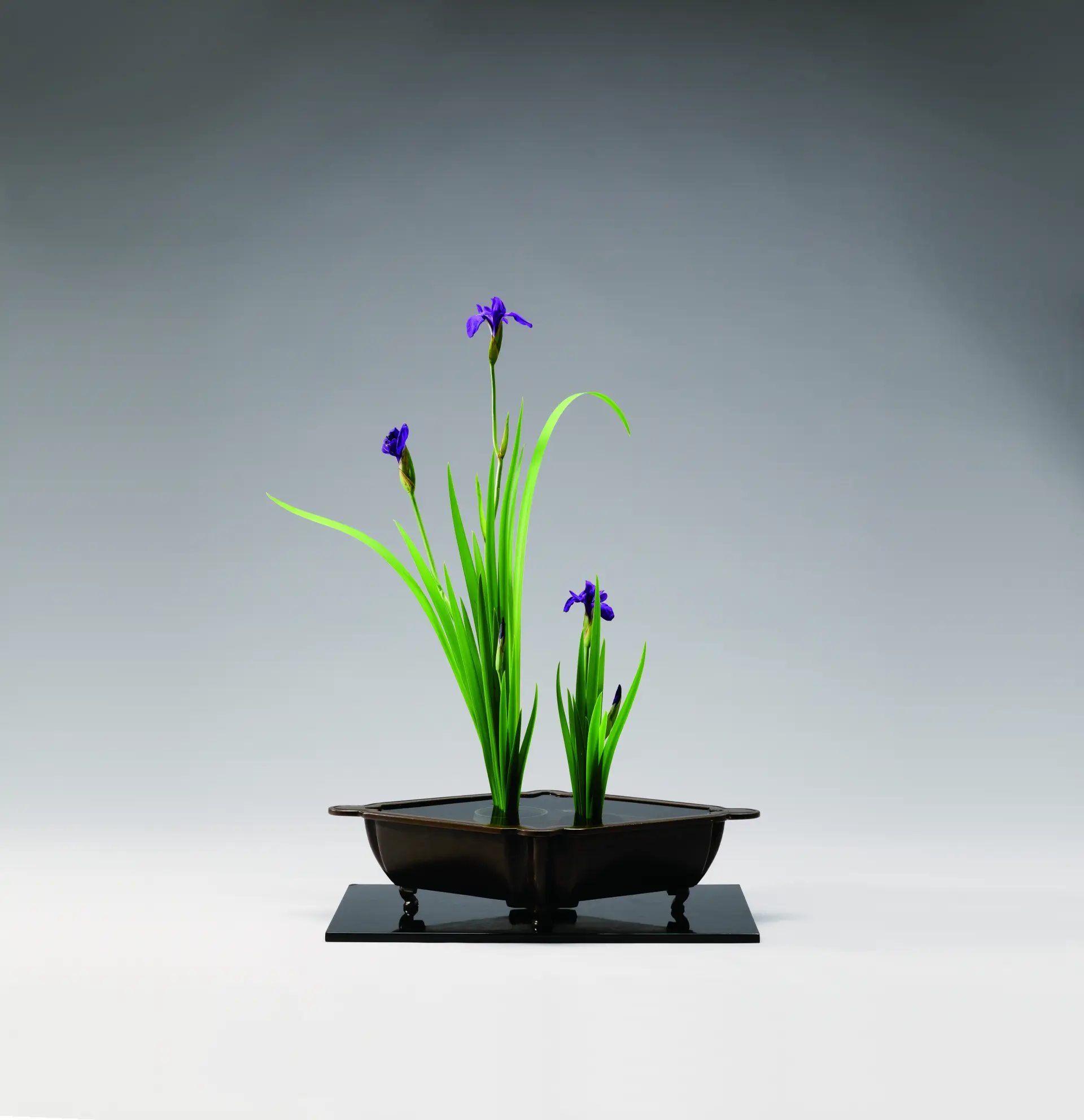
Shoka Shofutai was established during the Meiji period. It is characterized by small arrangements suited to the alcoves of compact reception rooms. Using only a few branches, it emphasizes the life within plants. Shoka Shofutai consists of three principal branches—Shin, Soe, and Tai—modeled on the three forces of heaven, earth, and humanity, traditionally regarded as the foundation of all things. The three branches respond to one another. Their clean, upright growth from the waterline reveals the beauty of shussho inherent in plants.
Shoka Shimputai, a new form of Shoka adapted to modern life, was introduced in 1977 by the current headmaster, Ikenobo Sen’ei.
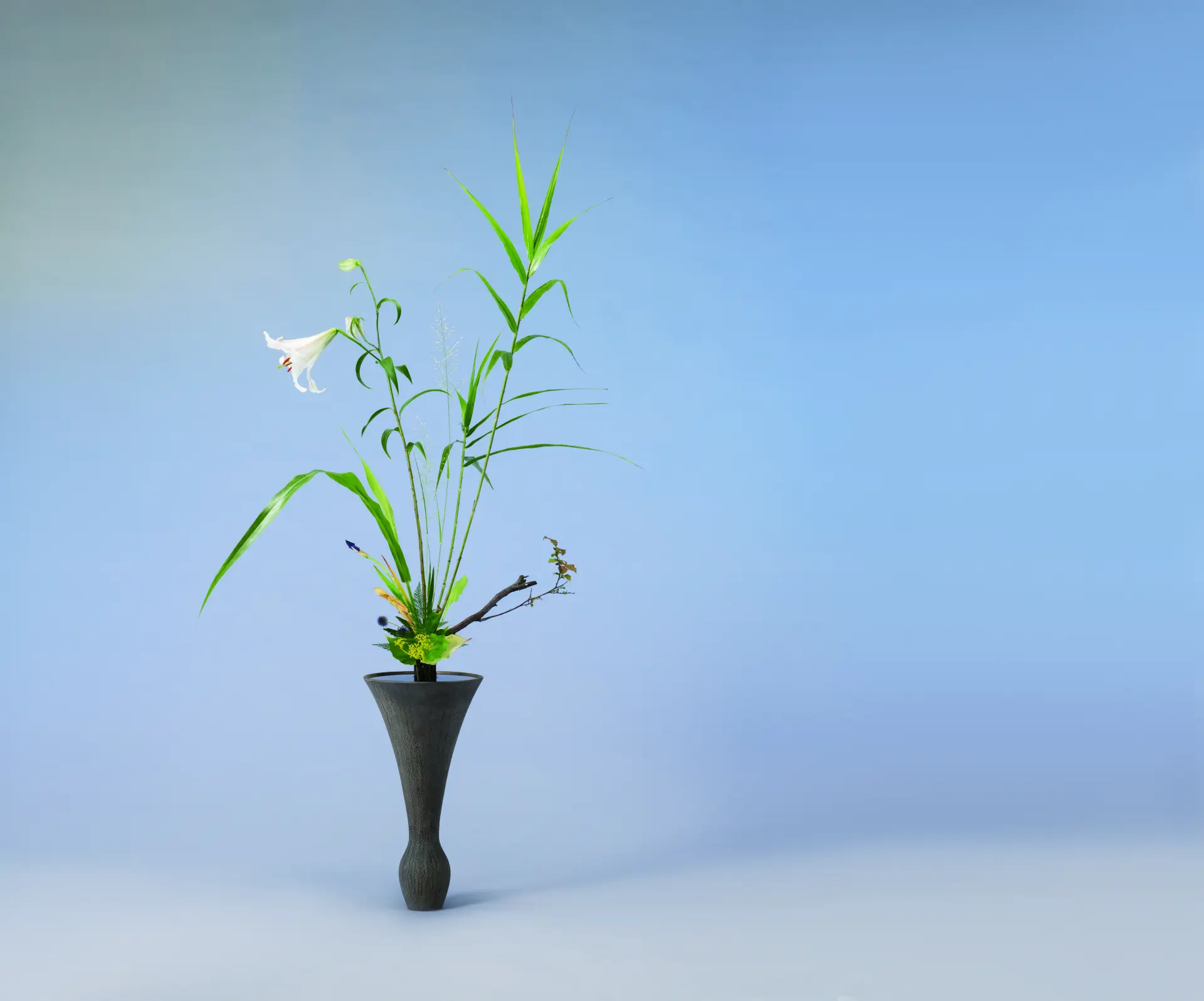
Against the background of Ikenobo’s traditional aesthetic, Shoka Shimputai examines plants from many angles—including color, form, texture, the expansive growth of leaves, and the lively movement of branches—to discover diverse kinds of beauty. It expresses forms of shussho beauty that do not fit within the conventional structure of Shoka Shofutai.
Jiyuka
Ikenobo has created various styles in response to changes in architecture. As Western-style architecture became widespread from the Taisho through the Showa period, nageire and moribana arrangements placed in entryways or on tables grew popular in place of Rikka and Shoka displayed in alcoves. These styles developed into Jiyuka, or free-style ikebana, which has no established form.
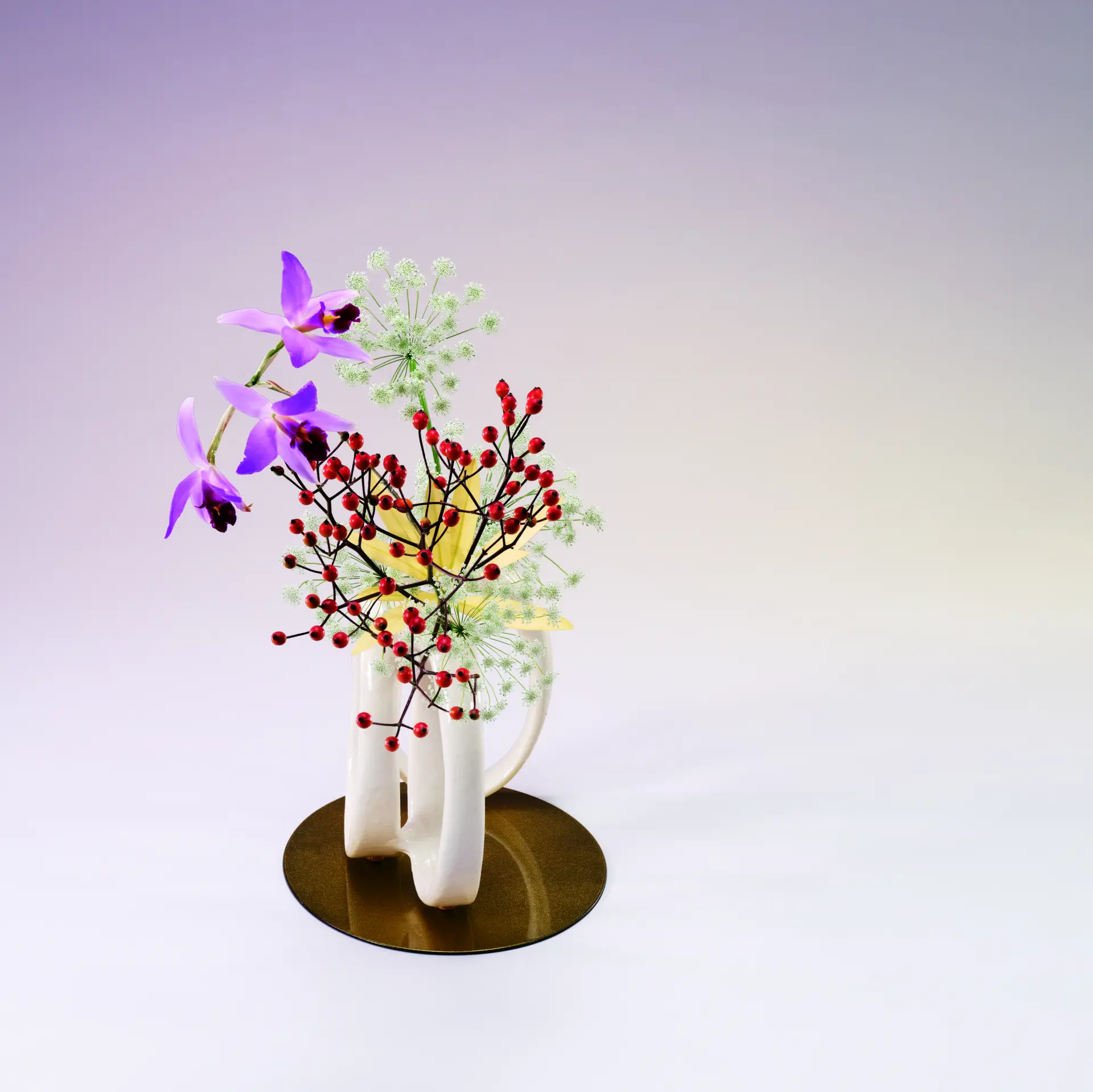
Jiyuka is therefore the newest form of ikebana, born in the modern era. In recent years, ikebana has expanded beyond residential spaces and is now used as a form of display in event venues, on stages, and in store windows. Jiyuka discovers the beauty of plants from many perspectives and, as its name suggests, arranges them freely without a fixed form.
The materials used in Jiyuka are also unrestricted. Living plants are the main material, but they may be combined with non-plant materials. These are broadly divided into two categories: contrasting materials and processed materials. Contrasting materials include iron, paper, glass, and plastic, which are used to highlight their inorganic textures. Processed materials are plant materials that have been dried, colored, or bleached. Using them can make living plants appear even fresher. In both cases, materials should be chosen to serve the intended expression; using contrasting or processed materials is not an end in itself.
Because Jiyuka allows free forms unconstrained by conventions, it can encompass a wide range of expression, from classical ikebana to contemporary artistic work unconstrained by traditional concepts. This makes it the most approachable of the three styles. By focusing on the forms and textures of plants and arranging them freely, Jiyuka offers broad expressive possibilities. It has expanded ikebana into new spaces and situations beyond the alcoves traditionally assumed by Rikka and Shoka. The ikebana workshop offered to visitors at Ikenobo also uses the Jiyuka style.
The History of Ikebana
The Origins of Ikebana: Asuka to Nanboku-cho Periods
The Japanese have long lived close to nature, sensing the passage of life in the changing seasons. They attributed special meaning to evergreen trees, which remain green throughout the year, and revered them as vessels for deities.
After Buddhism was introduced to Japan in 538, the custom of offering flowers before the Buddha became widespread. Lotus flowers, abundant in India where Buddhism originated, were often selected for these offerings, but in Japan, flowers appropriate to each season were used.
Japan’s distinct four seasons each bring their own flowers, and people have cultivated an appreciation for them since ancient times. This is reflected in the Manyoshu, Japan’s oldest surviving poetry anthology, and the Kokin Wakashu, its first imperially commissioned waka anthology, both of which contain many poems about flowers.
In 587, Prince Shotoku founded Rokkakudo, the birthplace of ikebana.
The Establishment of Ikebana: Early Muromachi Period
During the early Muromachi period, many Chinese paintings and vessels known as karamono were brought to Japan. The shoin-zukuri architectural style developed partly to display them, giving rise to a culture of decorative display.
Shoin-zukuri is a Japanese architectural style that developed for samurai residences. It is characterized by a study at the center of the building, tatami flooring, rooms divided by shoji screens and fusuma sliding doors, and features such as alcoves. The alcove displayed the three ceremonial objects known as mitsugusoku: flowers, a candle, and incense.
In 1462, Ikenobo Senkei, a monk from Rokkakudo, was invited by a samurai to arrange flowers. His work gained acclaim throughout Kyoto. Senkei’s arrangements went beyond the earlier frameworks of Buddhist floral offerings and plants serving as vessels for deities. This marked the establishment of ikebana as a distinctly Japanese culture.
The Establishment of Ikebana Theory: Late Muromachi Period
In the first half of the 16th century, Ikenobo Senno arranged flowers at the Imperial Court and monzeki temples and became known as a “master of flowers.” Drawing on the accumulated knowledge since Senkei’s time, he formulated ikebana theory and began passing down instructional texts to his disciples. His teaching held that one should not merely admire beautiful flowers, as in earlier floral arrangements, but understand the character of plants and express nature in a vessel, sometimes using withered branches. Ikenobo continues to value this spirit today, and the philosophy of kado established in this period has been passed down uninterrupted to the present.
Later, the instructional text of Ikenobo Sen’ei, Senno’s successor, included a structural diagram for a style composed of seven principal branches that would later be called Rikka. This can be considered the establishment of Rikka’s basic form.
Sen’ei was also interested not only in flowers that were “stood upright,” but in flowers that were “brought to life” through arranging, and he taught that the natural character of a plant’s growth was essential. The tea ceremony flourished alongside ikebana at the time, and he is thought to have been deeply conscious of flowers arranged for tea gatherings. In other words, flowers were arranged to welcome guests.
The Development of Rikka: Azuchi-Momoyama to Early Edo Periods
During the Azuchi-Momoyama period, when Toyotomi Hideyoshi unified Japan, alcoves were installed in castles and samurai residences, and Ikenobo was commissioned to arrange flowers for them. In 1594, Ikenobo Senko created a large sunamono arrangement in a four-bay alcove at Maeda Toshiie’s residence to welcome Hideyoshi. The arrangement was highly praised and led to more commissions from samurai families.
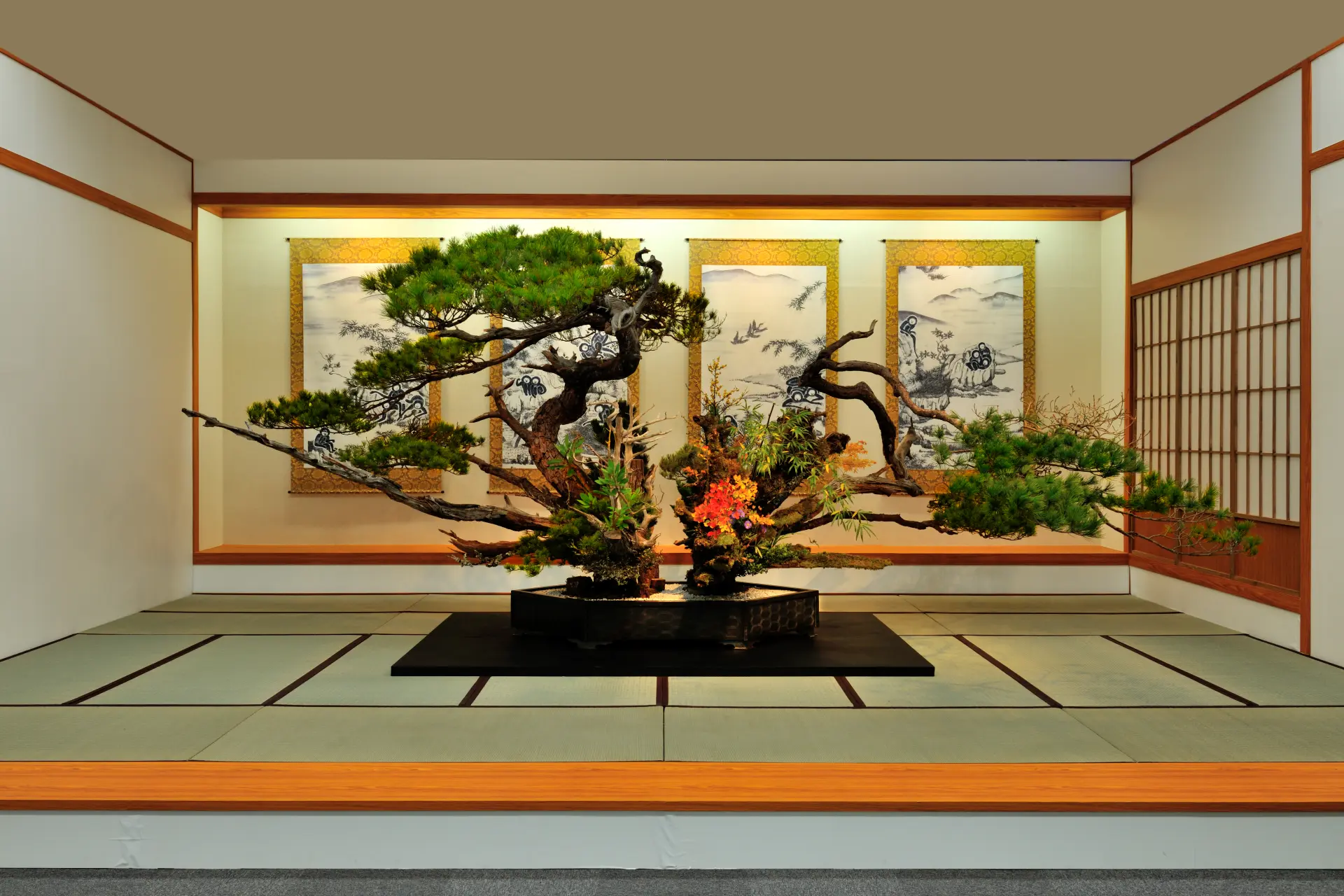
Commissions from samurai families continued into the Edo period. Ikenobo Senko II, who inherited the name of the first Senko, traveled to Edo and created Rikka arrangements at samurai residences. He also served as a leading instructor in Kyoto, where Rikka gatherings attended by court nobles and monzeki priests were held at the Imperial Court.
Rikka, perfected by Senko, spread beyond monks, court nobles, and samurai to the merchant class. As a result, the number of students also increased.
The Spread of Rikka and Establishment of Shoka: Mid-Edo Period
Rikka, perfected by Ikenobo Senko II, also influenced Genroku culture, which flourished mainly in the Kyoto-Osaka region. Many Rikka terms appear in the joruri puppet plays of Chikamatsu Monzaemon. Since joruri was popular entertainment among townspeople at the time, this indicates that Rikka was fashionable among them.
As Rikka spread, lighter arrangements “brought to life” in small tea rooms and rustic sukiya-style spaces also attracted interest. These were called nageire. By the mid-18th century, nageire had been refined into a dignified form and became established as Shoka.
The Popularity of Shoka: Late Edo Period
By this time, the status of Shoka was rising. Its simpler form compared with Rikka made it extremely popular, and the number of students grew rapidly. Women also began entering the previously male-dominated art of ikebana.
Ikebana Education at Girls’ Schools: Meiji to Early Showa Periods
Ikenobo Senjo, the headmaster at the time, became an ikebana instructor at the Kyoto Prefectural Girls’ School in 1879 and devoted himself to teaching ikebana to women. As a result, the proportion of female ikebana practitioners rose rapidly.
The Birth of Jiyuka: Postwar Period to Heisei Era
After World War II, ikebana based on individual aesthetic sensibility and free from formal restrictions attracted attention. By the late 1960s and 1970s, it had become established at Ikenobo as Jiyuka. It expanded the possibilities of ikebana amid changing and increasingly Westernized living spaces, the spread of Western flowers, and a growing emphasis on individuality.
Ikebana Today
After World War II, ikebana spread overseas, and people of all ages and genders began studying it, passing the culture on to future generations.
Ikebana began as something displayed in the home, but today it is exhibited in spaces ranging from large facilities to stages. Its possibilities continue to expand through active collaboration with fields such as painting, film, music, and theater, as well as live flower-arranging performances.
Observing Floral Materials
A defining feature of Ikenobo ikebana is its ability to bring out the best qualities of plants. Rather than viewing plants simply in terms of color and form, practitioners must discover their virtues within the qualities that make each plant itself, and then understand its color and form as a result. This essential character is the plant’s shussho, the quality valued above all in Ikenobo ikebana. Is ikebana an inanimate construction? No—it is made of living flowers. Practitioners must carefully consider the meaning of using living plants and focus on their living qualities. Otherwise, the result is not ikebana.
What, then, does it mean to bring out the life of a plant? To do so, practitioners must understand its most vital qualities, which requires observation. This is the first step in creating ikebana. The following six points help reveal the qualities of floral materials.
- Learn where the plant grows
- Learn the season in which it grows
- Understand its texture
- Observe how its flowers and leaves are attached and grow
- Observe its expression
- Consider the impression the plant creates
In other words, what you feel when facing a plant is extremely important. The emotional response inspired by plants is the starting point of ikebana. More specifically, what you express will depend on where that response comes from: a natural landscape, the floral material’s color or form, or its movement. Engaging with and observing plants is fundamental to practicing ikebana.
Classifying Floral Materials
Woody Plants, Herbaceous Plants, and Intermediate Plants
Plants used in ikebana are classified not botanically, but into three categories that help represent natural vegetation: woody plants, herbaceous plants, and intermediate plants. Trees have character when seen from a distance, while grasses and other herbaceous plants appear beautiful up close. Therefore, when arranging both in one vessel, woody plants are placed toward the back and herbaceous plants toward the front. Their insertion points are kept separate, with woody plants grouped together and herbaceous plants grouped together.
Intermediate plants have qualities that make them difficult to classify as either woody or herbaceous. Plants that appear woody but do not form annual rings, or look herbaceous but do not wither in winter, fall into this category. Common examples include bamboo, wisteria, peonies, Japanese kerria, Japanese winterberry, and hydrangeas.
Land Plants, Aquatic Plants, and Amphibious Plants
In addition to woody, herbaceous, and intermediate plants, materials may also be classified as land or aquatic plants. Land plants grow on dry ground, while aquatic plants grow beside or in water. Typical aquatic plants include rabbit-ear iris, softstem bulrush, and yellow pond lily. Plants that grow both on land and near water are classified as amphibious plants, including Japanese iris and reeds.
Fruit-Bearing Plants, Foliage Plants, and Vines
These classifications appear in Shoka’s “Five Principles,” which set out guidelines for arranging fruit, leaves, and vines beautifully.
Common fruit-bearing plants include Japanese winterberry, Japanese bittersweet, and heavenly bamboo. Arrangements use them to express the beauty of their fruit. Because fruit eventually falls, it is not used at celebratory occasions.
Foliage plants are those with especially attractive leaves. Examples include rabbit-ear iris, hosta, cast-iron plant, Japanese iris, and Japanese banana. They are further divided into broad-leaved and long-leaved plants.
Vines are arranged to emphasize the striking way they grow by winding around other objects. Typical examples include morning glory, Japanese bittersweet, and wisteria.
Other classifications include trailing plants and swaying plants. Each classification exists to identify and make the most of the plant’s distinctive characteristics.
Tools Used in Ikebana
Several tools are needed to practice ikebana.
Floral Scissors
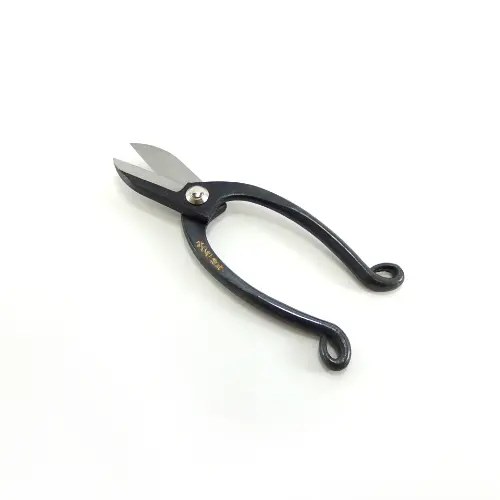
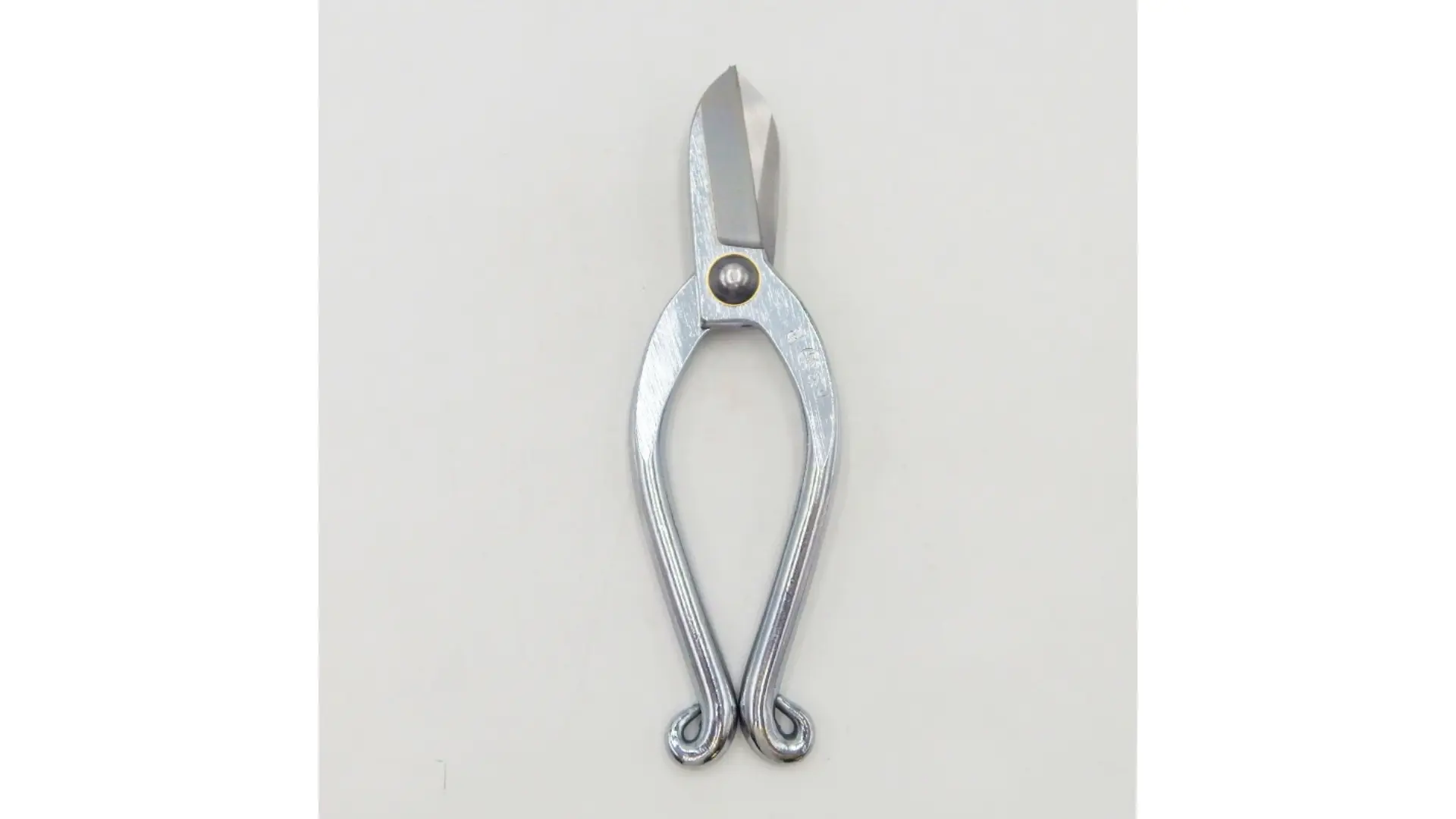
Floral scissors are used to cut flowers and are one of the essential tools of ikebana. Since they will be used for a long time, hold them to see whether they feel comfortable and choose a pair that is easy to use. Steel scissors are standard, but rust-resistant stainless steel models are also available today.
-
Floral scissors
-
Floral scissors
Vessels
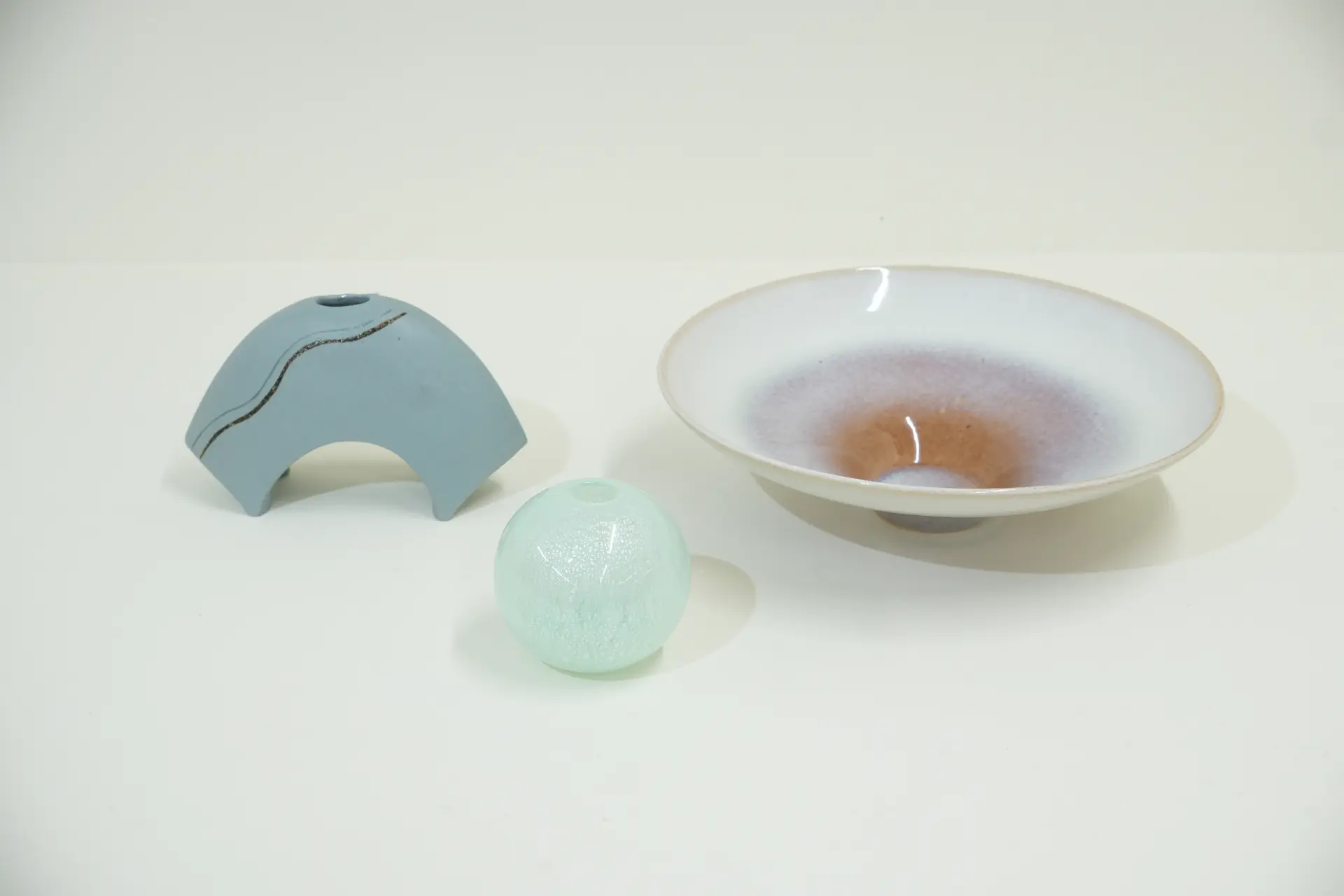
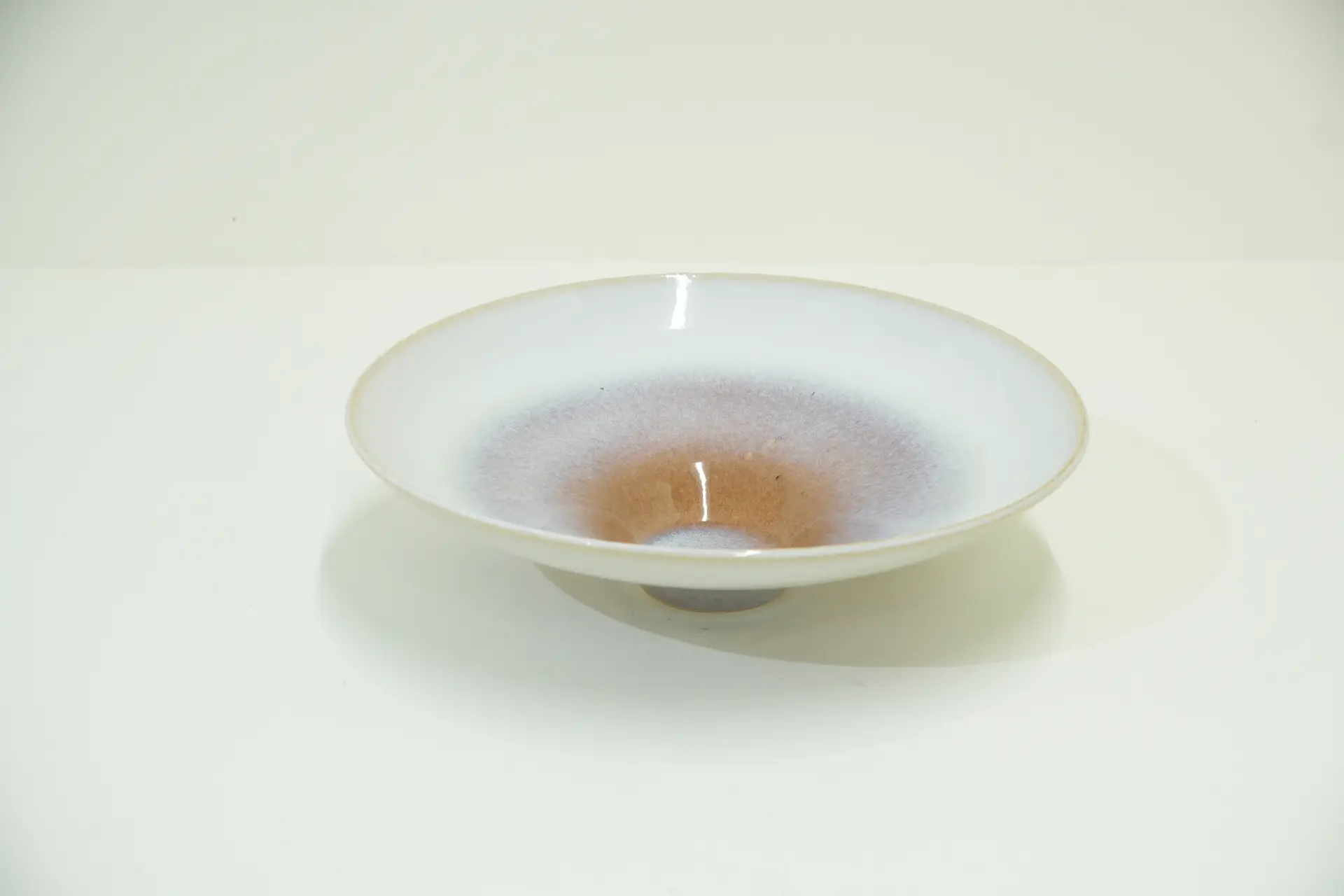
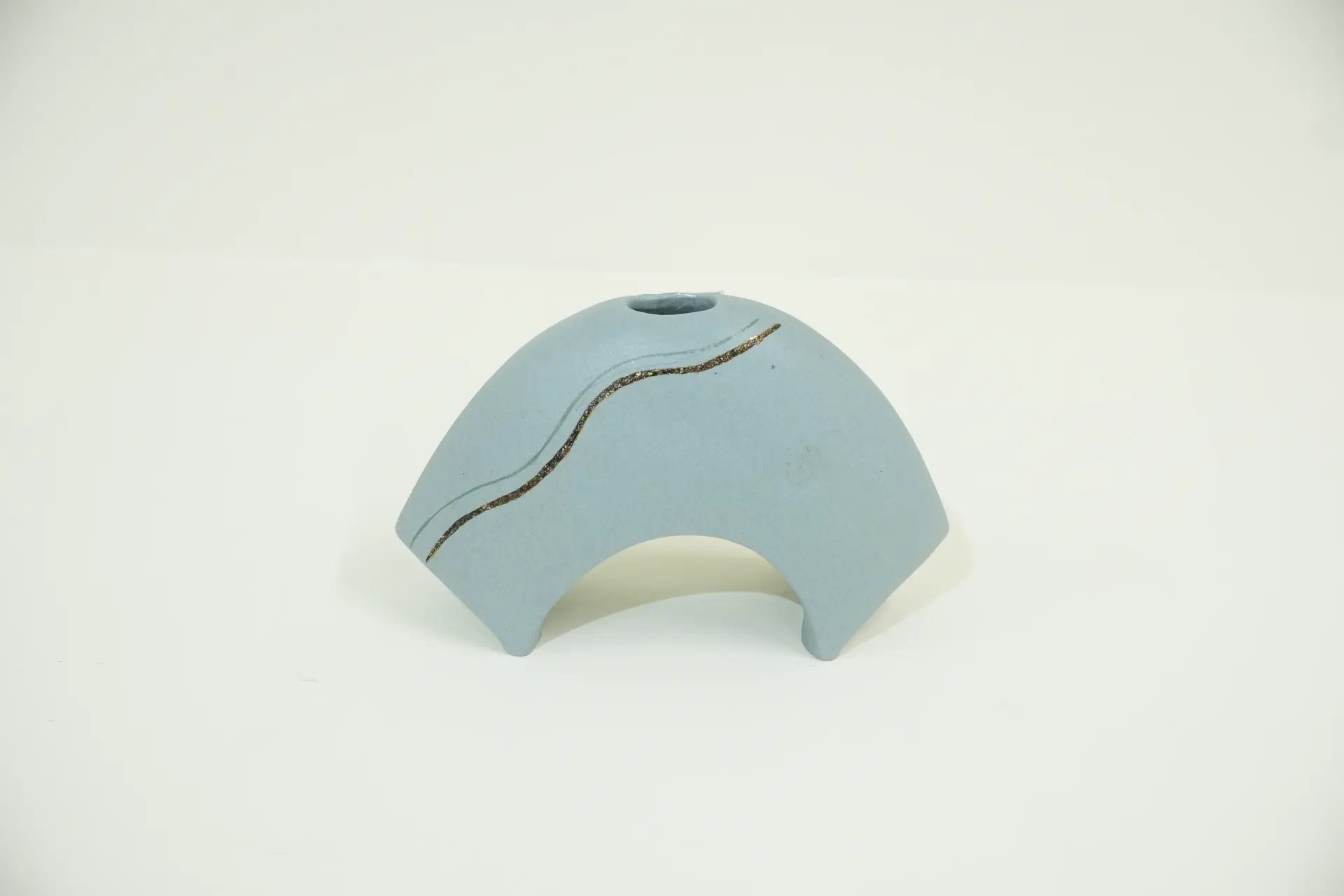
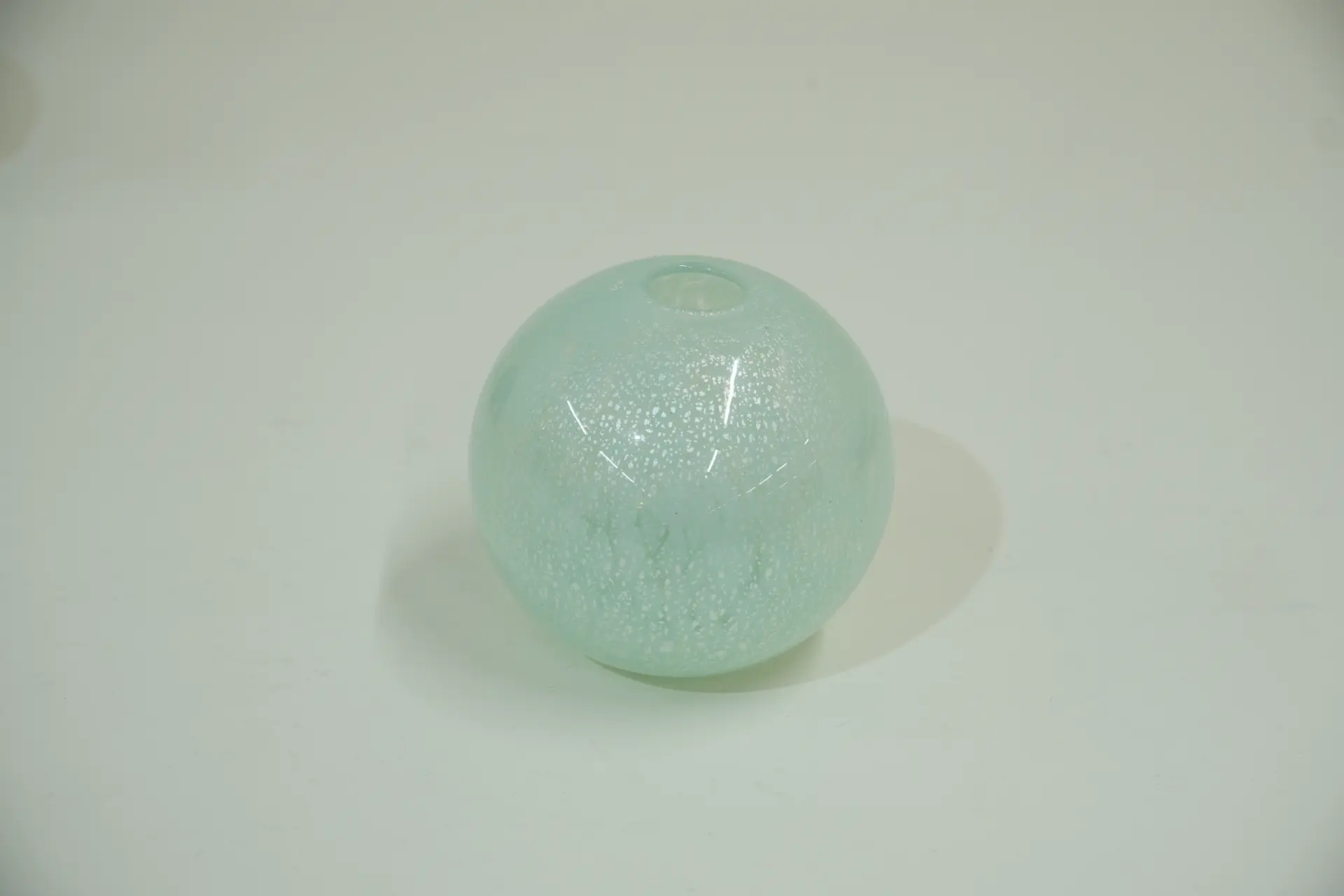
A vessel for arranging flowers is another essential tool. Many types are available, but beginners should choose a simple, standard round suiban, or shallow basin. More decorative forms require skill to make effective use of their design. Solid colors such as white, black, and green are recommended because they pair easily with many flowers. A vessel that is too small will hold only a few flowers, so choose one of a reasonable size.
In Jiyuka, everyday objects suited to the display location or highly designed tableware may also serve as vessels. Even a pasta plate or a cut-open milk carton may be used.
-
Vessel
-
Vessel
-
Vessel
-
Vessel
Flower Holders
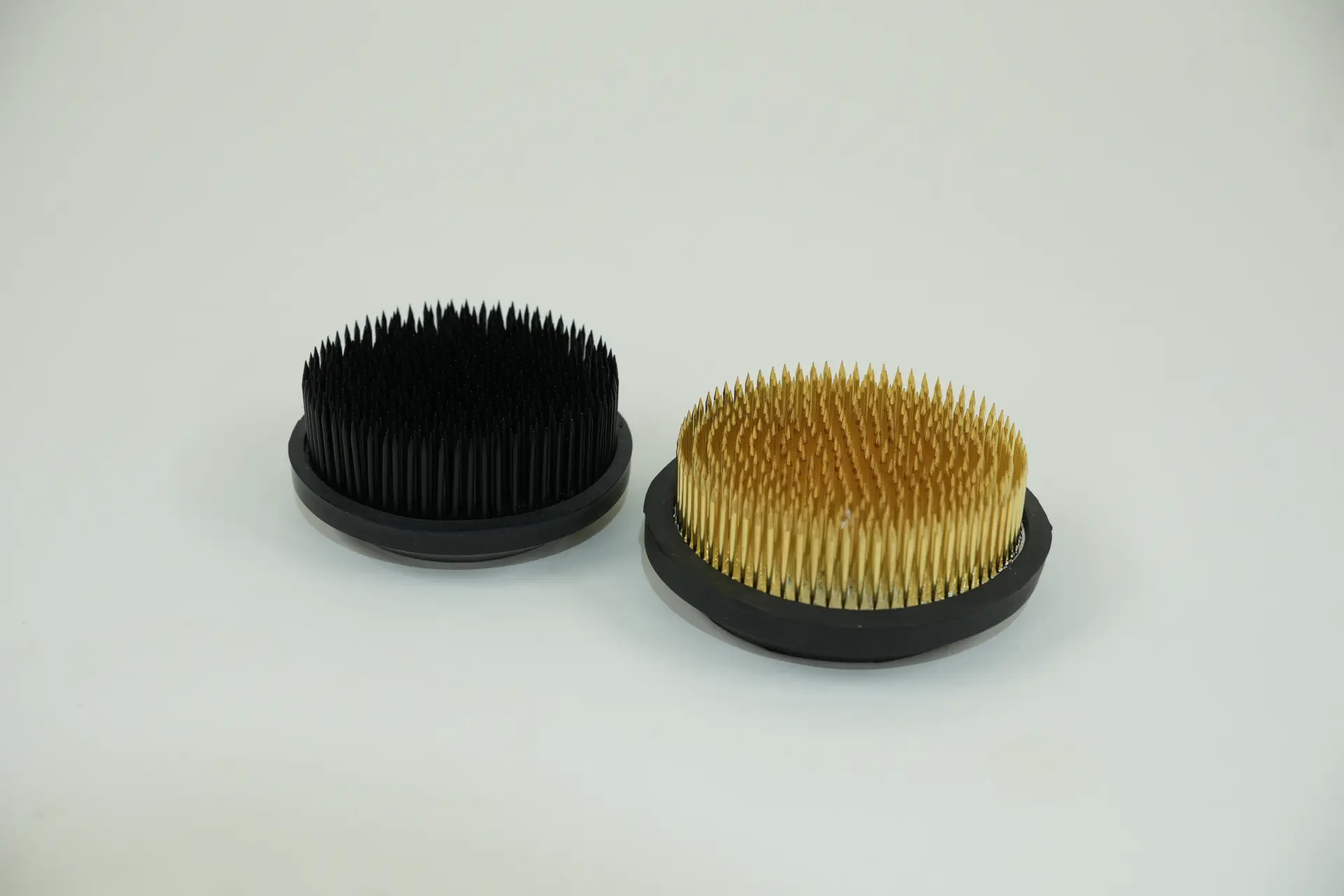
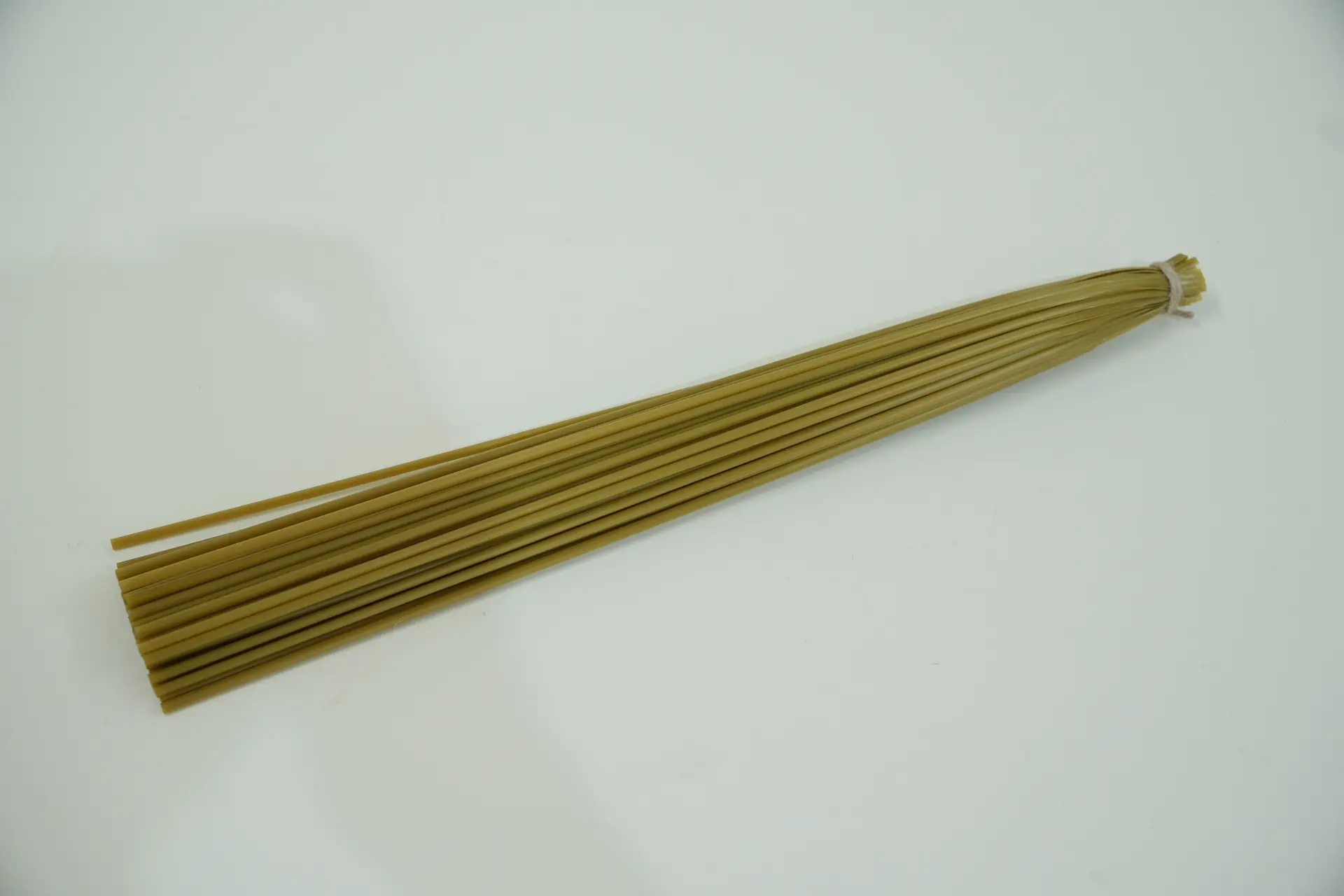
Flower holders secure flowers in place. The most common is a kenzan, recognizable by its bed of closely packed needles. Kenzan come in many sizes and should be selected to match the size of the vessel. Straw may also be packed into the bottom of a vessel to serve as a flower holder.
-
Flower holder
-
Flower holder
Summary
Ikebana differs from Western floral arrangement. Western floral arrangement is often described as an “aesthetic of addition,” using many flowers to fill as much space as possible. Ikebana, by contrast, is considered an “aesthetic of subtraction.” Rather than packing in many flowers, it uses as few seasonal plants as possible to create a richly expressive space.
The Japanese have long lived alongside seasonal flowers and plants, finding beauty in every stage and admiring them all. Spring brings new shoots, summer lush green foliage, autumn fruit, and winter bare, withered branches. Japan’s distinct four seasons and island environment have brought people into contact with a wide range of plants. By using the aesthetic of subtraction to create a rich space for welcoming guests, ikebana developed and has been passed down to the present as a distinctly Japanese tradition. When visiting Japan, take the opportunity to experience this culture born from the life of plants.
*Photos courtesy of Ikenobo
*References:
・Official Ikenobo Website
・Basic Ikenobo Ikebana Course: Essential Knowledge (Nihon Kadosha)
・Ikenobo Sen’ei, Seventy Years Walking with Flowers by the Pond (Nihon Kadosha)

Author
Freelance Announcer
Sayaka Motomura
Focused on sharing insights related to traditional culture, performing arts, and history.