
Discover the Rich, Radiant World of Kinkinshi Gold and Silver Thread
From kimono obi and ornate ceremonial robes to Buddhist and Shinto ritual objects, and even stage costumes, one brilliantly shining material stands out: “kinkinshi,” or gold and silver thread.
These light-catching threads have long supported the beauty of traditional crafts, appearing in Japanese clothing, ceremonial garments, and religious implements. Made by processing gold- or silver-coated film into ultra-fine thread-like strands, this material has played an important role in Japanese culture for centuries. It brought brilliance into everyday life.
Gold and silver thread is valued not only for its beauty, but also for what it symbolizes, including celebration and auspiciousness. Used as a refined material suited to festive occasions and sacred settings, it can also be seen as a symbol of the essential beauty of traditional craftsmanship.
In this article, we’ll introduce the history of kinkinshi, how it is made, and how its uses have evolved over time. Step into the dazzling and surprisingly deep world contained in a single fine thread.
Joyo and Gold and Silver Thread
In recent years, gold and silver thread has expanded far beyond traditional Japanese clothing and is now used in stage costumes, fashion, art, and interior design as well. It is a material that continues to shine across eras and applications.
Among the many production areas, Joyo City in southern Kyoto Prefecture produces more gold and silver thread than anywhere else in Japan. Located near the former Tokaido and Nara Kaido routes, where culture and commerce once intersected, and close to Kyoto City, this area became a center of the gold and silver thread industry from the late Edo period through the Showa era. The traditional production method was far from simple. Metal had to be stretched into thin foil, cut into fine strips, and then twisted into thread, making it one of Japan’s most delicate and labor-intensive forms of craftsmanship. Today, production methods have evolved, and factories and artisans still carry on the craft with a high level of technical skill, using a wide range of materials to create these threads.
In Joyo, the work is generally divided among specialists, and each stage showcases the expertise and experience of skilled craftspeople. Slight differences in luster or the feel of the twist are things that only human sensibility can handle.
More Than Half of Japan’s Production Comes from Joyo
Gold and silver thread is used in a wide range of fields, from traditional items like dazzling kinran brocade obi, Kabuki and Noh costumes, robes for high-ranking monks, and ceremonial aprons worn by yokozuna sumo wrestlers, to interior décor such as curtains, and more recently blouses, knitwear, and dresses. It appears in both Japanese and Western-style clothing. In fact, Approx. 80% of all gold and silver thread produced in Japan is made in the Minamiyamashiro region in southern Kyoto Prefecture. Of that, Approx. 50% to 60% of the national total comes from Joyo City alone.
Gold and silver thread made in Joyo is shipped not only to Kyoto’s Nishijin and Tango areas, both famous for kimono textiles, but also to textile production centers such as Tokamachi in Niigata Prefecture and Kiryu in Gunma Prefecture. Even more surprisingly, it is shipped not only within Japan. Joyo’s gold and silver thread is also used in saris, traditional dress in South Asia, including India, Nepal, and Pakistan. It is exported to Southeast Asia, the Middle East, and Europe, and is also used in stage costumes for theme parks and idol concerts. Because these garments need to look luxurious and eye-catching even from a distance, glittering gold and silver thread is an ideal material.
This is a bit outside the subject of gold and silver thread, but the “silver tape” shot into the air at artists’ live concerts is also made in Joyo. (Apparently, it is made from film used in the gold and silver thread process, but slit into wider widths.)
Why It Flourished in Joyo
Historically, this area prospered as a key point connecting Kyoto and Nara, and during the Asuka and Heian periods it also served as a route for Buddhist culture. It is also close to Nishijin, Kyoto’s major kimono textile district and the largest consumer of gold and silver thread, making it easy to transport raw materials and finished products, while also offering convenient access to Nara and Osaka. This gave the area an advantage in distribution.
Gold and silver thread production in Minamiyamashiro began in the late Edo period as handwork done by the wives of lower-ranking samurai serving under the Yodo Domain, ruled by the Inaba family, hereditary daimyo who supported the Tokugawa shogunate. After the Meiji period began, it developed further as side work for farming households.
Joyo had abundant groundwater and sits in a basin, giving it a warm, humid climate throughout the year, especially hot and humid in summer, with moisture tending to accumulate.
Why is humidity needed to make gold and silver thread? The answer lies in the materials and process used to produce traditional honkinshi, or genuine gold thread. The first step in the traditional method required applying gold leaf to Japanese paper. At that time, lacquer was used as the adhesive. Without a stable level of humidity, the lacquer would not dry properly, and gold thread could not be made. That is why this process came to be carried out in Joyo, where groundwater was plentiful and humidity was high.
Terada, in central Joyo, was said to be especially suited to twisted thread because of its high humidity. With the introduction of twisting machines in the Taisho era, production increased. The area also had the large tracts of land needed to install the machinery required for manufacturing. Thanks to its climate and geography, Joyo was well suited to gold and silver thread production, and after twisting machines were introduced, the industry became active beyond the Terada district as well.
Gold and Silver Thread Today
However, as war intensified during the Showa era, the gold and silver thread industry, a peaceful industry, was forced to suspend production in 1940. After the war, Japan’s textile industry grew rapidly across the country as the nation rebuilt. Demand rose for Kyoto’s traditional Nishijin weaving, Tango chirimen crepe, and other textiles, and the need for gold and silver thread as a decorative material surged. The industry recovered, and in 1951 the Kyoto Gold and Silver Thread Twisting Cooperative was established. Through 1955, the industry enjoyed a boom, and Joyo strengthened its presence as a “town of gold and silver thread.”
Later, as times changed, demand for kimono declined, and with it demand for gold and silver thread. Membership in the cooperative fell to about one-fourth of its peak. At its height, it had as many as 120 member businesses, but today that number is around 30.
Even in these circumstances, various efforts are being made to preserve the gold and silver thread tradition rooted in Joyo for future generations.
How Gold and Silver Thread Is Made
Originally, gold and silver thread was made by hand, with gold leaf applied to Japanese paper, which was then finely cut into thread. By the 1960s, rising demand created a need for mass production. There was no way artisans working by hand alone could keep up. Polyester film was then developed, and vapor deposition technology made it possible to produce gold and silver thread, leading to rapid mechanization. Mass production of gold and silver thread became a reality. In Joyo, many craftspeople are involved before a single thread is completed. The work is divided by process, and each stage has its own expert. First, let’s look at how it is made.
1. Plastic film is procured.
The materials include polyester, nylon, and polyethylene.
2. A processing machine called a vacuum deposition machine is used to apply a thin metal film to the plastic film. The metal film may be aluminum, pure gold, tin, gold, or platinum.
3. To add color and protect the metal layer, the film is coated with resin using a gravure printing press, which serves as a coating machine. The resin used here is a combination of synthetic resin, organic solvent, dye or pigment, and additives.
4. A laminating process is carried out to bond film to film. A gravure printing press is also used here as the laminating machine.
5. At this stage, the glitter film that serves as the raw material for gold and silver thread is finally completed.
*To achieve the desired color, luster, and structure, the order and combination of steps 2 through 4 vary, and some unnecessary steps may be skipped.
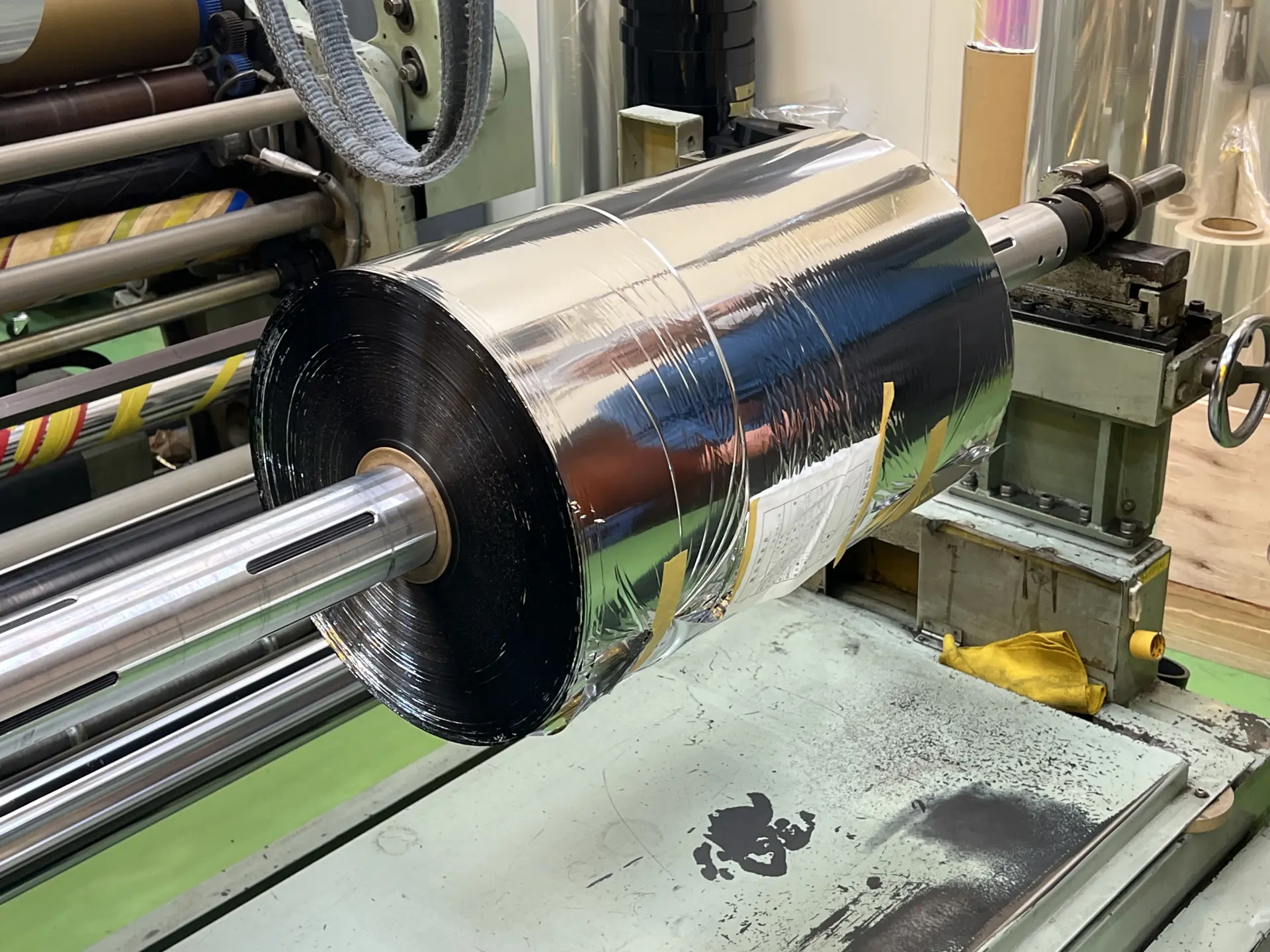
6. The glitter film is roughly cut using a large slitter machine.
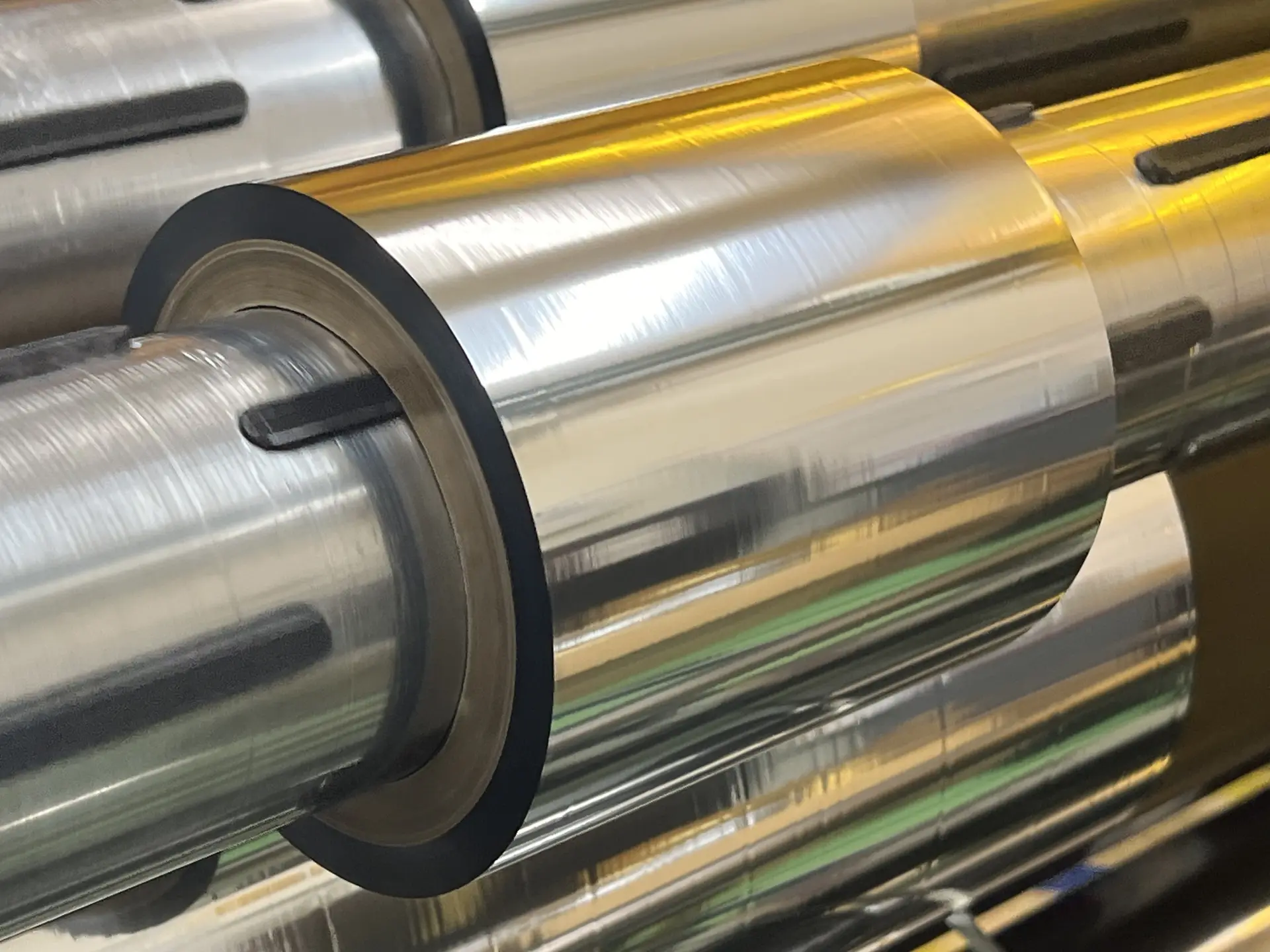
7. Next, the roughly cut film is slit even more finely using a micro slitter machine.
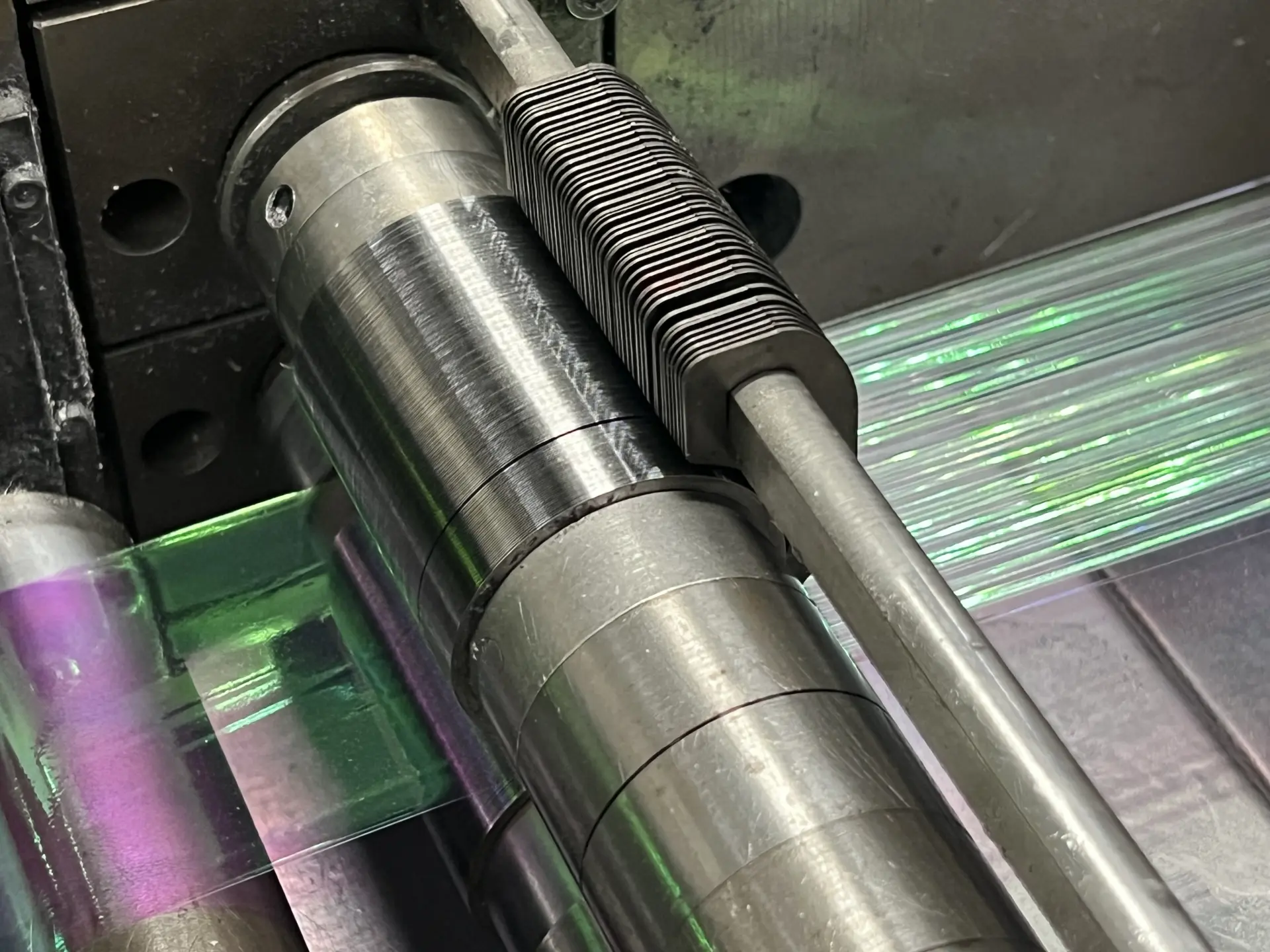
8. “Flat thread” is complete.
![[Flat thread]](https://static.gltjp.com/glt/data/article/22000/21092/20250811_034239_d20b403f_w1920.webp)
Because it expresses luster in the most direct way, flat thread can be used as is for applications that require a luxurious appearance.
9. Flat thread on its own also has weaknesses: it is prone to abrasion and can tear easily. To increase strength and create a more subdued look, it is twisted together with another thread, called a core thread, using a twisting machine. The flat thread is wound in a spiral around the core thread while a consistent twist is applied to form a single thread. Core threads may be made of nylon, polyester, silk, or other materials. Through this twisting process, the thread becomes more flexible, stronger, and easier to handle than flat thread alone.
10. Immediately after twisting, the thread tends to spring back against the twist. By applying steam and heat, that state is stabilized so the twist does not naturally loosen. This also helps prevent deformation during later processes such as weaving, knitting, and dyeing, improving the dimensional stability of the final product. Steam treatment can also reduce fuzz on the thread surface, sometimes increasing smoothness and luster.
Gold and Silver Thread Companies Keeping the Craft Alive in Joyo
Izumi Industry Co., Ltd.: Integrated In-House Production in a Highly Specialized Industry
Wanting to respond flexibly to requests from clients such as designers, apparel manufacturers, and processing companies, Izumi Industry has adopted an integrated in-house production system that allows it to carry out almost every step of manufacturing gold and silver thread and lame thread using its own machinery. The company was founded in 1975. It is a highly skilled manufacturer that has developed many industry-first products over the years.
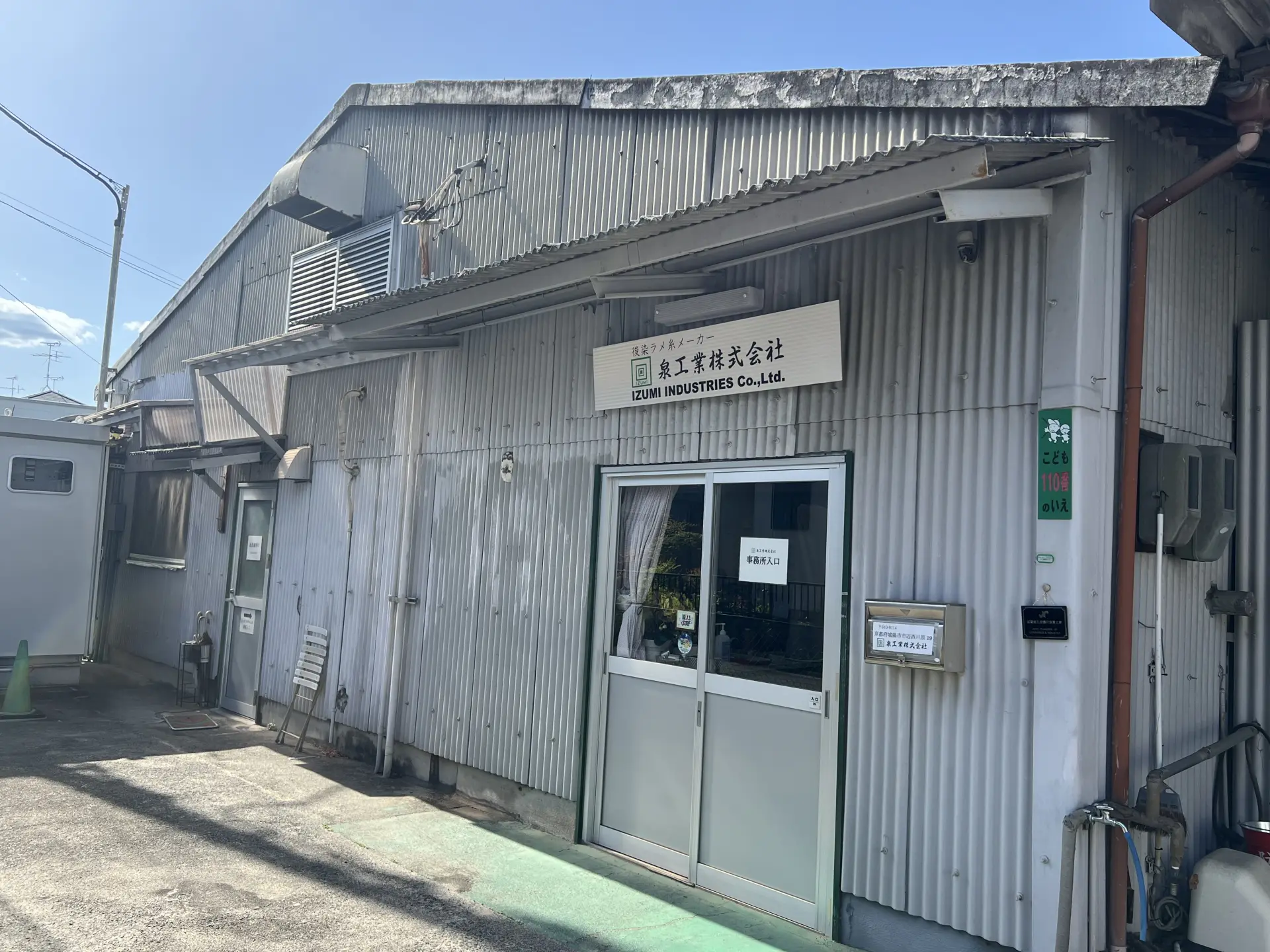
Here, transparent polyester film is colored during the coloring process, then slit into widths of several millimeters and processed into thread-like form. After that, two or more types of thread are twisted together and finished according to the intended use.
Each year, the company develops 5 to 10 new products, and the gold and silver thread made by Izumi Industry is used in a wide range of fields, including kimono, sportswear, bags, and curtains. What’s more, the single largest use for the gold and silver thread produced by Izumi Industry is apparently saris!
What Are the Gold and Silver Thread and Lame Thread Made by Izumi Industry?
Both gold and silver thread and lame thread are made by slitting synthetic resin film such as polyester film or nylon film into narrow strips to create thread-like material. They are not metal wire like stainless steel thread, and they are also different from metal foil like aluminum foil. Before twisting, their cross-section is not round but rectangular. (That is because the film is cut into narrow strips, giving it a rectangular cross-section.) In many cases, the color is added not by dyeing but by synthetic resin coating, through coloring or printing. Seen in cross-section, the structure is layered, with a thin metallic layer on top of the film and a transparent protective resin coating over that.
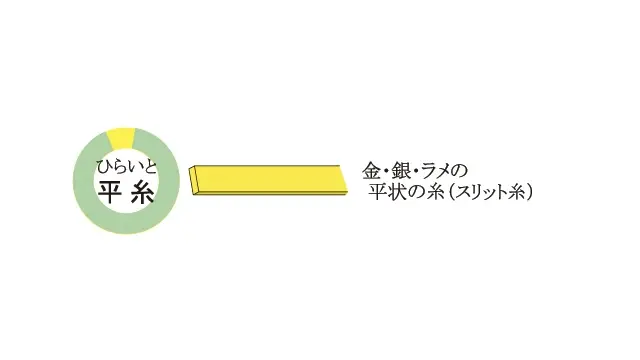
The state before it is twisted with a core thread, in other words when the film has simply been cut into narrow strips, is called “flat thread.” There are many types, and they can be compared and classified based on the following seven points.
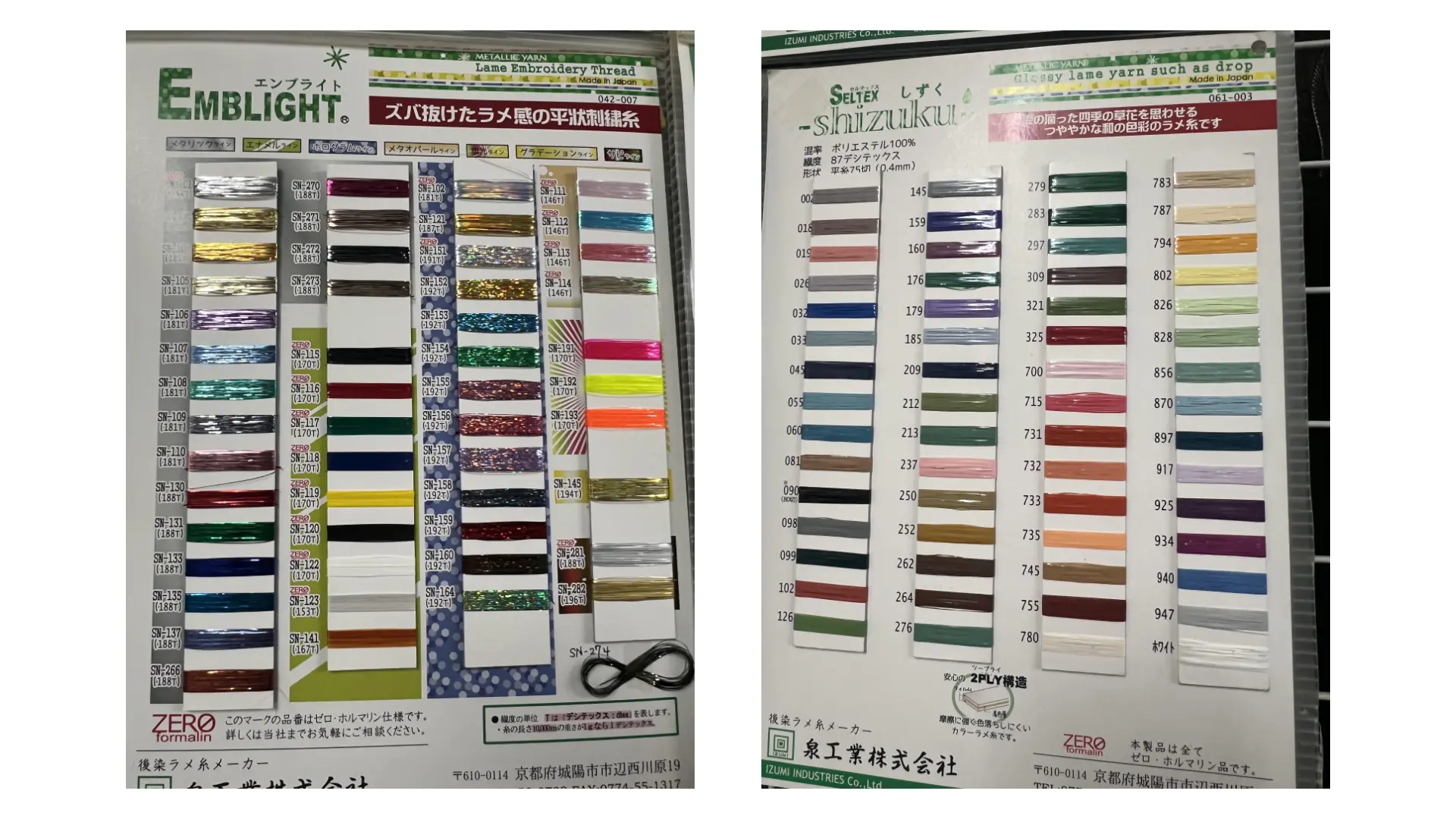
1. Cut Width (Size) of Lame Thread
The most commonly used measure for classifying the size of flat lame thread is cut width. This refers to the width of the flat thread. It is expressed using a unique unit called “kiri.” There are sizes such as 80 kiri, 120 kiri, and 200 kiri, and these can be calculated using the formula “30.3 (one sun on a kanejaku ruler) ÷ number of kiri = mm.”
For example, “200 kiri” means 0.1515 mm, and the larger the kiri number, the finer the thread.
2. Thickness (Size) of Lame Thread
Thickness is also important in classifying the size of lame thread. It is expressed in microns, such as 25 microns or 12 microns. As the unit suggests, it is extremely thin. 25 microns = 0.025 mm. The larger the number, the greater the thickness. This has a major effect on strength and texture.
3. Number of Film Layers and Structure
The structure of slit thread is extremely important when considering the durability of lame thread. 1PLY refers to thread in which the metal-deposited layer or resin-coated layer is exposed. 2PLY refers to thread in which the metal-deposited layer or resin-coated layer is sandwiched and protected between two films. Basically, these are the two main categories. In general, 2PLY is more durable, but 1PLY can be made with fewer production steps.
4. Material of the Lame Thread
Most flat lame thread is made of polyester or nylon. However, the core thread used in the later twisting process can be made from a variety of materials, so the finished thread comes in many different forms.
5. Type of Vapor-Deposited Metal
Lame thread with a metallic look is made by attaching real metal through a method called vacuum deposition. Aluminum, pure silver, and tin are commonly used. Some varieties also use genuine gold or platinum.
6. Color and Luster
Gold-colored lame thread is made by coating yellow or orange resin over an aluminum or pure-gold vapor-deposited layer, or over the film itself. There are also many other types, including “transparent lame thread” with no metal layer, pearl lame thread with a luster like the surface of a pearl, and hologram-like lame thread.
7. Physical Properties and Dye Fastness of Lame Thread
Physical properties such as chemical resistance during post-dyeing are related to factors such as the type of resin coating agent used and its compatibility with the metal used. Fastness also varies depending on the type of lame thread.
About Twisted Lame Thread
What kinds of twisted lame thread are there? Here is a closer look.
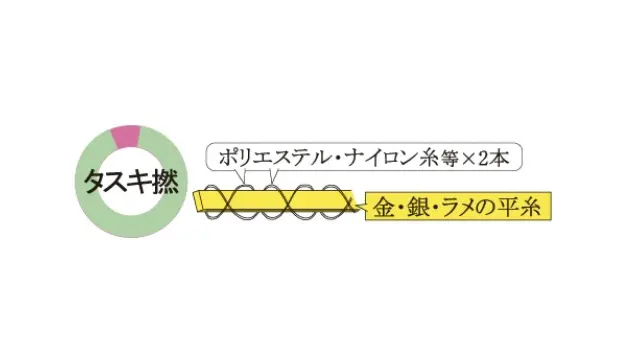
1. Tasuki Twist
This is made by double-cover twisting two threads with lame thread. To make the lame stand out, a fine core thread is often used. Because the slit thread is positioned in the core area, it has strong luster, second only to untwisted flat thread.
2. Hagoromo Twist
This is made by loosely covering a single core thread with lame thread through a covering twist. Because the lame thread is twisted, it has a sparkling appearance.
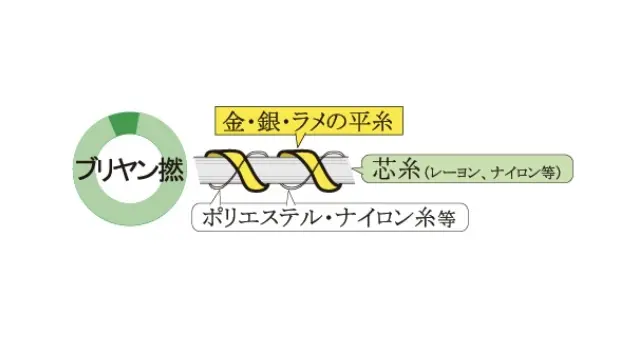
3. Brillant Twist
This is an improved version of hagoromo twist. In hagoromo twist, the lame thread is loosely wound on the outside, which makes it prone to breaking depending on how it is used. In brillant twist, a fine thread is wound from the outermost layer, suppressing the floating of the lame thread and adding strength.
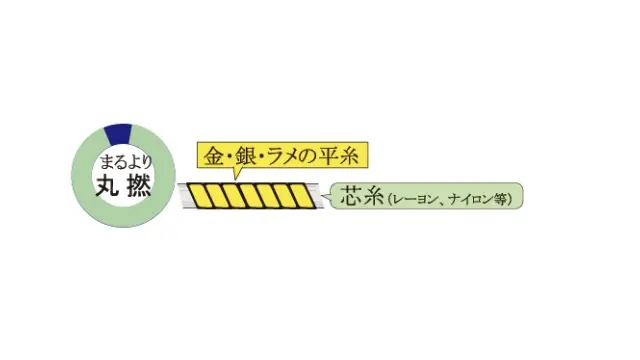
4. Maru Twist
This is made by densely covering a single core thread with lame thread through a covering twist. Because the lame thread is wound so that it covers the core thread without gaps, it creates a firm, elegant luster like metal wire.
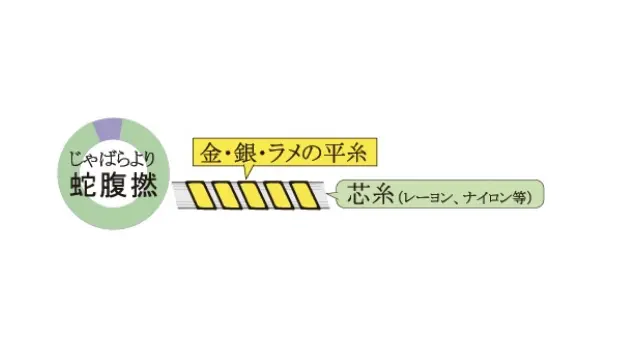
5. Jabara Twist
This is twisted thread with bellows-like gaps. Unlike maru twist, the core thread is slightly visible, so if a colored core thread is used, it can create a striped effect. One of the characteristics of jabara twist is that it makes use of the properties of the core thread as well.
This time we introduced some of the representative types of twisted lame thread, but there are many other twisting methods as well. One of the fascinating things about lame thread is how completely its look can change depending on the thickness and material of the threads used.
Factory Tour at Izumi Industry Co., Ltd.
We were shown the twisting process while speaking with President Hitoshi Fukunaga.
Core thread is paired with flat thread and twisted together. As soon as we entered the factory, we heard the lively sound of bobbins spinning at full speed. Here, one flat thread and one core thread can be combined into a single thread, but depending on the client’s request, the number can increase, and as many as 16 threads may be combined into one. Increasing the number changes the color, strength, and thickness.
*Izumi Industry also offers factory tours.
-
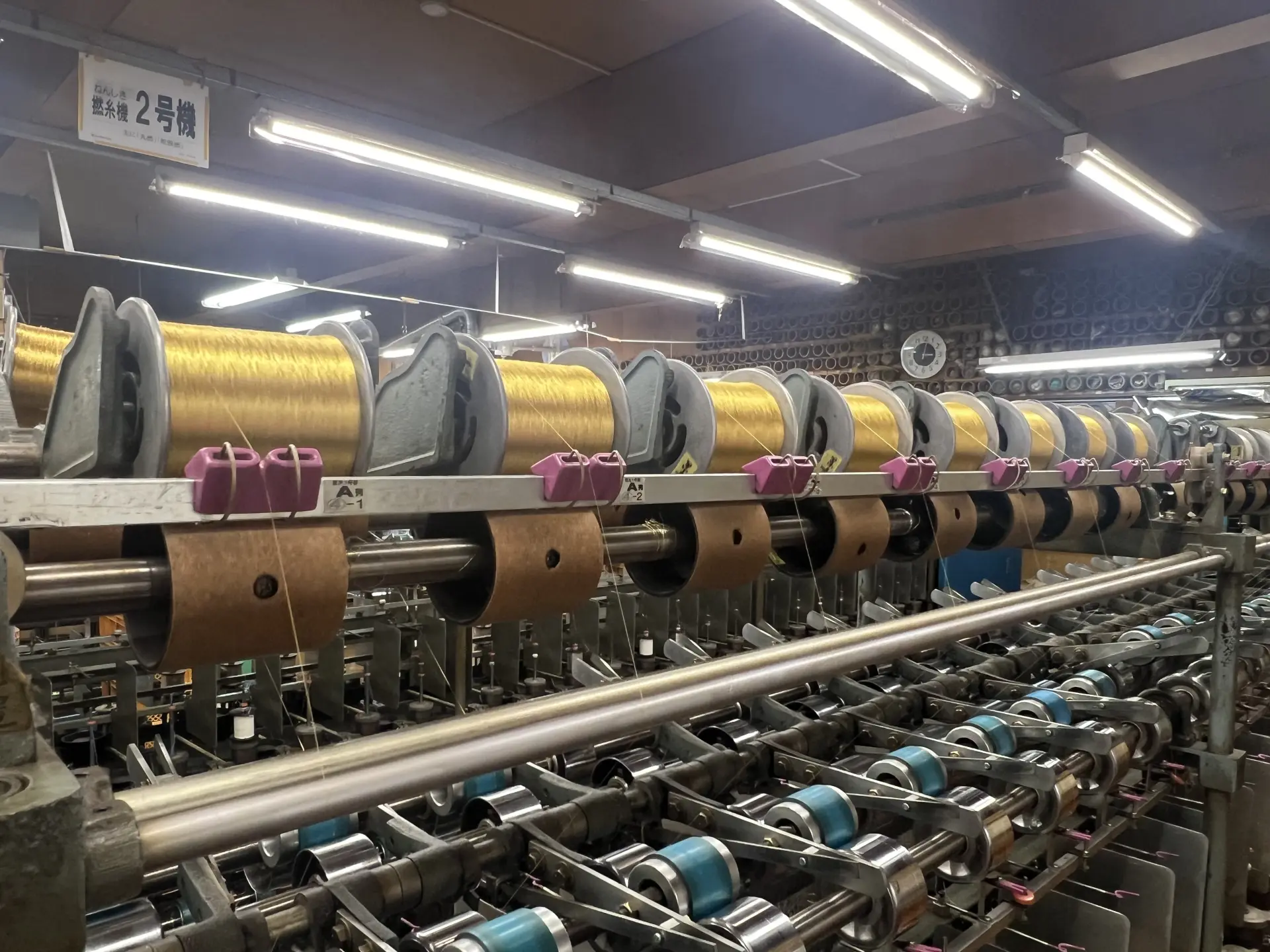
Twisting work at Izumi Industry
-
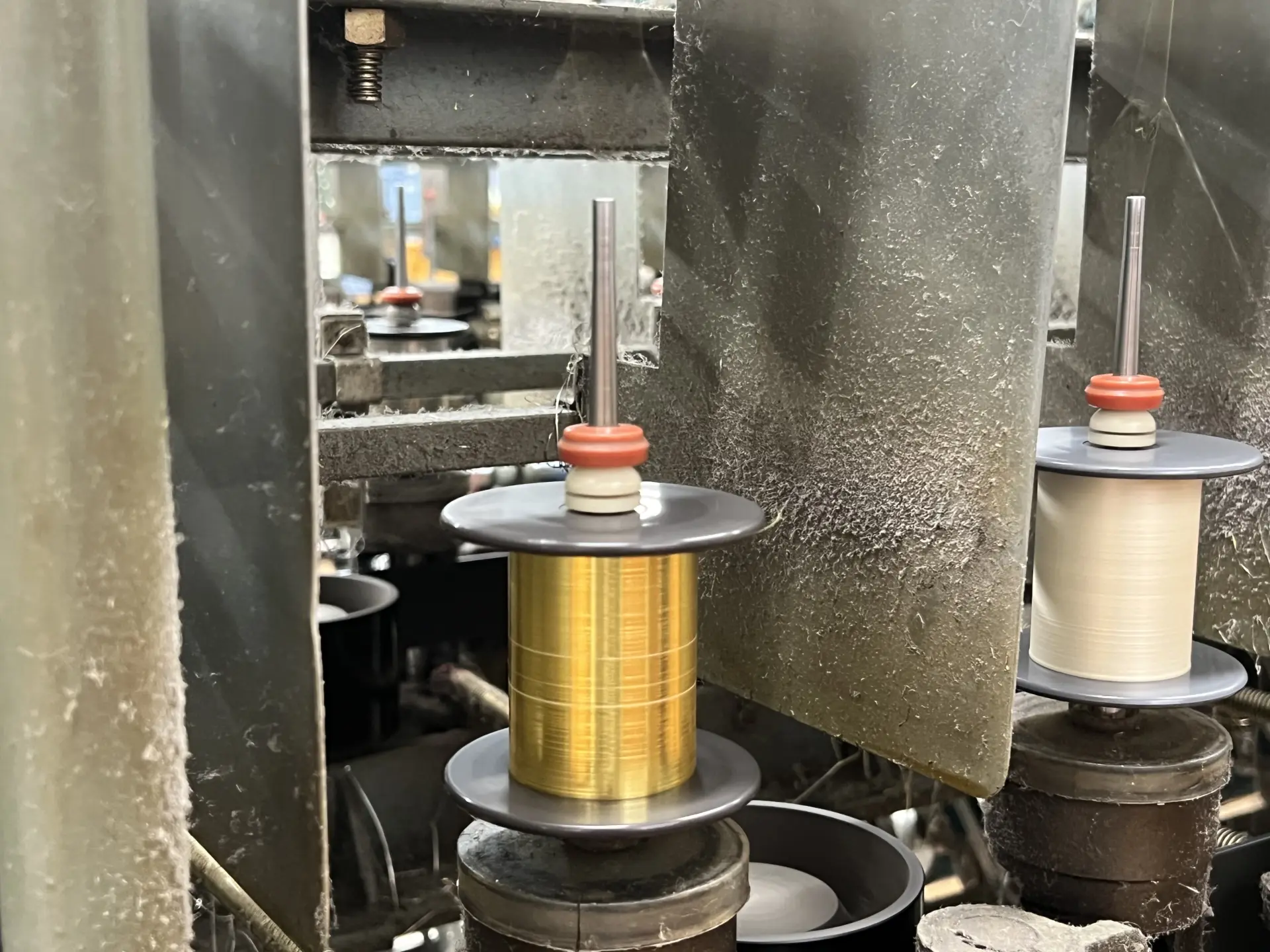
Twisting work at Izumi Industry
-
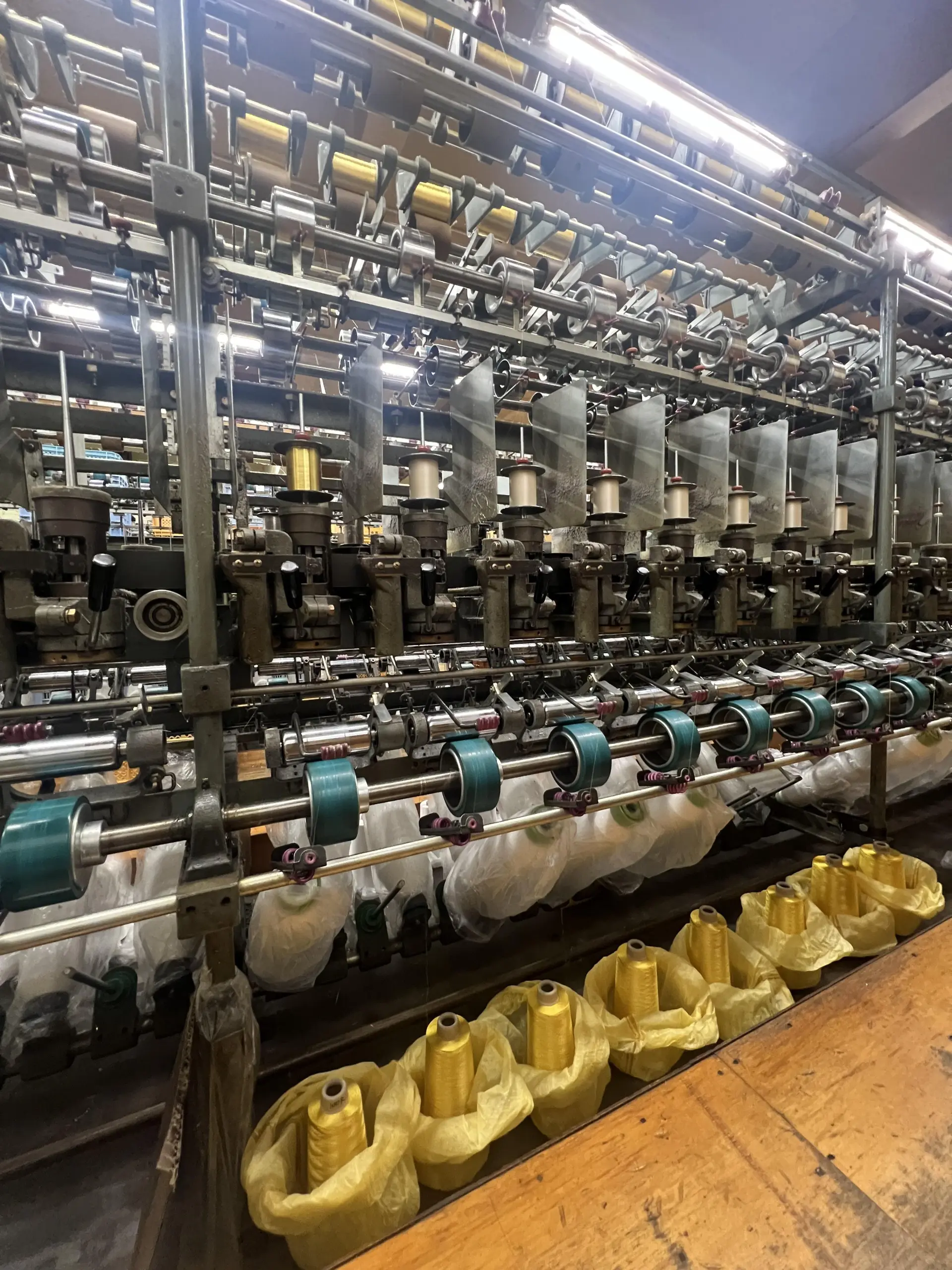
Twisting work at Izumi Industry
Kimura Slitter Handles the Rough Slitting Process
Kimura Slitter has been carrying out the rough slitting process for gold and silver thread in Joyo for about 45 years.
They cut metal-deposited film into anywhere from 2 to 20 sections, ranging in width from 150 mm to 42 mm.
The disc-shaped parts at the front are the blades. These circular blades are set against the grooves farther back to cut the film.
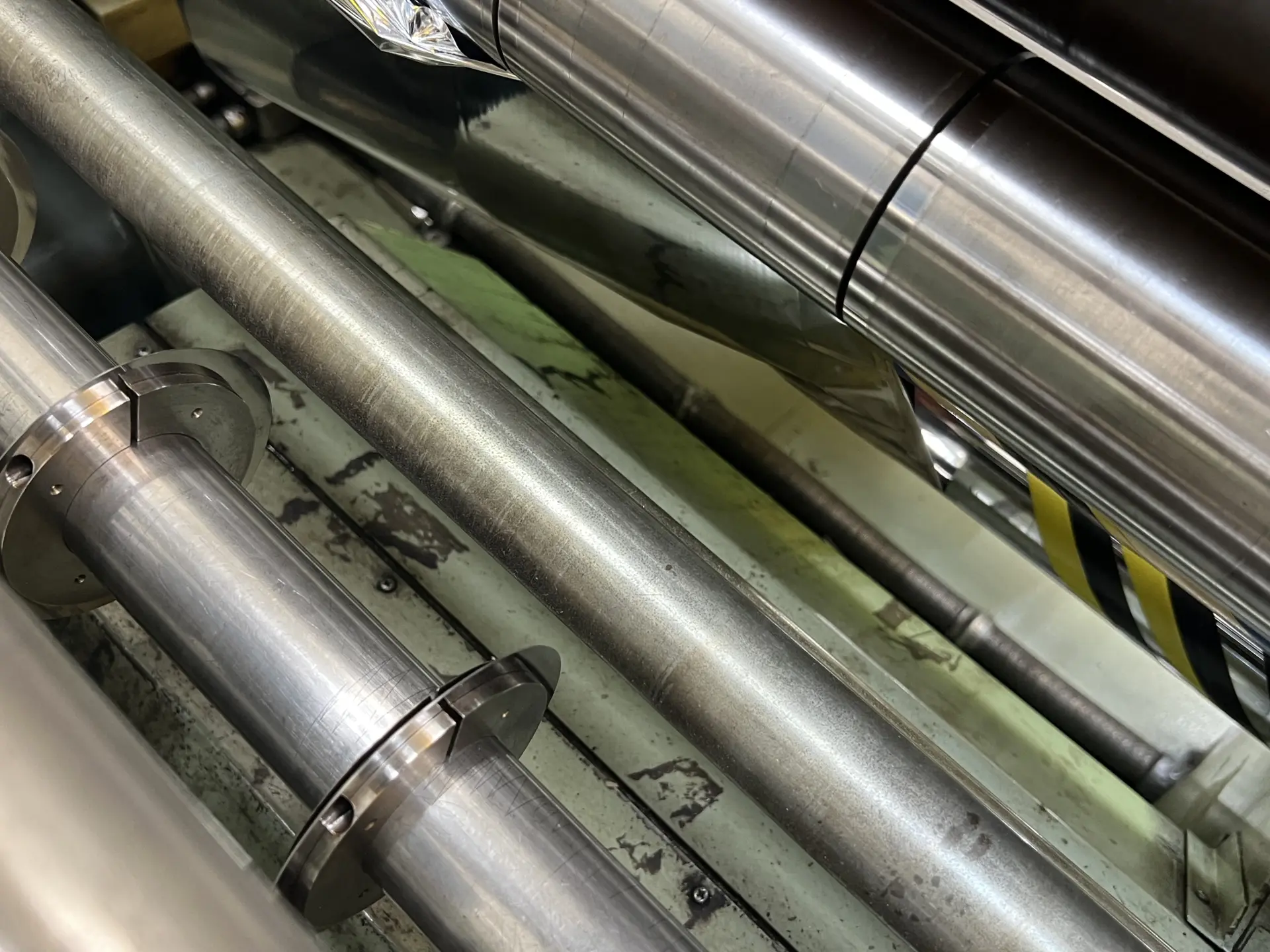
When we visited, they were in the middle of slitting film measuring 6,000 m in length. The machine works at a speed of Approx. 200 m per minute. It is finished Approx. 30 minutes later.
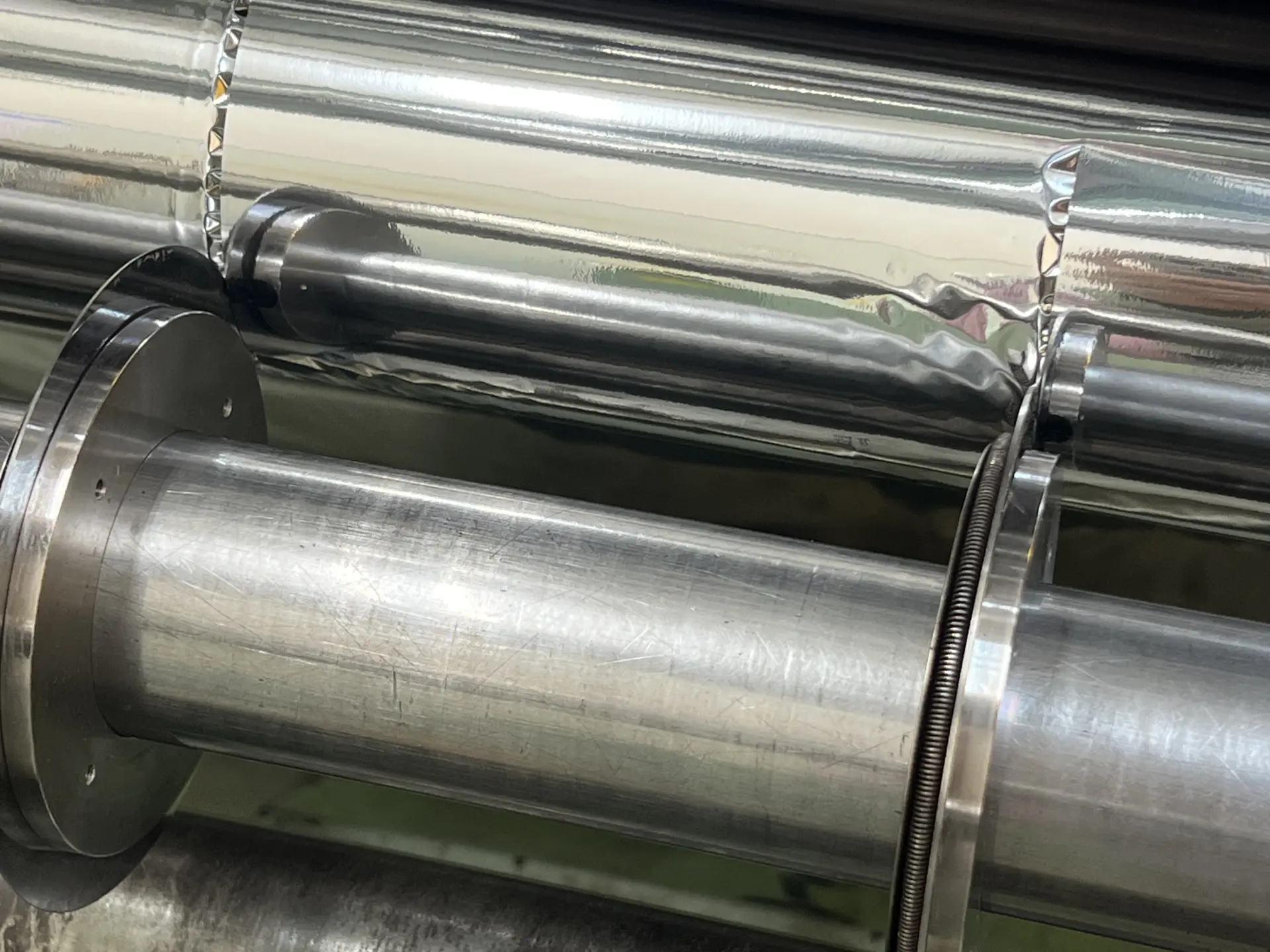
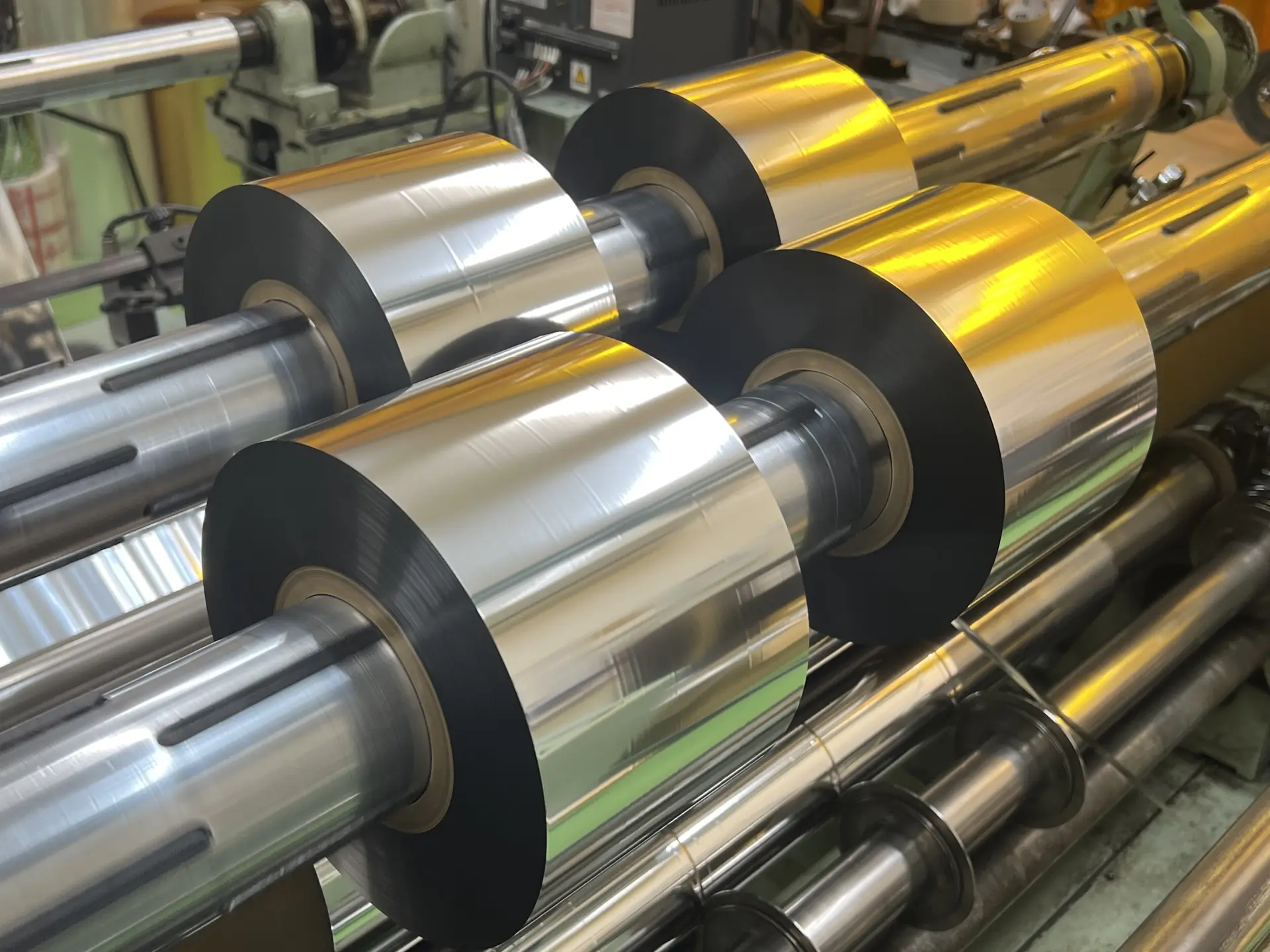
We were told that the moment the machine is running is when the most care is needed. If the film has lost color, or if there are foreign particles or wrinkles, problems will occur in the next micro slitter process, so they watch closely to prevent issues before they happen.
Yasuhisa Kimura, the head of Kimura Slitter, recalled getting excited as a child by making colorful, glittery cheering goods for school sports days. Sparkling materials really do have the power to lift people’s spirits.
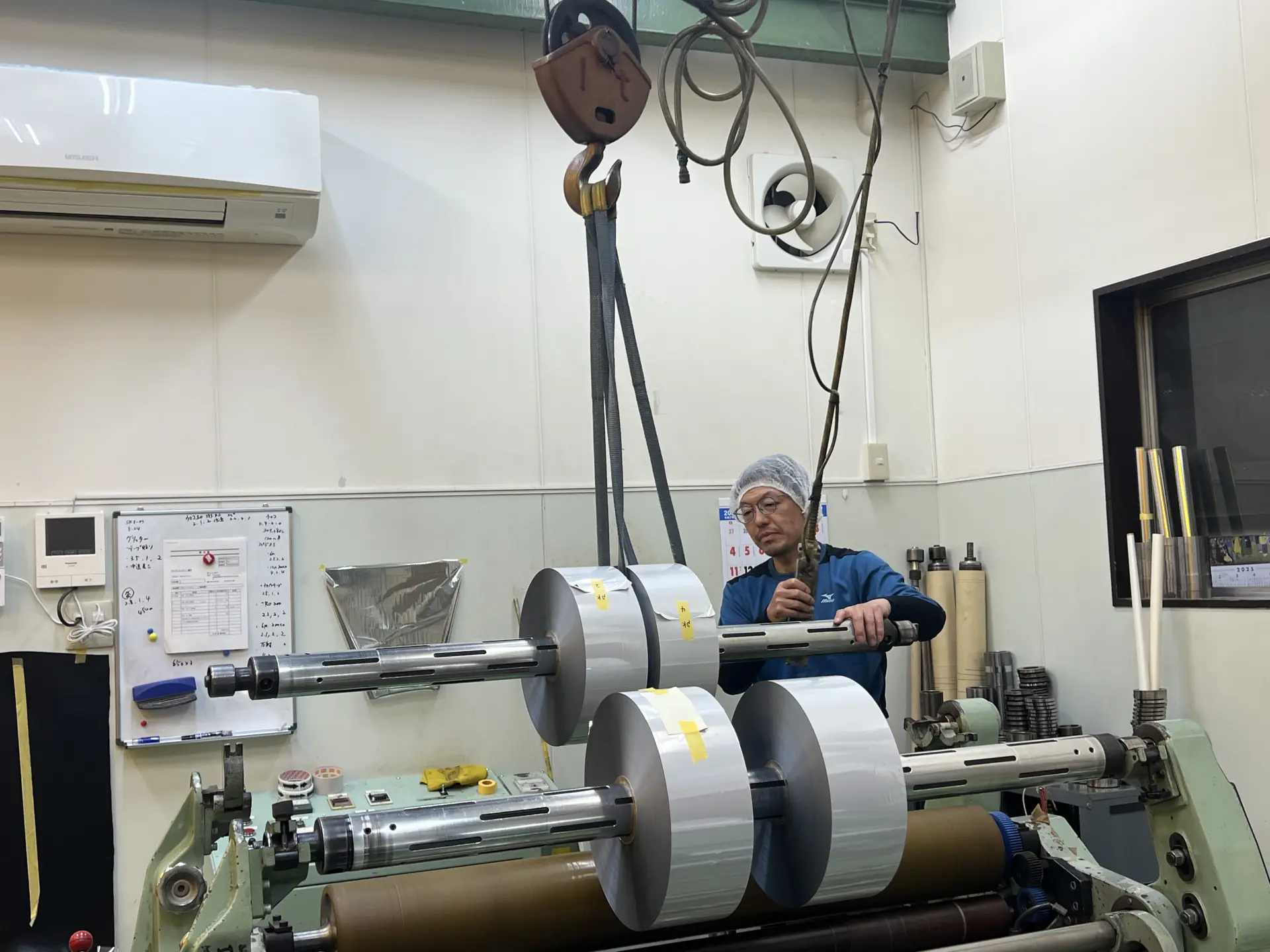
One comment from our conversation left a particularly strong impression: “Manufacturing is only possible through mutual cooperation.”
Watching Mr. Kimura work with such focus to ensure no defects were passed on to the next stage, we felt both the pride of the artisans and the importance placed on horizontal connections among the people involved in gold and silver thread production in Joyo.
Visiting the Factory That Produces the Finest Lame Thread in the Industry
Act Sakikawa Co., Ltd. specializes in cutting the roughly slit film into even finer strips. Founded about 35 years ago, the company produces what is said to be the finest lame thread in the gold and silver thread industry. Using film in four thicknesses, 6 microns, 7 microns, 12 microns, and 24 microns, the company manufactures a total of 20 types of thread in widths of 0.1 mm, 0.12 mm, 0.15 mm, 0.2 mm, and 0.25 mm.
Because the company specializes in extremely thin and fine materials, it also makes gold and silver thread for apparel such as glitter stockings and lingerie that do not feel uncomfortable against the skin.
Here too, as soon as we entered the workshop, we heard the loud sound of bobbins spinning. The roughly slit film is cut even more finely, into 350 to 400 strands. The delicate film is wound up like spider silk.
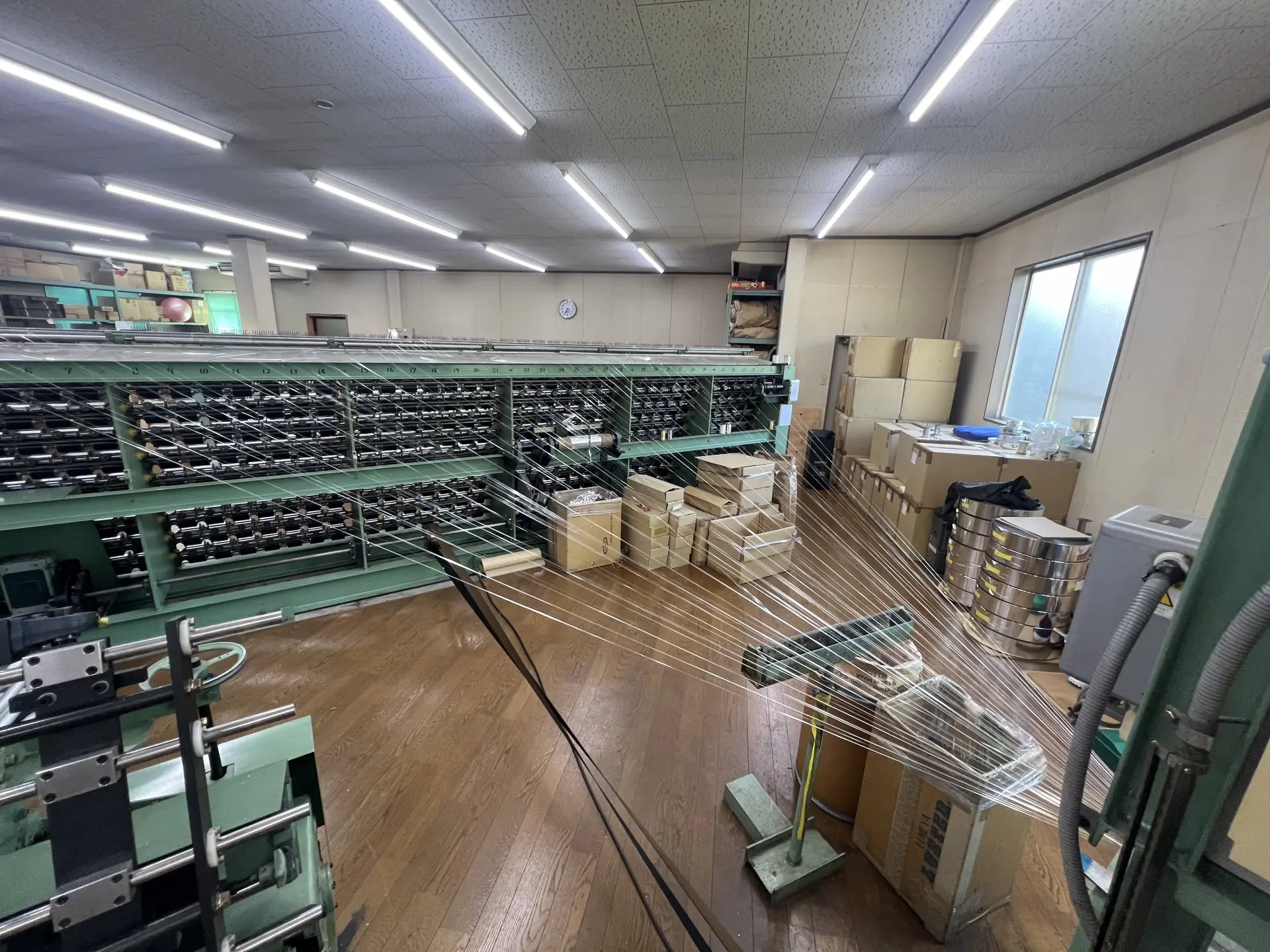
Each bobbin is wound with around 30,000 to 40,000 meters of material per day, and it takes about 1.5 to 2 days to complete one bobbin.
-
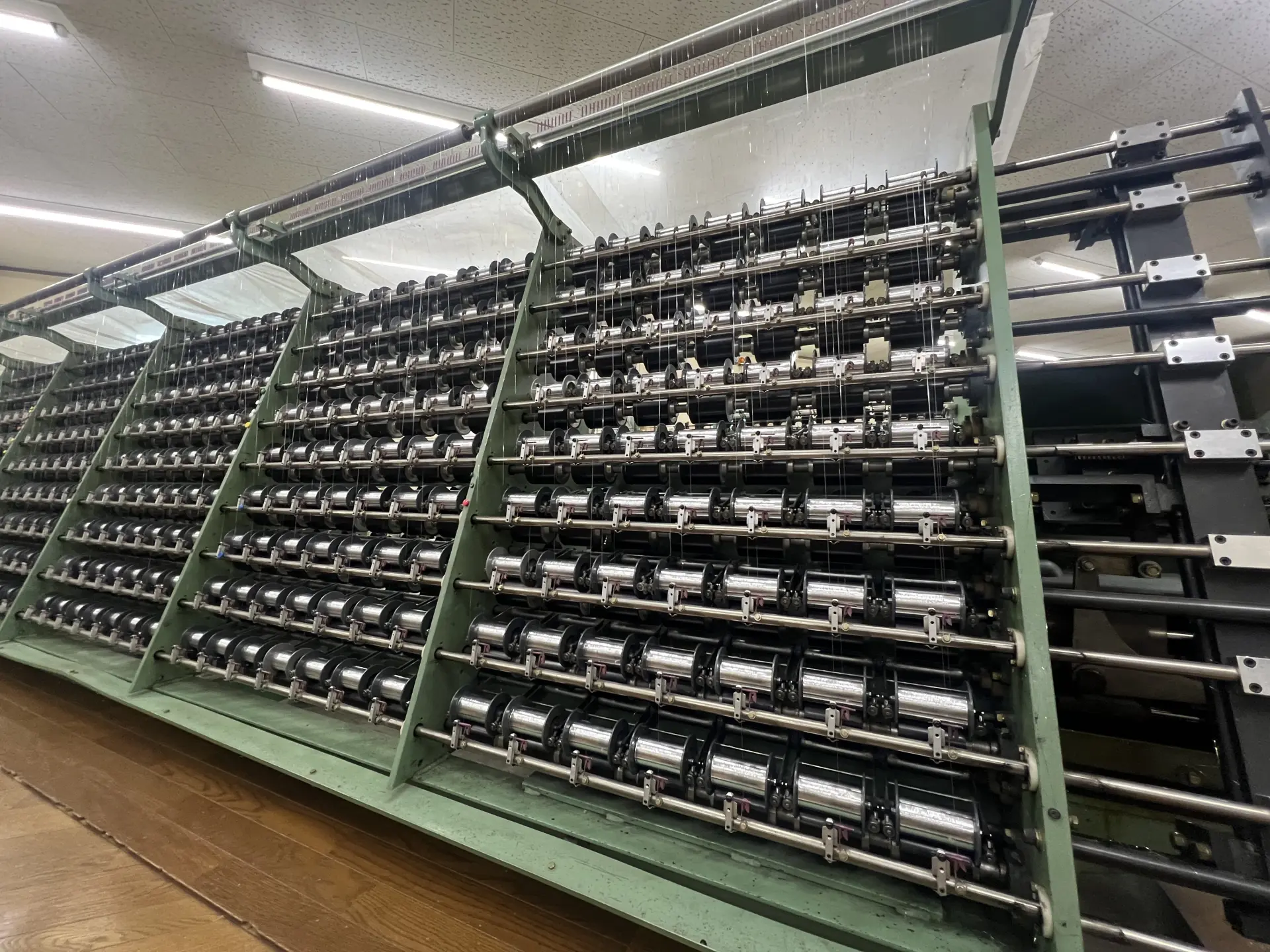
Being wound onto a bobbin
-
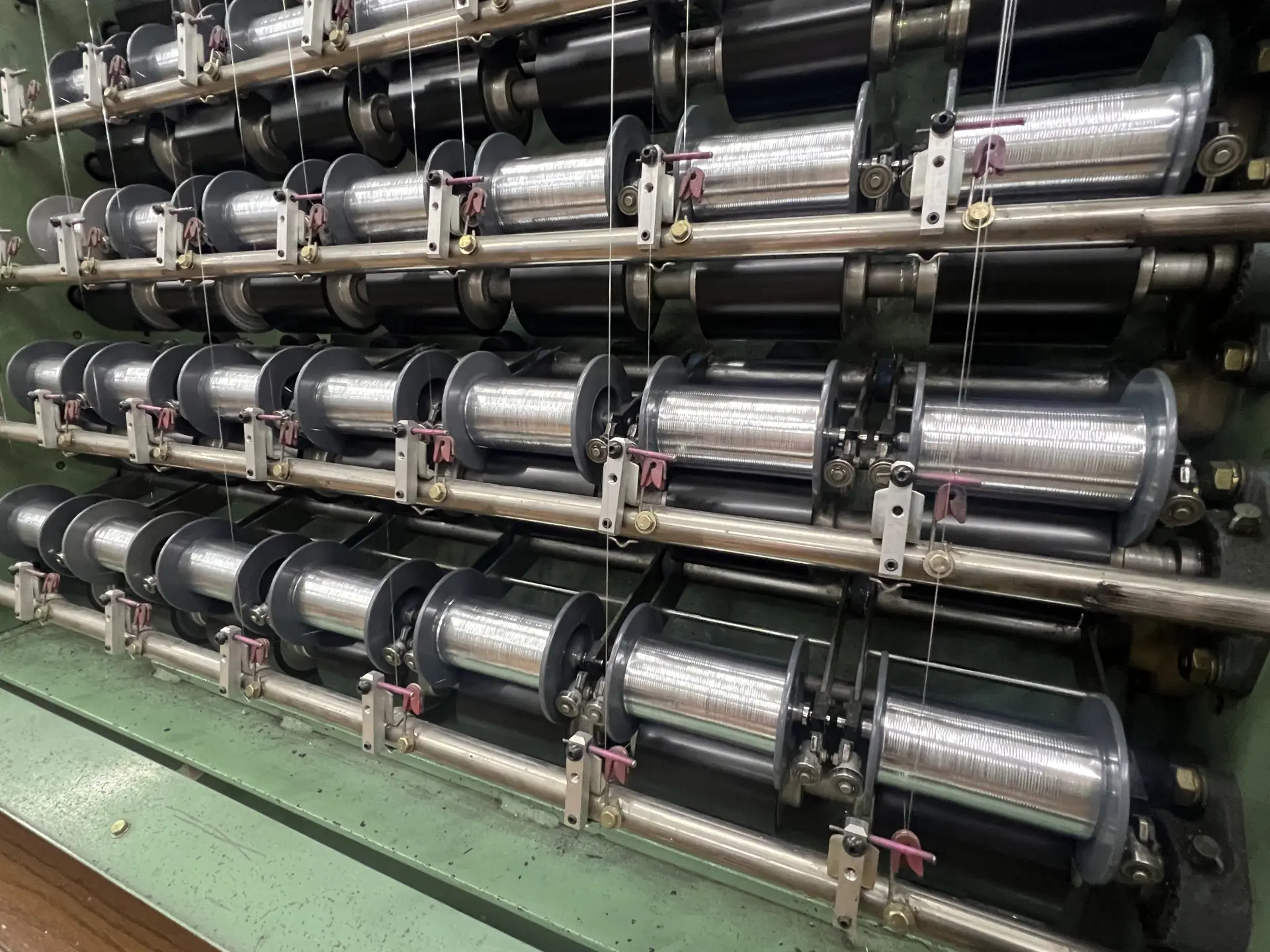
Being wound onto a bobbin
They told us that the greatest concentration is required while the machine is running. If no one is watching, the thread may snap and fly off, so while the machine is in motion, at least one craftsperson stays with it at all times to monitor it.
After visiting several factories this time, what stood out most was that every step has its own professional whose craftsmanship truly shines. The division of labor increases specialization and allows each person to pursue their technique more deeply.
Passing Gold and Silver Thread on to the Next Generation: Sansaishi
The Background Behind the Brand’s Birth
Gold and silver thread has long supported the beauty of kimono and woven textiles, but as demand for kimono declined with the times, demand for gold and silver thread in the traditional clothing field also decreased. In response, people began searching for ways to revitalize “gold and silver thread,” a major local industry in the Kyoto Yamashiro area including Joyo.
In 2005, the Gold and Silver Thread Resource Utilization Project was established within the Joyo Chamber of Commerce and Industry. Wanting to preserve for future generations the craftsmanship that supported Kyoto’s traditional crafts, and to create new demand, they launched a domestic luxury gold and silver thread brand to explore new directions for the material. Its name is “Sansaishi.”
This initiative began with the idea of creating items people could use in everyday life while drawing on traditional techniques. Craftspeople who know and love gold thread gathered together to form the Kyo-Yamashiro Sansaishi Council. Koji Tsuchihashi, chairman of the council, says, “We have to think about how gold and silver thread, which has developed as a local industry in Joyo, can continue to be used from here on.” He also said, “By picking up Sansaishi products, I hope people will discover that Joyo is home to such wonderful gold thread.”
Product Lineup
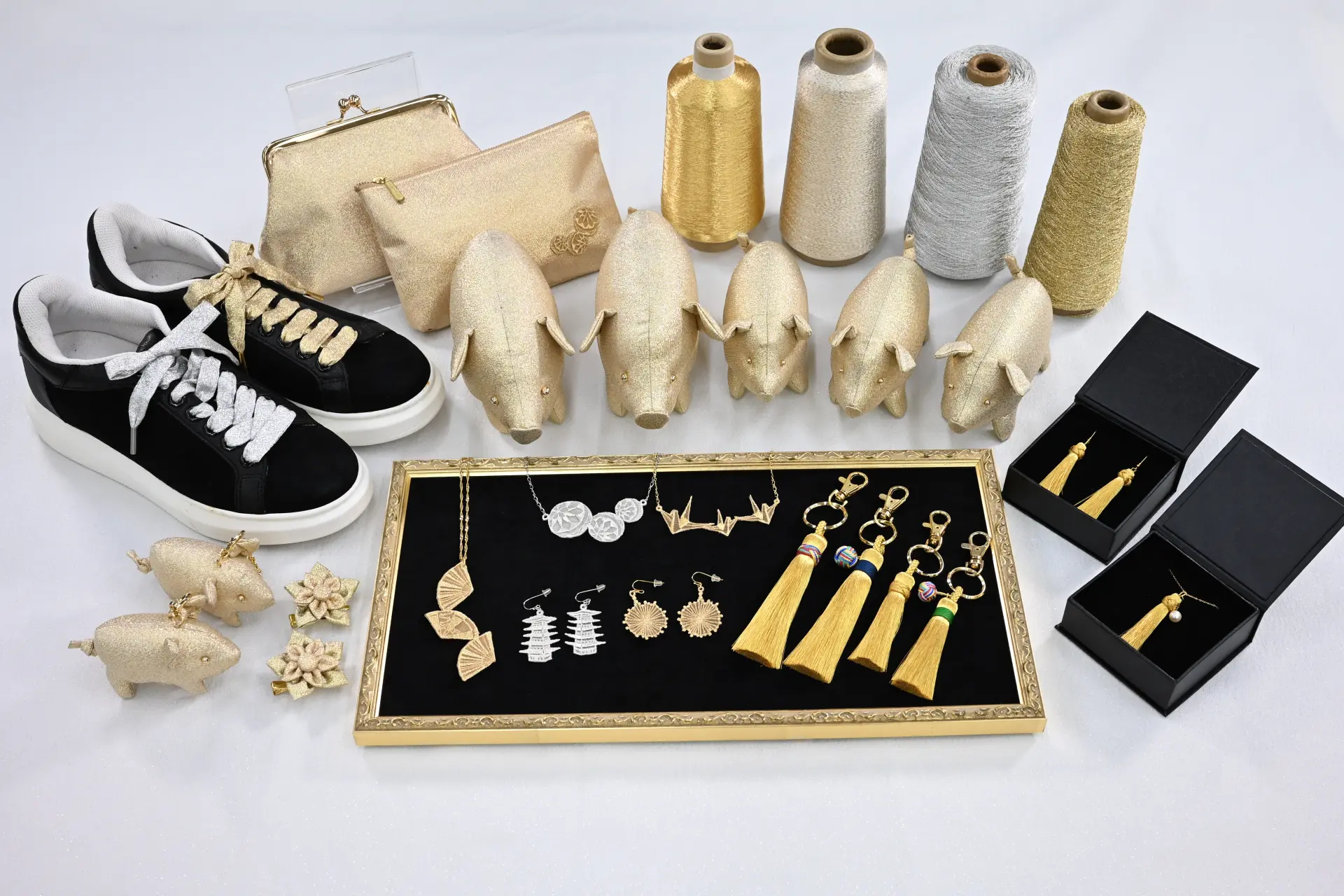
Sansaishi products are broadly divided into three lines. One is products that make the most of the sparkle of the thread itself, such as tassel charms, embroidered accessories, embroidered charms, and tasseled jewelry.
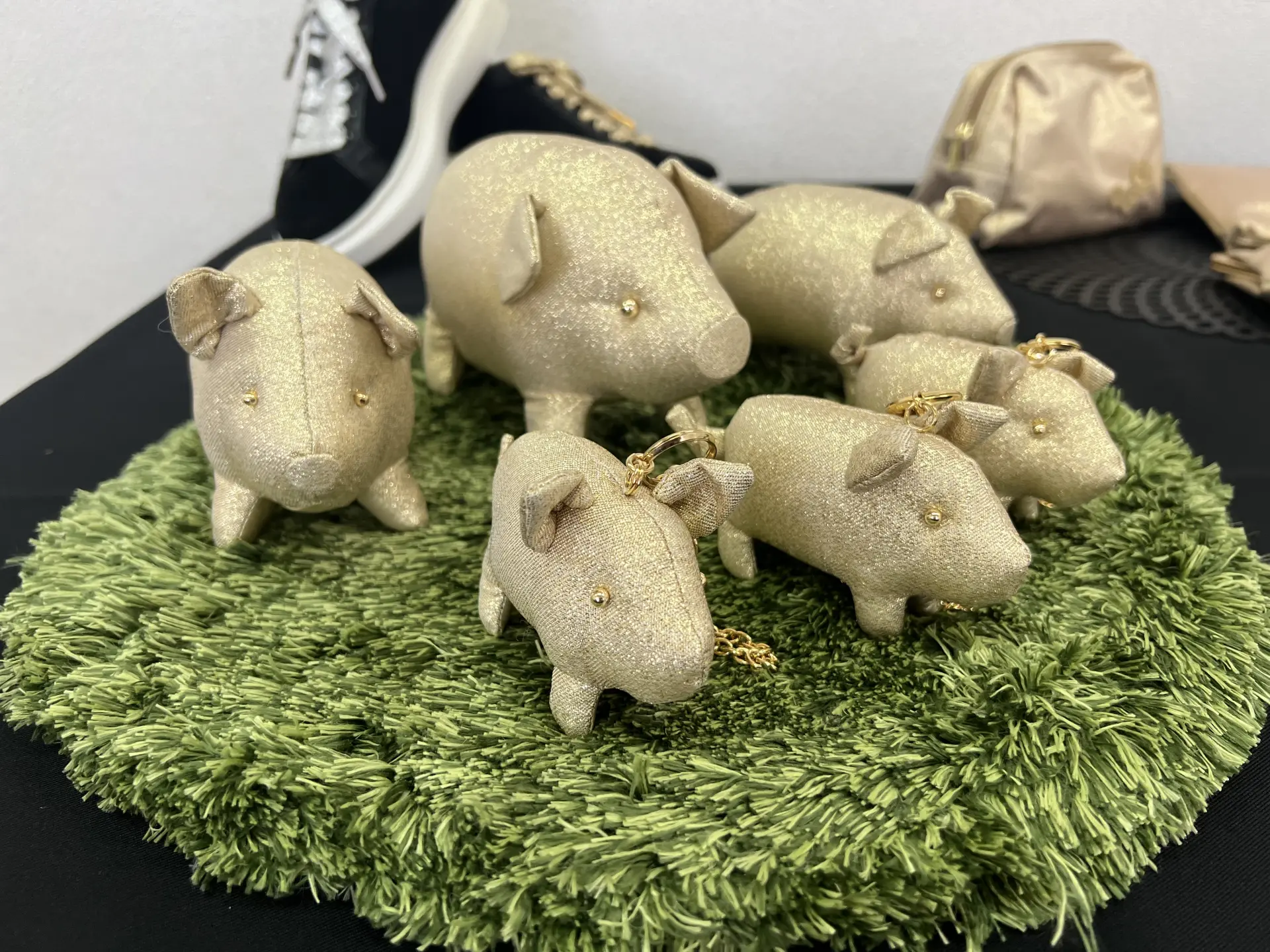
Another is products finished with lavishly woven fabric made only from gold thread and silk, such as golden pigs, lottery ticket cases, pouches, seal cases, bags, and shoelaces. The third is products made from gold and silver thread using Kyoto kumihimo braiding techniques, including headbands and pet accessories. All of them feature elegant colors and are designed as items that invite happiness through the power of gold. There are currently 38 kinds, and they are sold at department store special events and other venues.
There is also an official Sansaishi shop, where items can be purchased online.
Golden Pig
Each golden pig is completely handmade, and each one seems to have a slightly different facial expression, giving it its own unique character.
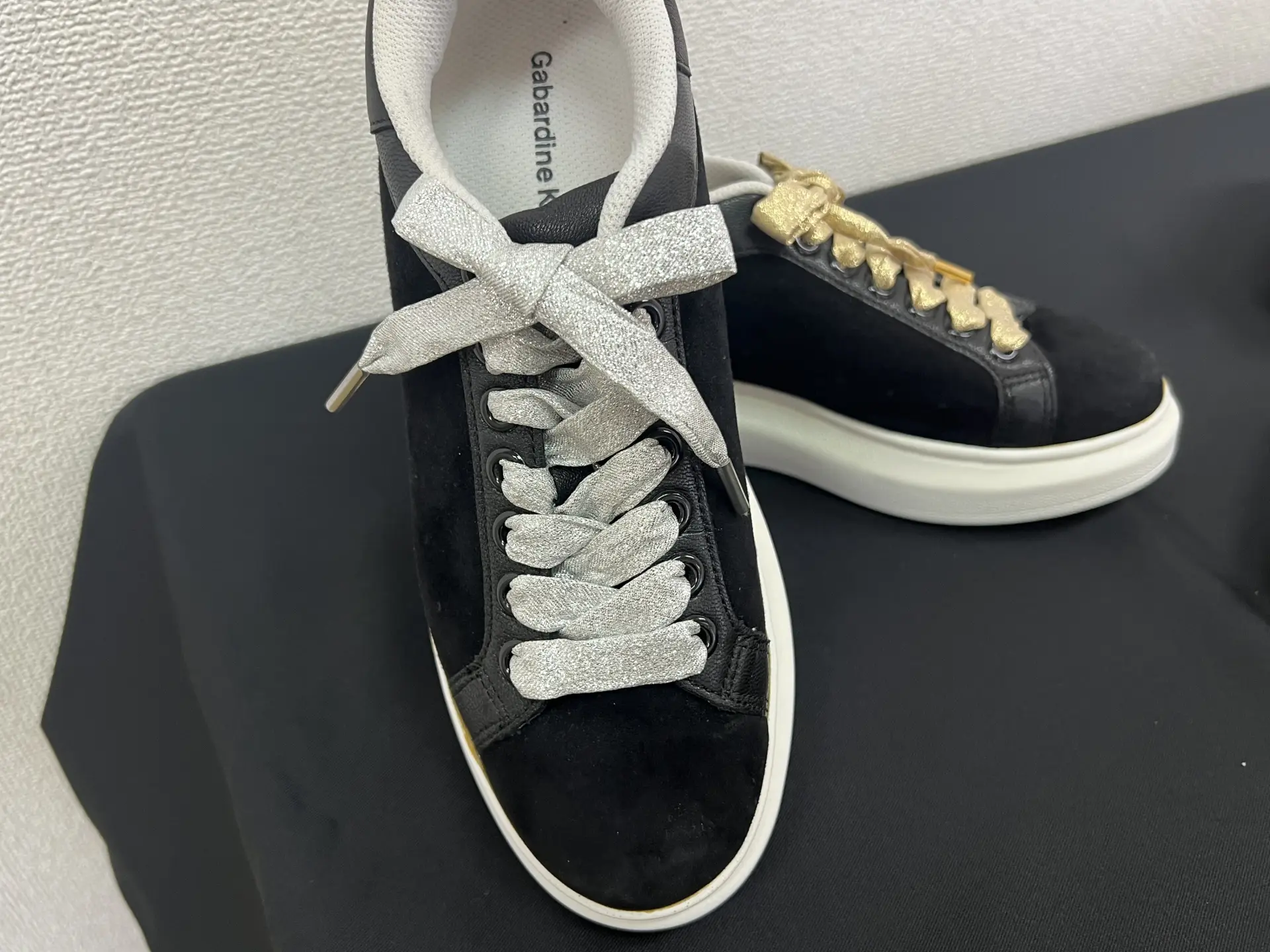
Shoelaces
Just swapping your favorite sneakers’ laces for shoelaces made with gold and silver thread gives them a gorgeous look!
Even simple black or white sneakers take on a completely different feel when gold or silver is added.
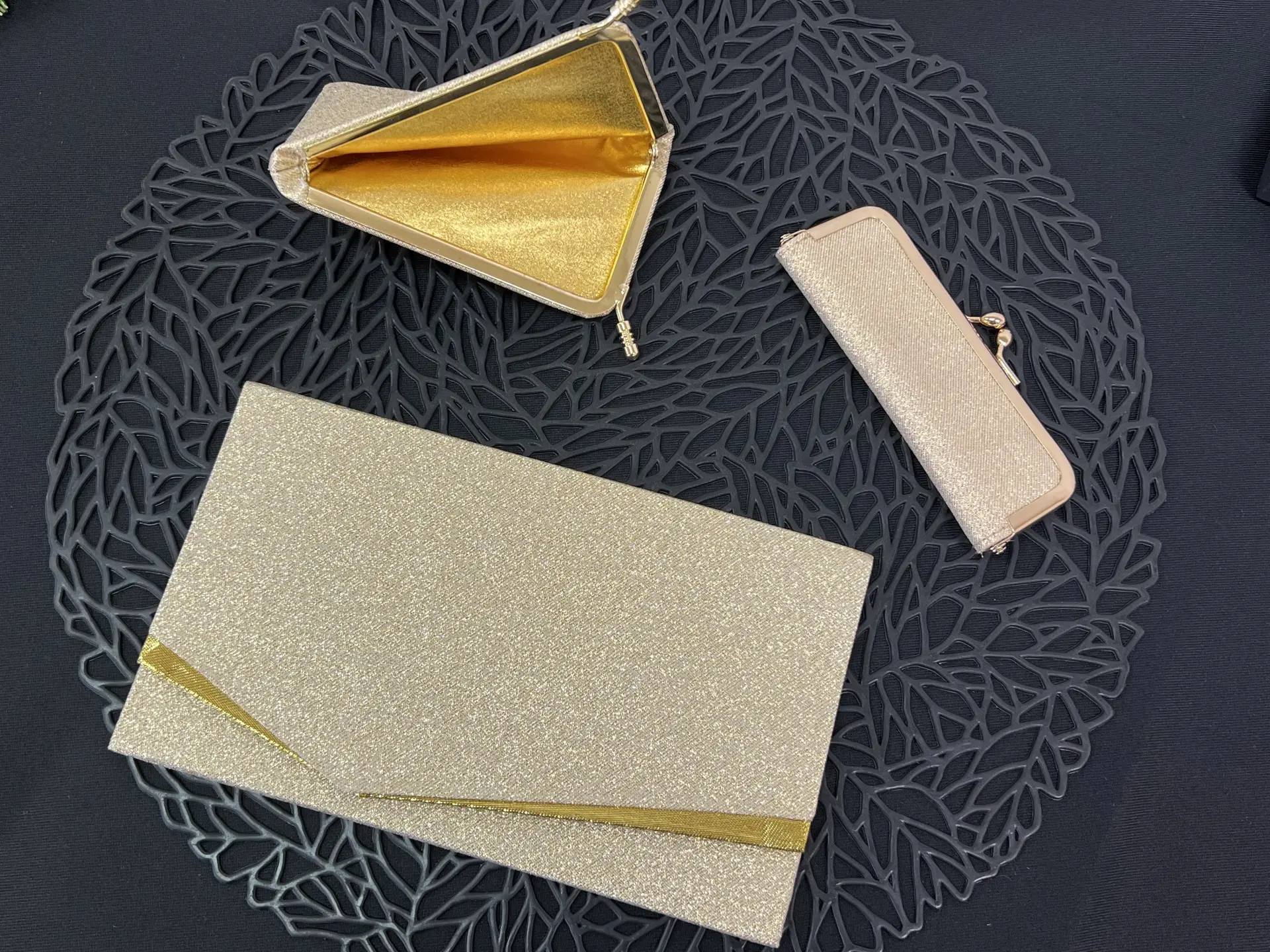
Gamaguichi Purse
There are also gamaguchi purses, a traditional Japanese style of wallet, as well as seal cases, luxuriously made with fabric woven from gold and silver thread.
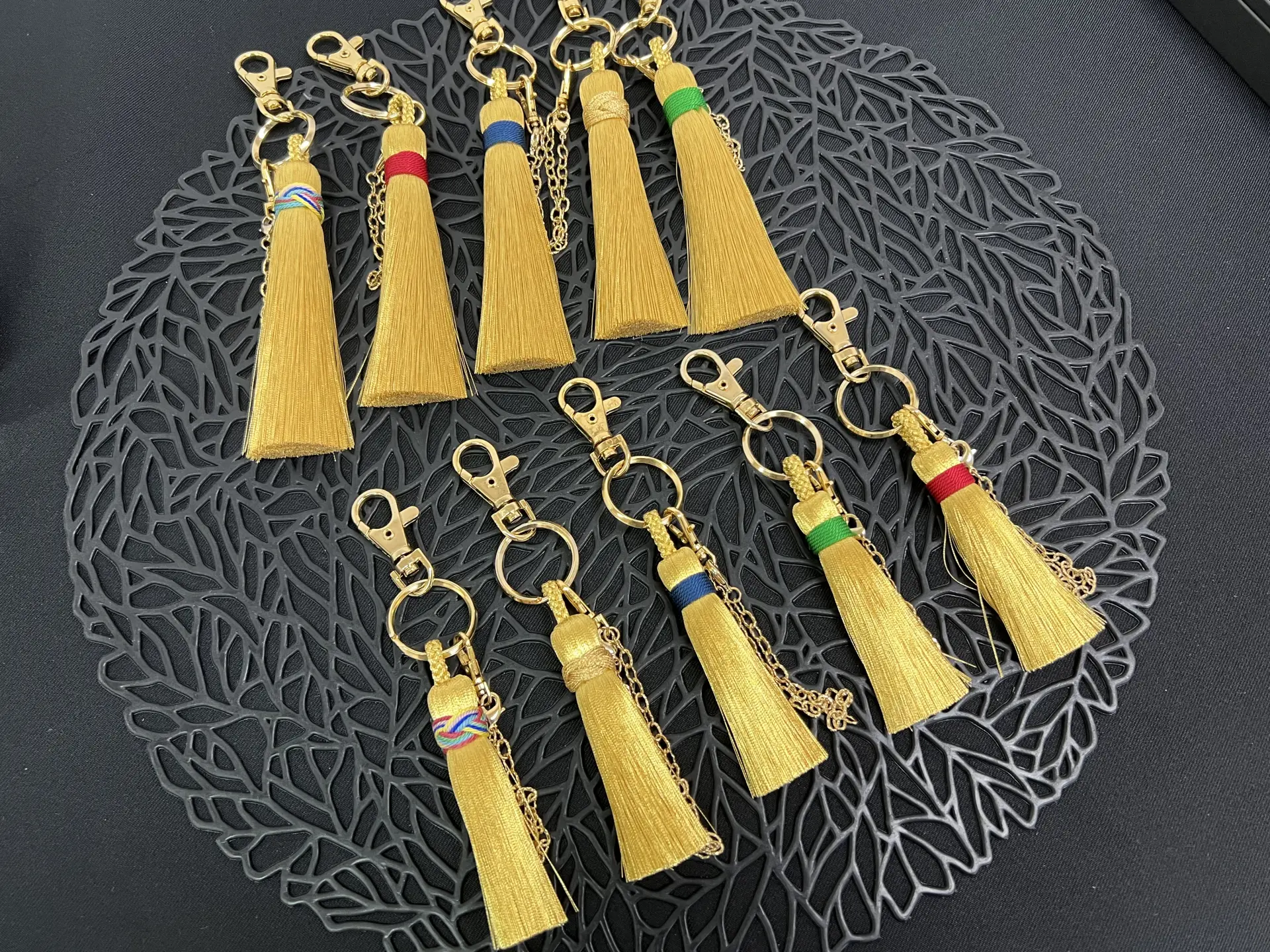
Tassel Charm
These tassel charms show the brilliance of gold directly. Add one to a bag for a more elegant, eye-catching look.
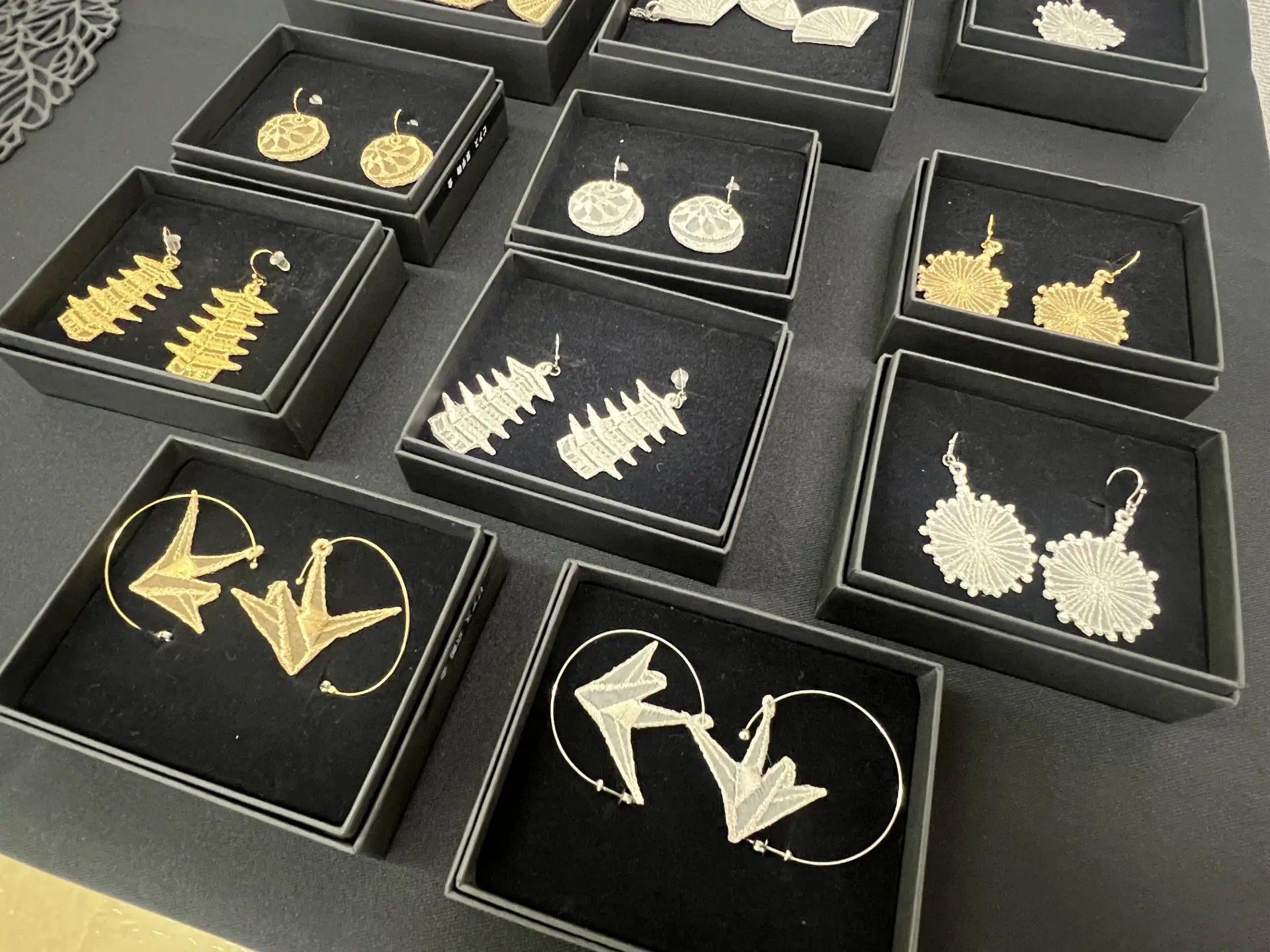
Earrings
Earrings shaped like origami cranes, five-story pagodas, and temari balls, all made from gold and silver thread. They would also make a wonderful souvenir.
Summary
Gold and silver thread is not just decoration. It is a crystallization of culture, woven with techniques refined through skilled handwork and supported by human sensitivity.
In the past, gold and silver thread was a natural part of daily life in Japan, from kimono for special occasions and ceremonial garments used before the gods to Buddhist ritual objects and stage costumes for Noh and Kabuki. Each carried meanings such as prayer, blessing, and respect. Their luxurious brilliance was not simply for visual beauty, but also an expression of the Japanese spirit that values life’s milestones and rituals.
Its value deserves to be appreciated again today. Joyo, Kyoto Prefecture, is home to many companies that have refined gold and silver thread manufacturing techniques over many years and supported traditional crafts. They are not only preserving these skills, but also thinking as a whole community about how gold and silver thread can remain relevant in modern times, continuing new initiatives such as Sansaishi. Even if the applications change, the spirit at the core remains the same: making beautiful things with care. Joyo’s craftspeople have opened up the possibilities of this material through their own efforts, and it has continued to shine in every era.
Of course, gold and silver thread is still used in traditional kimono and other classic items today. But through new approaches, it has continued to evolve while remaining a part of the culture it helps weave together. Passed from artisan to artisan, and from one light to another, its brilliance will continue on. That is why we hope visitors from overseas will also come to know gold and silver thread. If you visit Japan, be sure to bring some of that sparkle home with you.

Author
Freelance Announcer
Sayaka Motomura
Focused on sharing insights related to traditional culture, performing arts, and history.