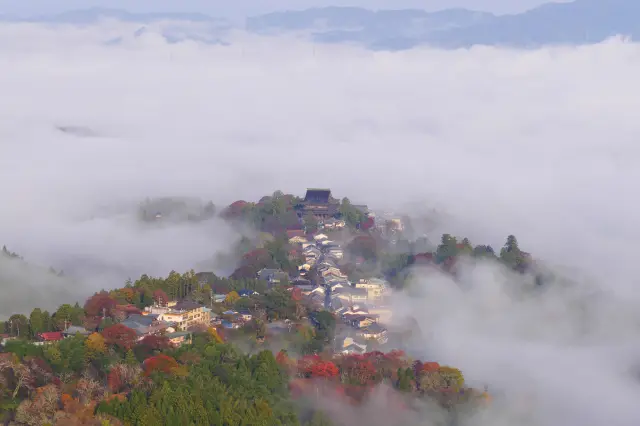
A sacred site of Shugendo mountain asceticism located just below the summit of 1,076-meter Mt. Tamaki. According to legend, Emperor Jimmu rested his troops here and prayed for victory during his eastern expedition. The shrine has long been revered as the inner sanctuary of the Kumano Sanzan. It is registered as a component of the World Heritage Site “Sacred Sites and Pilgrimage Routes in the Kii Mountain Range” and the Omine Okugakemichi National Historic Site.
The shrine is accessible by car, but drivers should exercise caution on the narrow mountain road, which has a series of sharp turns. Snowfall is also common in winter. Dense fog frequently settles over the area, creating an ethereal atmosphere throughout the shrine grounds.
The dignified main sanctuary is built of zelkova wood and features a hip-and-gable roof. The shrine office, built in 1804, combines traditional shoin-style architecture with lodging for ascetic practitioners, a style characteristic of Shugendo communities. It is designated a National Important Cultural Property. Do not miss the fusuma sliding-door paintings by Tachibana Yasuharu, a late-Edo-period artist of the Kano school.
Farther uphill from the main sanctuary, near the summit, stands Tamaishi-sha, which enshrines a sacred stone said to have been placed there by Emperor Jimmu. This auxiliary shrine is also said to be the origin of Tamaki Shrine’s name. Shugendo practitioners traditionally visit Tamaishi-sha before worshipping at the main sanctuary.
Highlights
-
The inner sanctuary of the Kumano Sanzan, associated with the legend of Emperor Jimmu’s eastern expedition.
-
A sacred site along the Omine Okugakemichi and part of a World Heritage Site.
-
The shrine office features a distinctive architectural style and is designated a National Important Cultural Property.
-
The shrine office houses masterful fusuma paintings by an artist of the Kano school.
-
Tamaishi-sha, near the summit, is regarded as a spiritual power spot.