Kenchoji Temple

Verified [Verified] denotes information that has been published with confirmation of its owing parties.

Kenchoji Temple

One of Japan’s earliest Zen temples, with 770 years of history and the prestigious status of the highest-ranking of Kamakura’s Five Great Zen Temples.

3.20 2

Last update :
Supervised by :  Kenchoji Temple

Founded in 1253 (Kencho 5) by Hojo Tokiyori, the fifth regent of the Kamakura shogunate, who invited the eminent Song dynasty monk Rankei Doryu to serve as its founding abbot, Kenchoji was Japan’s first monastery dedicated exclusively to Zen training. It flourished as the highest-ranking of Kamakura’s Five Great Zen Temples and is the head temple of the Rinzai Kenchoji Sect, which has more than 400 branch temples. Its official name is Kofukusan Kencho Kokoku Zenji. The mountain name Kofuku derives from Kobukuro, while the temple’s name comes from the Kencho era.

The temple follows a layout characteristic of Zen monasteries, with its principal structures—including the Somon Gate, Sanmon Gate, Butsuden Hall, and Hatto Hall—arranged in a straight line. Its many cultural treasures include the National Treasure portrait of Rankei Doryu. The temple bell, also a National Treasure, was commissioned by the temple’s founder, Hojo Tokiyori, and is said to be the most beautiful in the Kanto region. The expansive grounds offer natural scenery throughout the seasons. From the Shojoken observation deck beyond Hansobo Shrine at the far end of the grounds, visitors can look out over the temple complex, the town outside its gates, and Sagami Bay, with views extending as far as Mount Fuji on clear days.

After visiting the temple, stop by Tenshin-an outside the gate to try kenchin-jiru, a soup whose name is said to have evolved from “Kenchoji no shiru,” meaning “Kenchoji Temple’s soup.”

Highlights

  • A Chinese Zen-style temple patronized by Hojo Tokiyori and Hojo Tokimune.
  • Chinese juniper trees planted by founding abbot Rankei Doryu that have survived since the temple was established.
  • The National Treasure temple bell, said to be the most beautiful in the Kanto region.
  • Venture as far as Hansobo Shrine for views that surpass expectations.
  • Try kenchin-jiru, a local specialty and Buddhist vegetarian dish said to have originated at this temple.

Photos

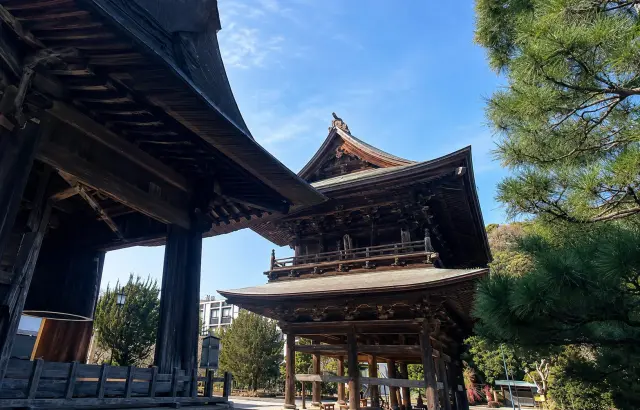
  • The Sanmon Gate, which is said to free those who pass through it from all attachments. A National Important Cultural Property

    The Sanmon Gate, which is said to free those who pass through it from all attachments. A National Important Cultural Property

  • The temple bell hanging in the bell tower beside the Sanmon Gate, renowned as the most beautiful in the Kanto region

    The temple bell hanging in the bell tower beside the Sanmon Gate, renowned as the most beautiful in the Kanto region

  • The Butsuden Hall, which enshrines the principal image of Jizo Bodhisattva. A National Important Cultural Property

    The Butsuden Hall, which enshrines the principal image of Jizo Bodhisattva. A National Important Cultural Property

  • The Hatto, or Lecture Hall, where monks once listened to sermons by the abbot. A National Important Cultural Property

    The Hatto, or Lecture Hall, where monks once listened to sermons by the abbot. A National Important Cultural Property

  • The Cloud Dragon painting on the ceiling of the Hatto Hall’s inner sanctuary

    The Cloud Dragon painting on the ceiling of the Hatto Hall’s inner sanctuary

  • Chinese juniper trees planted by founding abbot Rankei Doryu that have survived since the temple was established

    Chinese juniper trees planted by founding abbot Rankei Doryu that have survived since the temple was established

Official FAQs

Frequently Asked Questions have been vetted and answered directly by each listing.

Q

Are goshuin temple seals available?

A

Goshuin are available for the principal image of Jizo Bodhisattva, Shakyamuni Buddha, the Thousand-Armed Kannon (No. 28 on the Kannon pilgrimage), Nos. 9 and 10 on the Jizo pilgrimage, and Binzuru Sonja. Hansobo goshuin for Hansobo Daigongen and No. 11 on the Jizo pilgrimage are available at Hansobo Shrine.

Q

Is parking available?

A

Large vehicles: ¥2,000; standard vehicles: ¥600 per hour

Q

Are coin-operated lockers available?

A

No.

Q

Are zazen meditation sessions available?

A

Free sessions are held every Friday and Saturday from 3:30 p.m. to 4:30 p.m. Standard temple admission is required.

Reviews

2

Some reviews are AI-translated.

  • See More

    It truly lives up to its reputation as one of Kamakura's most iconic historic temples. The temple grounds are very large, and you can take your time admiring the old buildings, gardens, and serene Zen atmosphere along the way. Unfortunately, I had limited time on this visit and didn't make it all the way to the innermost area, but that bit of regret gives me a reason to come back next time.

    Kenchoji Temple isn't far from Tsurugaoka Hachimangu Shrine, but it's much less crowded, making it especially relaxing and pleasant to walk around. The temples in the Kita-Kamakura area are really worth exploring at a leisurely pace. I recommend setting aside a day for a “Kamakura temple pilgrimage,” stopping along the way and experiencing a different side of Kamakura.

  • See More

    The moment you walk in, you feel so calm. It really has that true Zen temple vibe.

Details

Name in Japanese
建長寺
Postal Code
247-0062
Address
8 Yamanouchi, Kamakura, Kanagawa Prefecture
Phone
0467-22-0981
Closed on
Open daily
Hours
8:30 a.m.–4:30 p.m.
Admission
¥500; elementary and junior high school students: ¥200
Access
From Kita-Kamakura Station on the JR Yokosuka Line, take an Enoden bus bound for Kamakura for 5 minutes and get off at the Kenchoji bus stop. Alternatively, it is a 15-minute walk from the station.
Credit Cards
Not accepted
Official website
Official website (Japanese)
Hokkaido Tohoku Kanto Chubu Hokuriku Kansai Chugoku Shikoku Kyushu Okinawa