The mall has quite a few clothing, general merchandise, household goods, and food stores, so you can take your time browsing and choosing things while getting a feel for the everyday lives of local people in Japan. Compared with shopping areas designed specifically for tourists, this kind of large shopping mall feels more like part of local life and can meet a variety of shopping needs all in one place. If you happen to find something you like, you can also take it home as a souvenir of your trip!
YouMe Town Takamatsu | Review by Gina C
Other Reviews by Gina C
-

Shurijo Castle Park
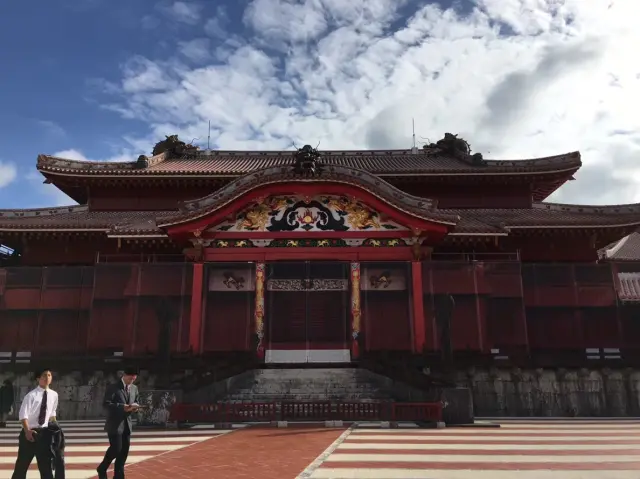
Shurijo is a proud Okinawan icon whose brightly-painted vermillion walls also make it the only red castle in Japan. The castle served as the esteemed seat of politics, trade and culture for the Ryukyu Kingdom that existed during the 450 years between 1429 and 1879.
While visiting Okinawa, I made a special trip to the iconic Shurijo Castle Park. Before even entering the main area, I saw the towering red walls and historic stone gates. The style is very different from typical Japanese castles and has a strong Ryukyu Kingdom character. Once inside the park, I slowly made my way up the winding stone paths and steps. The walls on both sides were spectacular, and it felt as if I had traveled back in time and stepped into the history of the former Ryukyu Kingdom.
Along the way, I admired the historic buildings. Although the weather was a little hot and the walk took some effort, seeing these preserved historic ruins made it well worth it. What impressed me most were the vivid vermilion buildings with their intricate traditional Ryukyuan decorations, which gave them a unique, exotic atmosphere.
Visiting in person, I also learned that Shurijo Castle had suffered a fire and that some areas are still being restored and rebuilt. Seeing the reconstruction work gave me a stronger sense of how much local people value and preserve their history and culture. This was more than just a sightseeing trip; it also gave me a deeper understanding of Okinawa's history.
-
-

Irohazaka Winding Road
Connecting central Nikko to Lake Chuzenji, this 15.8 km scenic road is a renowned tourist route. It consists of two separate roads: the "First Irohazaka" for descending and the "Second Irohazaka" for ascending. The road features 48 hairpin turns, named after the 48 characters of the ancient Japanese syllabary "Iroha." The origins of Irohazaka trace back to the mountain worship of Mt. Nantai, dating to the Nara period. Due to its sacred nature, the Okunikko area, which begins at Irohazaka, was considered holy, and women were prohibited from entering until the Meiji era. The area was developed and opened in the Showa era.
While visiting Nikko, I took a bus to Lake Chuzenji. Along the way, it passed through the very famous Irohazaka Winding Road (いろは坂). Its most distinctive feature is the seemingly endless series of hairpin turns as the road keeps climbing up the mountain, with views of the forested mountains from different angles along the way. I was originally looking forward to enjoying the scenery outside the window, but once I actually rode the bus, I realized that this mountain road was much more thrilling than I had imagined!
The bus kept turning left and right, with a sharp curve every short distance. As it twisted and turned, I started to feel dizzy and even a little nauseous. Motion sickness was really unpleasant. Although the scenery along the way was beautiful, I wasn't in the mood to enjoy it at all and just hoped the bus would reach the destination soon.
-
-

Shinkyo Bridge
The World Heritage site "Shrines and Temples of Nikko" in Nikko City, Tochigi Prefecture, consists of the Futarasan Shrine, Toshogu Shrine, Rinno-ji Temple, and the surrounding archaeological sites. The Shinkyo Bridge, also known as "Yamasuge's Snake Bridge" or "Sacred Bridge", spans the entrance and is one of the cultural properties that constitute the World Heritage site. It is also designated as an Important Cultural Property of Japan.
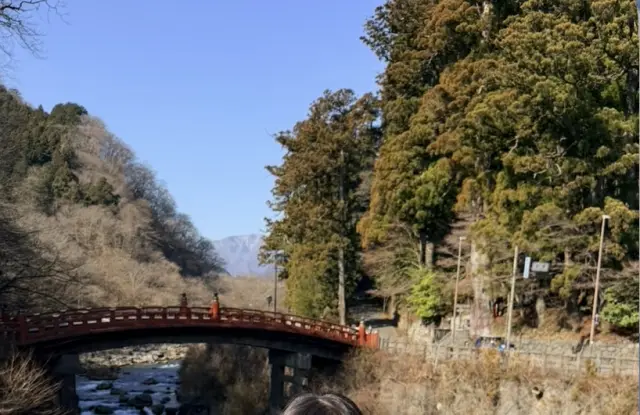
When visiting Nikko, you definitely shouldn't miss the historic Shinkyo Bridge. Before I even got close, I could see the vivid vermilion wooden bridge spanning the Daiya River from a distance. It stood out beautifully against the lush green mountains and forest around it. At the bridge, I could hear the gentle sound of flowing water. Above were the blue sky and mountain views, and the scenery in front of me was as beautiful as a postcard.
The moment I saw Shinkyo Bridge in person, I was truly amazed! The red bridge with its traditional Japanese railings looked historic and had a slightly mysterious feel. The stream below was clear and fast-flowing, and the sound of the water hitting the rocks created a beautiful scene together with the quiet forest around it.
-