

Enjoy Spring! A Guide to Cherry Blossom Viewing in Japan: Best Hanami Spots and Peak Bloom Times Nationwide
Cherry blossoms are the symbol of spring in Japan. For Japanese people, they’re a presence that lets you feel the season’s arrival.
Of course, there’s the beauty of sakura in full bloom, but their fleeting nature—after you’ve waited and waited, they bloom and then quickly fall—is also part of the appeal.
Cherry blossoms brightening all kinds of scenery—shrines and temples, famous castles, mountains, the sea, and riversides—doesn’t thrill only Japanese people. If you’re visiting Japan in spring, you probably want to see the breathtaking views created by sakura.
In this article, we’ve carefully selected famous cherry blossom spots across Japan and their typical peak bloom times by region.
Peak Cherry Blossom Season Across Japan
Many areas typically reach peak bloom from late March to early April.
However, timing varies by region—for example, Hokkaido often peaks from early to mid-May, while Okinawa can peak in late January.
With that in mind, here’s a table summarizing the typical peak bloom period in each of Japan’s eight regions.
Peak bloom also shifts depending on the year’s weather, so please treat these as a guideline.
- Hokkaido
- Early May to mid-May
- Tohoku (Aomori, Akita, Iwate, Miyagi, Yamagata, Fukushima)
- Mid-April to early May
- Kanto (Ibaraki, Tochigi, Gunma, Saitama, Chiba, Tokyo, Kanagawa)
- Late March to early April
- Chubu (Yamanashi, Nagano, Gifu, Shizuoka, Aichi)
- Late March to early April
- Hokuriku (Niigata, Toyama, Ishikawa, Fukui)
- Early April to mid-April
- Kansai (Osaka, Kyoto, Hyogo, Shiga, Nara, Wakayama, Mie)
- Late March to early April
- Chugoku (Tottori, Shimane, Okayama, Hiroshima, Yamaguchi)
- Late March to early April
- Shikoku (Tokushima, Kagawa, Ehime, Kochi)
- Late March to early April
- Kyushu (Fukuoka, Saga, Nagasaki, Oita, Kumamoto, Miyazaki, Kagoshima)
- Late March to early April
- Okinawa
- Late January to early February
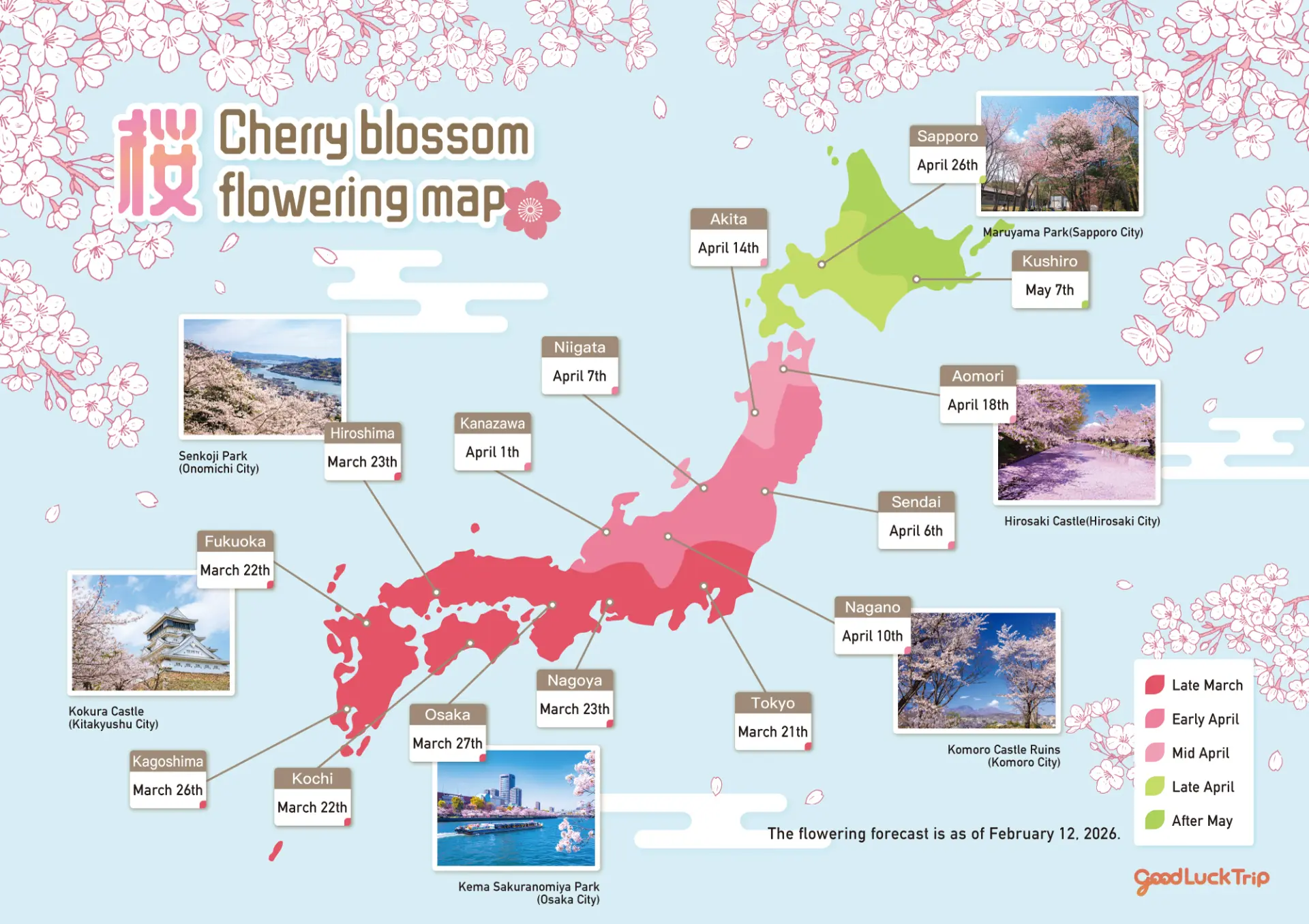
【2026】Japan Cherry Blossom Forecast
If you want to know the 2026 peak bloom period and flowering dates across Japan, use the cherry blossom map below as a reference.
That said, peak bloom varies by prefecture and even by hanami spot within each region, so for details, refer to the typical peak bloom timing listed for each spot introduced below.
Enjoy the Beauty of Sakura with Tips Inspired by How Japanese People Celebrate
For centuries, Japanese people have loved cherry blossoms and enjoyed them in many different ways.
If you’re traveling to Japan during peak season, use these classic hanami traditions as inspiration when planning your itinerary.
It’s a great way to fully experience what makes sakura so special.
Japan’s “Hanami”: Enjoying Cherry Blossoms Picnic-Style
When sakura are at their best, Japan has a tradition and culture of enjoying “hanami.”
Spreading a picnic sheet under the trees and eating, drinking, and even singing with a group while admiring the blossoms is a classic spring outing.
Some people enjoy hanami solo, but it’s most commonly done with a group.
Hanami culture began in the Nara period (710–794), when people admired plum blossoms.
In the Heian period (794–1185), the aristocracy began viewing cherry blossoms instead of plum blossoms, and by the Edo period, hanami had spread to the general public. Even today, many Japanese people still enjoy hanami each spring.
To experience hanami culture, why not bring food and drinks and take your time enjoying a relaxed meal under the cherry trees?

Admire the Dreamy Glow of Illuminated Night Cherry Blossoms
Cherry blossoms seen at night, or viewing cherry blossoms at night, are called “yozakura,” and it’s a familiar way for Japanese people to enjoy sakura.
At many famous cherry blossom spots, the trees are lit up at night with lights and lanterns.
Illuminated sakura look completely different from daytime, creating a magical atmosphere.
If you’re visiting a well-known cherry blossom spot, be sure to enjoy not only the daytime blossoms, but also yozakura at night.

Join a “Sakura Festival” Held During Peak Bloom
At famous cherry blossom spots and nearby areas, “sakura festivals” are often held when the blossoms are at their peak.
While events vary by festival, many feature rows of food stalls and let you enjoy local bites along with illuminated night cherry blossoms.
Some sakura festivals even offer performances of traditional Japanese arts among the blooming trees.
Of course, seeing the blossoms is part of the fun, but enjoying the event itself and its atmosphere is the real highlight of a sakura festival.
It can also be a great chance to connect with locals and other travelers.


3 Must-Visit Hanami and Cherry Blossom Spots in Hokkaido, Where Peak Bloom Comes Latest in Japan
From here, we’ll introduce three carefully selected cherry blossom spots in each region of Japan.
First up is Hokkaido, Japan’s northernmost region.
Hokkaido is a popular destination known for its vast natural scenery, seafood, and local specialties.
In Hokkaido, cherry blossoms reach their peak a bit later, from early to mid-May.
Let’s take a look at some of Hokkaido’s best cherry blossom spots.
Be sure to keep an eye out for Ezo-yamazakura, a variety that blooms only in Hokkaido, and enjoy your hanami.
1. Goryokaku Park
Goryokaku is a Western-style fortress built in 1866.
Until it was taken over by the new Meiji government, it served as the political center of Ezochi.
Later, it was opened to the public in 1914 as “Goryokaku Park,” and visitors began coming as it became a sightseeing spot and a national Special Historic Site.
Goryokaku Park is also famous as a place to enjoy beautiful flowers.
One highlight is its cherry grove—Goryokaku Park is so iconic for cherry blossoms that people often say “Goryokaku means sakura.”
The sight of Approx. 1,530 cherry trees blooming all at once is truly breathtaking.

- Typical peak bloom
- Early May
2. Maruyama Park
Located on the north side of Maruyama Primeval Forest, Maruyama Park has long been loved as a classic cherry blossom spot.
Inside the park, Approx. 120 cherry trees—including Ezo-yamazakura and Somei Yoshino—are planted, and the area becomes lively with hanami visitors in spring.
Maruyama Park has many trees besides cherry blossoms, so the white and pink tones of the blossoms stand out even more against the surrounding greenery.
The Ezo-yamazakura here are known for their deep-colored flowers, and they pair beautifully with the other trees.
With its open, airy feel, it’s a great place for a refreshing hanami.
There are also benches, making it perfect for a walk.

- Typical peak bloom
- Late April to early May
3. Matsumae Park
Matsumae Park is located in Matsumae District, Hokkaido, and features the symbolic Matsumae Castle as well as residences recreated to reflect the Edo period (1603–1868).
It’s also popular as a sightseeing spot where you can experience Japanese culture.
In the park, you can see 250 varieties and Approx. 10,000 cherry trees, and enjoy comparing different colors and shapes.
Matsumae Park is also selected as one of Japan’s Top 100 Cherry Blossom Spots.
A must-see is the Kechimyaku-zakura, a cherry tree over 300 years old, known for its powerful presence.
During peak bloom, the Matsumae Sakura Festival is held, and the park is also illuminated at night.
You can expect a dreamy cherry blossom scene throughout the grounds.

- Typical peak bloom
- Early May

Tohoku’s Iconic Hanami Spots: “Michinoku’s Top Three Cherry Blossom Destinations”
In northern Japan, the Tohoku region is made up of Aomori, Iwate, Akita, Yamagata, Miyagi, and Fukushima.
Compared with other regions, it has many cherry blossom spots, offering a wide range of spring views—from blossoms brightening grand natural landscapes to sakura blooming within shrine and temple grounds.
Among them, Tenshochi in Kitakami City, Iwate; Hirosaki Park in Hirosaki City, Aomori; and Kakunodate in Semboku City, Akita are considered the region’s top cherry blossom destinations and are known as “Michinoku’s Top Three Cherry Blossom Destinations.”
If you’re visiting Tohoku in spring, be sure to stop by these three famous spots introduced below.
1. 【Iwate】Kitakami Tenshochi Park
Tenshochi is not only one of “Michinoku’s Top Three Cherry Blossom Destinations,” but is also selected as one of Japan’s Top 100 Cherry Blossom Spots.
Located along the Kitakami River, the park’s Approx. 2 km row of cherry trees becomes a “sakura tunnel” that gently welcomes visitors.
You can also take a horse-drawn carriage or a sightseeing boat to enjoy the cherry-lined scenery in style.
With around 10,000 cherry trees of Approx. 150 varieties blooming in abundance, the spectacular view—each variety competing in beauty—is a must-see.

- Typical peak bloom
- Mid-April to late April
2. 【Aomori】Hirosaki Park
Hirosaki Park spreads across the grounds of Hirosaki Castle, which is designated as an Important Cultural Property of Japan.
Hirosaki Park is home to two of Japan’s most notable Somei Yoshino trees.
The first is the Somei Yoshino with Japan’s largest trunk circumference, measuring 537 cm around.
The second is Japan’s oldest Somei Yoshino, at 130 years old.
The variety of blossoms is also impressive, with 2,600 cherry trees across 50 varieties in full bloom.
During peak bloom, the Hirosaki Sakura Festival—often said to be Japan’s best—also takes place.

- Typical peak bloom
- Late April to early May


3. 【Akita】Kakunodate
Known as the “Little Kyoto of Michinoku,” Kakunodate still preserves its Edo-period townscape today.
The weeping cherry blossoms at the samurai residences and the 2 km-long sakura tunnel along the Hinokinai River embankment are breathtaking.
This atmospheric streetscape—where cherry blossoms add color to a landscape preserved since the Edo period—is a must-see.

- Typical peak bloom
- Late April to early May
Enjoy Sakura in Every Setting! 3 Must-Visit Hanami and Cherry Blossom Spots in Kanto
Located in eastern Honshu, the Kanto region consists of seven prefectures, including Tokyo (Japan’s capital), Kanagawa, and Saitama.
In Tokyo and Kanagawa, you can enjoy urban spring scenes—like cherry blossoms lined up with skyscrapers, or sakura blooming in streets with an international vibe.
On top of that, one of Kanto’s strengths is how easy it is to reach spots where cherry blossoms bloom amid rich natural scenery.
Compared with other regions, it’s also easier to visit multiple locations, so use the famous spots below as a base and explore a variety of hanami destinations.
1. 【Tokyo】Ueno Park (Ueno Onshi Park)
Ueno Park is in Taito City, Tokyo, and its official name is Ueno Onshi Park.
Managed by the Tokyo Metropolitan Government Bureau of Construction, it covers 530,000 square meters, making it a vast and historic park.
In spring, it draws visitors from Japan and abroad as a famous cherry blossom destination, and is one of Tokyo’s 대표 sightseeing spots.
Made up of Ueno Hill and Shinobazu Pond, it offers diverse greenery and waterside scenery, serving as an oasis in the city.
Ueno Onshi Park has around 1,200 cherry trees, and you can enjoy beautiful views of Somei Yoshino and mountain cherry blossoms spreading overhead.
There are also light-ups, so be sure to enjoy the magical night cherry blossoms as well.
Timed to the bloom, the Ueno Sakura Festival is also held, drawing large crowds of hanami visitors.

- Typical peak bloom
- Early March
![[Ueno Park Travel Guide] A Place to Feel Refreshed by Nature and Culture](https://static.gltjp.com/glt/data/article/21000/20394/20230831_131736_902a620c_w640.webp)
2. 【Tokyo】Meguro River
Meguro River is one of Tokyo’s top hanami spots.
During cherry blossom season, festivals and nighttime illuminations are held, and the area becomes lively with crowds of visitors.
The sight of Approx. 800 Somei Yoshino lining the river, softly glowing lanterns, and reflections of blossoms and lights on the water creates an especially charming, Japanesque scene.
The best time to see the “sakura tunnel” over Meguro River is from late March to early April.
Hidden highlights include “hanafubuki,” when petals scatter in the wind like a blizzard, and “hanaikada,” when fallen petals float on the water like a raft.
During the festival, many food stalls line the riverside, offering not only classic street foods, but also sakura-themed sweets and drinks, plus plenty of other options.

- Typical peak bloom
- Late March to late April

3. 【Saitama】Morita Tekko Gongen-do Sakura Tsutsumi (Prefectural Gongendo Park)
Satte Gongendo Sakura Tsutsumi is famous as one of Kanto’s top cherry blossom spots. A tunnel of pink formed by Approx. 1,000 Somei Yoshino blooming along 1 km, paired with the bright yellow canola flowers below the embankment, creates a stunning contrast. During the Sakura Festival, held every year from late March to April, Approx. 100 stalls also set up. The festival draws as many as one million visitors.
It’s also used as a filming location for various movies, and many people visit for “pilgrimage” trips to famous scenes.

- Typical peak bloom
- Late March to early April
Historic Spring Scenery You’ll Love! 3 Must-Visit Hanami and Cherry Blossom Spots in Chubu
Chubu, made up of five prefectures including Yamanashi, Nagano, and Shizuoka, sits in central Honshu and is known for its natural scenery blessed with mountains and rivers.
Japan’s iconic Mt. Fuji is also in the Chubu region.
In addition to cherry blossoms blooming in mountains and along rivers, you’ll find many spots where you can enjoy sakura alongside Japan’s historic atmosphere.
Here are three especially popular cherry blossom destinations in Chubu.
1. 【Nagano】Takato Castle Ruins Park
Takato Castle Ruins Park, on the former site of Takato Castle, features historic structures that retain the area’s past, along with Approx. 1,500 Takato Kohigan-zakura cherry trees found only here.
When they reach peak bloom, the entire area turns a beautiful shade of pink.
The sight of historic Japanese structures surrounded by a sea of blossoms is exceptionally beautiful.
After sunset, the park is illuminated, adding a mysterious touch to the scenic setting and creating a magical space to enjoy night cherry blossoms.

- Typical peak bloom
- Early April to late April
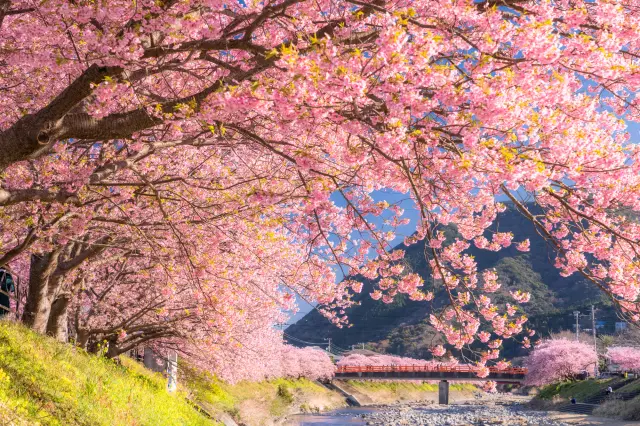
2. 【Shizuoka】Kawazu Cherry Blossoms Along the Kawazu River
Along the Kawazu River, early-blooming cherry blossoms are known to start flowering in early February.
These blossoms were discovered in Kawazu Town in 1955 and are called “Kawazu-zakura.”
They’re known for their large flowers and deep pink color, and thanks to Izu’s mild climate and their early-blooming nature, they reach full bloom over the course of Approx. one month.
Approx. 850 cherry trees bloom along the river alone, and across Kawazu Town, Approx. 8,000 Kawazu cherry trees bloom in full.

- Typical peak bloom
- Early February to early March
3. 【Nagano】Komoro Castle Ruins / Kaikoen Garden
During the Warring States period, Takeda Shingen ordered Yamamoto Kansuke—also known as a master castle builder—to create a new layout that became the basis of Komoro Castle.
In Tensho 18 (1590), after Toyotomi Hideyoshi unified Japan, Sengoku Hidehisa, who was put in charge of Komoro, carried out major renovations to the castle and developed the castle town, building it into the stronghold seen in today’s remains. It’s a rare “anajiro” (a castle built lower than the surrounding castle town), with structures such as the Otemon Gate and stone walls still preserved in their original form.
After the castle’s role ended with the abolition of feudal domains in Meiji 4 (1872), it was developed as “Kaikoen,” a park that enshrines Kaiko Shrine, and was reborn as a modern park.
Today, it’s also known as one of Nagano’s leading cherry blossom spots and is selected as one of Japan’s Top 100 Cherry Blossom Spots.
Don’t miss the three Komoro Yaebenishidare trees, which can only be seen in Komoro.
Their deep, near-purple pink color and double-layered petals blooming in a weeping form can only be seen in Komoro City.
Also beautiful is the view from atop the stone walls of the Honmaru ruins, where Approx. 500 cherry trees in the grounds spread out like a sea of clouds—be sure not to miss it.

- Typical peak bloom
- Mid-April to late April
3 Must-Visit Hanami and Cherry Blossom Spots to Add to Your Hokuriku Travel Plan
Hokuriku is made up of Niigata, Toyama, Ishikawa, and Fukui—areas in central Honshu along the Sea of Japan.
One of its defining features is its natural scenery, shaped by grand mountains and, at times, the dramatic Sea of Japan.
It’s also popular for its outstanding cuisine, especially seafood.
At Hokuriku’s cherry blossom spots, you can enjoy sakura alongside distinctly Japanese scenery such as traditional gardens, castle ruins, and riversides.
If you’re traveling to Hokuriku in spring, here are three cherry blossom destinations you’ll want to add to your plan.
1. 【Ishikawa】Kenrokuen Garden
A strolling garden that took Approx. 180 years to create under successive lords of the Kaga Maeda clan, and is counted as one of Japan’s Three Great Gardens.
A strolling garden is designed to be enjoyed while walking through the entire grounds, unlike a sit-and-view garden meant to be appreciated from a palace room or study.
Across its vast grounds of Approx. 34,600 tsubo, ponds, winding streams, and artificial hills are scattered throughout, allowing visitors to stop at different points and enjoy the whole garden.
It’s also known for its seasonal beauty, and its nighttime illuminations—transforming the garden into a fantastical scene—are especially popular.
Kenrokuen Garden has Approx. 400 cherry trees, and in spring, an elegant view unfolds as the blossoms harmonize with the garden’s refined scenery.
The calm you feel amid the vibrant beauty is something uniquely found in Japanese gardens.

- Typical peak bloom
- Early April
2. 【Fukui】Asuwa River Cherry Blossom Promenade
The Asuwa River flows through central Fukui City, and along its banks, around 600 cherry trees color the riverside for Approx. 2 km.
Since the trees line both sides of the path, the blossoms form a tunnel overhead, creating the feeling of being wrapped in cherry blossoms.
During peak bloom, the Asuwa River Cherry Blossom Promenade is illuminated after sunset, and the area takes on a magical atmosphere.
Also within walking distance is Asuwa-yama Park, which is likewise selected as one of Japan’s Top 100 Cherry Blossom Spots—be sure to stop by.

- Typical peak bloom
- Late March to mid-April
3. 【Toyama】Takaoka Kojo Park
One of Japan’s leading moat parks, located in central Takaoka City and also designated as a National Historic Site park.
The park was developed on the former site of Takaoka Castle, built in Keicho 14 (1609) by Maeda Toshinaga, the second head of the Kaga Maeda clan, and stone walls from the time of construction remain today.
Within the spacious grounds surrounded by three moats, facilities such as shrines, a museum, a zoo, and restaurants are scattered throughout.
In spring, around 1,800 cherry trees bloom along the moats, which make up Approx. 30% of the park, adding color to the calm setting. The reflections on the water are also beautifully atmospheric.
During the Takaoka Sakura Festival, the park is illuminated as well, and the blossoms softly glow in the light.

- Typical peak bloom
- Early April
Stunning Views Where Sakura Meets Japan’s History and Culture! 3 Must-Visit Hanami and Cherry Blossom Spots in Kansai
Kansai once flourished as Japan’s political center and is home to the ancient capitals of Kyoto and Nara.
Many historic buildings, shrines and temples, and old streetscapes still remain, letting you feel Japan’s history and culture.
The region is also blessed with nature and offers many scenic spots with beautiful landscapes.
Kansai is full of cherry blossom destinations, where you can enjoy spring scenes in harmony with buildings that reflect Japan’s history and culture.
Here are three especially famous cherry blossom spots in Kansai.
1. 【Kyoto】Ninna-ji Temple
The head temple of the Omuro school of Shingon Buddhism, registered as a UNESCO World Cultural Heritage site as part of the “Historic Monuments of Ancient Kyoto.”
Construction began in 886 in the early Heian period, by imperial order of Emperor Koko (the 58th emperor), and it was founded in 888 by Emperor Uda.
The Kondo (Main Hall) at the back of the grounds was relocated in the early Edo period (Kan’ei era, 1624–1645) from the Shishinden Hall of the Kyoto Imperial Palace, originally built in the Momoyama period.
As a rare surviving example that conveys palace architecture of the time, it is the only structure at Ninna-ji designated as a National Treasure.
In spring, Somei Yoshino and weeping cherry trees bloom throughout Ninna-ji’s grounds, as if competing in beauty.
Among them, the late-blooming, short-statured cherry trees known as “Omuro-zakura” are especially stunning.
People have long visited to see Omuro-zakura, and the site is designated both as one of Japan’s Top 100 Cherry Blossom Spots and as a national Place of Scenic Beauty.
Another highlight is the illumination of the graceful Omuro-zakura and the National Treasure Kondo.
The view of Ninna-ji covered in cherry blossoms will make the beauty of this World Heritage site feel even more profound.

- Typical peak bloom
- Early April to mid-April
2. 【Osaka】Kema Sakuranomiya Park
Kema Sakuranomiya Park stretches along both banks of the Okawa River in central Osaka. It’s a 4.2 km-long riverside park developed from the Kema Arai Seki weir, where the river branches from the Yodo River, downstream to Tenmabashi Bridge.
It’s also famous as one of the city’s top hanami spots, and the sight of Approx. 4,800 cherry trees in full bloom—especially around the area from Tenmabashi to near Sakuranomiya Bridge—is spectacular.
From daytime until late at night, it draws large crowds of hanami visitors every year.

- Typical peak bloom
- Late March to mid-April
3. 【Nara】Mount Yoshino
Mount Yoshino refers to a ridge that stretches from the south bank of the Yoshino River in central Nara Prefecture toward the Omine mountain range.
It can also refer to the area dotted with shrines and temples centered around Kinpusen-ji Temple.
The UNESCO World Heritage listing “Sacred Sites and Pilgrimage Routes in the Kii Mountain Range” includes Mount Yoshino, and the entire area is registered as a World Heritage site.
It’s also known as Japan’s top cherry blossom destination. In spring, the blossoms gradually open from Shimo-senbon up through Oku-senbon, beautifully coloring the entire mountain.
Approx. 30,000 cherry trees are planted here, and after sunset the blossoms are illuminated, creating a magical, scenic atmosphere.

- Typical peak bloom
- Late March to mid-April

A Wide Variety of Spring Scenes! 3 Must-Visit Hanami and Cherry Blossom Spots in Chugoku
The Chugoku region lies in western Honshu, between the Sea of Japan and the Seto Inland Sea.
It consists of five prefectures, including Tottori (famous for the Tottori Sand Dunes) and Shimane (home to the popular Izumo Shrine).
It has plenty of cherry blossom destinations as well as major attractions, letting you enjoy a wide variety of spring scenery.
If you’re sightseeing in Chugoku in spring, be sure to visit the cherry blossom spots introduced below too.
1. 【Yamaguchi】Kintaikyo Bridge
Kintaikyo Bridge spans the Nishiki River in Iwakuni City, Yamaguchi Prefecture. Built in 1673, it is Approx. 35 m long and about 5 m wide.
It’s a rare wooden arch bridge on a global scale, with a structure unlike any other.
It’s designated as a National Place of Scenic Beauty and is currently aiming for UNESCO World Cultural Heritage registration.
The main structure of Kintaikyo Bridge is built using traditional Japanese wooden joinery techniques.
The area around Kintaikyo Bridge is also a cherry blossom destination, and together with Kikko Park a short walk away, it’s selected as one of Japan’s Top 100 Cherry Blossom Spots.
When Approx. 1,500 cherry trees planted around Kintaikyo Bridge reach peak bloom, their white and pale pink petals beautifully decorate the bridge.
After sunset, the area is illuminated, creating a fantastical world unlike the daytime view.

- Typical peak bloom
- Late March to early April
2. 【Okayama】Tsuyama Castle
Its predecessor was Tsuruyama Castle, built in 1441 by Yamana Tadamasa, which was abandoned during the Onin War and the Bunmei disturbances.
Later, Mori Tadamasa—known as the younger brother of Mori Ranmaru, a close aide to Oda Nobunaga—began rebuilding the castle, renaming “Tsuruyama” to “Tsuyama.”
Construction began in 1604, and after 13 years, a grand castle was completed, becoming one of Japan’s Three Great Hilltop Castles on Plains.
The area around the ruins is now maintained as Kakuzan Park and is also known as a cherry blossom destination where Approx. 1,000 cherry trees bloom in full. During the season, you can view illuminated cherry blossoms from atop the stone walls.

- Typical peak bloom
- Late March to early April
3. 【Hiroshima】Senkoji Park
One of the Onomichi Three Mountains is Senkoji-yama, at an elevation of 144.2 m. Senkoji Park spreads from its summit down the hillside.
A major draw is how easy it is to reach: a ropeway runs from the city to the park, and it takes Approx. 3 minutes. Along the way, you can enjoy views of Onomichi’s townscape, recognized as a Japan Heritage site.
In the park, Approx. 1,500 cherry trees of various varieties—including Somei Yoshino, weeping cherry blossoms, and double-flowered cherry blossoms—are planted, and it gets very lively with hanami visitors in spring.
From the observation deck, you can enjoy sweeping views of the city and the Seto Inland Sea through the cherry blossoms.
The cherry-lined paths along the way are also beautiful, and you’ll feel the pleasant, seasonal spring atmosphere.
During peak bloom, you can also admire night cherry blossoms lit by the warm glow of paper lanterns after sunset.

- Typical peak bloom
- Early April to mid-April
Feel Japanese Culture and the Beauty of Sakura! 3 Must-Visit Hanami and Cherry Blossom Spots in Shikoku
Shikoku is an island in southwestern Honshu, and as its name suggests, it consists of four prefectures: Tokushima, Kagawa, Ehime, and Kochi.
It’s a region packed with highlights, including stunning Seto Inland Sea views, historic hot springs, and exceptional local cuisine—especially seafood.
Shikoku’s popular cherry blossom spots are places where you can feel Japanese culture, such as gardens and castles.
Some spots also offer the beautiful pairing of cherry blossoms and canola flowers, letting you soak up the full spring atmosphere.
If you’re planning a spring trip to Shikoku, be sure to visit the cherry blossom spots introduced below as well.
1. 【Kagawa】Ritsurin Garden
Ritsurin Garden in Takamatsu City, Kagawa Prefecture is a cultural property garden designated as a Special Place of Scenic Beauty, and is the largest of its kind in Japan.
The flat garden area covers 16 hectares. Including Mt. Shiun, which forms the backdrop, the total area is Approx. 75 hectares.
It received the highest three-star rating in the Michelin Green Guide Japan, and features a strolling garden across its spacious grounds.
With six ponds and 13 artificial hills, you’ll encounter different beautiful views with every step.
In spring, Ritsurin Garden offers a distinctly Japanese, scenic view as plum blossoms and cherry blossoms bloom throughout the grounds.
Around 150 charming cherry trees can be enjoyed mainly in the North Cherry Grove and South Cherry Grove.
The typical peak bloom period is from late March to early April.
Approx. 300 blossoms, including Somei Yoshino and Edo-higan, bloom beautifully.

- Typical peak bloom
- Late March to early April
![[Ritsurin Garden Visitor Guide] A Scenic Spot Where You Can Experience Japanese Atmosphere and Culture](https://static.gltjp.com/glt/data/article/21000/20428/20230920_101638_0487f8f3_w640.webp)
2. 【Ehime】Matsuyama Castle
Matsuyama Castle is a symbol of Matsuyama City and is also famous as an impregnable castle.
It has 21 Important Cultural Properties including the main keep, and plenty of highlights such as the main keep, Ichinomon Gate, and Shichikumo Gate. Inside the main keep, valuable historical materials are also on display.
It’s also fun to see the defensive features that made it so hard to attack, such as lattice windows, arrow slits, and stone-dropping openings.
With armor try-ons and a matchlock gun experience corner, you can enjoy taking photos while experiencing history firsthand.
Shiroyama Park at the foot of the castle is popular as a cherry blossom spot, and it gets crowded with hanami visitors during the typical Somei Yoshino blooming season.
In addition to Somei Yoshino, various types of cherry blossoms such as Kawazu-zakura and Yoko-zakura are planted, creating beautiful scenery where historic architecture and sakura blend together.
The illuminated main keep and glossy cherry blossoms after sunset are also beautiful.

- Typical peak bloom
- Late March to early April

3. 【Kochi】Hyotan-zakura Park
Hyotan-zakura Park, located upstream along the Niyodo River in Agawa District, Kochi Prefecture, is a scenic viewpoint with sweeping views of the surrounding mountains.
In spring, Approx. 250 cherry trees bloom throughout the park, decorating the open landscape in soft pink.
A must-see is the park’s namesake: the Hyotan-zakura, an old cherry tree Approx. 500 years old, designated as a prefectural Natural Monument.
With a height of Approx. 21 m and a base circumference of Approx. 6 m, seeing it up close is sure to leave you awestruck by its beauty and power.
Walking paths are also maintained, and canola flowers bloom along the paths and around the cherry trees, so you can stroll while enjoying the feel of spring. It’s a must-visit spot for hanami in Kochi.

- Typical peak bloom
- Late March to early April
3 Must-Visit Hanami and Cherry Blossom Spots in Kyushu
Kyushu is an island region in southwestern Japan.
It consists of seven prefectures, including Fukuoka—popular for its urban appeal, beautiful natural scenery, and outstanding local food—as well as Kumamoto and Kagoshima, known for their grand landscapes.
Each prefecture and area has its own character, and every move brings new discoveries.
Cherry blossom destinations are also diverse, offering plenty of variety to keep visitors engaged.
Here are three especially famous cherry blossom spots, carefully selected from the many options.
1.【Kumamoto】Isshingyo no Ozakura
Isshingyo no Ozakura is a single cherry tree in Minamiaso Village, Aso District, and is a Yamazakura cherry tree that’s over 400 years old.
It stands Approx. 14 m tall, with a trunk circumference of over 7 m.
It’s among the largest in all of Kyushu and serves as a symbol of Minamiaso Village.
During the Warring States period (1467–1590), Minamiaso Village was called “Mine-mura,” and the lord of Kakuyoku Castle, built here, lost his life in a battle elsewhere.
His wife and children returned to Mine-mura and planted cherry saplings to console the spirits of the lord and his clan.
Because they devoted themselves to spiritual practice (offering sincere prayers), it came to be called Isshingyo no Ozakura.
Another feature is the canola fields that spread out around it.
Since the canola flowers reach their peak at nearly the same time as the cherry blossoms, you can enjoy the sight of a magnificent sakura standing amid delicate yellow blooms.

- Typical peak bloom
- Late March to early April
2. 【Fukuoka】Akizuki Suginobaba
Akizuki, in Asakura City, Fukuoka Prefecture, is blessed with mountains and rivers and preserves an old-fashioned townscape. It once flourished as a castle town, to the point of being called the “Little Kyoto of Kyushu.”
Akizuki is also designated as an Important Preservation District for Groups of Traditional Buildings. The Approx. 500 m tree-lined road leading to the Akizuki Castle Ruins is Akizuki Suginobaba.
Around 200 cherry trees line both sides, and when they reach peak bloom, a cherry blossom tunnel forms.
As you walk this road lined with historic buildings and blossoms, you may feel like you’ve stepped back in time.

- Typical peak bloom
- Late March to early April
3. 【Fukuoka】Kokura Castle
Kokura Castle was built by Hosokawa Tadaoki, who entered the region for his achievements in the Battle of Sekigahara, starting in 1602 over a period of seven years.
Later it became the seat of the Ogasawara clan, but in 1866 it burned down, leaving only the stone walls. After the war, the keep was rebuilt at the strong request of local citizens.
In spring, around 300 cherry trees bloom around Kokura Castle, creating a beautiful view as sakura color Fukuoka’s only castle keep.
The dignified scenery of the illuminated keep and cherry blossoms after sunset is also a must-see.
Typically from late March to early April, the Kokura Castle Sakura Festival is held, with food stalls lining the area.
It’s also recommended to enjoy the blossoms at a relaxed pace while tasting food bought from the stalls.

- Typical peak bloom
- Late March to early April

3 Must-Visit Hanami and Cherry Blossom Spots in Okinawa, Where Peak Bloom Comes Earliest in Japan
Okinawa Prefecture, Japan’s southernmost region, is made up of around 160 islands centered on the main island.
Its highlights include stunning views of emerald-blue seas and white-sand beaches, as well as a unique culture shaped by the history of the Ryukyu Kingdom.
With Japan’s warmest climate, some spots in Okinawa reach peak bloom as early as late January, making it the earliest place in Japan to see cherry blossoms.
If you’re planning to visit Okinawa from January to February, consider adding the cherry blossom spots below to your itinerary.
1. Nakijin Castle Ruins
Nakijin Castle Ruins is located in Nakijin Village, Kunigami District, and is also sometimes called “Hokuzan Castle.”
Together with nine other sites including Shuri Castle Ruins, it is registered as a World Heritage site.
Across grounds roughly the same size as Shuri Castle, you’ll find scenery where stone walls that make use of the terrain blend with rich nature.
From the highest point, you can look out not only over the grounds but also to the beautiful sea beyond.
It’s also known as a cherry blossom destination, with around 230 Kanhi-zakura trees blooming within the castle grounds.
The breathtaking view accented by deep pink blossoms is not to be missed.
There are also light-ups that create a magical look for the Kanhi-zakura, so visit after sunset as well.

- Typical peak bloom
- Late January to mid-February
2. Nago Castle Park
Nago Castle Park in Nago City is known for its outstanding views over downtown Nago and the East China Sea.
It’s considered one of Okinawa’s top scenic spots.
At the visitor center “subaco,” built in a spot with great visibility, you can take a break with coffee and other drinks while enjoying the view from large windows.
There are around 10,000 Kanhi-zakura trees in the grounds, and it’s also known as a cherry blossom destination.
The view of Kanhi-zakura framed by a torii gate with downtown Nago beyond is especially beautiful. Another highlight is being able to enjoy sunsets along with Kanhi-zakura.
At the Nago Sakura Festival, held every January, you can enjoy events that showcase Okinawan culture, and it draws big crowds of locals and travelers.

- Typical peak bloom
- Late January to early February
3. Yaedake Sakura no Mori Park
Yaedake Sakura no Mori Park is located halfway up Mt. Yaedake in Motobu Town, Kunigami District.
It’s also popular as a hiking course, and is loved by locals as well as travelers.
At peak bloom, around 7,000 Kanhi-zakura trees burst into bloom.
The deep pink blossoms harmonize with the green trees, creating a vivid and elegant landscape.
Another great point is that you can enjoy cherry blossoms at your own relaxed pace.
Don’t forget to visit the observation deck too, where beautiful natural scenery spreads out before you.

- Typical peak bloom
- Mid-January to early February
FAQ About Cherry Blossoms in Japan
Q
What are Japan’s three major cherry blossom destinations?
A
Hirosaki Park in Aomori, Mount Yoshino in Nara, and Takato Castle Ruins Park in Nagano.
Q
What are Japan’s three greatest cherry trees?
A
They are Miharu Takizakura in Fukushima, Yamataka Jindai-zakura in Yamanashi, and Neodani Usuzumi-zakura in Gifu.
Q
When can you see cherry blossoms in Japan?
A
It depends on the region, but many places are best from late March to early April.
Summary
In this article, we’ve introduced famous cherry blossom spots across Japan and their typical peak bloom times.
To fully enjoy spring in Japan, be sure to visit the places we’ve shared.
If possible, try viewing the blossoms using the hanami traditions Japanese people enjoy, as introduced in this article.
It may lead you to experiences and scenery you’ve never seen before.
Also, please enjoy the soothing pages below that help you feel the arrival of spring.