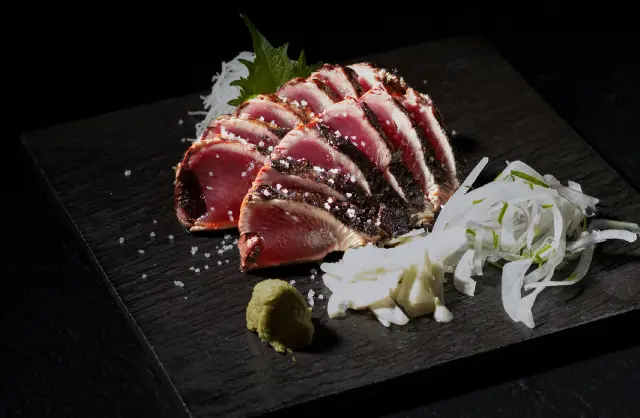
Of course you have to eat bonito when you come to Kochi! This time, I made a special trip to Myojinmaru Main Branch to try their legendary straw-seared salted bonito tataki.
It's seared over straw right in front of you, giving it an incredible aroma. The outside is lightly charred while the inside is fresh and tender, and just a little salt makes it so delicious you can't stop eating! Even the sashimi was fresh, sweet, and delicious.
As expected, it was extremely popular during mealtime and almost completely full! Just imagine chatting with friends while eating bonito and having a few drinks—that's what makes traveling so enjoyable〜
Kochi bonito is seriously irresistible. No wonder you keep craving it after trying it! Next time I come to Kochi, I'll definitely visit again!
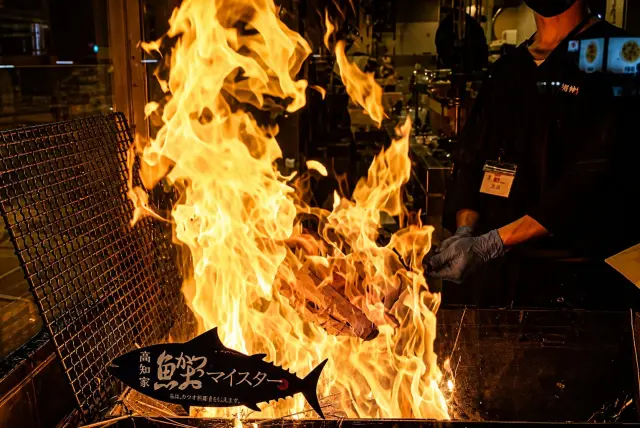
Myojinmaru Main Branch | Review by wendy
Other Reviews by wendy
-
Roadside Station Shodoshima Olive Park
This park is popular for its Mediterranean-like scenery and excellent facilities. There are many photo spots that make you want to take pictures, such as a white windmill perched on a hill overlooking the Seto Inland Sea and an English garden with approximately 120 varieties of herbs and roses in full bloom.
As the name suggests, this is a hill surrounded by olive trees. Following the winding path, the biggest eye-catcher is the windmill—a real-life setting from Kiki's Delivery Service!
Almost every visitor rents a broom, holds it between their legs, bends their knees, and jumps, trying to capture that “flying witch” look. The whole place is basically one giant flying photo studio.
Luckily, the weather was excellent that day, and we took postcard-like photos. There is also an exquisite statue of Athena in the park, while small yellow flowers and dandelion-like blooms cover the ground beneath the olive trees. In the sunlight, the scenery has a beautiful Mediterranean feel.
Since it was a three-day weekend in Japan, most visitors were Japanese, followed by Taiwanese, with a few Korean tourists as well. When no one was talking, it was honestly hard to tell which country anyone was from. -
-
Angel Road
Located in the southwest part of Shodoshima, "Angel Road" is a sandy path that appears twice a day at low tide, connecting four islands. It's a popular spot bustling with tourists, thanks to rumors that any two people walking hand-in-hand along the path will be blessed with happiness in the future. It's also frequently used as a filming location for movies and dramas.
We took a high-speed ferry all the way to Shodoshima for the dreamy “Angel Road” and even planned an overnight stay. It definitely didn't disappoint!
The most unique thing about this place is that **you can only walk across the sandbar to the island in the middle at low tide**. At high tide, you can only admire it from afar. We happened to arrive at high tide, so although we couldn't walk on Angel Road, we were unexpectedly treated to a gorgeous sunset. The orange-red sky reflected on the water, and it was incredibly romantic.
Staying at the Shodoshima International Hotel is an added bonus. You can enjoy the sunrise and sunset over Angel Road right from your room without having to deal with the crowds.
Sometimes that's just how traveling goes. Although the tide wasn't ideal, we got to see the most beautiful sunset.
**We didn't get to walk Angel Road, but an angel gave us a sunset instead. -
-
Oku-Iya Niju Kazurabashi Bridge
Beyond Oboke Gorge, called one of the leading unexplored regions of Japan, you will find Oku-Iya Niju Kazurabashi Bridge. On a plateau with an elevation of about 1000 meters, there is an ancient double suspension bridge by this name, made of creeping plants such as ivy-leafed ferns.
When visiting the remote mountains of Tokushima, Shikoku, don't miss the rustic Oku-Iya Niju Kazurabashi Bridge! The vine bridges suspended over the gorge sway slightly as you walk, with a mountain stream directly below your feet. It's quite a thrill, so you'll definitely need some courage.
This time, we visited both Iya no Kazurabashi and Oku-Iya Niju Kazurabashi. The scenery and experience were actually very similar. However, the former is easier to access and much more crowded. You often have to wait in line, and people have to walk shoulder to shoulder across the bridge, making it really hard to take good photos.
In contrast, Oku-Iya Niju Kazurabashi is in a more remote location, so there are far fewer visitors. You can take your time walking and taking photos, and you also get to experience both the Male Bridge and Female Bridge!
If you can work out the transportation, I'd recommend this place instead. It feels much more secluded, and you can enjoy the experience more fully! -