
Create Your Own One-of-a-Kind Sake! Experience the Depth of Sake Blending at My Sake World
Have you ever thought, “I’d like to make sake that suits my own taste”? Sake is usually enjoyed as it is, but it can also be blended. You can mix different labels from the same brewery or combine sake from different breweries. Brewing sake itself is difficult, but blending makes it easy to create a drink tailored to your preferences. Even today, some breweries make products by blending various labels, and in fact, sake shops during the Edo period sold blended sake adjusted to each customer’s taste.
It is a method with a long history in Japan. Blending sake can create a deeper flavor or bring the taste closer to your own preferences. Why not try this experience in Kyoto, a city known for sake? There is a facility where you can blend sake from various breweries and take it home with you. Using droppers and beakers to mix sake feels just like a science experiment, and it is now a very popular experience in Kyoto.
This article introduces sake blending and a facility where you can try it. If you’re thinking of tasting sake in Kyoto, be sure to read this before your trip!
What Is Sake?
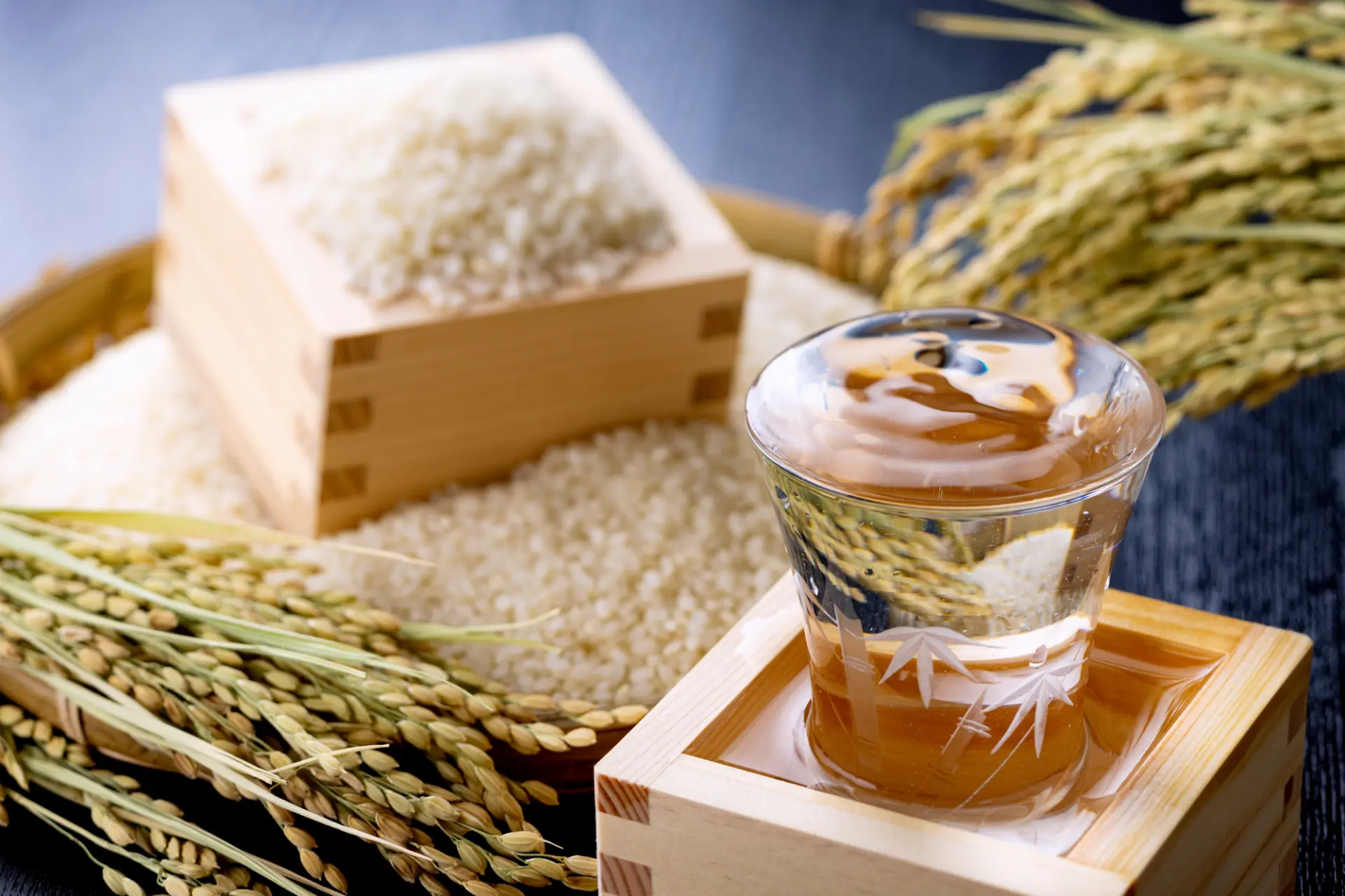
Sake is a uniquely Japanese brewed alcoholic beverage made mainly from rice, rice koji, and water. There are various theories, but rice cultivation is said to have begun in Japan about 3,000 years ago, transforming people’s lives from the days of hunting and spreading a rice-farming culture. Although there is no exact historical record, it is believed that sake began to be made sometime after that. As rice-farming culture spread, rice harvests came to be greatly affected by the weather, and over time, the Japanese people developed a deep awe and respect for nature. Nature itself came to be regarded as divine, and customs arose in which rice and sake were offered to the gods, then received as sacred offerings afterward. Even today, sake is offered at shrines, placed on household Shinto altars, and remains essential to Shinto rituals. More than just something for gourmet dining or getting tipsy, sake is deeply connected to Japanese culture and festivals.
What Does It Mean to Blend Sake?
Many people may think of sake as something to enjoy by each label’s individual character, such as “Dassai,” “Kokuryu,” or “Juyondai.” This is because in the modern era, brewery brands became established, people began to enjoy the “individuality of each brewery,” and brewing techniques for ginjo and junmai sake improved, leading to the production of many sake varieties that taste great on their own.
However, if you look back as far as the Edo period, blending sake was actually quite common. At that time, brewing techniques were not as advanced as they are today, and the quality of sake was not stable. Even at the same brewery, the quality of rice varied from year to year due to weather, rice-polishing techniques were not yet highly developed, and temperature control was difficult, so the finished sake differed depending on the year. Breweries also blended sake to even out the flavor and stabilize quality. It is said that the practice of mixing sake was called “aishu” at the time. Even today, some major breweries adjust sake from different tanks before shipping in order to keep the flavor consistent.
Also, during the Edo period, sake shops—retailers—are said to have blended sake according to customers’ preferences. In an era before bottles, sake was delivered from breweries to shops in barrels. Customers would go to a sake shop with their own “kayoi tokkuri,” a reusable sake flask similar to a personal bottle today, and buy sake by measure. At that time, the shop would blend sake to match requests such as “a little drier” or “make it sweeter!” Records remain showing that some sake shops created blends according to such customer preferences.
When you think about it, blending is also done with wine, whisky, coffee, rice, tea, and more, so it makes sense that blending sake can create a delicious drink too.
Sake Blending Experience at My Sake World
The facility that has revived this traditional way of enjoying sake from the Edo period for the modern day is My Sake World Kyoto Kawaramachi in Kyoto City. Here, you can taste different sake as you blend them to your liking and create your very own “My Sake.”
The facility’s beginnings reportedly came from the idea that “there may be other ways to enjoy sake besides just drinking it,” leading the founders to make and sell blended sake together with breweries. When they brought blended sake to restaurants, they were told, “If it’s easy to adjust the flavor, we’d like you to make an original blend just for us!” As they blended sake together, people responded that the blending process itself was fun. That led to the idea that turning it into an experience might help spread awareness that sake can be blended. The idea worked! Sake blending is now gaining popularity, and the number of participants is rapidly increasing.
Another appealing point is that it is within walking distance of Shijo-Kiyamachi, Kyoto’s busiest downtown area, and Kiyomizu-dera Temple, making it easy to stop by while exploring the city. It’s great for friends or couples, and solo visitors can casually drop in as well. Try various sake and create your own perfect blended sake, your “My Sake.”
Try Making Your Own “My Sake”!
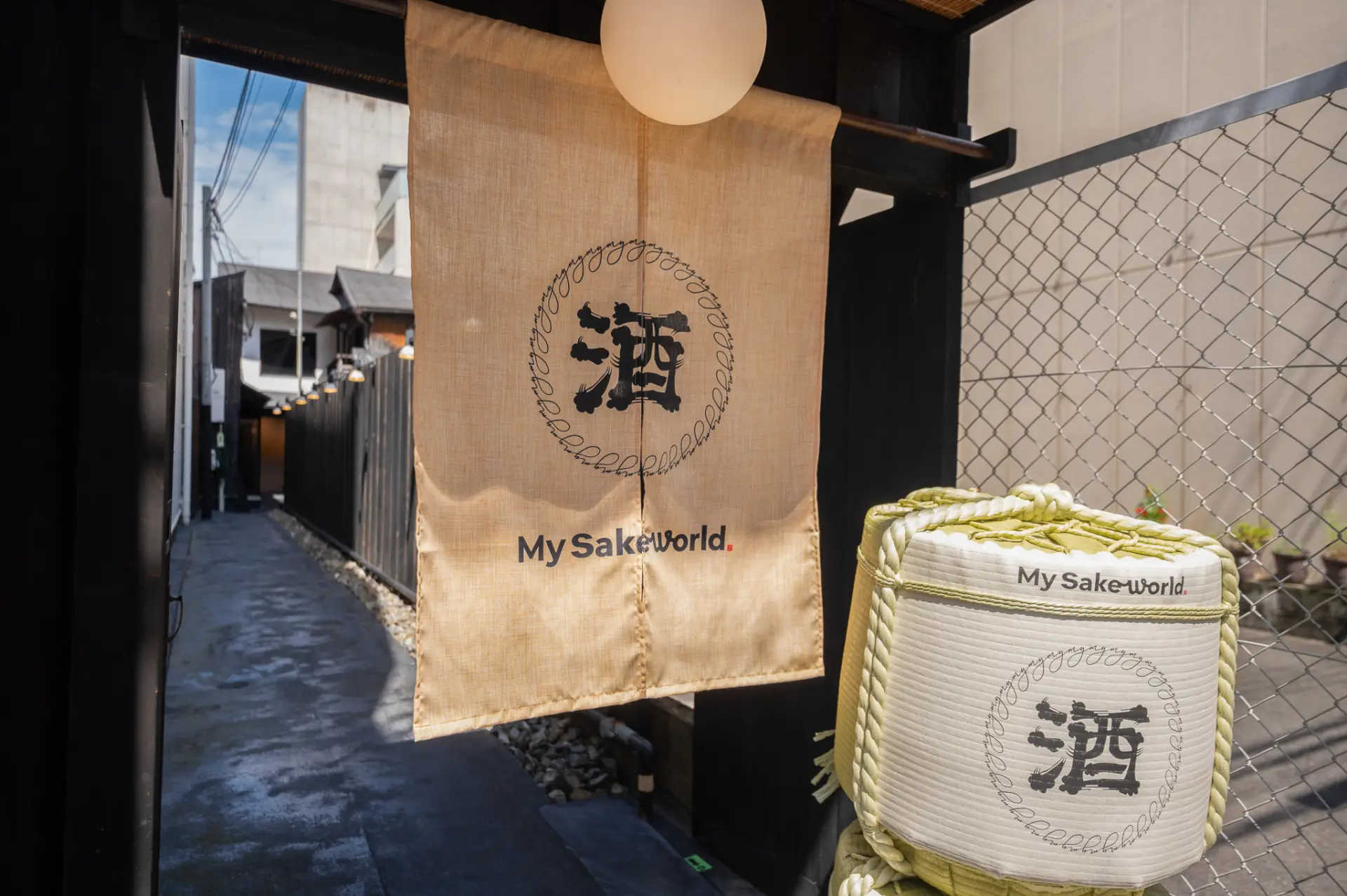
My Sake World Kyoto Kawaramachi is about a 7-minute walk from Hankyu Kawaramachi Station. Take Exit 10, then head south on Teramachi Street.
The spacious interior can accommodate up to 30 people. The experience is basically done standing, and one of its features is that you can participate without a reservation. Seated participation is also possible, but there are only 6 seats, so reservations are required if you prefer to sit. Groups are welcome too, and recently, more companies have been using the experience for corporate training.
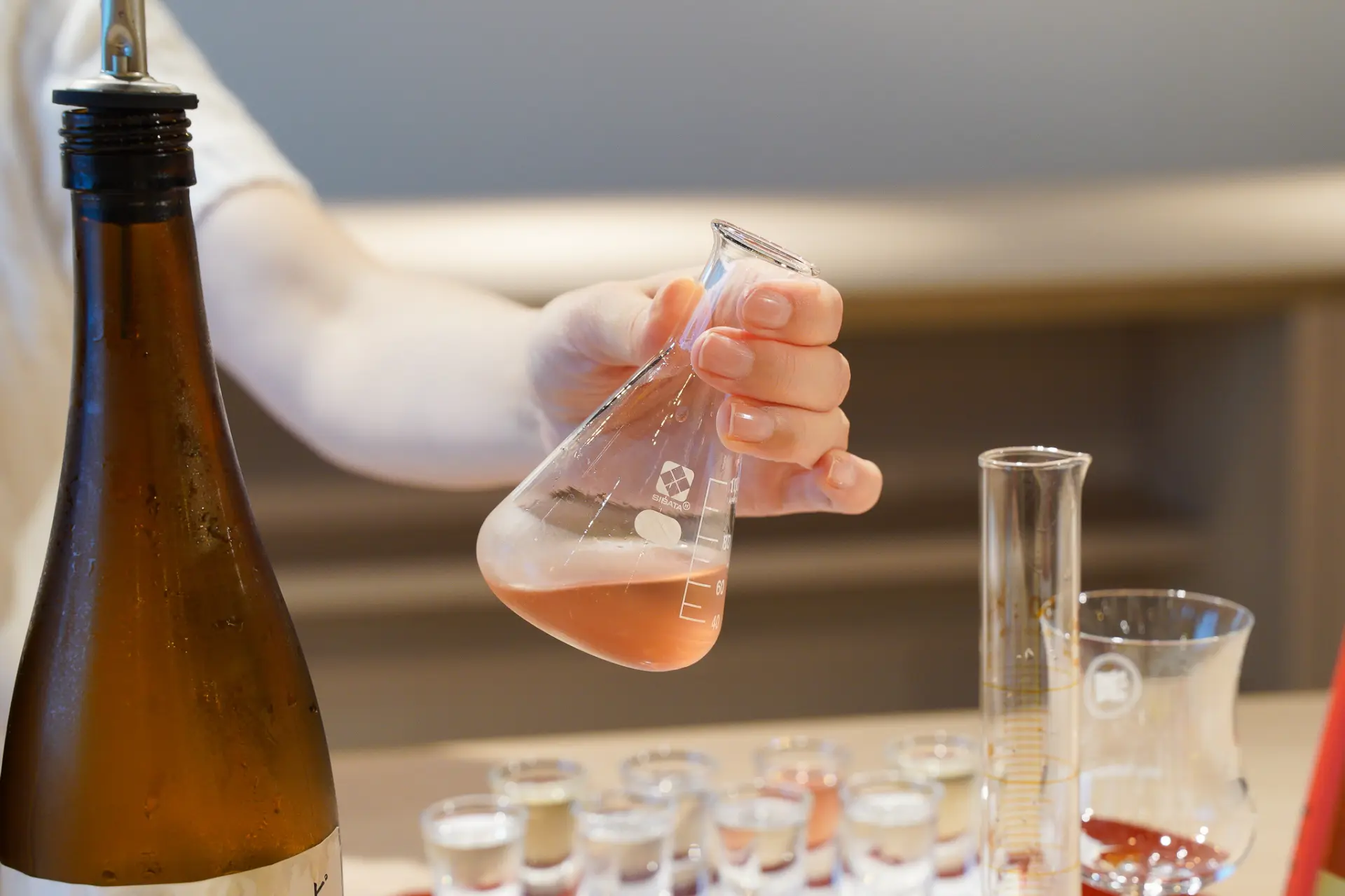
Graduated cylinders and Erlenmeyer flasks are set up on the tables, making it feel just like an experiment in a science classroom. It’s exciting to wonder what will begin.
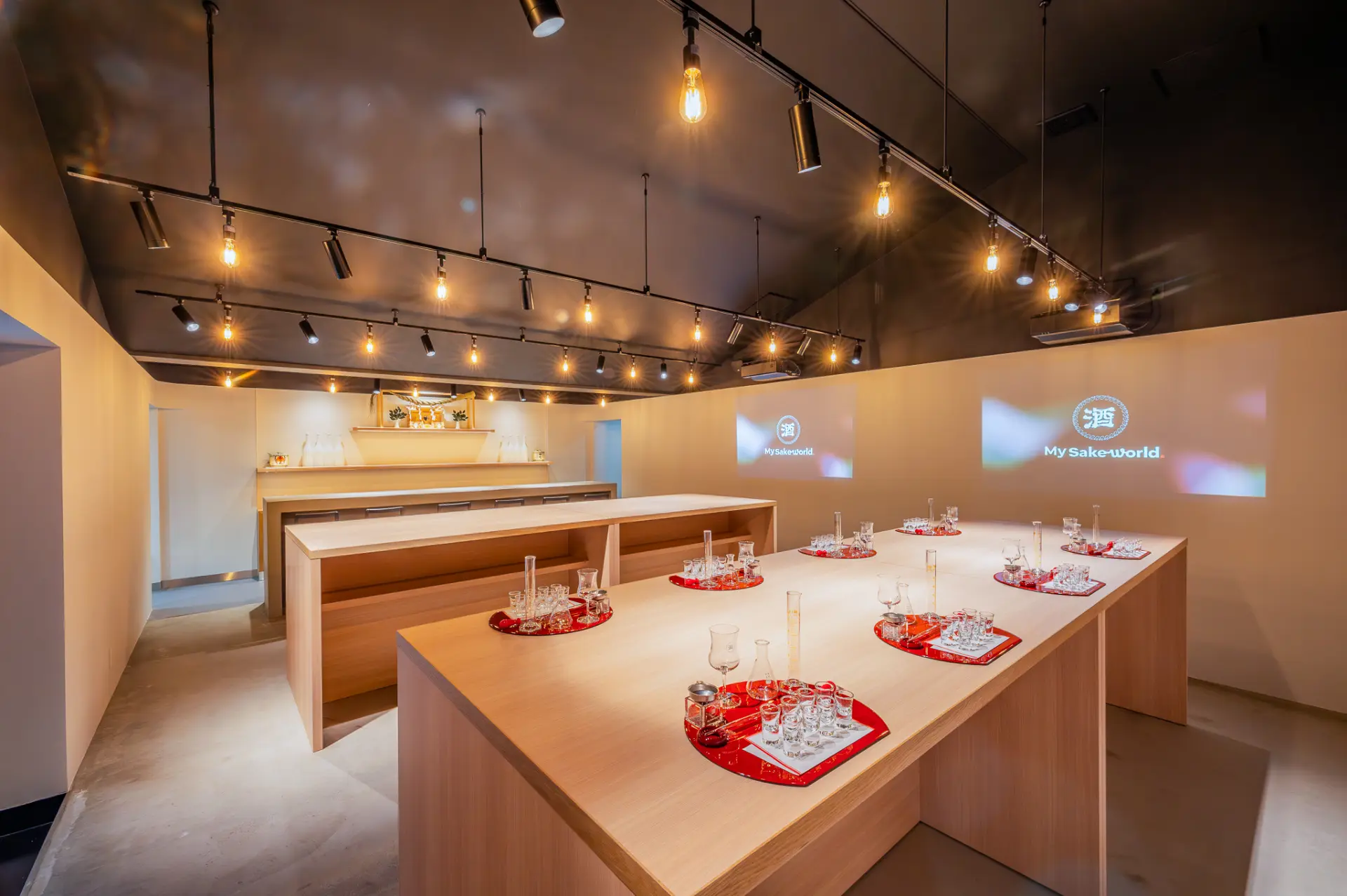
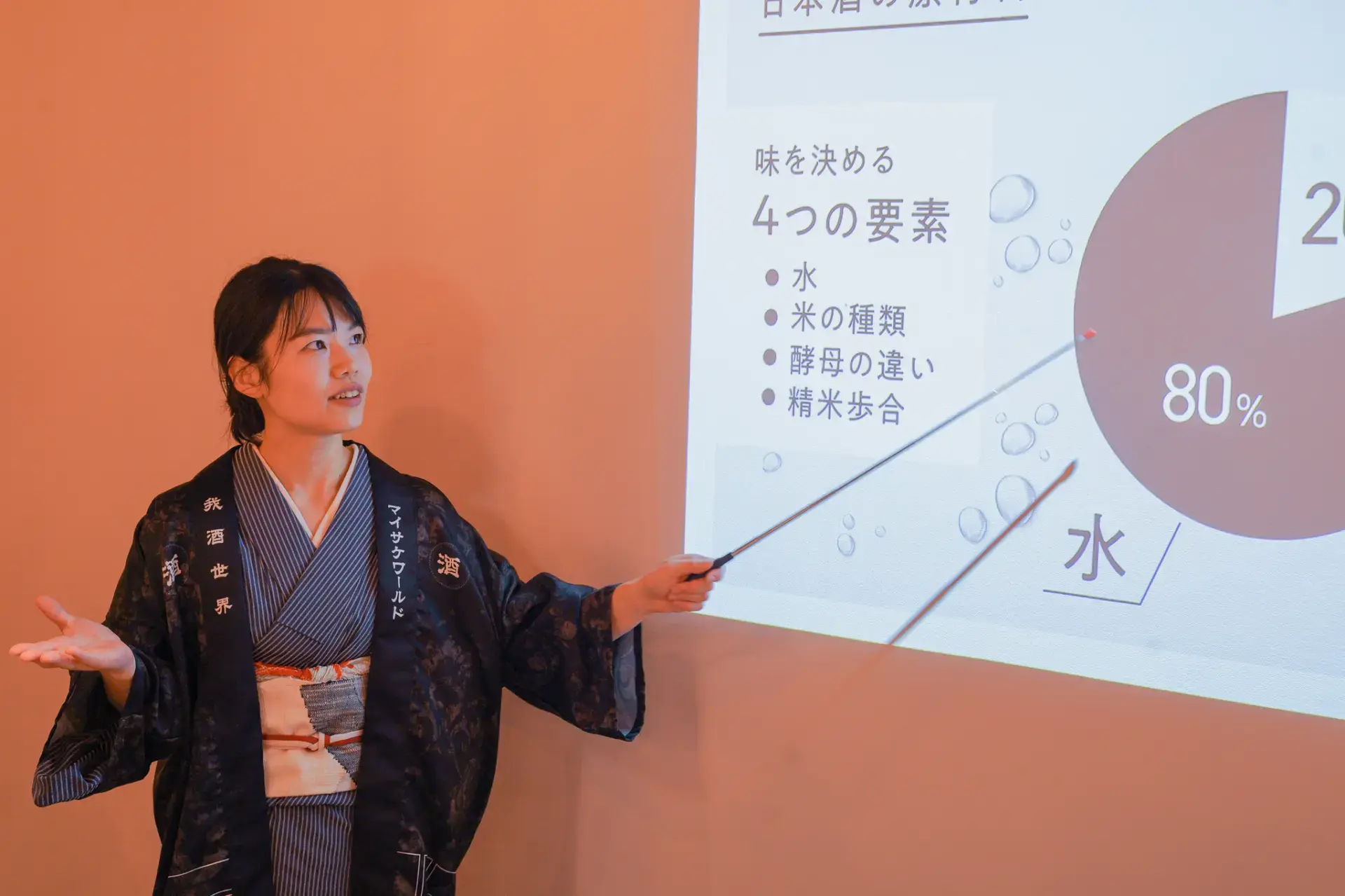
Before the blending experience begins, there is a short classroom-style lesson.
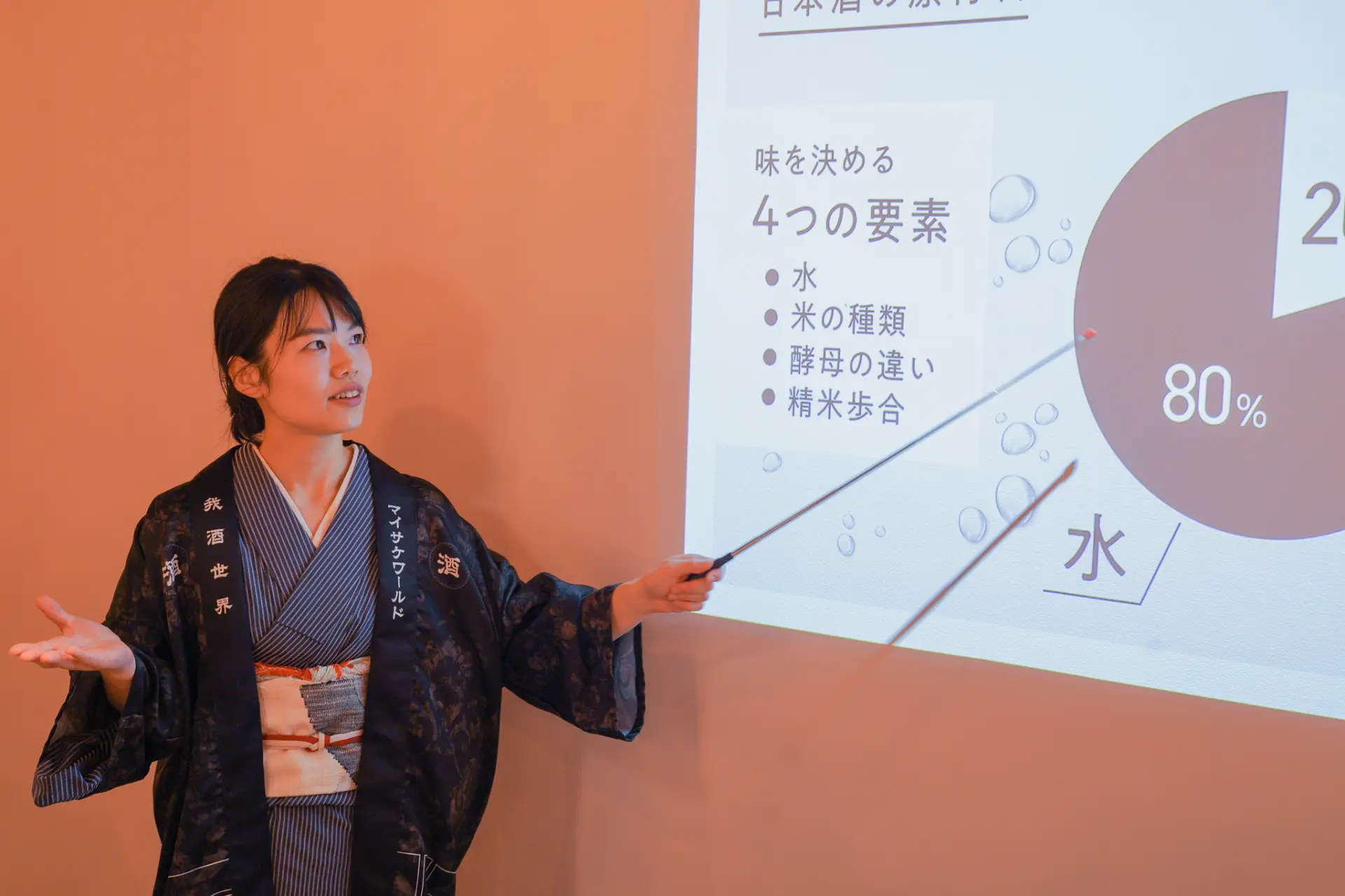
We learned about the history of sake, how deeply it is connected to Japanese festivals and Shinto rituals, and how “traditional knowledge and skills of sake-making with koji mold in Japan,” including this culture and spirituality, was inscribed on UNESCO’s Intangible Cultural Heritage list in 2024. The staff also explains in detail sake categories such as junmai, junmai ginjo, and junmai daiginjo, as well as how flavor differs depending on the rice-polishing ratio, so even those who do not know much about sake can enjoy the experience with confidence.
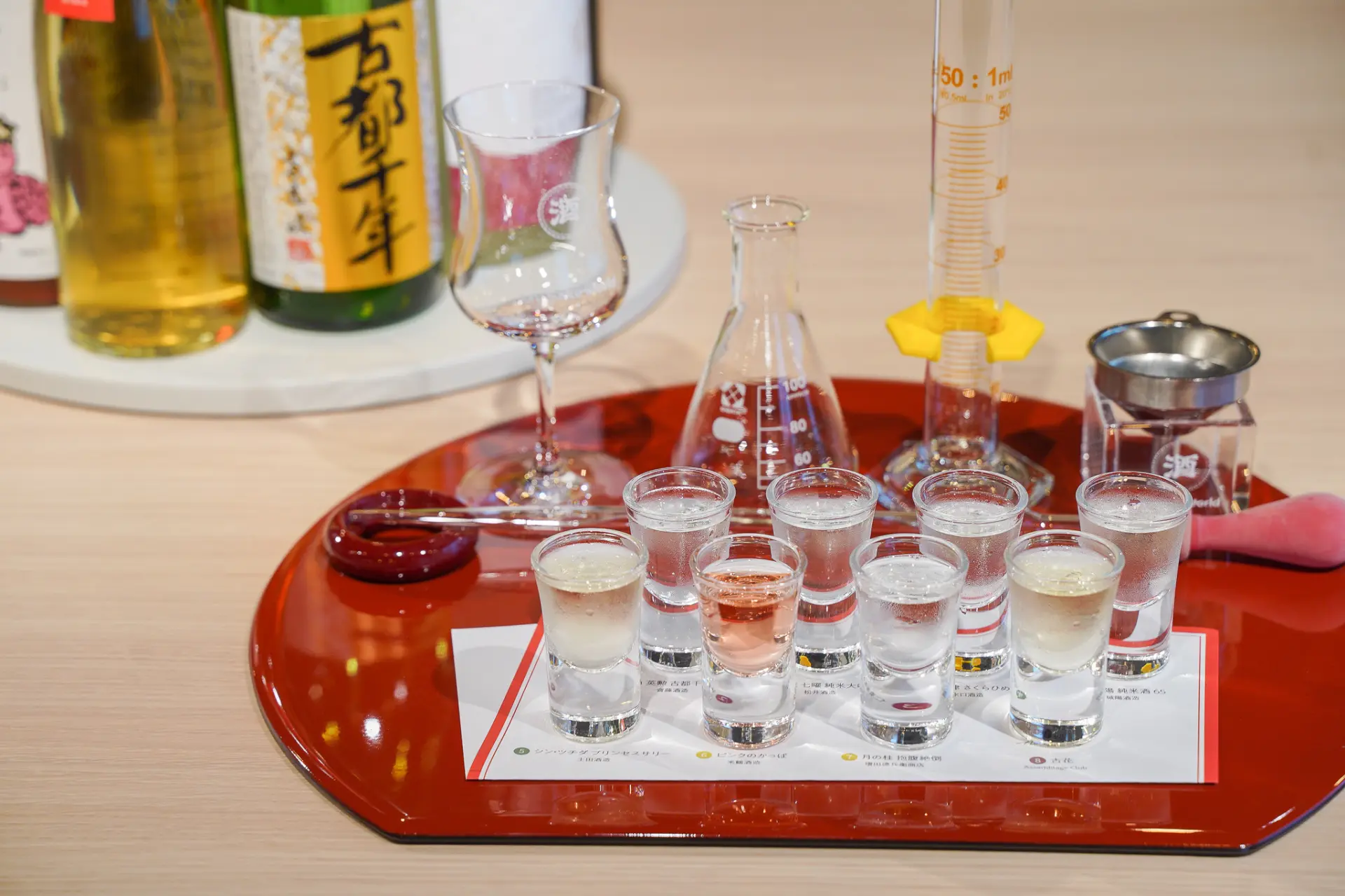
After the roughly 10-minute lesson, you taste the 8 types of sake to be blended that day.
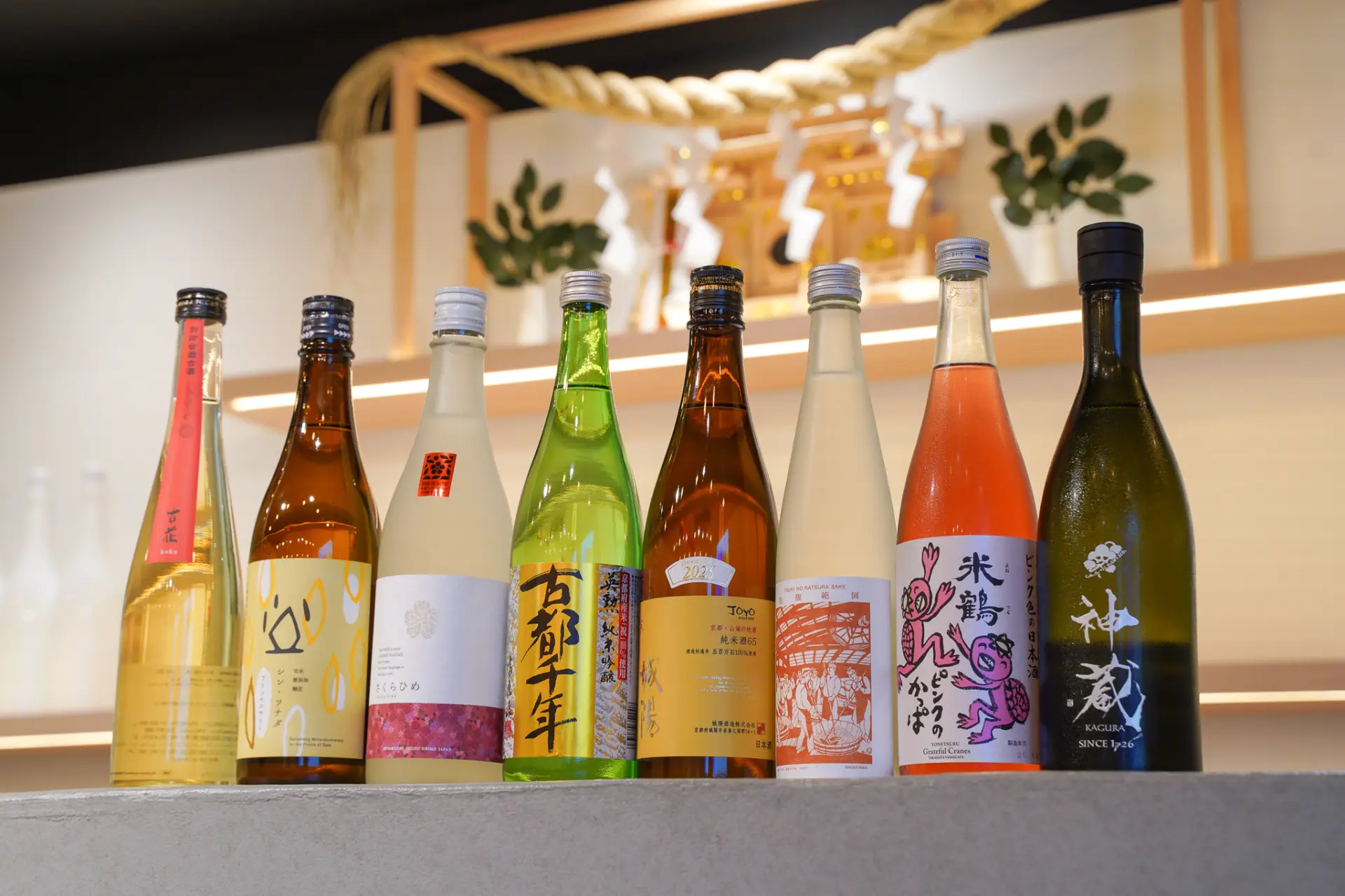
Our visit was in June 2026. The lineup that day consisted of 8 types: “Eikun” from Saito Sake Brewery in Kyoto, “Kagura” from Matsui Sake Brewery in Kyoto, “Nikitatsu” from Minakuchi Shuzo in Ehime, “Joyo” from Joyo Shuzo in Kyoto, “Shin Tsuchida” from Tsuchida Sake Brewery in Gunma, “Pink no Kappa” from Yonezuru Sake Brewery in Yamagata, “Tsuki no Katsura Houfukuzettou” from Masuda Tokubee Shoten in Kyoto, and “Assemblage Club 06 KOKA-Koka-” from Kyoto’s Assemblage Club. They work with 50 breweries from across Japan, mainly in Kyoto, and the sake lineup changes once every 6 months. Each time, they choose 8 types while considering how well the sake varieties pair with each other.
You taste each one in order, and as you do, make a note of 3 sake you like. The staff says that if you think too logically about the combinations, it often does not go well and you may end up with a “My Sake” that does not match your taste, so it is best not to overthink it and to follow your instincts.
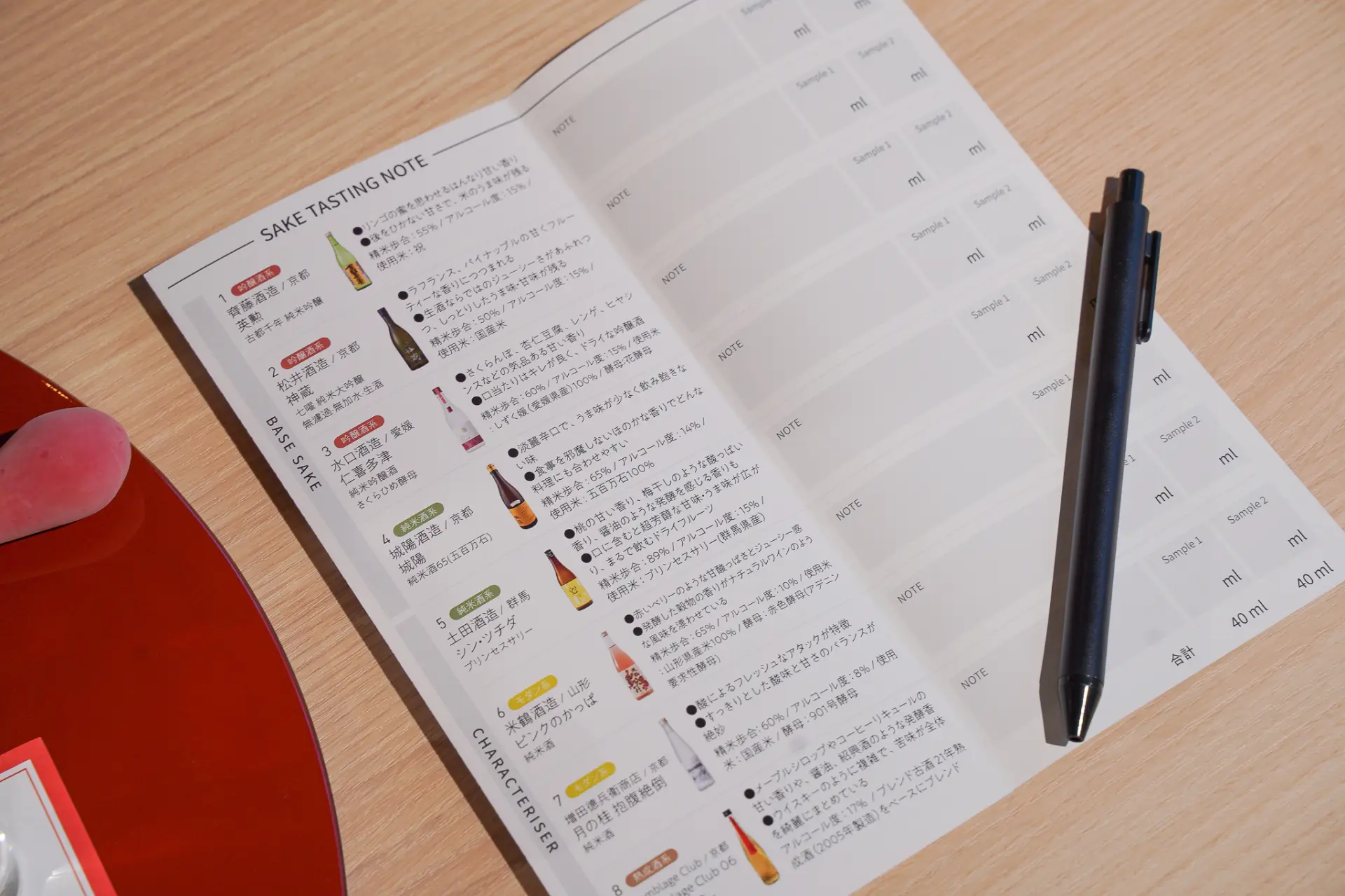
The sake is broadly divided into 4 types: ginjo-style, junmai-style, modern-style, and aged-style. You taste each one while the staff explains what kind of sake it is.
First are 3 ginjo-style sake, all known for their aroma.
The first, “Eikun,” features a sweet aroma like apple nectar, but the sweetness does not linger, and the umami of the rice remains in your mouth. It is one of the sake brands often seen at restaurants in Kyoto. I liked the flavor, so I marked this as my first pick.
The second, “Kagura,” is also one of Kyoto’s popular sake brands. It is very tropical, with an aroma often described as La France pear or pineapple. This one is nama-zake, or unpasteurized sake, which also gives it a juicy character. I liked its bright aroma that brings summer to mind, so I marked this as my second pick.
Next, “Nikitatsu” is brewed using flower yeast, giving it a sweet aroma reminiscent of cherries. At the same time, it has a crisp mouthfeel and is a dry ginjo sake.
By comparing them in small amounts, you can once again realize how much the taste and flavor can differ by brewery, even among the same ginjo-style sake.
Next are 2 junmai-style sake.
“Joyo” is light and dry. Its aroma does not interfere with food, and the flavor is one you will not tire of. Since it pairs easily with any kind of dish, I also often choose it with meals in everyday life.
From here, the distinctive sake continued! You are sure to be surprised by the wide range of flavors sake can have.
The second junmai-style sake was “Shin Tsuchida.” It was my first time trying it, and my first impression was, “Does this taste like curry?” And that makes sense. It is actually made with an indica rice called “Princess Sari.” We also heard that this sake takes global warming into account, against a background in which sake rice is suffering high-temperature damage and harvest yields are decreasing. It is a sake full of stories that overturns the assumption that sake must be made with japonica rice. It is characterized by extremely rich umami.
When tasting “Shin Tsuchida,” you experience umami—discovered in Japan and now recognized internationally—together with dashi made only from bonito and kombu.
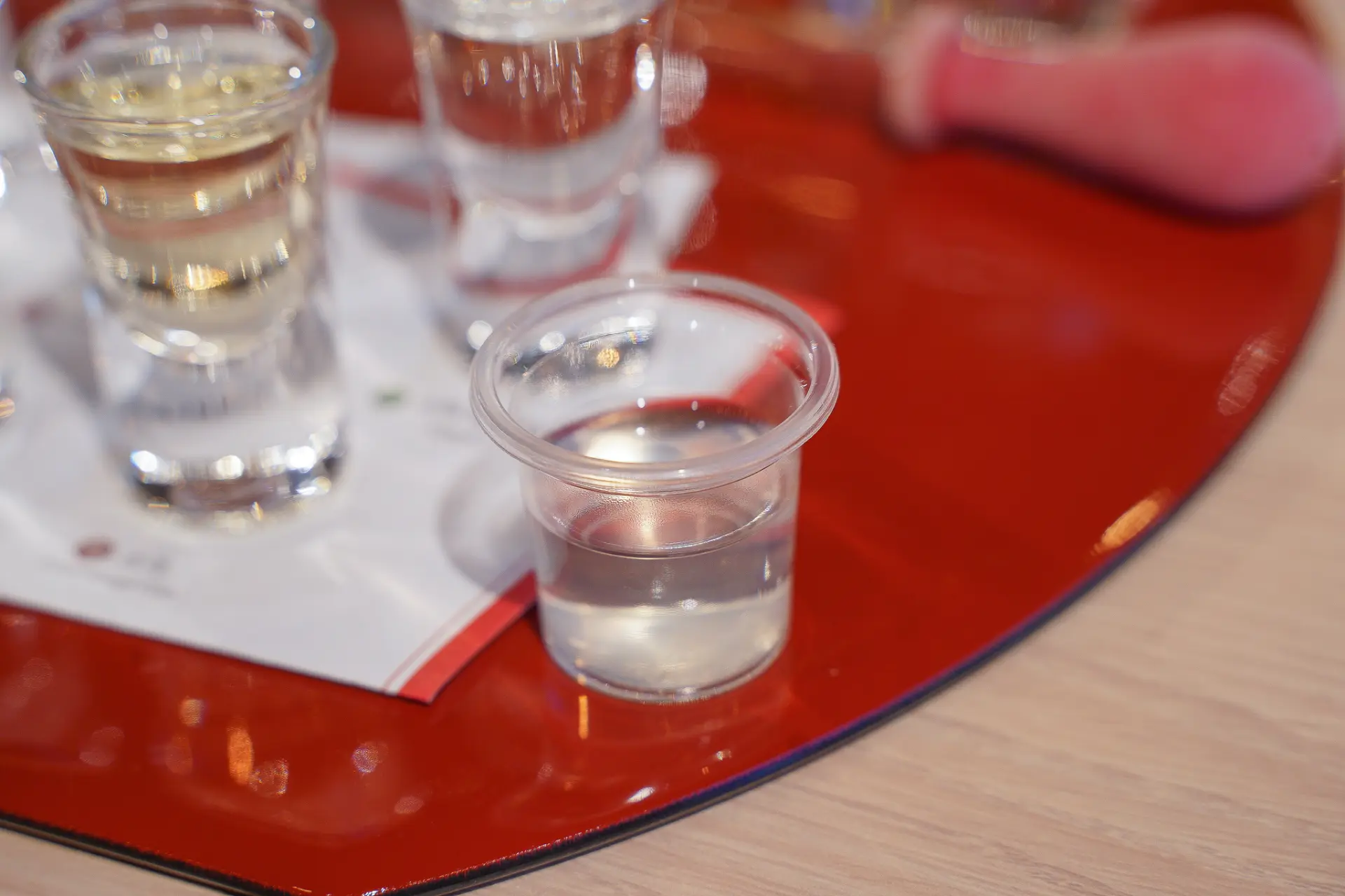
The staff explained that umami is the reason something can taste good even without being seasoned with salt or soy sauce. When you take another sip of “Shin Tsuchida” at this point, you can feel the umami elements drawing each other out and becoming even stronger. Incidentally, they always include 1 sake with strong umami, so even if the sake lineup changes, you can still experience a comparison of umami.
Next are 2 modern-style sake with flavors you might not expect from sake.
The first modern-style sake has a faint pink color. “Pink no Kappa,” with its berry-like sweet-and-tart flavor, is made with red yeast. It also has a wine-like quality. I liked its sweet-tart taste, and I thought adding pink would give the sake color and make it look festive, so I marked it as well.
My first impression of “Tsuki no Katsura Houfukuzettou” was its refreshing acidity. But it also has sweetness, and you can tell it is a very well-balanced sake. This one also suited my taste and caught my attention.
Last is the aged-style sake. The staff said they want people to know that sake can become delicious through aging. That sake was “Assemblage Club 06 KOKA-Koka-.” It had richness and a slight bitterness, with a complex flavor reminiscent of Shaoxing wine.
The lineup is designed to be easy to understand so that even people who have not been very familiar with sake can learn how production methods affect flavor and discover the depth of sake. Every single one truly had a distinctive flavor, and it was enjoyable to taste them while noticing their differences.
Now it is time for your first step as a sake blender!
Centering on the sake you marked, you create a total of 40 ml. The reason for choosing around 3 types is that if you increase the number beyond that, it becomes harder to adjust, so about 3 types is just right.
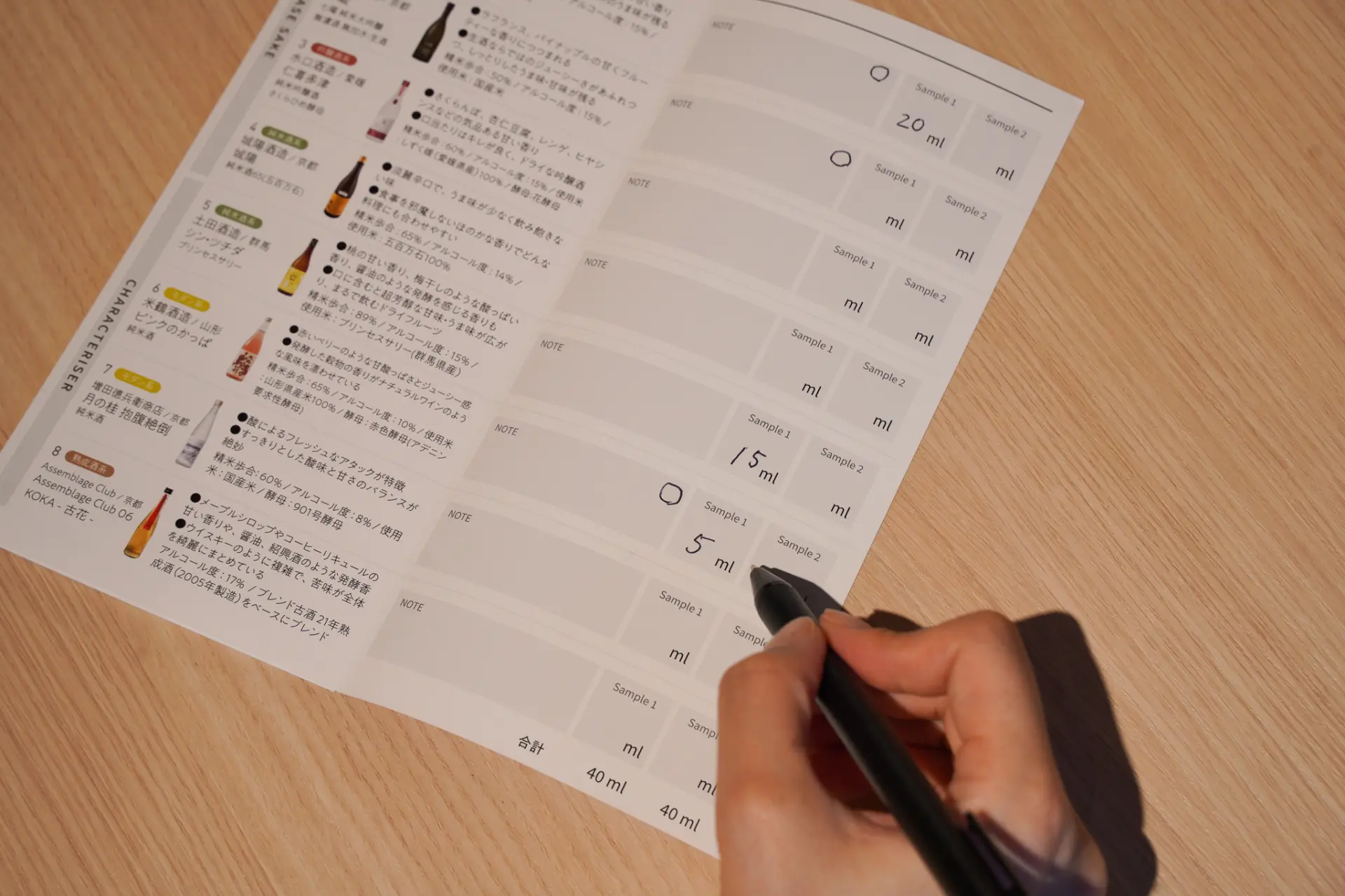
This time, I marked “Eikun,” “Kagura,” and “Pink no Kappa,” but the umami of “Shin Tsuchida” stayed with me, so I decided to include that too.
In the end, I chose to make it with 20 ml of “Eikun,” 15 ml of “Shin Tsuchida,” and 5 ml of “Pink no Kappa.”
You measure the sake while checking the markings on the graduated cylinder.
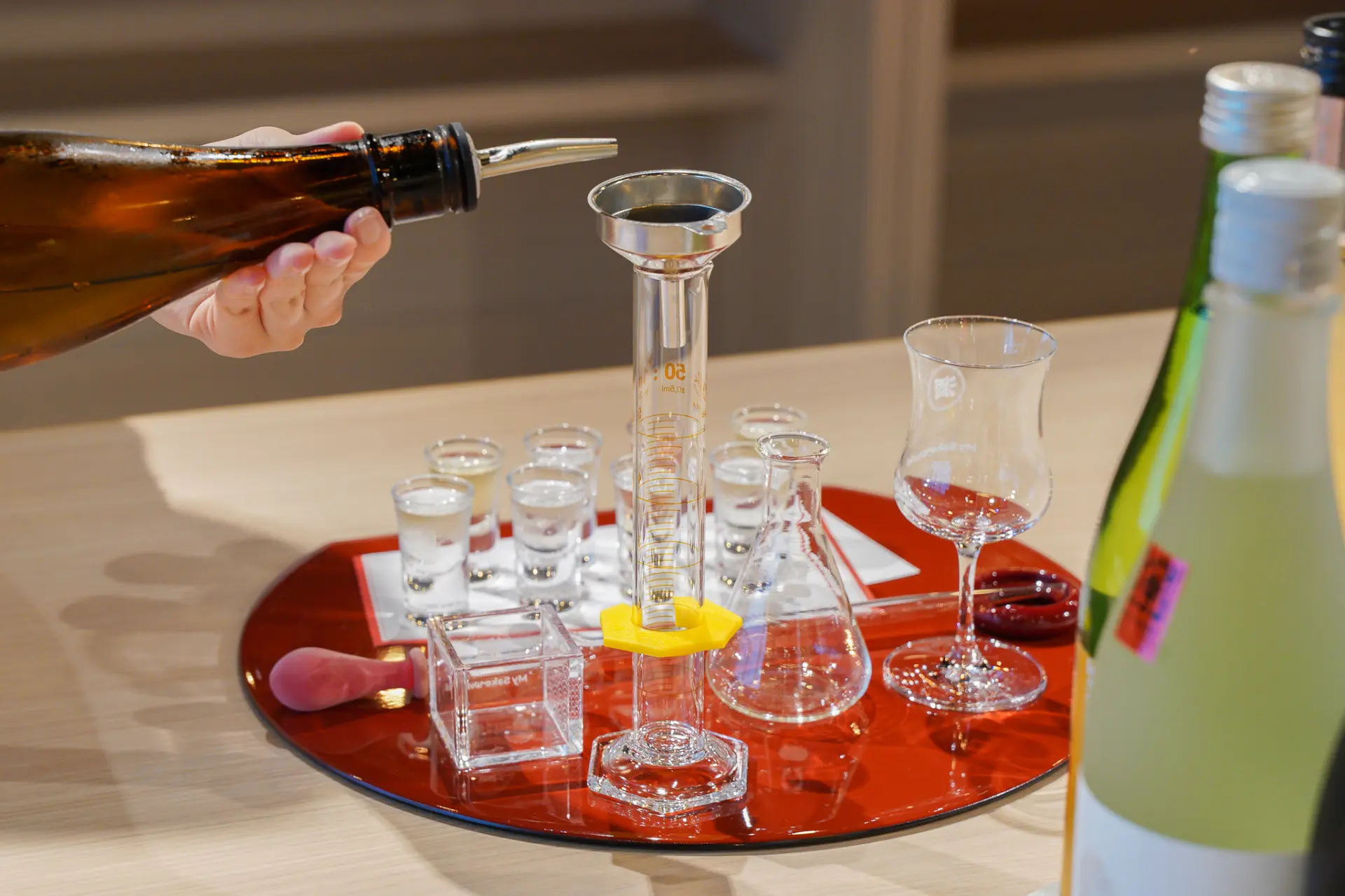
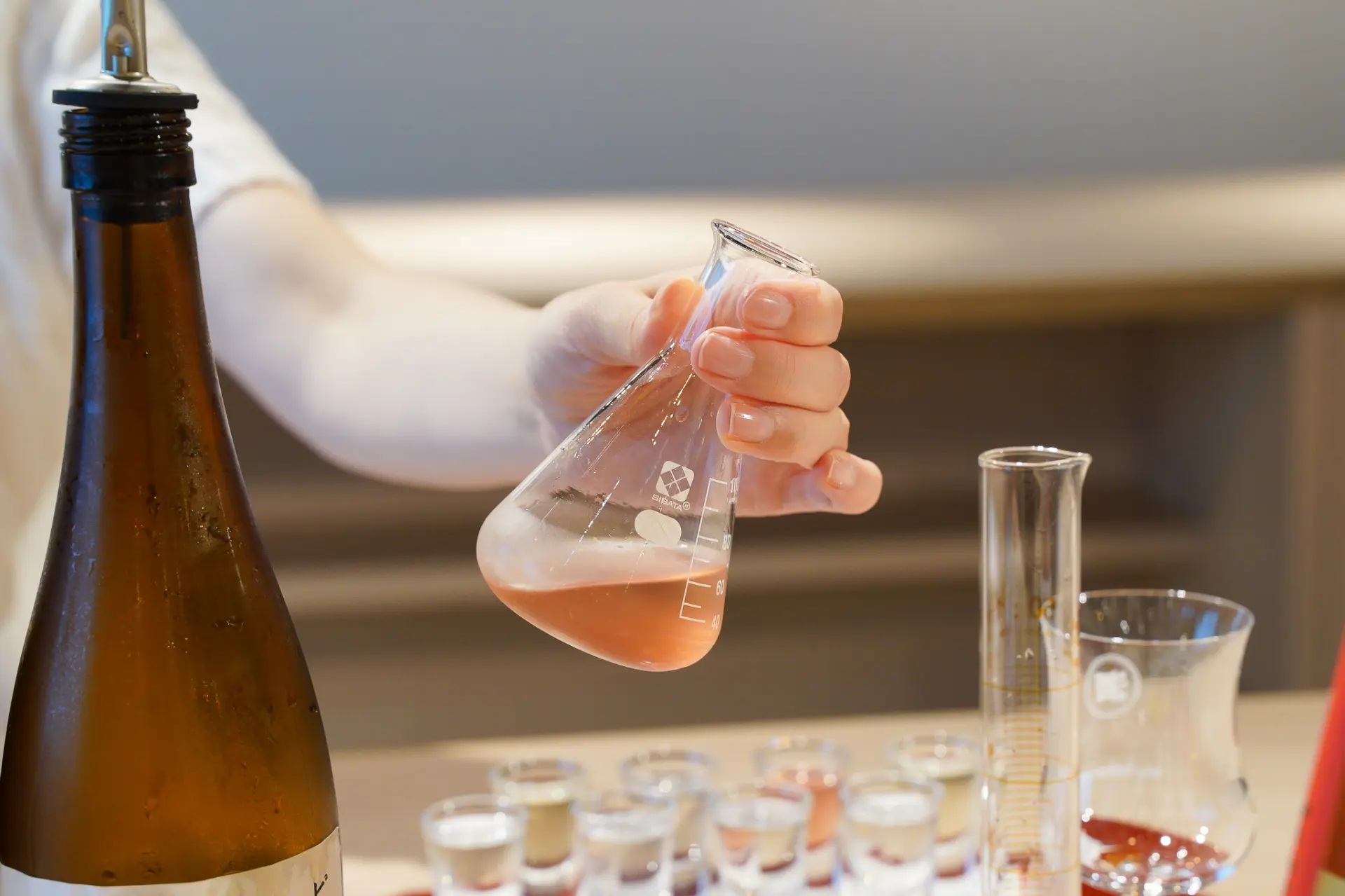
The measured sake is poured into an Erlenmeyer flask. Repeat this process until all 3 types of sake are in the flask. This step really feels like a science experiment. It was a strange sensation that also made me feel a little nostalgic.
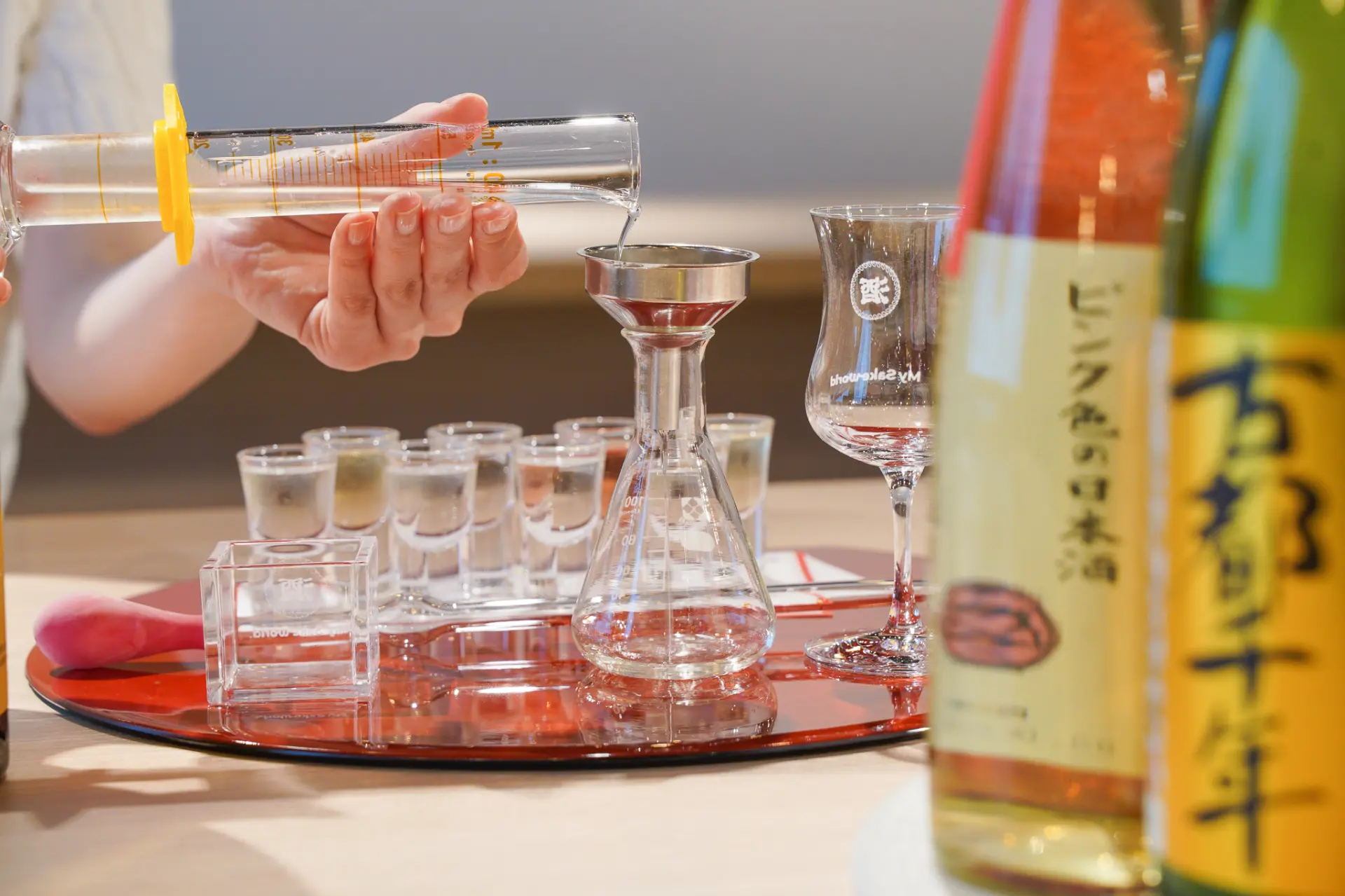
Swirl the flask to mix it, then pour it into a glass, and it’s complete.
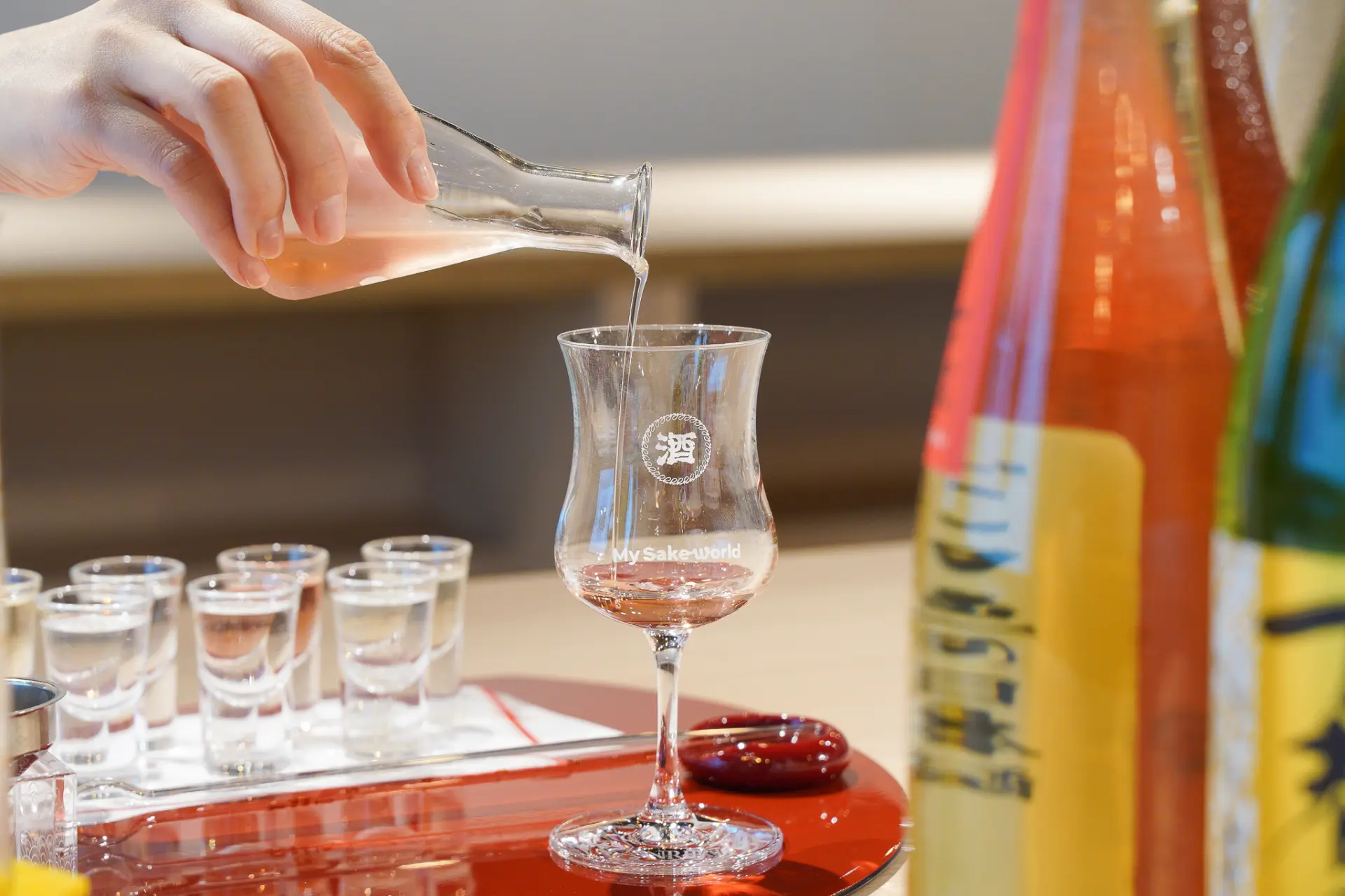
Now, let’s taste it and see if it turned out to suit my preferences!
The result was refreshing, with sweetness from “Pink no Kappa” and richness from “Shin Tsuchida.” As expected, when you bring together only the sake that instantly appealed to you, you can end up with a spot-on delicious drink unlike anything you have tasted before. I was surprised!
Next is the second blend. You can use the same sake and change the ratios, or if you like your first blend and do not feel it needs adjustment, you can make something completely different. Either is fine.
This time, since I was satisfied with the first blend, I decided to use different types of sake to create a different flavor.
I tried 3 types: 30 ml of “Eikun,” 5 ml of “Kagura,” and 5 ml of “Houfukuzettou.” Just like before, I measured them with the graduated cylinder, poured them into the Erlenmeyer flask, mixed them, and poured the blend into a glass to complete it.
When I tasted this one, it also matched my preferences quite well. A tropical sweet-and-tart note was added to the sweetness, creating a flavor that makes you want to drink it heartily in summer.
After 2 trial blends, I had created 2 blended sake that suited my taste!
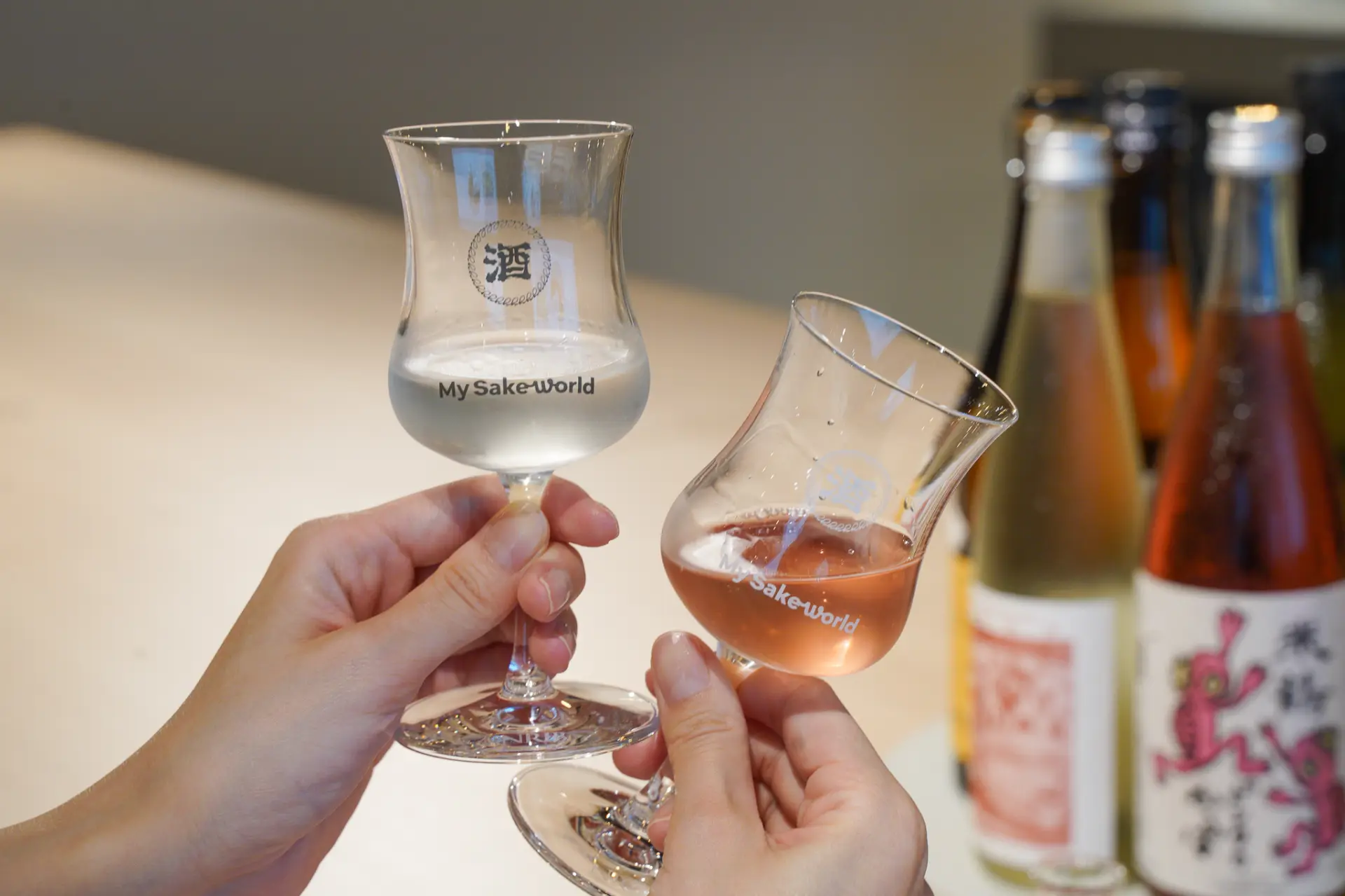
Now compare the finished blends. Take your time deciding which one you like better.
I felt that I might prefer the second one, so the “My Sake” I would take home was decided: the second blend!
Write the finalized sake and the amount of each in the recipe notebook and hand it to the staff. While they make it for you, choose a label for the bottle. There are 4 types to choose from: black and white labels, plus 2 floral designs.
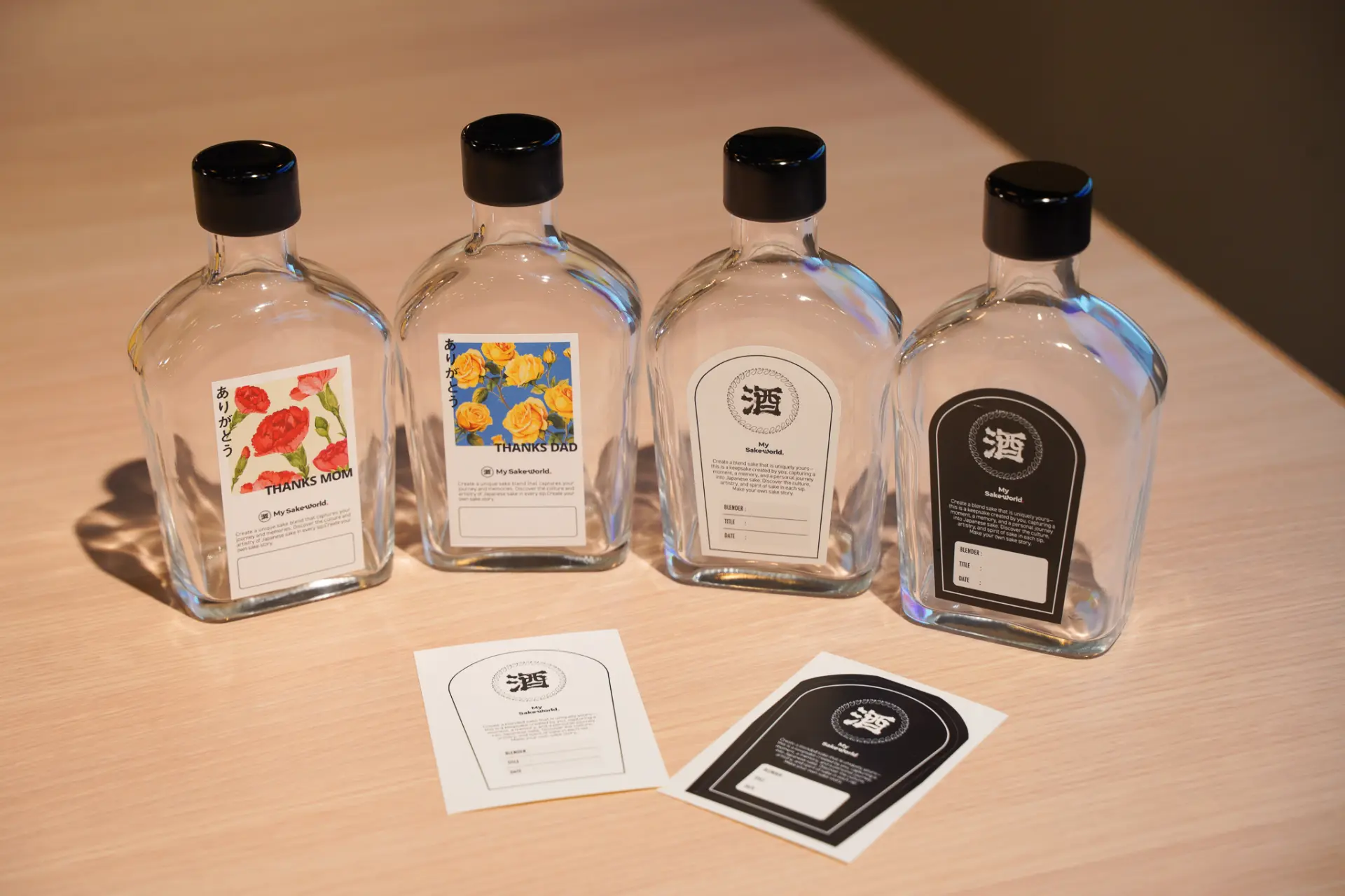
This time, I chose the white label. Write your name, the date, and the name you have chosen for your “My Sake.”
The finished sake is bottled at SakeWorld Makino Brewery, a separate building by the entrance, and handed over at the brewery counter there.
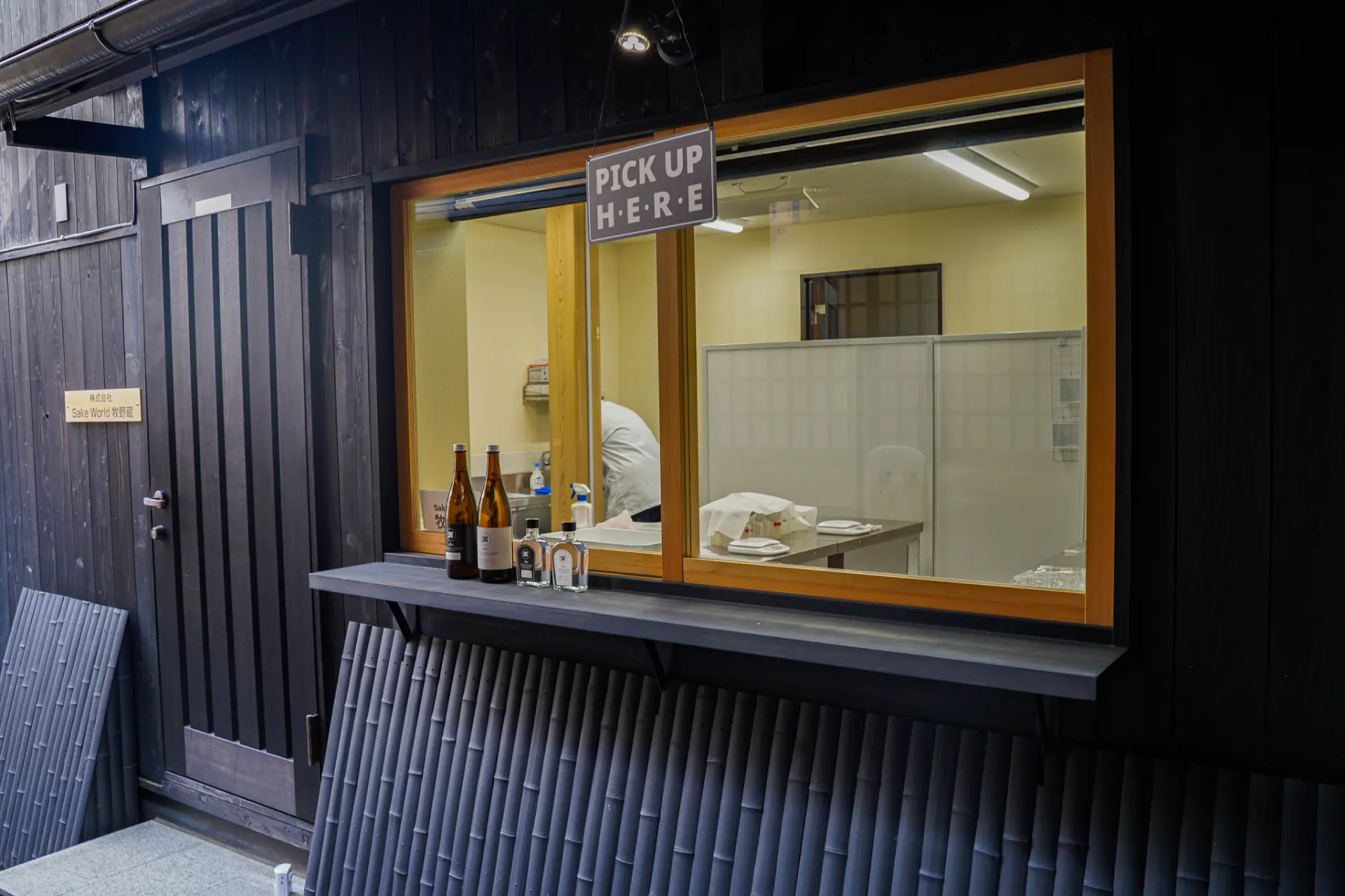
I received my “My Sake” and a certified sake blender certificate.
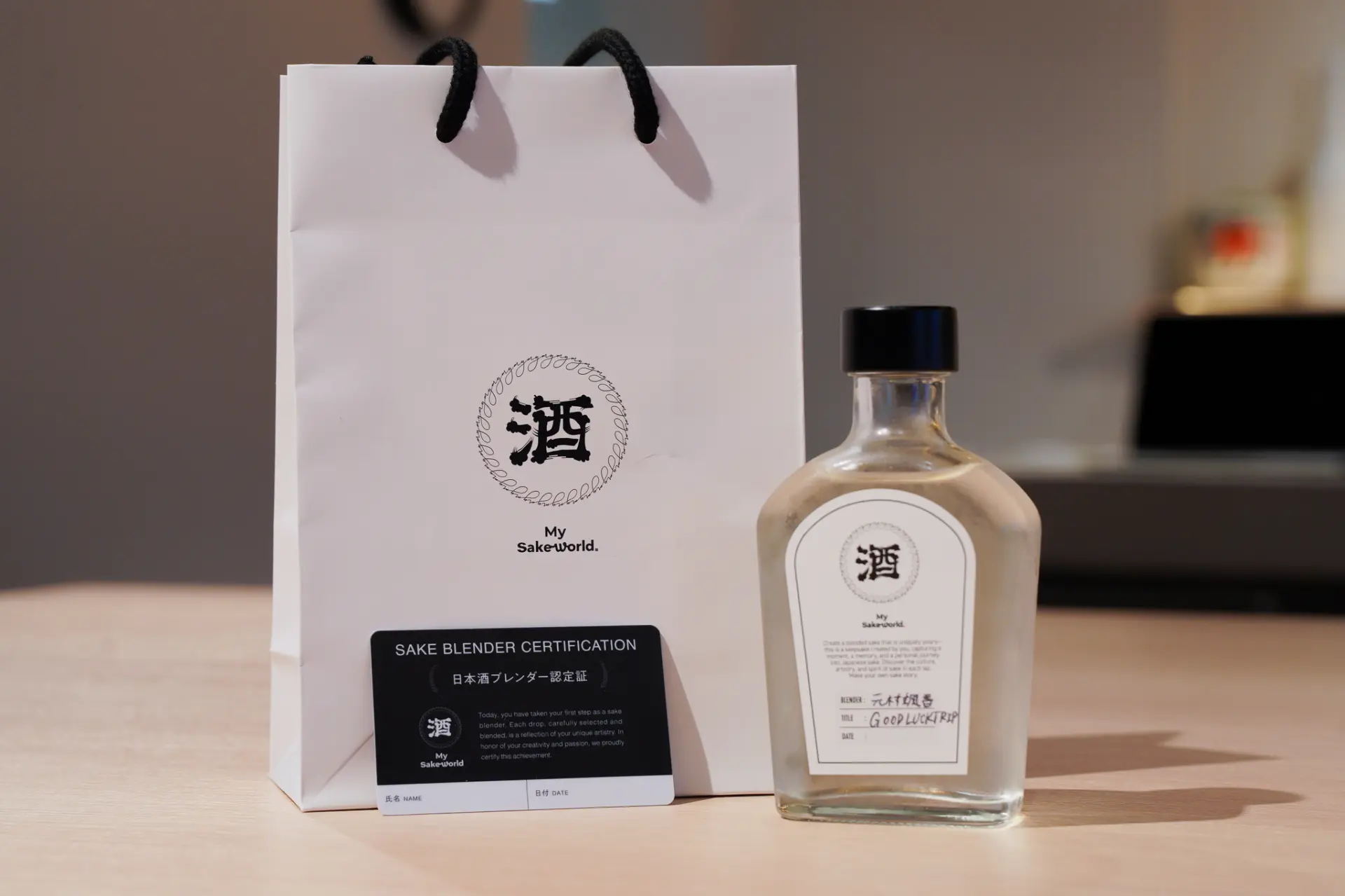
For the completed “My Sake,” the recipe is saved at the brewery, so if you are in Japan, you can purchase it again until the lineup changes, for up to 6 months.
At My Sake World Kyoto Kawaramachi, you can also participate in a sake tasting comparison experience, not only the blending experience. In the tasting comparison experience, staff introduce each label in detail as you drink, so unlike a tasting set at a restaurant, it is recommended for those who want to drink while gaining a deeper understanding of sake.
Summary
I had a strong image of sake as something to be tasted as a single label on its own, but looking back through its history, I learned that the culture of mixing sake is also part of sake’s story, as shown by records of the word “aishu.” Through the sake blending experience, I was able to reconnect with the deliciousness of rice and water, as well as Japanese culture. In addition to the fun of searching for a favorite label, I felt this experience lets you discover the joy of creating a flavor all your own.
The “My Sake” I made by trusting my instincts became one of my favorite bottles! For this visit, I went alone, and there was a special kind of enjoyment in quietly and seriously focusing on sake. In fact, I had visited My Sake World Kyoto Kawaramachi before with a friend. At that time, my friend’s sake preferences were similar to mine, and the base sake we chose were almost the same. But when I tasted the “My Sake” my friend made, I was surprised that just 1 different type of sake or a slight difference in quantity could create a blended sake with a completely different aroma and flavor. If you go with several people, you are sure to have a fun time discovering your friends’ tastes.
Also, among the 8 types of sake used for blending, popular ones may remain, but almost all of them are replaced once every 6 months, making this an experience you will want to try again and again.
Be sure to visit My Sake World Kyoto Kawaramachi and experience the culture of sake blending, which has existed since the Edo period!

Author
Freelance Announcer
Sayaka Motomura
Focused on sharing insights related to traditional culture, performing arts, and history.