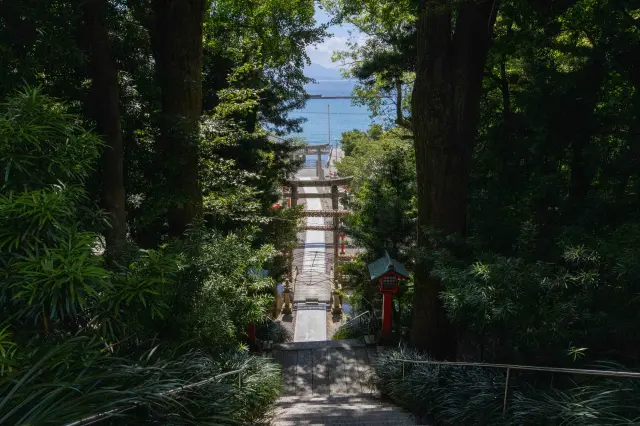
One of Japan’s oldest shrines, Munakata Taisha even appears in Japanese mythology. It enshrines the Three Goddesses of Munakata, daughters of Amaterasu Omikami, the ancestral deity of Japan’s Imperial Family. It is the head shrine of approximately 6,200 shrines throughout Japan, including Munakata and Itsukushima shrines and other shrines dedicated to the Three Goddesses of Munakata. Long revered for safeguarding the prosperity of the Imperial Family and protecting the nation, the goddesses are now worshipped as the foremost deities of all paths, including safe travel by sea and road, as well as one’s path through life, the arts, and health.
Munakata Taisha consists of three shrines connected across the sea: Okitsumiya on Okinoshima Island, Nakatsumiya on Oshima Island, and Hetsumiya in Munakata. Hetsumiya is the shrine most commonly visited by worshippers. Oshima Island, home to Nakatsumiya, is a 15- to 25-minute ferry ride from the Konominato Port ferry terminal. The island is also home to the Okitsumiya Yohaisho, a worship hall where visitors can pray while facing Okinoshima Island. Landing on Okinoshima Island is prohibited for everyone except Munakata Taisha priests, so the shrine there cannot be visited.
Hetsumiya’s spacious grounds offer many places of interest. These include the Main Sanctuary, designated an Important Cultural Property of Japan; Takamiya Saijo, said to be the shrine’s most powerful spiritual site; the Second and Third Shrines, whose historic buildings were bestowed by Ise Jingu; and the Shinpokan Museum, also known as the “Shosoin of the Sea,” which displays ritual objects, tools, ornaments, and other artifacts excavated from Okinoshima Island.
Highlights
-
A shrine included in a UNESCO World Heritage Site.
-
Hetsumiya, the principal shrine, also enshrines divided spirits of the deities of Okitsumiya at the Second Shrine and Nakatsumiya at the Third Shrine.
-
The sacred grounds have a pure and serene atmosphere.
-
The Shinpokan Museum houses approximately 80,000 National Treasures.