
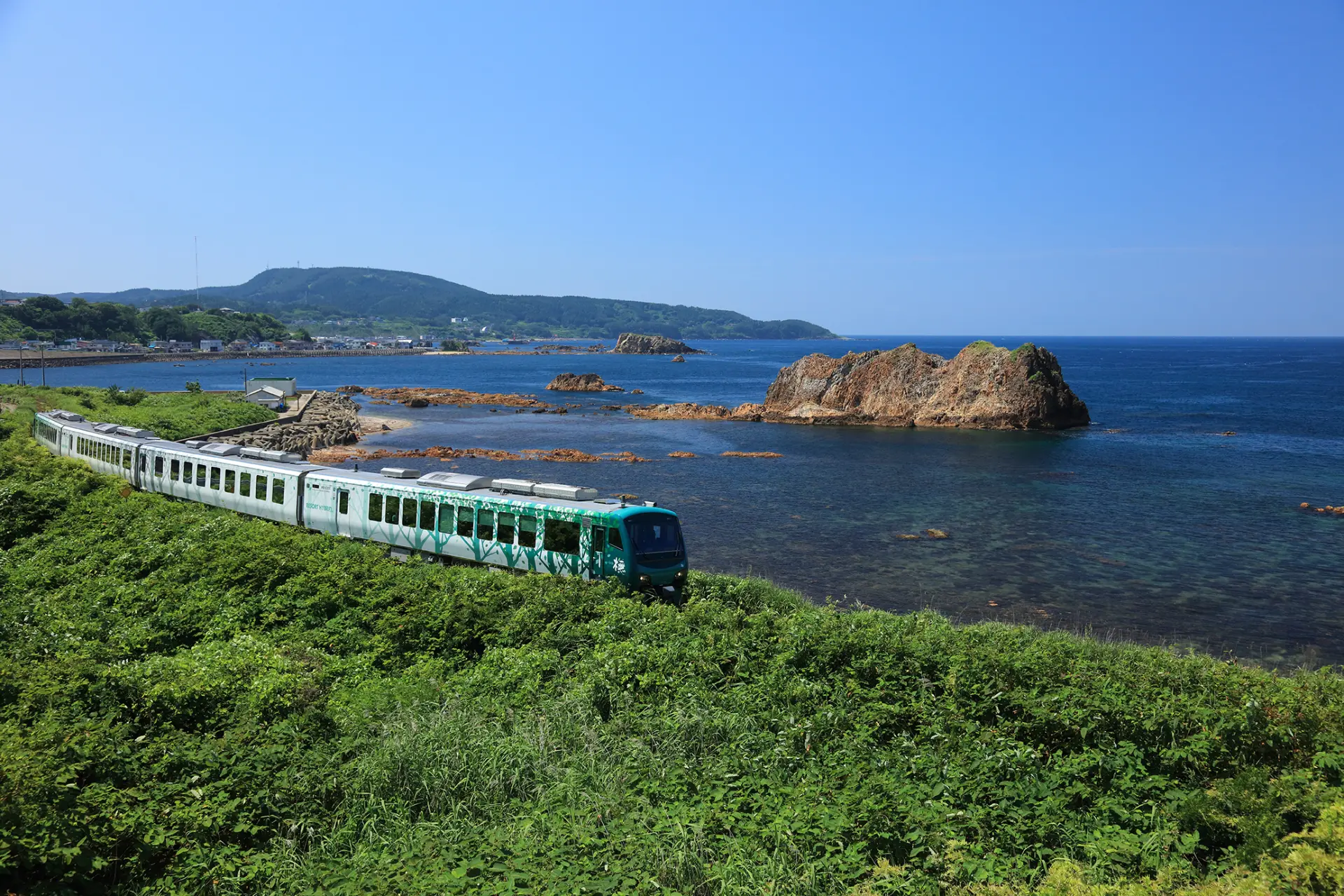
Photo courtesy of JR East
A Journey on the Resort Shirakami Sightseeing Train to Experience the Gono Line’s Spectacular Scenery
The JR Gono Line runs mainly along the Sea of Japan from Higashi-Noshiro Station in Akita Prefecture to Kawabe Station in Aomori Prefecture. With views of the shimmering blue sea and the Shirakami Sanchi mountain range, it is known as one of Japan’s most scenic railway lines. Board JR East’s Resort Shirakami sightseeing train—Buna, Aoike, or Kumagera—and immerse yourself in the evocative scenery unfolding outside the windows.
The JR Gono Line: One of Japan’s Most Popular Local Railways
The Gono Line is a 147.2-km local railway connecting Higashi-Noshiro Station in Akita Prefecture with Kawabe Station in Aomori Prefecture. The entire line opened in 1936 and has supported local communities ever since. Its remarkable views from the train have also made it a favorite among railway enthusiasts and travelers.
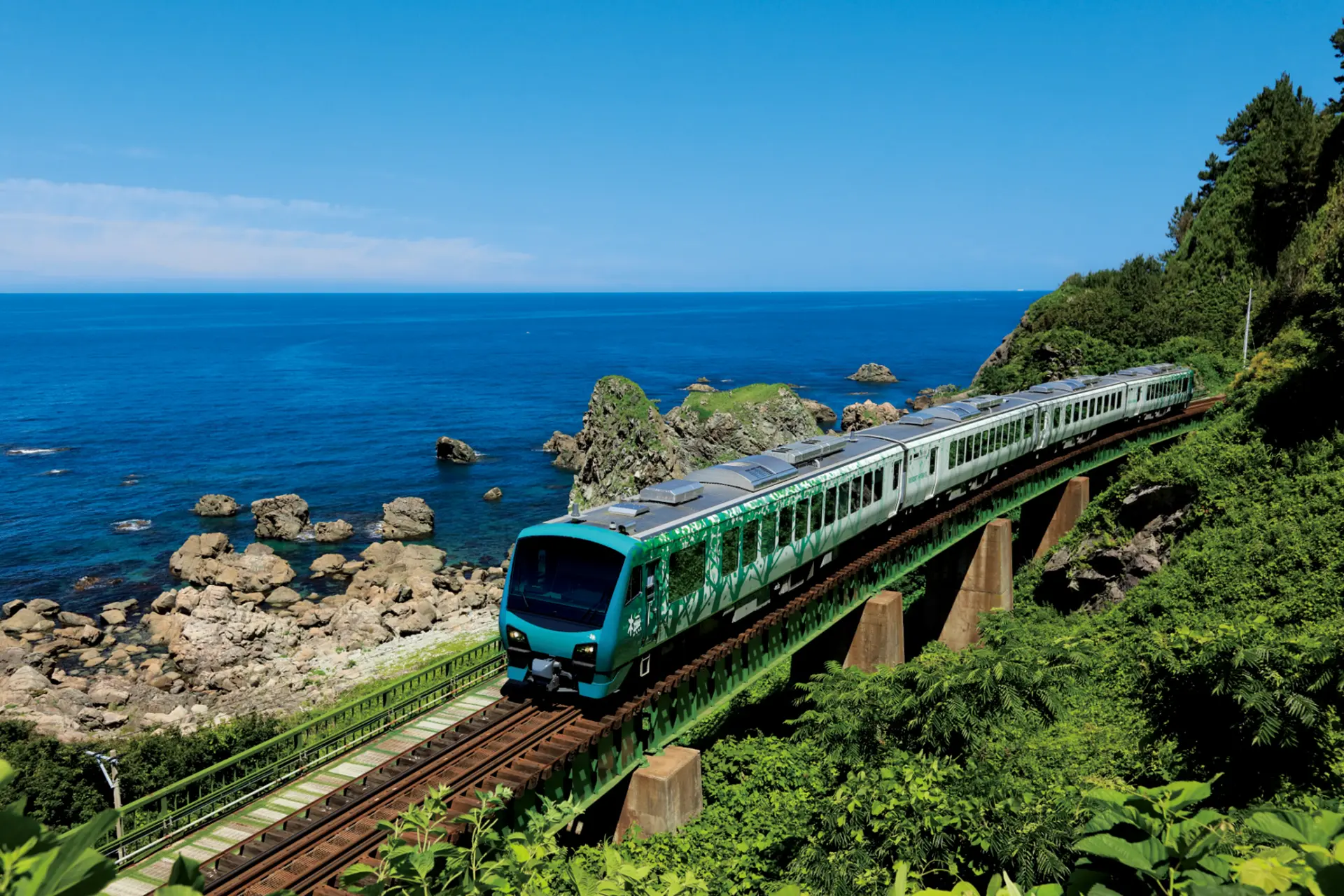
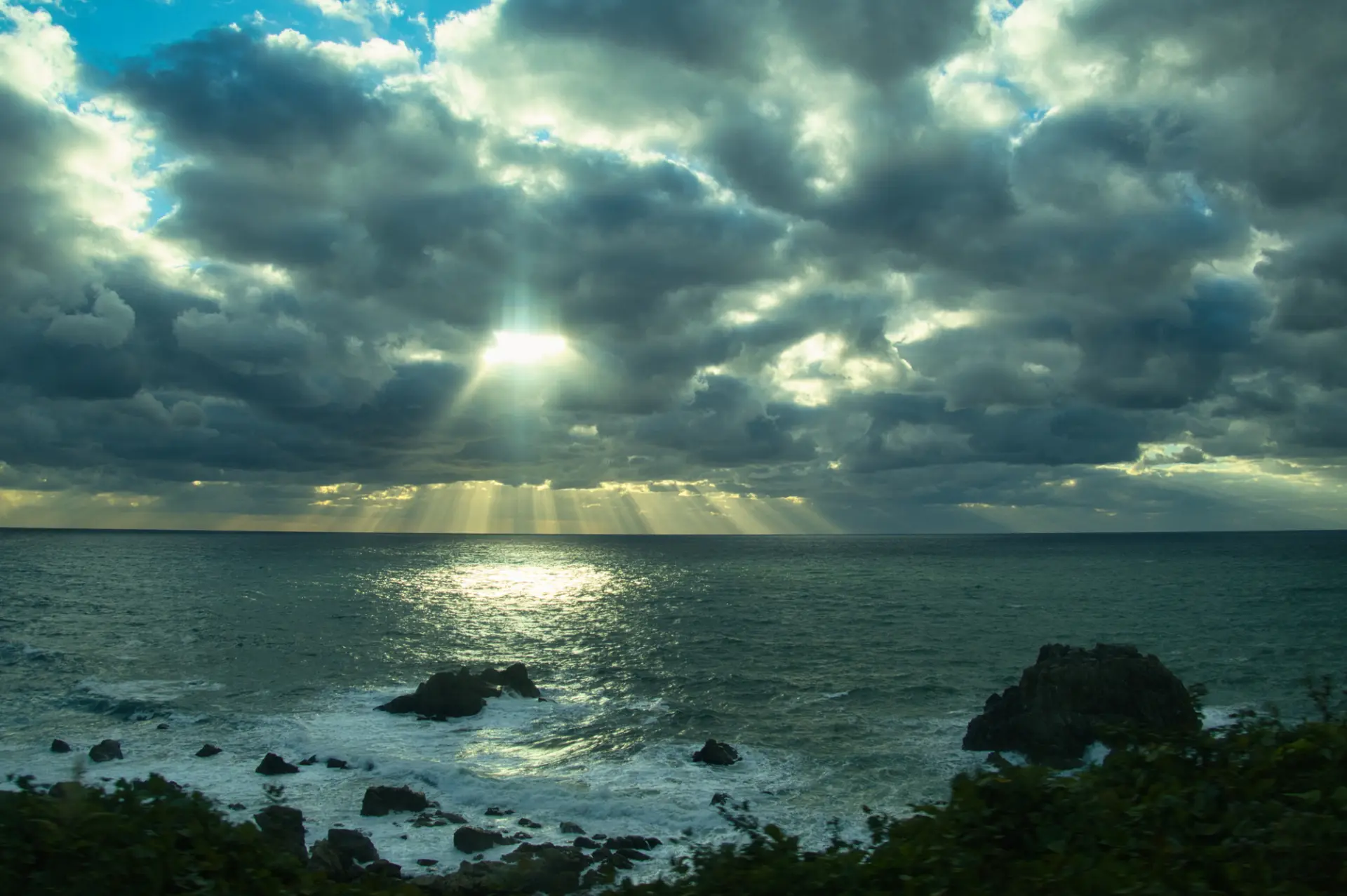
The Gono Line’s greatest attraction is its view of the Sea of Japan, which changes with the weather and time of day. The train travels so close to the shore that passengers can see the white foam bubbling on the waves, passing stretches of coastline where surf crashes against unusual rock formations. By day, the deep blue sea and sky extend into the distance. In the evening, the surroundings glow as the sun appears to melt into the horizon. The majestic Shirakami Sanchi mountain range, Mount Iwaki on the Tsugaru Plain, and the region’s apple orchards offer scenery with a very different character from the coast.
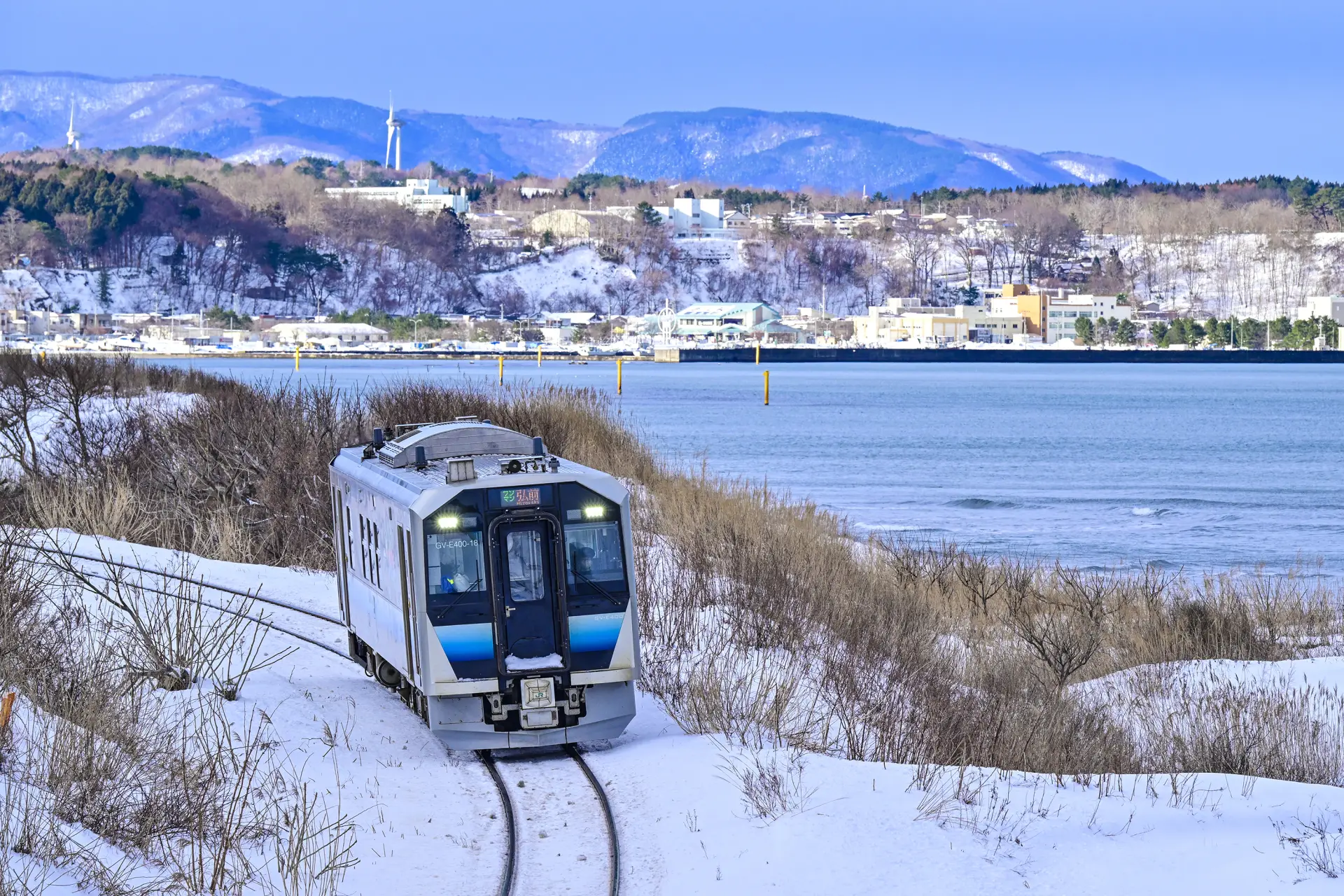
The line is also dotted with places worth getting off to explore, including Juniko, known for its mysterious blue Aoike Pond; Koganezaki Furofushi Onsen, famous for an open-air bath that feels as though it is part of the sea itself; and the Senjojiki Coast, with its vast expanse of rock shelves.
Traveling the entire Gono Line on local trains can require transfers, and some trains terminate before reaching the end of the line. It is therefore easier to plan your itinerary around the Resort Shirakami sightseeing train. If you would like to make stops along the way, consider using local trains as well, and check both the amount of time available at each destination and the schedules of the trains before and after your visit.
Traveling the Gono Line on the Resort Shirakami Sightseeing Train
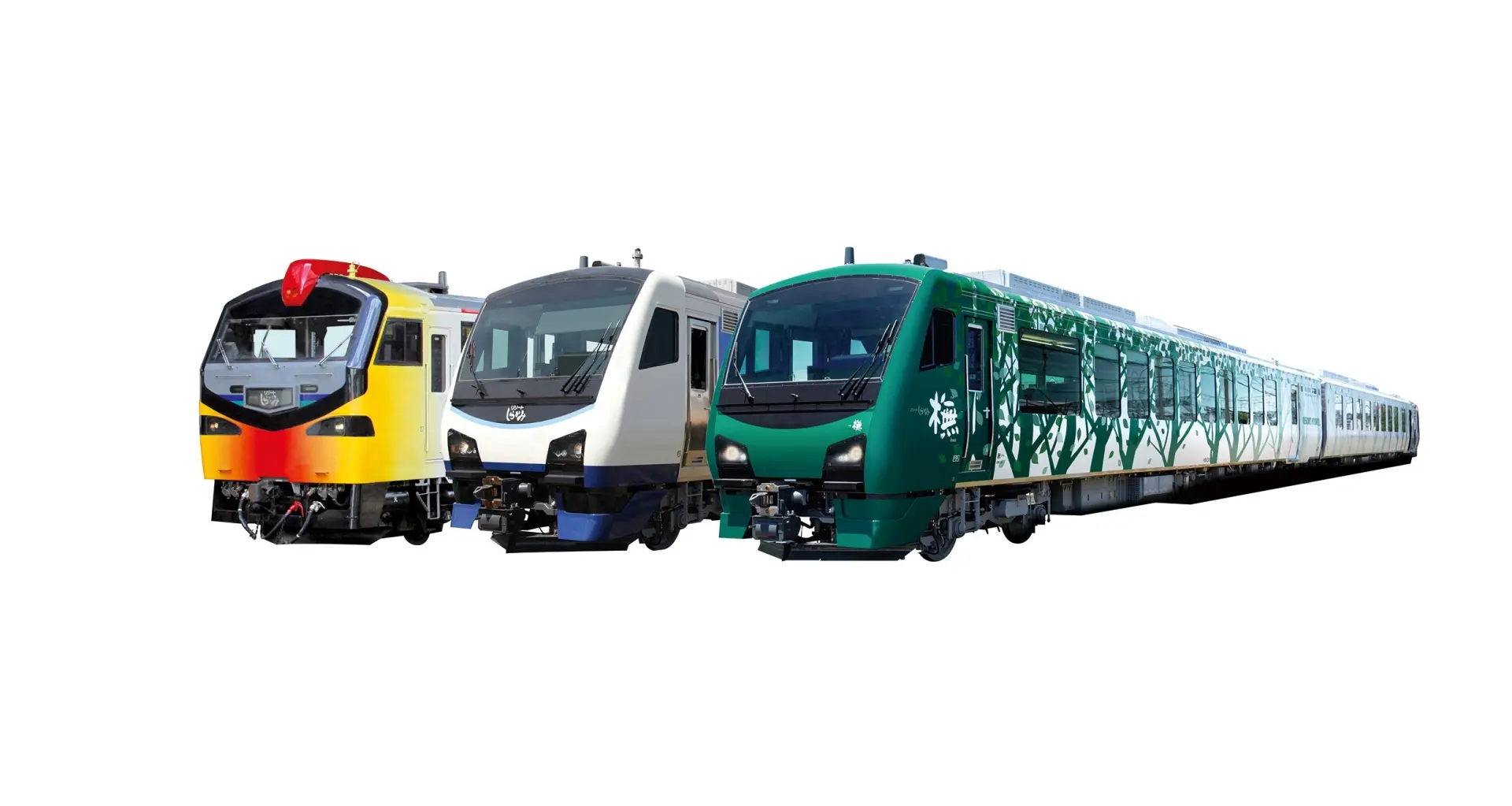
The Resort Shirakami is a rapid train connecting Akita Station with Aomori and Hirosaki stations via the Gono Line. It operates with three train sets—Buna, Aoike, and Kumagera—and all seats are reserved. In addition to the regular fare, passengers need to pay only the reserved-seat fee, making it a particularly affordable sightseeing train.
During winter, it operates mainly on Fridays, Saturdays, and Sundays, as well as over the New Year holidays and on certain public holidays. Check the official website for details. Outside the winter season, it runs almost every day. Between four and six inbound and outbound services operate each day, providing travelers with plenty of options.
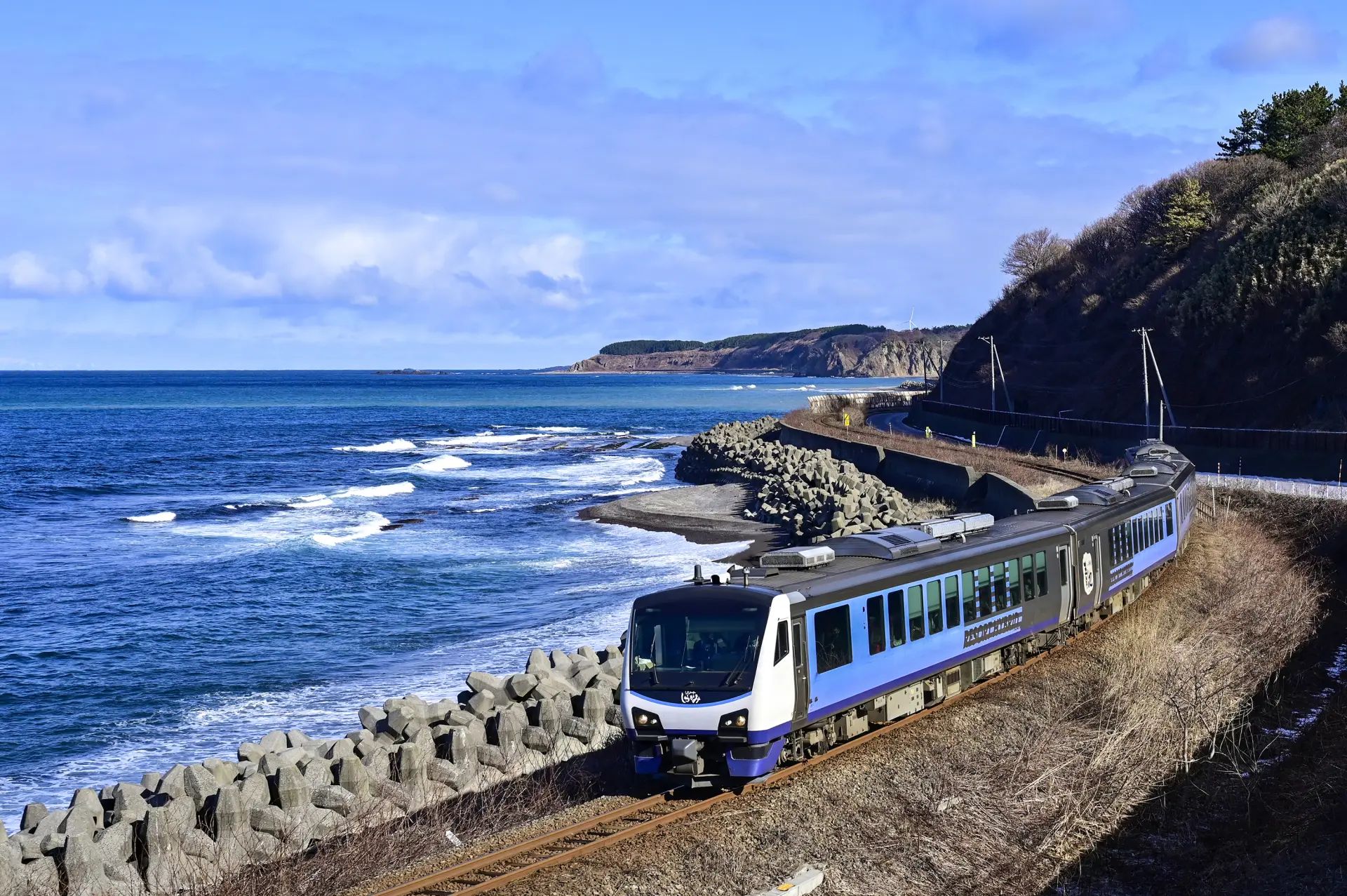
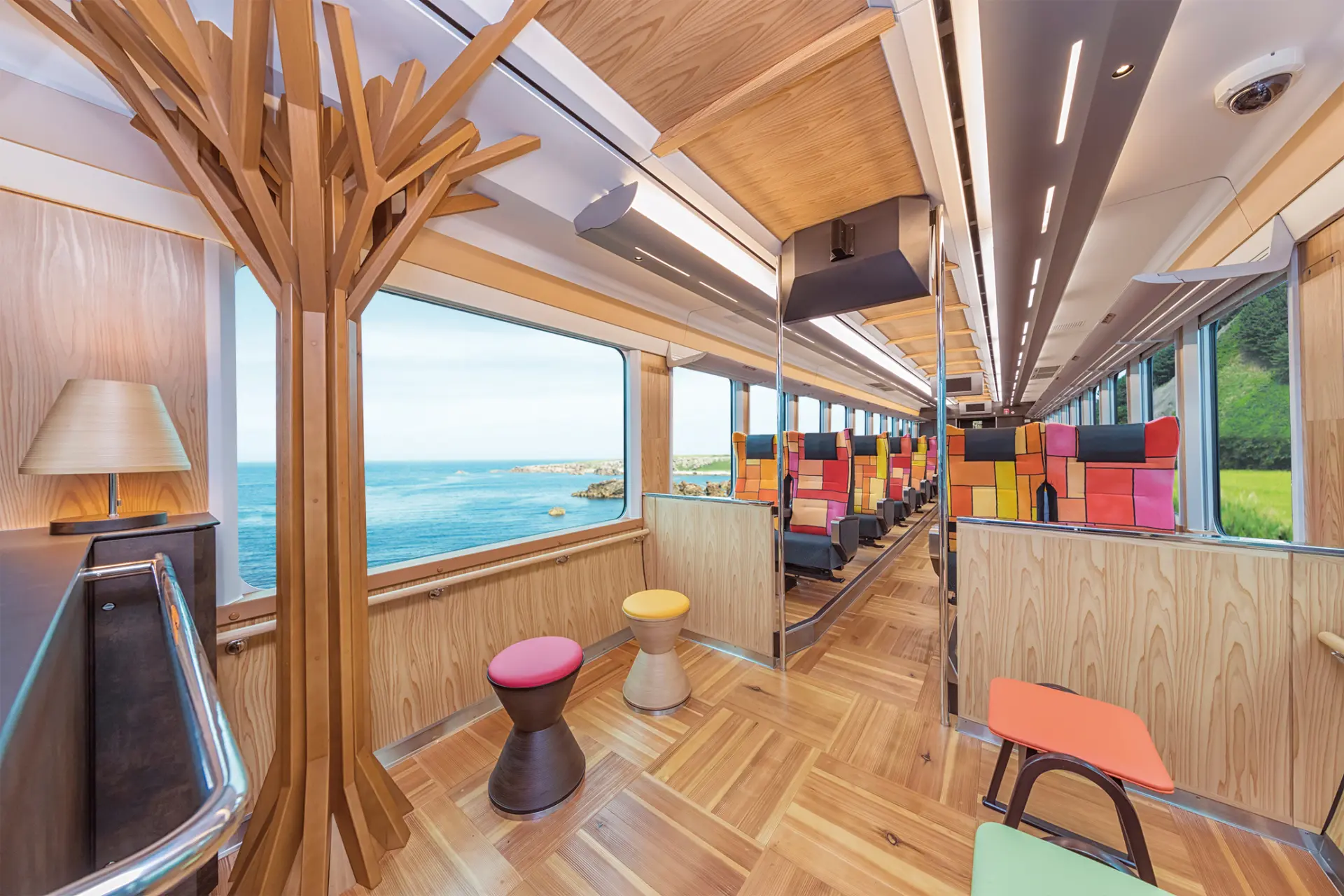
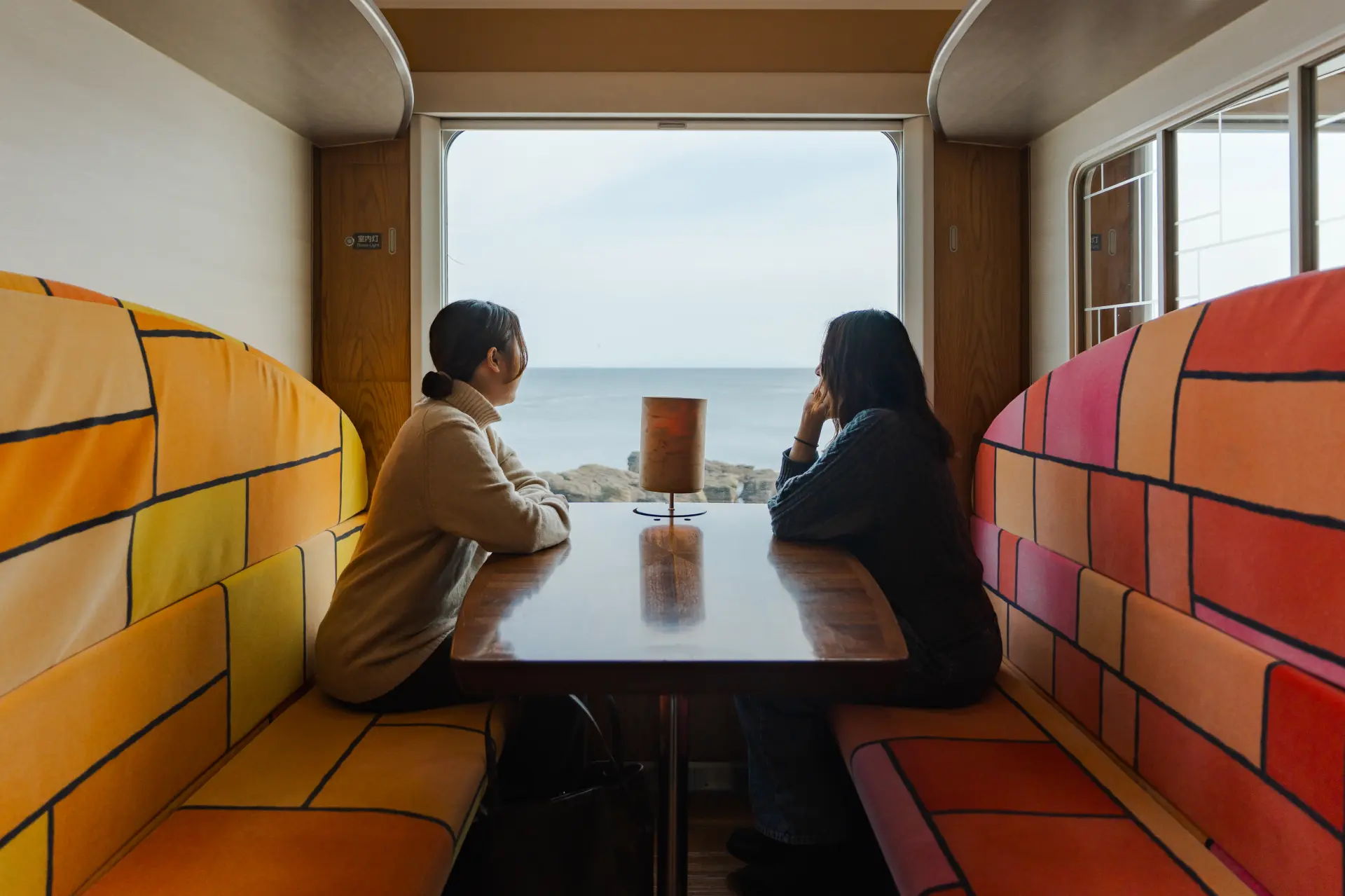
The cars feature large windows and spacious seating, allowing passengers to relax and take in the changing scenery. The train slows down along some especially scenic sections, and certain services also stop at Senjojiki Station long enough for passengers to take a short walk along the coast.
The Aoike was introduced as its current diesel-hybrid train in 2010, followed by the Buna in 2016. The newer Buna train features a warm interior incorporating wood from along the route, including Japanese beech—the train’s symbolic tree—as well as Akita cedar and Aomori hiba cypress. The Buna and Aoike trains also have sales areas with self-checkout registers where passengers can purchase beverages, snacks, railway merchandise, and other items.
The Resort Shirakami also hosts onboard events introducing passengers to the traditional performing arts of communities along the route. These include live performances of Tsugaru shamisen, a style of three-stringed instrument from the Tsugaru region of Aomori Prefecture; storytelling performances featuring local folktales in the Tsugaru dialect; and the Kinta Mamejo Puppet Theater, an Intangible Folk Cultural Property of Aomori Prefecture. Dates and eligible trains vary, so check the official website in advance.
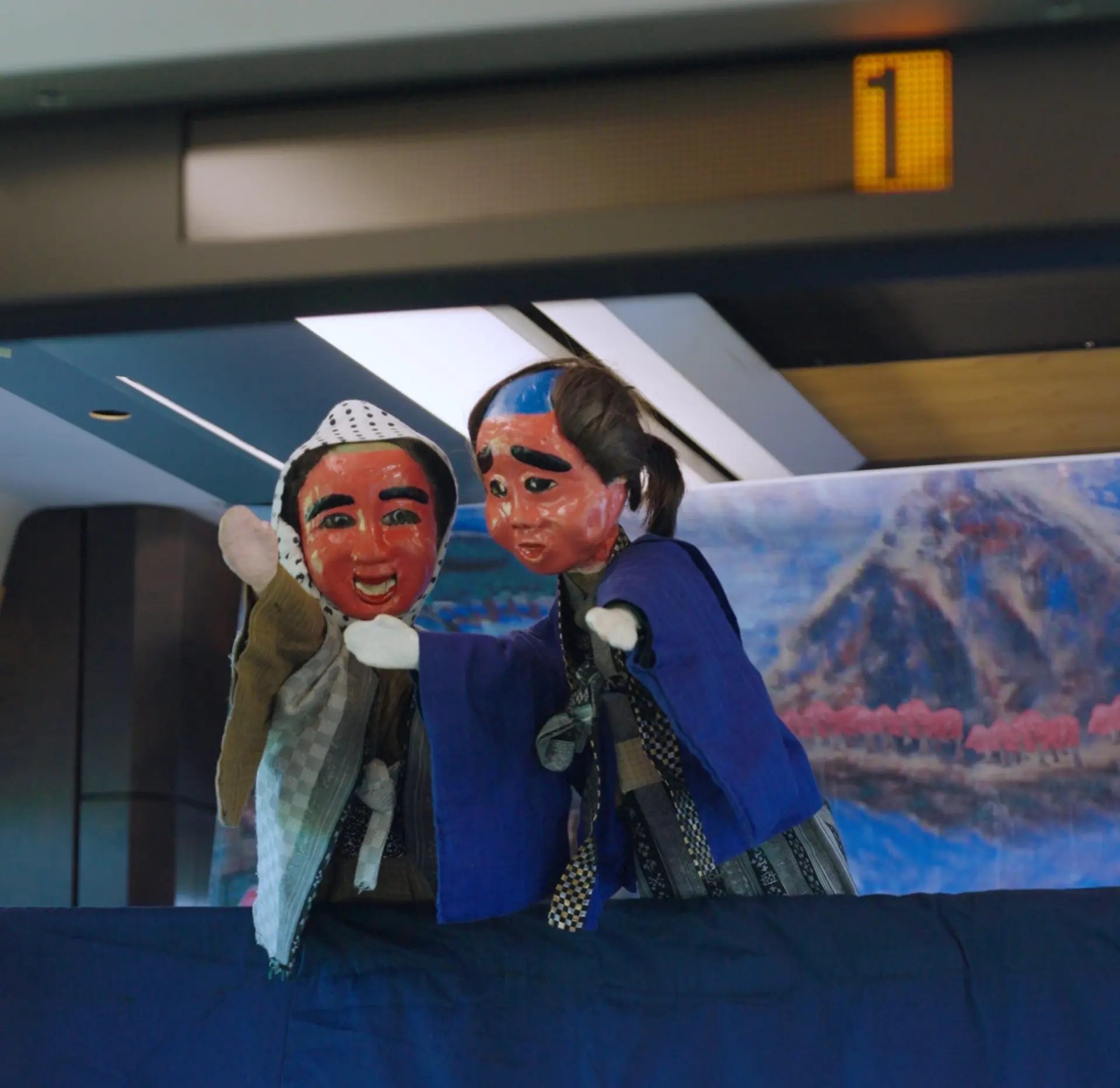
To sample local flavors from along the route, try the mobile ordering service. Boxed meals, snacks, sweets, hot coffee, and other items can be reserved in advance and picked up on a station platform or at another designated location on the day of travel. Experiencing the region through its performing arts and food, as well as the scenery outside the windows, is another pleasure unique to this train.

How Do You Get to the Resort Shirakami Sightseeing Train?
The Resort Shirakami departs from Akita Station, a stop on the Akita Shinkansen. It travels along the Ou Main Line before joining the Gono Line at Higashi-Noshiro Station. Beyond Kawabe Station, the train continues to Hirosaki Station, a major hub in Aomori Prefecture, and Aomori Station, which is accessible from the Tohoku Shinkansen.
From Tokyo Station, the journey to Akita Station takes about 4 hours on the Komachi Akita Shinkansen. When boarding from the Aomori side, the Hayabusa Tohoku Shinkansen takes approximately 3 to 3.5 hours to reach Shin-Aomori Station. Because the Resort Shirakami also stops at Shin-Aomori Station, passengers can transfer directly from the Tohoku Shinkansen without first traveling to Aomori Station.
The train is easily accessible from both Aomori and Akita prefectures, making it especially convenient for travelers.
Services departing from Akita Station are Resort Shirakami No. 1, departing Akita at 8:19 a.m. and arriving at Aomori at 1:34 p.m.; Resort Shirakami No. 3, departing Akita at 10:50 a.m. and arriving at Hirosaki at 3:50 p.m.; and Resort Shirakami No. 5, departing Akita at 2:00 p.m. and arriving at Aomori at 7:37 p.m.
Services departing from Aomori or Hirosaki stations are Resort Shirakami No. 2, departing Aomori at 8:09 a.m. and arriving at Akita at 1:29 p.m.; Resort Shirakami No. 4, departing Aomori at 1:52 p.m. and arriving at Akita at 7:01 p.m.; and Resort Shirakami No. 6, departing Hirosaki at 4:06 p.m. and arriving at Akita at 8:42 p.m.
A complete journey takes approximately 4.5 to 5.5 hours in either direction.
Times are based on information published for fiscal year 2026. Operating dates vary by train, and departure and arrival times are subject to change. Check the official website before traveling.
Basic Information
- Railway Company and Train Name
- JR East Resort Shirakami (Buna, Aoike, and Kumagera)
- Route and Travel Time
- Akita Station–Aomori Station or Hirosaki Station (approximately 4.5–5.5 hours)
- Operating Days
-
Operates daily; in winter, services run mainly on Fridays, Saturdays, and Sundays
Check the official website for details - Number of Services
-
4–6 services per day, depending on the season
Check the official website for details - Price Range
-
Regular fare for the section traveled (¥4,620 from Akita Station to Aomori Station), plus an ¥840 reserved-seat ticket throughout the year
The train can also be used with a Gono Line Free Pass, offering unlimited travel within the designated area for 2 days, priced at ¥4,040 for adults and ¥2,020 for children, plus a reserved-seat ticket - How to Purchase Tickets
- Reserved-seat tickets are available at Midori no Madoguchi ticket offices and reserved-seat ticket machines at major JR stations, as well as through Ekinet
- Official website
- Official website (Japanese)
Six Spectacular Views from the Resort Shirakami
The Resort Shirakami journey from Akita Station to Aomori or Hirosaki Station takes approximately 4.5 to 5.5 hours. The ever-changing views outside the windows keep passengers engaged throughout the journey and are the Gono Line’s greatest attraction. Here are the scenic highlights to watch for, beginning at Higashi-Noshiro Station, the starting point of the Gono Line on the Akita side.
1. Shirakami Sanchi World Natural Heritage Site (Higashi-Noshiro Station–Iwadate Station)
After entering the Gono Line, be sure to look out the inland-facing windows as well. The majestic peaks of Shirakami Sanchi draw close, with layers of ridgelines rising one behind another. From snow-covered winter landscapes to the fresh greenery of spring and summer and the colorful foliage of fall, Shirakami Sanchi presents a different scene in every season. It also creates a striking contrast with the uninterrupted ocean horizon that appears later in the journey. The mountain scenery is another major highlight of the Resort Shirakami’s route along the Sea of Japan.
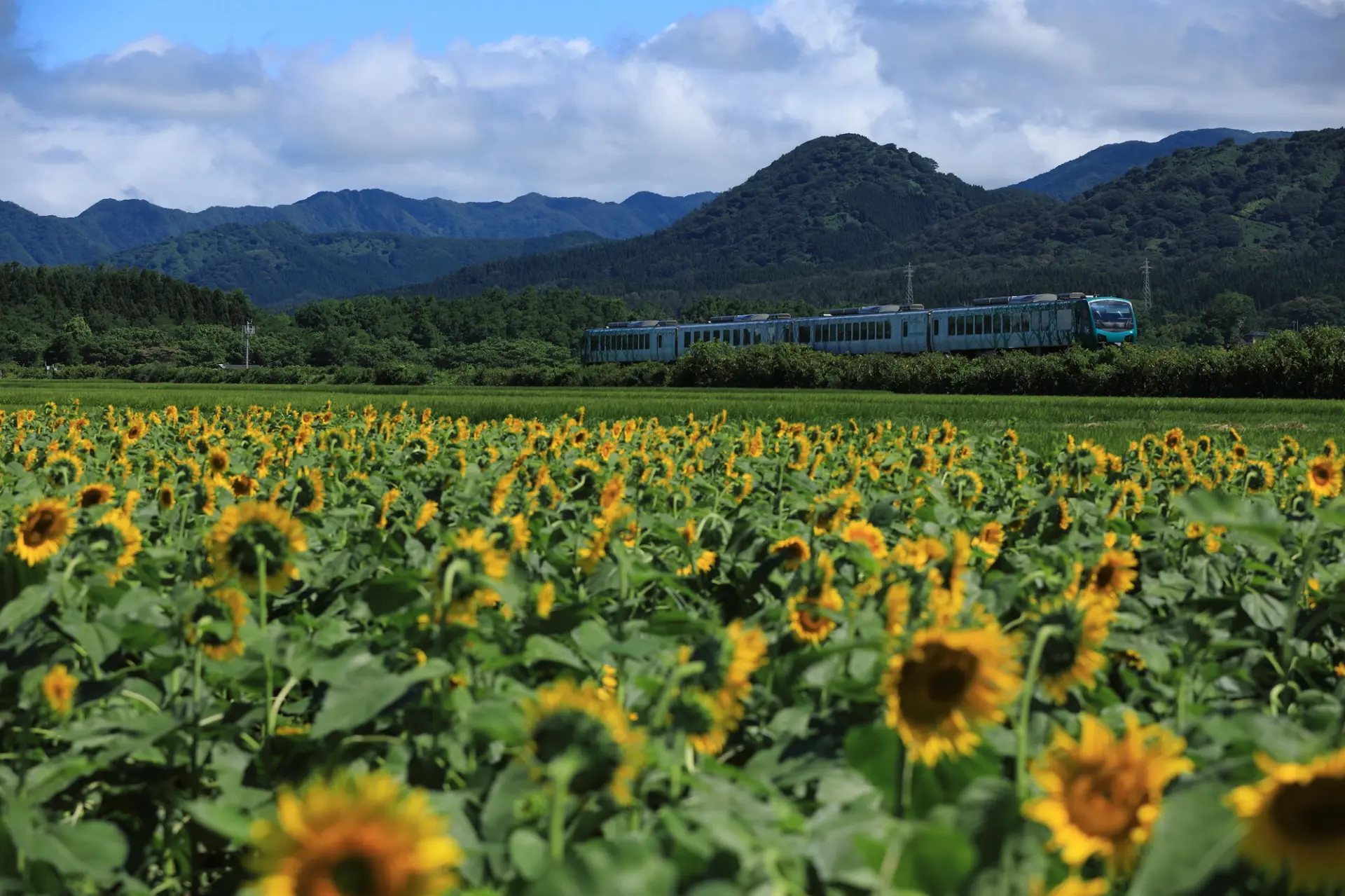
Shirakami Sanchi is an expansive mountainous region extending across Aomori and Akita prefectures. Its natural beauty has earned it the description “a forest where the gods dwell.” Part of the region became one of Japan’s first UNESCO World Natural Heritage Sites in 1993. As passengers admire the mountains, the train reaches Akita-Shirakami Station. From around this station, the Sea of Japan comes into view on the left side in the direction of travel. This marks the beginning of an approximately 80-km journey along the coast.
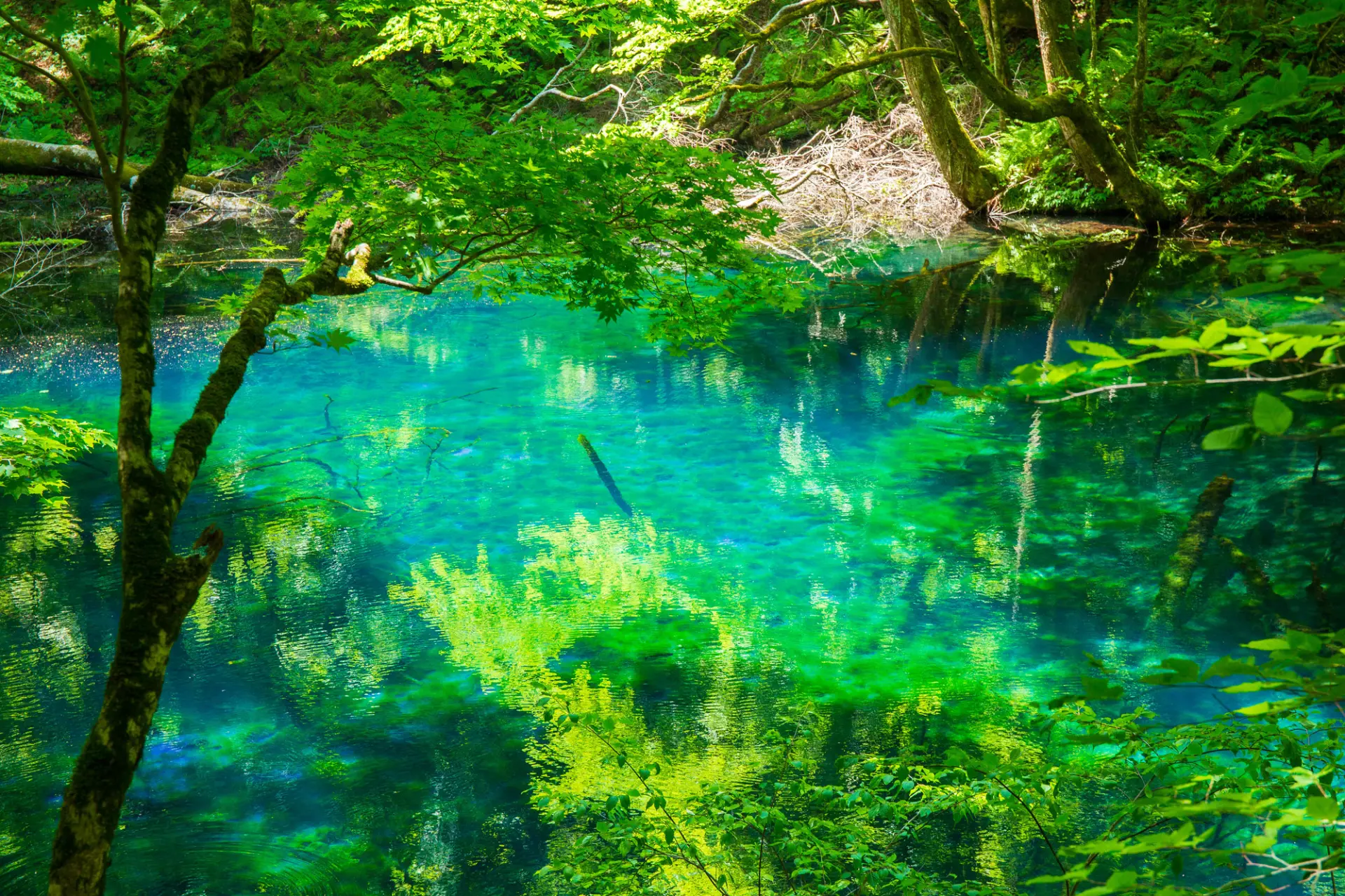
For a closer encounter with the natural environment of Shirakami Sanchi, get off at Juniko Station, beyond Omagoshi Station, and visit Juniko at the foot of the mountains. The area contains 33 ponds and lakes of various sizes, including Aoike Pond, which shimmers with a mysterious blue color. Visitors can explore walking routes with maintained paths, although a guide is required in winter.
2. Omagoshi: One of the Gono Line’s Finest Coastal Views (Iwadate Station–Omagoshi Station)
Omagoshi extends between Iwadate and Omagoshi stations, across the prefectural border between Akita and Aomori. Its coastline creates a vivid contrast between rugged rock faces and deep blue water, making this scenic section a well-known location for photographing the Gono Line. White waves wash over the reefs, producing impressive views both when the sea sparkles in daylight and as the sun sets in the evening.
Resort Shirakami Nos. 1, 3, and 5 slow down near Iwadate Station, one of the finest viewpoints on the Gono Line. This allows passengers to take their time admiring the shimmering sea, intricate coastline, and other dynamic scenery.
3. The Tsugaru West Coast and Its Beautiful Sunsets over the Sea of Japan (Omagoshi Station–Ajigasawa Station)
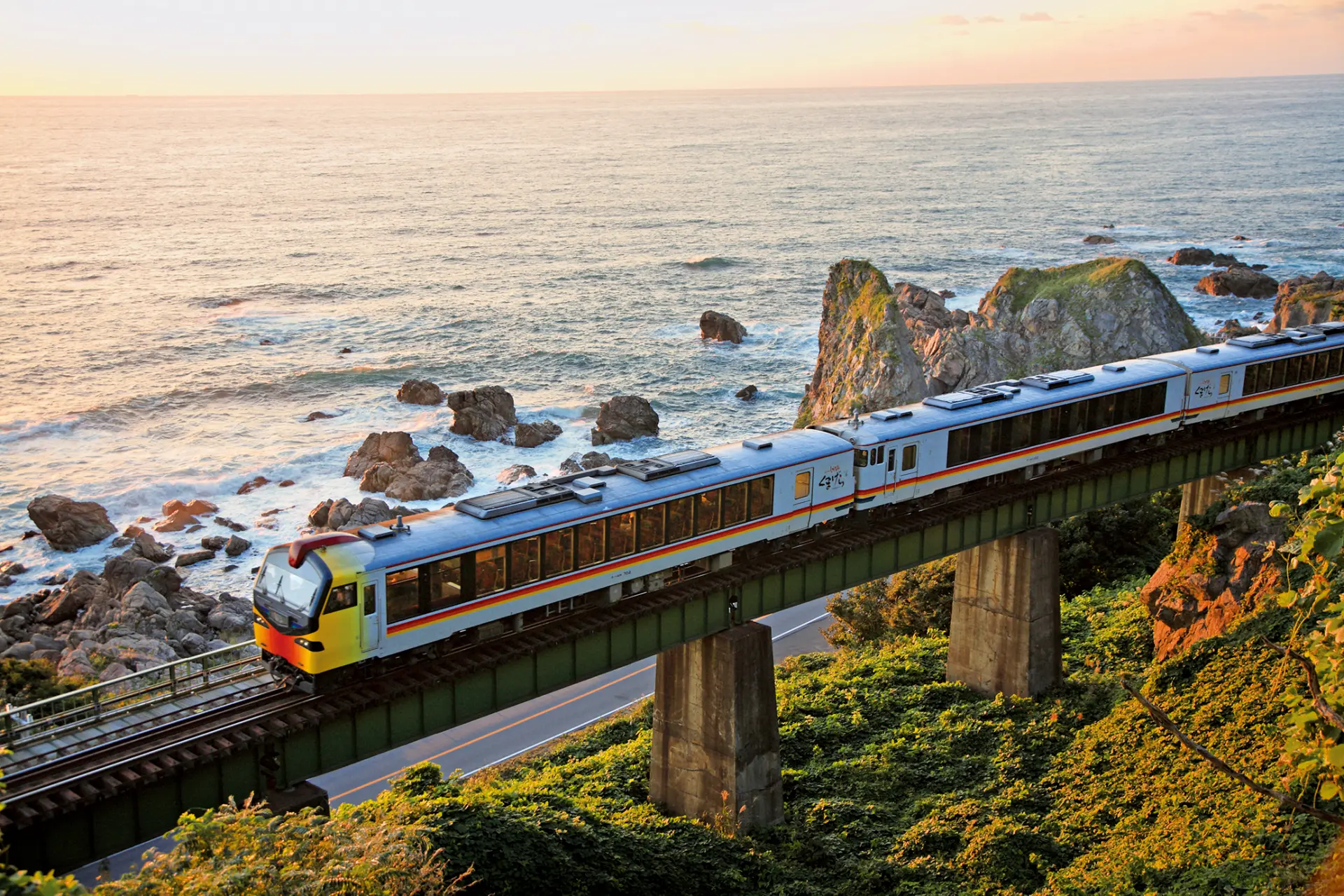
The area from Fukaura to Ajigasawa in Aomori Prefecture is one of the Gono Line’s most scenic coastal sections, with a rocky shoreline and expansive ocean views extending as far as the eye can see. Take in the grand scenery from the train windows. Between Fukaura and Hiroto stations, passengers can see the waves of the Sea of Japan breaking against rugged rock formations at close range.
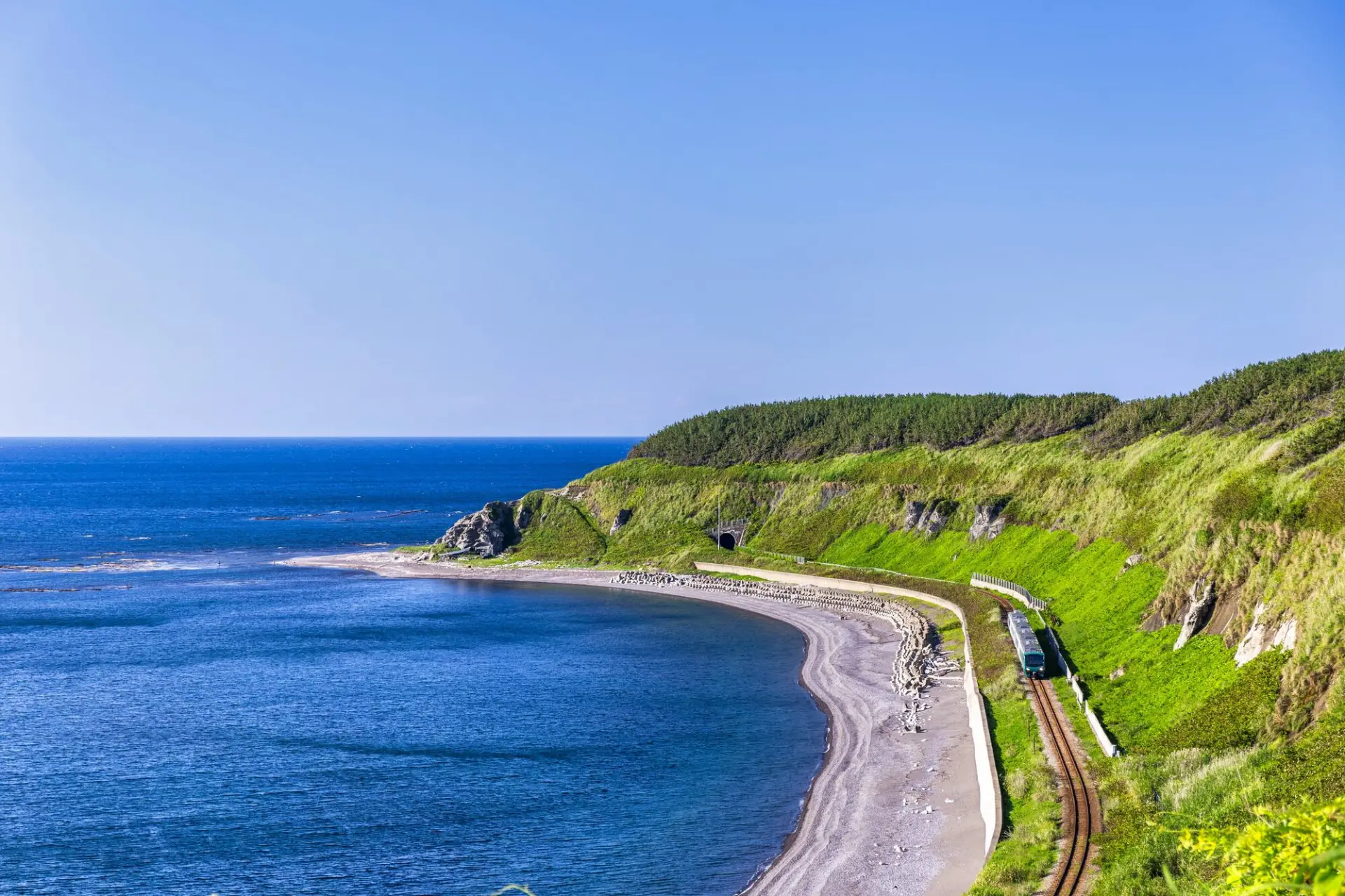
The port town of Fukaura is also known for its beautiful sunsets over the Sea of Japan. Okazaki Coast and Senjojiki Coast have been selected among Japan’s 100 Best Sunset Spots, and the evening scenery around Fukaura is one of the Resort Shirakami’s highlights. To see the sunset, check the sunset time in advance and choose a train that will be passing through this area around dusk. The view of the settlement, with both the sea and the houses in the foreground bathed in golden light, is particularly memorable.
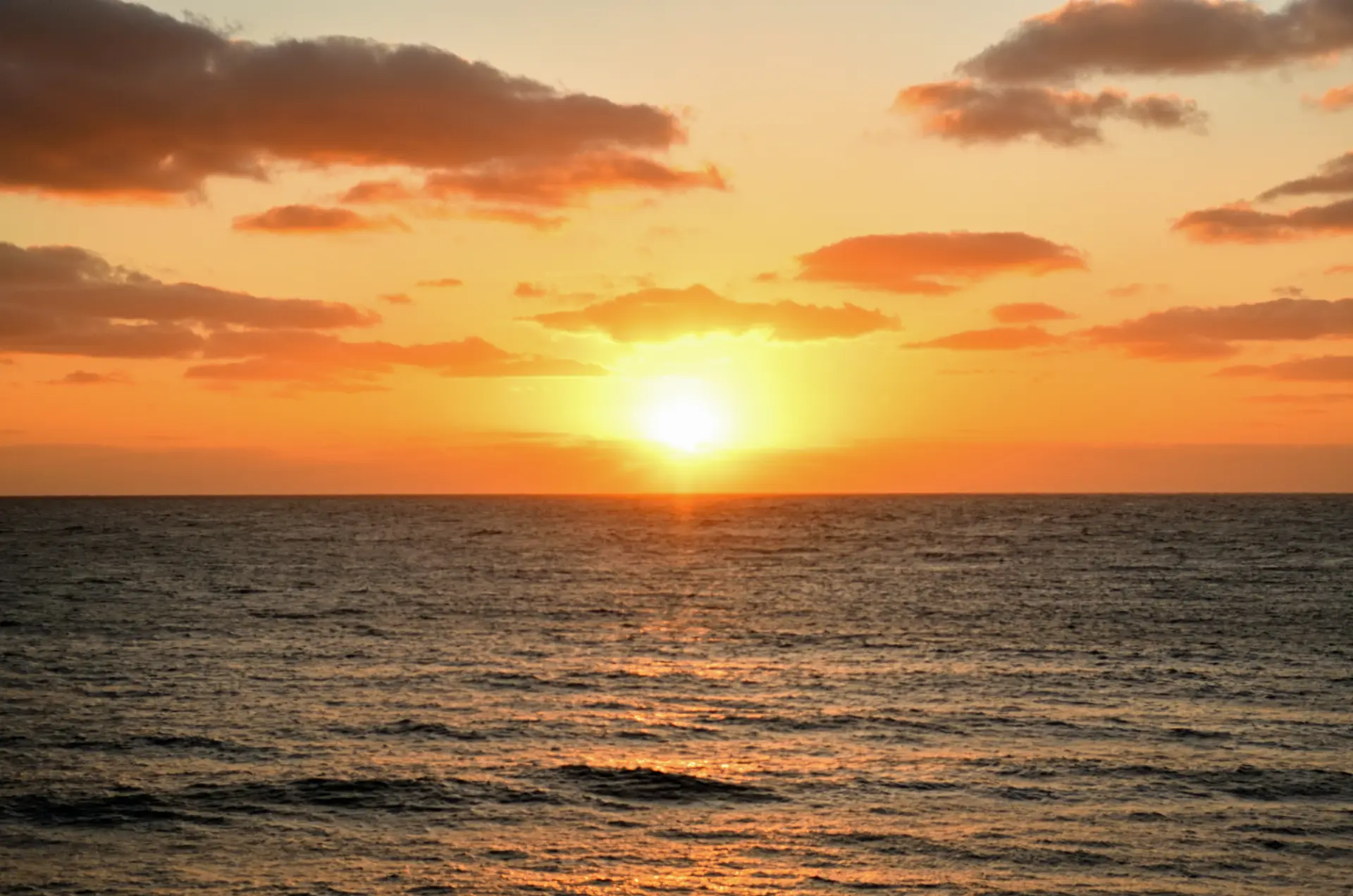
4. Yukiaizaki Coast, Covered in Daylilies in Early Summer (Fukaura Station–Hiroto Station)
Also located between Fukaura and Hiroto stations, Yukiaizaki Coast is a scenic area where green coastal grasslands, rugged and unusually shaped rocks, and the blue Sea of Japan come together.
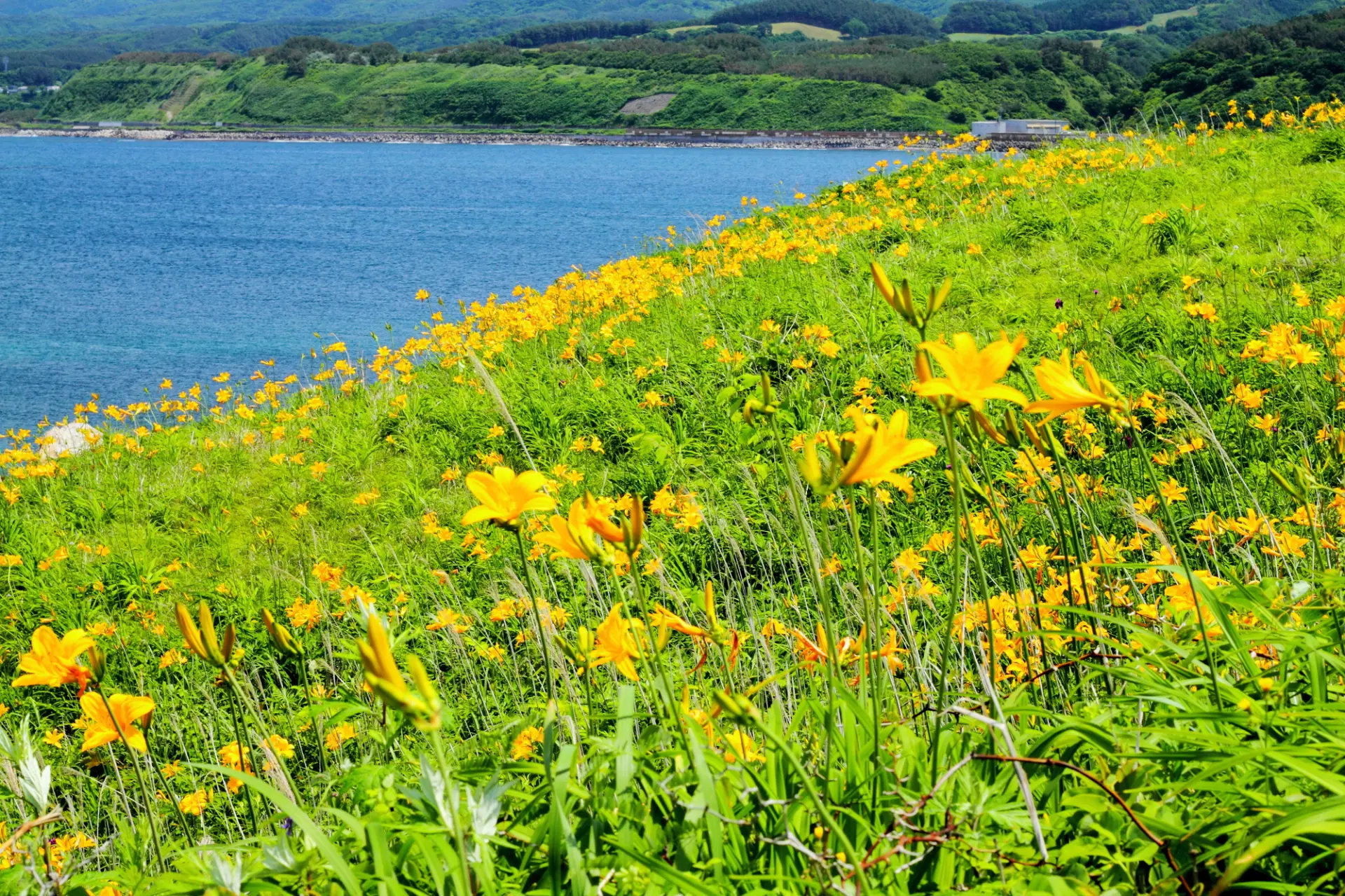
Around June, large colonies of daylilies bloom with yellow flowers across the cape, creating a vivid contrast with the blue sea. To take your time admiring the flowers swaying in the sea breeze, consider exploring the area on foot. The coast is about a 5-minute taxi ride from Fukaura Station, allowing visitors to stroll from a perspective different from the train windows while feeling the refreshing sea breeze and listening to the waves.
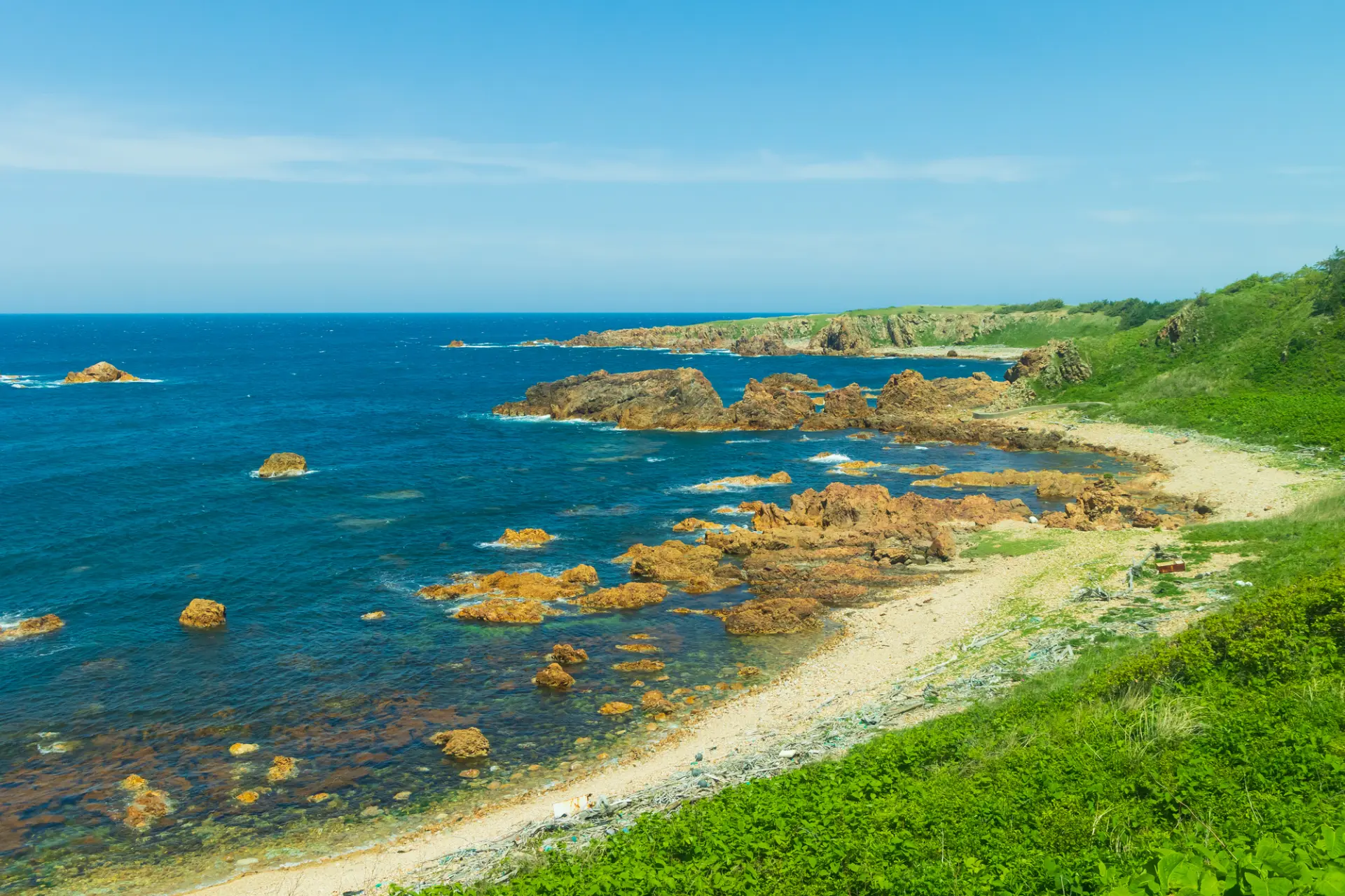
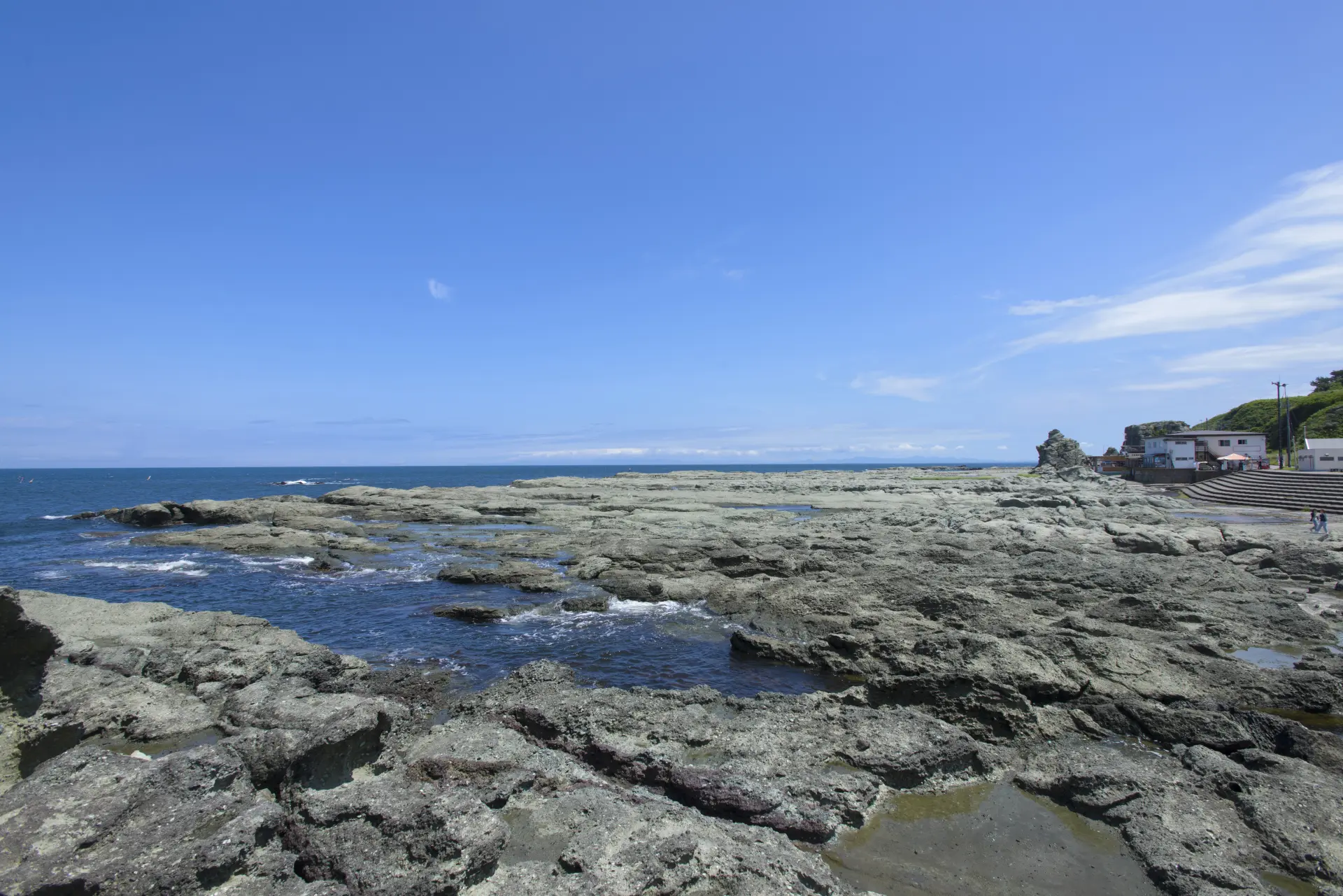
5. Senjojiki, a Scenic Rock Shelf Formed by the Uplift of the Seabed (Senjojiki Station)
Cross the road from Senjojiki Station, an unmanned station on the Gono Line, and you will find a vast coastline of rock shelves extending into the sea. Senjojiki stretches for approximately 12 km. Its name is said to come from a legend in which a lord of the Tsugaru Domain had 1,000 tatami mats laid out here for a banquet. The flat, unusually shaped rocks washed by the waves are well worth seeing.
Resort Shirakami Nos. 2, 3, 4, and 5 stop for approximately 15 minutes so passengers can walk along the Senjojiki Coast. Step close to the sea seen from the train and experience this unusual landscape, said to have formed when the ground was uplifted by an earthquake in 1792.
After departing Ajigasawa Station, the train eventually leaves the coastline behind and continues into the Tsugaru Plain.
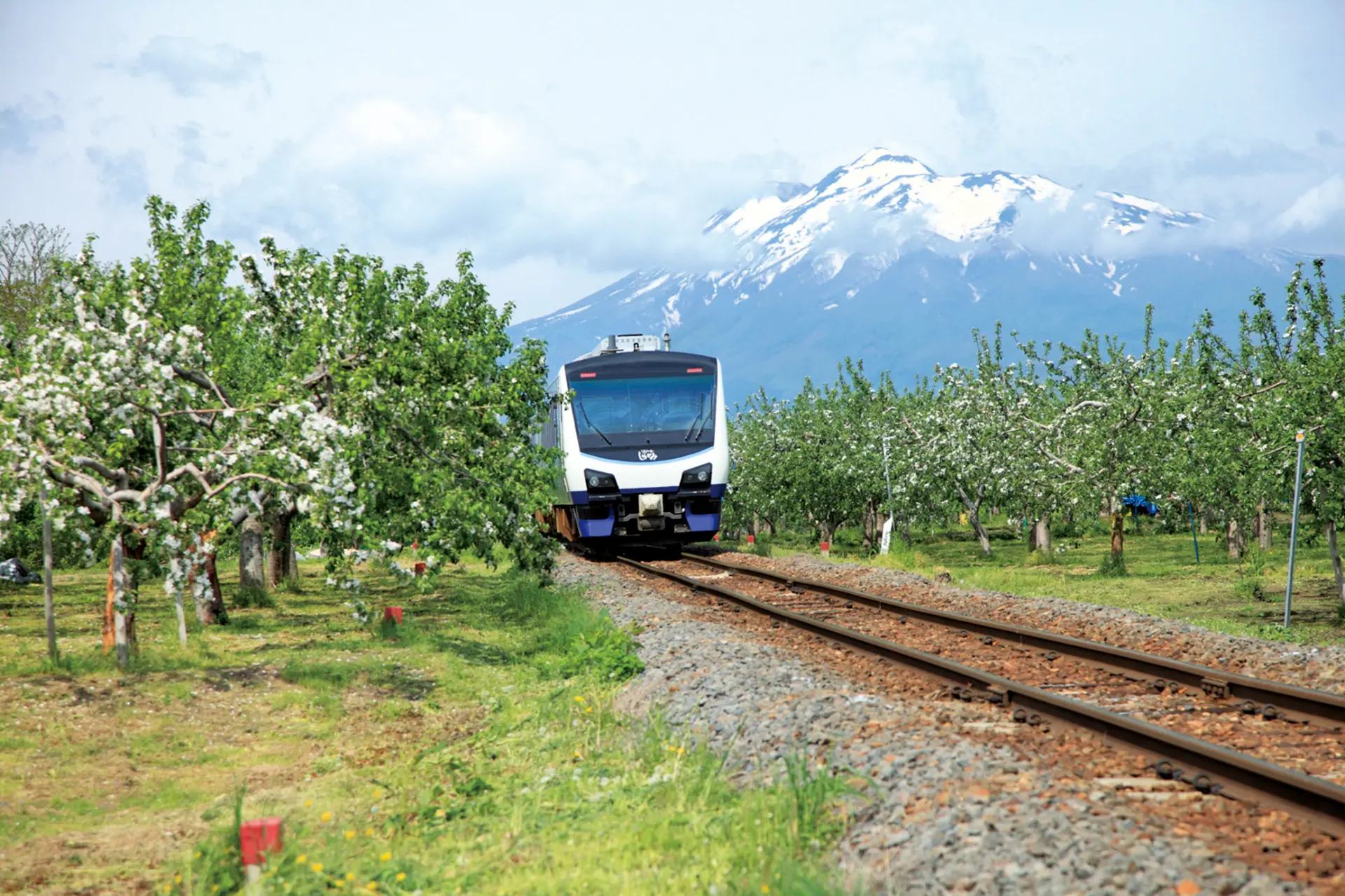
6. Apple Orchards, the Tsugaru Plain, and “Tsugaru Fuji” (Goshogawara Station–Kawabe Station)
As the train enters the Tsugaru Plain, the scenery outside the windows changes to a peaceful rural landscape. Mount Iwaki, affectionately known as “Tsugaru Fuji,” comes into view. As the train moves onward, the mountain’s appearance gradually changes, revealing its gently sloping foothills and summit from different angles.
Apple orchards extend along the section between Goshogawara and Kawabe stations. The area around Hayashizaki and Fujisaki stations is especially scenic, offering views of Mount Iwaki beyond the orchards. In spring, white apple blossoms and the lingering snow on Mount Iwaki brighten the view. In fall, trees laden with red fruit add color to the landscape. These distinctly Tsugaru scenes offer a different atmosphere from the coastal section of the journey.
Three Places Along the Gono Line Worth Getting Off to Visit
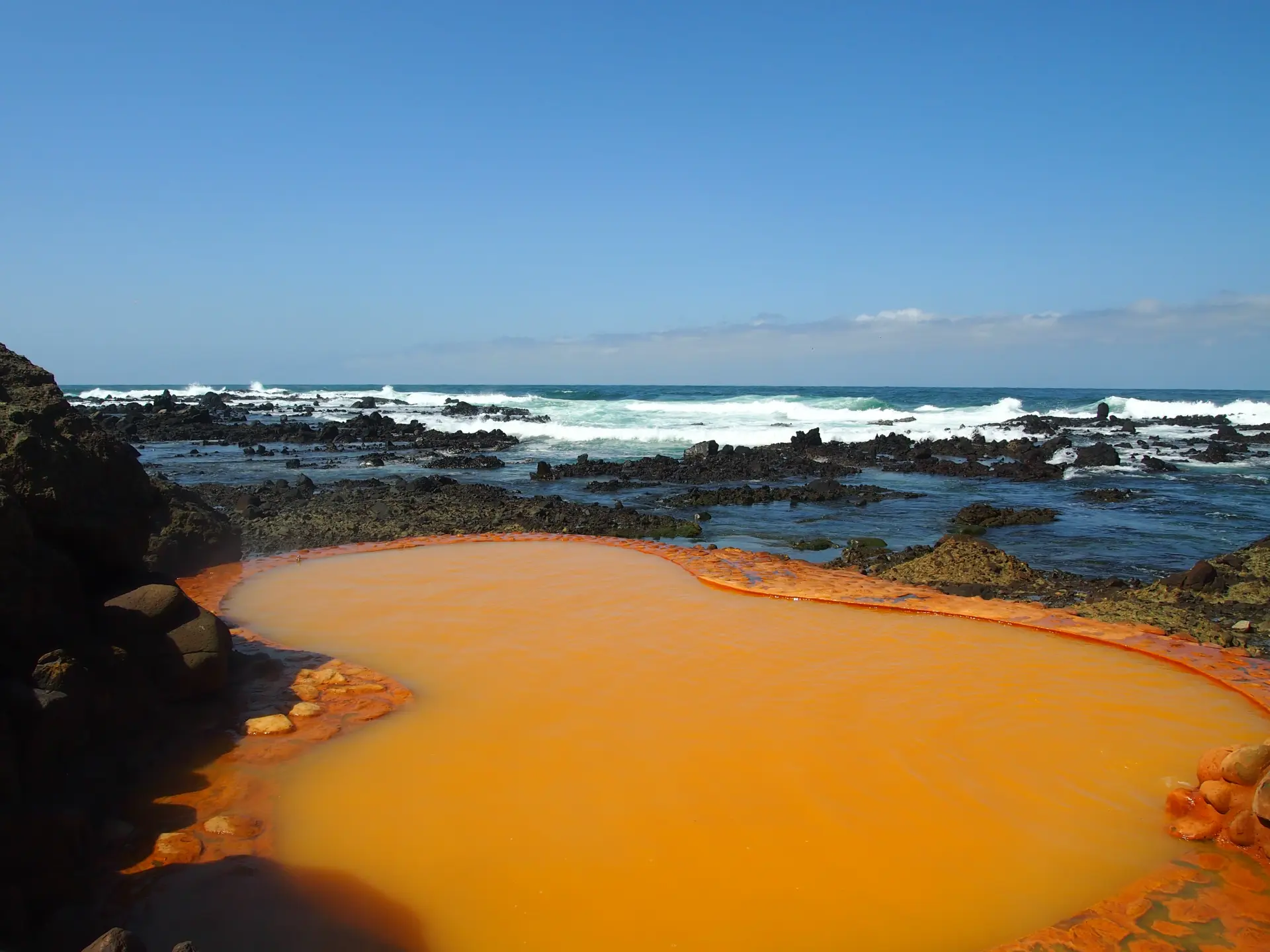
1. Koganezaki Furofushi Onsen (Wespa Tsubakiyama Station)
This secluded inn stands on Henashizaki Coast at the tip of Koganezaki, facing the Sea of Japan in Fukaura, Aomori Prefecture. It is famous for its open-air baths built among the rocks along the shore. The gourd-shaped mixed-gender bath and women-only bath make bathers feel as though they are soaking in the sea itself. With views of the open ocean and horizon, guests can relax in a spacious setting while listening to the waves and feeling the sea spray.
Hot spring water has flowed here since long ago, and local residents once dug baths into the rocks. The hot spring is said to have been named Furofushi in 1971. Rich in iron, the reddish-brown water flows at a rate of 400 liters per minute. The baths are filled directly from the source, warming visitors thoroughly.
Approximately 5 minutes by free shuttle bus from Wespa Tsubakiyama Station. Reservations are required.
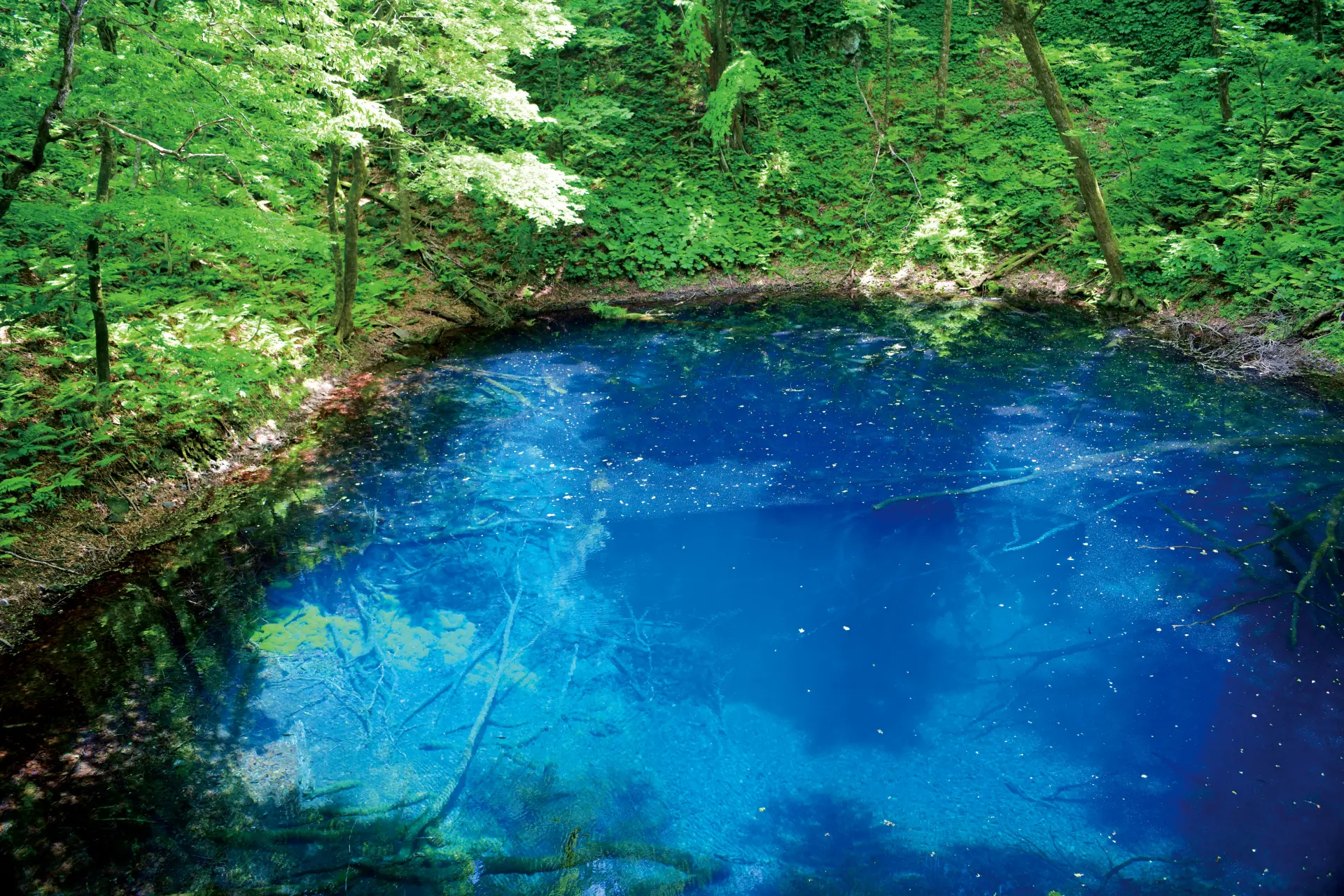
2. Juniko and Aoike Pond Trekking (Juniko Station)
Surrounded by beech forests in the western part of Shirakami Sanchi in Fukaura, Aomori Prefecture, Juniko consists of 33 ponds and lakes of various sizes. They are believed to have formed following a landslide caused by a major earthquake in 1704. The name Juniko, meaning “12 lakes,” is said to come from the 12 bodies of water visible from Mount Kuzure.
The most popular is Aoike Pond, with an impressive cobalt-blue color resembling blue ink poured into the water. It is so clear that fallen trees lying beneath the surface can be seen. The water becomes even clearer in May and June, when snowmelt flows into the pond. In addition to Aoike, walking routes lead through natural forests dominated by beech trees and past Wakitsubo Pond, known for its clear water, allowing visitors to enjoy the refreshing woodland atmosphere.
Approximately 15 minutes by local bus from Juniko Station. The bus does not operate in winter. A guide is required for walks from December through March.
3. Tsurunomai Bridge (Mutsu-Tsuruda Station)
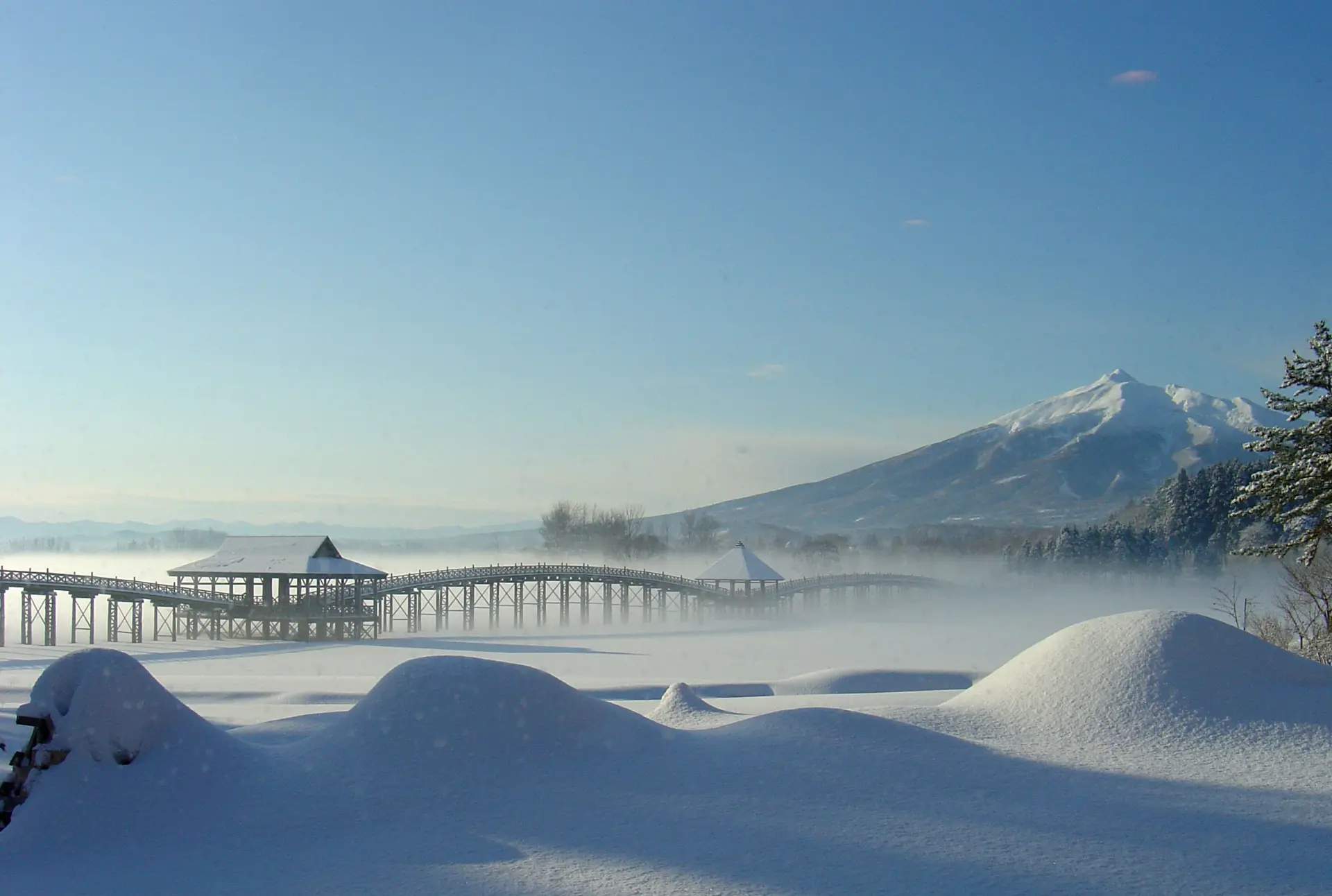
Built from Aomori hiba cypress and cedar, Tsurunomai Bridge is 300 meters long. It crosses Tsugaru Fujimi Lake, which reflects majestic Mount Iwaki on its surface, and is Japan’s longest wooden triple-arched drum bridge. True to its name, meaning “dance of the cranes,” its graceful arches resemble a crane spreading its wings.
The warmth of the wood gives the bridge a welcoming appearance. Following several years of renovations, it reopened to the public with a refreshed look in spring 2026. In Japanese, the phrase “long wooden bridge” sounds similar to “bridge of longevity,” making it a place associated with good fortune and long life. It is said that crossing the bridge brings longevity.
10 minutes by taxi from Mutsu-Tsuruda Station.
Summary
The Gono Line is an ideal local railway for travelers who want to fully immerse themselves in the scenery outside the windows. Simply riding the Resort Shirakami reveals an endlessly changing landscape: the calm shoreline, rugged rocky coasts, unusual rock formations, and varied seascapes of the Sea of Japan, as well as the Shirakami Sanchi mountain range and Mount Iwaki rising over the Tsugaru Plain.
From the winter Sea of Japan, where pure white snow appears to blend into the open ocean, to the shimmering fresh greenery of spring and summer, each season brings a new view worth traveling to see.
Supervising Editor
Writers & Editors
GOOD LUCK TRIP Editors
Sharing lesser-known ways to experience Japan with the world!