Holly

Holly 's page

I love exploring Japan and using my camera and words to document the scenery, food, and human stories I encounter along the way, while also searching for travel surprises in unassuming corners. I have to return to Japan every so often to recharge, so I can find the motivation to go back to everyday life and keep working hard as a corporate slave.

Number of reviews 75/ Number of likes 277

Reviews

  • Nijo-jo Castle

    After winning the Battle of Sekigahara in 1600 and unifying the country, Tokugawa Ieyasu had Nijo-jo Castle built as his base in Kyoto. It is a historical monument with a history of over 410 years as a castle in the heart of the capital. It was designated a UNESCO world heritage site as a part of the “Historic Monuments of Ancient Kyoto” in 1994.

    • Kyoto Station, Shijo Kawaramachi, Kyoto Imperial Palace
    • Shrines & Temples
    See More

    Nijo-jo Castle is very famous for its cherry blossoms. There are many varieties inside the castle grounds, from early-blooming to late-blooming ones, so the viewing season lasts longer than at places with only one variety. The Nijo-jo Castle Cherry Blossom Festival and nighttime illuminations are also held every spring. Although I visited near the end of cherry blossom season, luckily I still saw quite a few trees in full bloom.

    Nijo-jo Castle is also very important in Japan’s modern history. It was at Ninomaru Palace that the 15th shogun, Tokugawa Yoshinobu, asked for opinions on returning political authority to the emperor. He later formally returned power to the imperial court, symbolizing the end of Tokugawa shogunate rule. Today, when visiting Ninomaru Palace, you can also see mannequins in the Great Hall recreating this historical scene.

    Another interesting feature of Ninomaru Palace is the corridor commonly known as the “nightingale floor.” It makes a sound when you walk on it. I tried really hard to see if I could cross without making any noise, but it was simply impossible. As soon as you put any weight on it, it chirps.

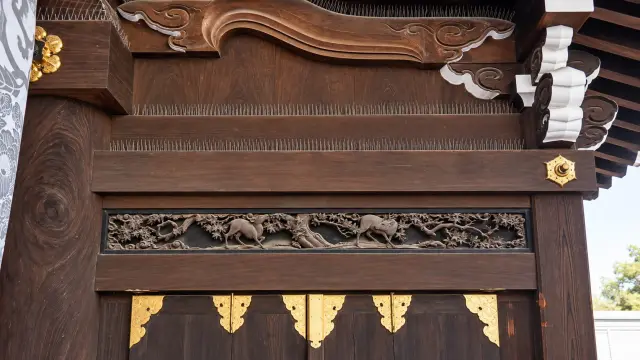
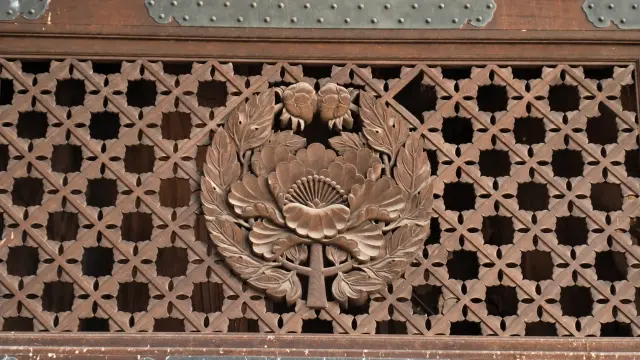
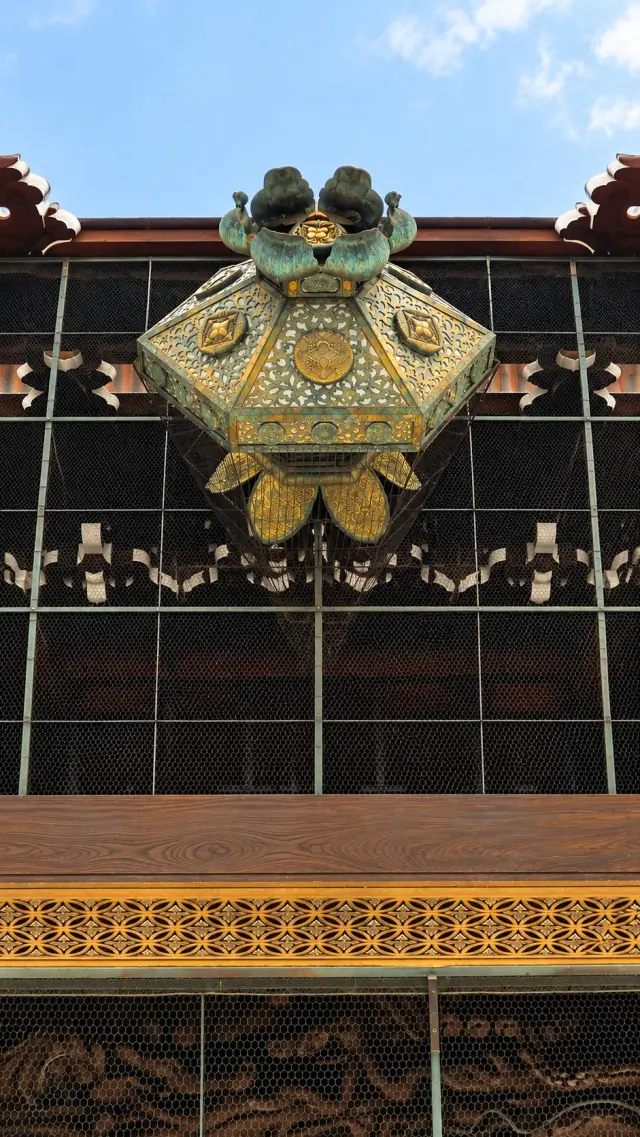
    My personal favorite is still the Karamon Gate before entering Ninomaru Palace. The cypress-bark roof has karahafu gables on both the front and back, and the gate is covered in vividly colored carvings of pine, bamboo, plum blossoms, cranes, Chinese guardian lions, and more. It’s truly magnificent. Many traditional buildings in Kyoto tend to have a more understated feel, but the Karamon gates at Nijo-jo Castle and Toyokuni Shrine take a completely different approach. Just looking at them, you can really feel the difference that comes with being in power.

    Nijo-jo Castle originally also had a five-story keep, said to have been relocated from Fushimi Castle, but it burned down after being struck by lightning in 1750 and was never rebuilt. Today, you can only climb the former keep’s stone base to see the ruins and surrounding scenery, which feels a little unfortunate. But from another perspective, the truly valuable part of Nijo-jo Castle isn’t the keep, but the fact that Ninomaru Palace has survived. Most of the original palaces at Edo Castle, Osaka Castle, and Nagoya Castle have disappeared, and Nagoya Castle’s Honmaru Palace was only recently reconstructed based on historical records. Although part of Kawagoe Castle’s Honmaru Palace remains, it is no longer a complete palace complex. Nijo-jo Castle’s Ninomaru Palace, however, has been preserved intact, along with its Kano school wall paintings, transoms, and decorative metal fittings. This is what truly makes it irreplaceable among Japanese castle architecture.

  • Fushimi Inari Taisha

    It is the head shrine of about 30,000 Inari shrines which are traditionally familiar throughout Japan and the god is worshiped for bountiful harvests of grain, business prosperity, the safety of households, recovery from illness, and wish fulfillment. This shrine was established in 711 AD.

    • Fushimi, Rakunan
    • Shrines & Temples
    See More

    Fushimi Inari Taisha really is one of Kyoto’s classic sights and is well worth visiting at least once. Probably because it’s so famous, the approach and shopping street at the foot of the mountain are almost always bustling. If you want a quieter visit, I highly recommend coming early, seeing the shrine and walking through the Senbon Torii first. By the time you come back down, the shops will be starting to open, so you can grab something to eat, recharge, and then continue with your next activity.

    The shrine’s most iconic feature is, of course, the Senbon Torii. Rows of vermilion torii gates stretch all the way into the mountain, and actually walking through them is still very impressive. Once, I really did climb all the way up Mount Inari to the area around Ichinomine, near the summit. I have to say, the scenery on the mountain itself isn’t especially spectacular, but the atmosphere is completely different from below. At the bottom, there are still tourists, shops, and bustling crowds, but it gets quieter the higher you go. Eventually, all that’s left is the forest, torii gates, and small shrines, creating an even stronger sense of mystery.

    There’s also the famous “Omokaru Stone” next to the Okusha Hohaisho. First, make a wish in front of the stone lantern, then lift the round stone on top. If it feels lighter than you imagined, it means your wish is more likely to come true. If it feels heavier than expected, it means you may need to put in more effort. When I lifted it, all I could think was that it was pretty heavy. Apparently, the problem wasn’t the stone—my wish was just too heavy.

    What truly makes Fushimi Inari Taisha special isn’t just the Senbon Torii itself, but also the fox messengers seen everywhere. If time and energy allow, I recommend not stopping at the first section of the Senbon Torii. Walk at least a little farther up, and you’ll see a completely different side of Fushimi Inari Taisha.

  • Nishiki Market

    Nishiki Market is located on Nishikikoji Street, north of Shijo Street, Kyoto’s main street. The fish market thrived here, and in 1615, it received official permission from the Edo Shogunate to expand. It is called “Kyoto’s kitchen” and offers a wide range of foods such as Kyoto vegetables, fresh-water fish from Lake Biwa, Hamo (conger pike), Guji (tilefish), Sasakarei (half-dried flounder), Yuba (tofu skin), Namafu, and pickles. Most of Kyoto’s special ingredients can be found here.

    • Kyoto Station, Shijo Kawaramachi, Kyoto Imperial Palace
    • Shopping Streets
    See More

    Nishiki Market felt to me like a blend of a Japanese shopping street and traditional markets such as Kizu Market and Omicho Market. The entire street is packed with shops selling everything from Kyoto pickles, tofu, tamagoyaki, seafood, and dried goods to wagashi and matcha desserts. However, Nishiki Market now officially reminds visitors not to eat while walking. After purchasing food, it is best to eat in front of the shop or in a designated area inside.

    That said, there aren't many places where you can sit down and eat, so you may want to have something beforehand and then come browse. It's good for trying small snacks, while many items are better bought to eat back at your hotel. This time, I also bought tamagoyaki from one shop. I had high expectations, but after eating it, I realized I really do seem to prefer the Kanto style. I looked it up afterward and learned that Kansai-style tamagoyaki mainly features the flavor of dashi and is lighter, while I prefer the sweeter Kanto version with a more pronounced flavor. Another interesting item commonly seen in the market is baby octopus stuffed with a quail egg. A whole baby octopus has a quail egg inside, giving it a very distinctive appearance. This was also my first time trying it here, and it was a memorable snack.

    At the eastern end of Nishiki Market is Nishiki Tenmangu Shrine. The main deity enshrined here is Sugawara no Michizane, so like other Tenmangu shrines, it is known for worship related to learning and wisdom and is very popular. After all, who wouldn't want to pray for knowledge and wisdom? The grounds also have “Nishiki Water,” which springs from about 30 meters underground. It's very convenient to stop by and pray after reaching the end of the market.

    Next to Nishiki Tenmangu Shrine is the Shinkyogoku branch of Tamaru Inbo, which I make a point of visiting every time I come. Their “Kyo Ufufu Stamps” come in around 1,000 designs, ranging from Japanese-style patterns and Kyoto themes to amusing text stamps. If you like planners and stamps, it's really easy to lose control here. The prices certainly aren't cheap, but the stamp designs and craftsmanship are excellent, and I personally feel the quality justifies the price.

  • Kamigamo Shrine (Kamowakeikazuchi Shrine)

    In ancient times, Kamowakeikazuchi-no-okami, the god of the shrine, descended to the mountain northwest of the main shrine, and the Kamo clan, a powerful local family, built a shrine building in 678, and it is the oldest shrine in Kyoto.

    • Kinkakuji, Kamigamo
    • Shrines & Temples
    See More

    I happened to catch the Kamigamo Handicraft Market, held at Kamigamo Shrine on the fourth Sunday of every month. I have to say, Japan's handicraft markets are really great for shopping. The vendors aren't just local Japanese people—you'll also see international artists taking part. They sell everything from fabric goods, leather items, pottery, and woodwork to household goods, and many of the pieces aren't just attractive but also highly practical. Some stalls even clear out materials or unfinished items at very reasonable prices.

    Because of that, even though I hadn't particularly planned on buying anything, I ended up shopping the whole way through. The item that left the strongest impression on me was an orange canvas bag with cowhide handles. I still use it today, and it's truly very durable. The market also has some food stalls, but they mostly sell small baked goods, coffee, and handmade snacks rather than full meals. So if you plan to stay for a while, I'd recommend eating beforehand. The market is currently held from 9:00 to 15:00 on the fourth Sunday of every month, so check the date in advance if you want to catch it.

    Another thing I really like about visiting in summer is the stream that runs through the shrine grounds where the market is held. When you get hot from browsing, you can take a walk by the water. Lots of children play in the stream. If you plan to visit in summer, I'd recommend bringing an extra towel or a pair of sandals so you can play in the water more easily. After all, this kind of atmosphere is rarely seen in Taiwan.

    As for the shrine itself, Kamigamo Shrine and Shimogamo Shrine are both important shrines for the Kamo Festival, also known as the Aoi Festival. Both have striking vermilion tower gates, but they felt different to me. Shimogamo Shrine's gate feels grander, while Kamigamo Shrine's feels a little more refined and elegant. That may also have something to do with the large lawns, streams, and more open surroundings.

    I visited near the end of cherry blossom season, so I wasn't expecting much. To my surprise, the large weeping cherry tree on the grounds still had blossoms, so I was very lucky. It was also almost May and just before the Kamo Kurabeuma horse race, so I saw riders and horses moving around the grounds. Kamigamo Shrine's Kamo Kurabeuma is held every year on May 5 and is an ancient equestrian ritual that has continued for over 900 years. Just seeing the horses being prepared was already very impressive, though unfortunately I didn't get to see the actual event this time.

    There is also a sacred horse stable on the grounds, and I was lucky enough to see the white horse this time. Kamigamo Shrine has long had deep ties to horse worship and equestrian rituals, so everything from the sacred horse to the Kamo Kurabeuma gives this shrine a distinctive character that's less common among other shrines in Kyoto. Of the shrine items, my favorite is still the rabbit-shaped fortune slip. The tiny rabbit is truly adorable and is one of their signature items.

    Overall, I really like Kamigamo Shrine. If you happen to visit on the fourth Sunday of the month when the handicraft market is held, I highly recommend setting aside half a day to browse at a leisurely pace, plus about another hour to properly visit the shrine grounds. That will pretty much fill the day. If you're even luckier, you may come across a Shinto wedding. I saw a bride in a white shiromuku kimono here, and she fit the atmosphere of the shrine beautifully.

  • Hirano Shrine (Kyoto)

    Located in the Kitano area of Kyoto, Hirano Shrine is a historic old shrine founded in the late Nara period and moved to its current location when the capital was transferred to Heian-kyo. Since the Heian period, cherry trees have been planted within the shrine grounds as a symbol of enhanced vitality. Today, around 60 varieties and 400 cherry trees bloom in splendor, with diverse varieties flowering one after another over Approx. one and a half months.

    • Kinkakuji, Kamigamo
    • Shrines & Temples
    See More

    I hadn't specifically planned to visit Hirano Shrine. I just happened to go to nearby Kitano Tenmangu that day and wandered all the way here, where I discovered that Hirano Shrine is actually quite a famous cherry blossom spot in Kyoto. What surprised me most was that the cherry trees here aren't limited to the common Somei Yoshino. There are about 400 cherry trees of roughly 60 varieties on the grounds, and the different varieties bloom at different times, making the viewing season much longer than at typical cherry blossom spots. Even though we visited toward the end of the season, we were still able to enjoy the blossoms.

    Unfortunately, I didn't visit during the most beautiful peak bloom. But while exploring the shrine, we met an older man who kindly took us to touch the sacred stone called “Suehirogane.” After reading the explanation, I learned that it is a magnetic iron meteorite or iron-rich rock that the shrine regards as a sacred stone and an object of prayer. At the time, I was a little confused about why I had suddenly been taken to touch a rock, but it still made for an interesting travel memory.

    Hirano Shrine isn't a large tourist shrine, but its wide variety of cherry blossoms and long history alone make it well worth visiting. If you can choose when to go, I still recommend cherry blossom season most of all. It's especially convenient to visit together with Kitano Tenmangu since they're not far apart. If you can make it during peak bloom, the scenery will probably be much more spectacular than what I saw this time.

Hokkaido Tohoku Kanto Chubu Hokuriku Kansai Chugoku Shikoku Kyushu Okinawa