Japan Autumn Leaves Guide: Read up this Rundown of Japan’s Best Foliage!
Japan is seen around the world as one of the best of the few countries with colorful autumn foliage.
As its reputation suggests, there are countless spots where you can find picture-perfect fall leaves, enough to make it hard to pick.
Below is a rundown spots so good they made Japan’s Top 3 Fall Foliage Sites, as well as three top spots per different region so you can hit the road without a hitch.
What’s the Buzz Around Japan’s Autumn Leaves
Across the world you’ll find places where autumn leaves shimmer in a single hue of red or yellow, but in Japan you’ll be surprised by the full range of rich reds, yellows, and greens found together at once.
This vibrant tapestry of color is why Japan’s autumn leaves are so sought-after.
What’s more, iconic spots like temples, shrines, and historic architecture make for coveted, Japan-esque snapshots you’re sure to love.
Anything from enjoying a hot springs soak under the tree boughs to looking out over from a ropeway, the sheer number of ways to take in the magic of Japanese autumn leaves is astounding.

Best Time to See Autumn Leaves in Japan
The best time to see the autumn in Japan varies by region, so be sure to check in advance. The below table is a handy breakdown of where to go and when.
- Hokkaido
- Late September to late October
- Tohoku
-
Late September to mid-November
(Aomori, Akita, Iwate, Miyagi, Yamagata, Fukushima) - Kanto
-
Early October to early December
(Ibaraki, Tochigi, Gunma, Saitama, Chiba, Tokyo, Kanagawa) - Chubu
-
Late September to early December
(Yamanashi, Nagano, Gifu, Shizuoka, Aichi) - Hokuriku
-
Mid-October to early December
(Niigata, Toyama, Ishikawa, Fukui) - Kansai
-
Mid-October to early December
(Osaka, Kyoto, Hyogo, Shiga, Nara, Wakayama, Mie) - Chugoku
-
Mid-October to late November
(Tottori, Shimane, Okayama, Hiroshima, Yamaguchi) - Shikoku
-
Early October to late November
(Tokushima, Kagawa, Ehime, Kochi) - Kyushu
-
Late October to early December
(Fukuoka, Saga, Nagasaki, Oita, Kumamoto, Miyazaki, Kagoshima)
Best times to visit may shift ahead or behind the dates above due to variable weather patterns each year.
Best Time to See Autumn Leaves in Japan
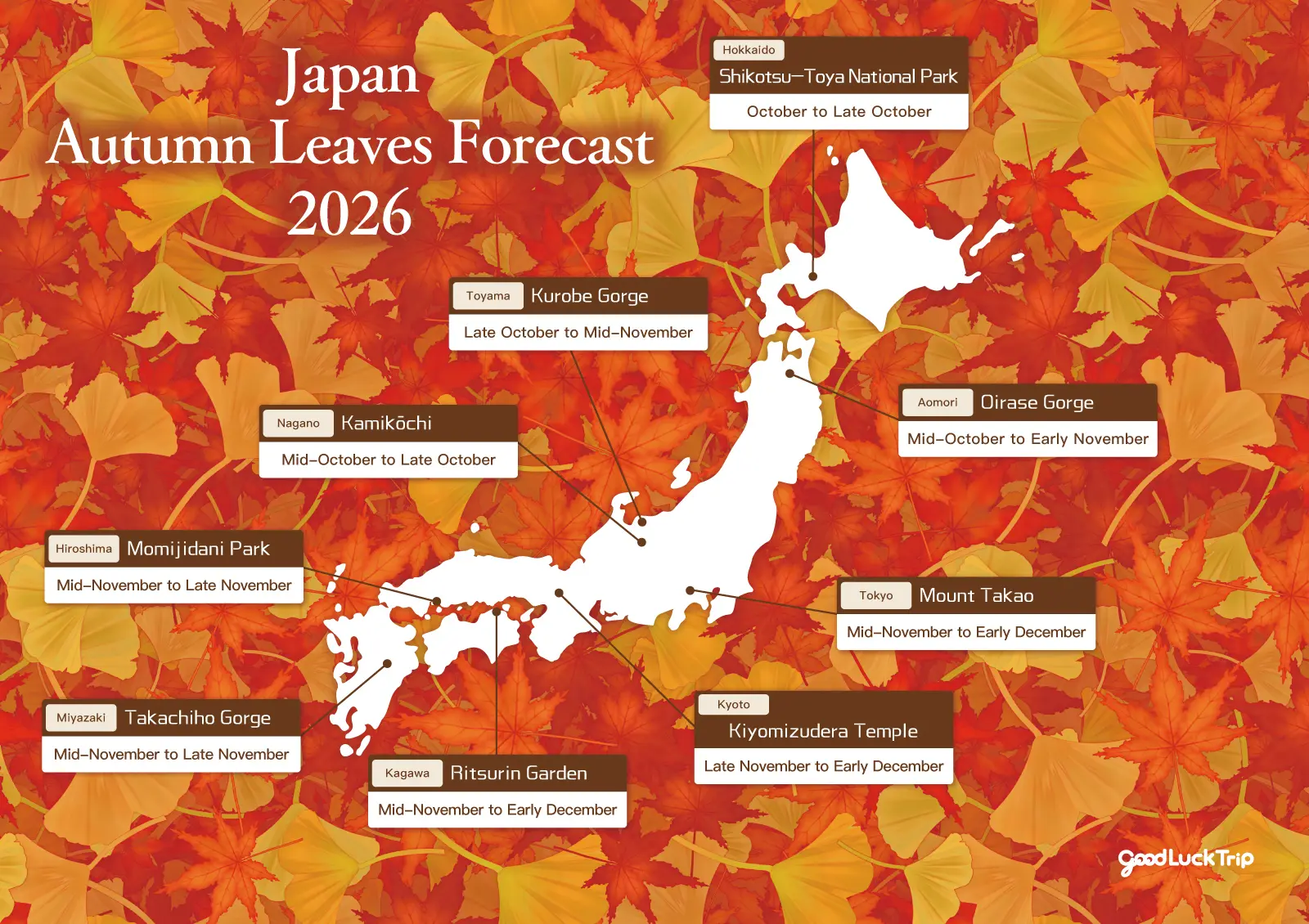
Please refer to the following autumn leaves map for the best time to see autumn leaves in 2025.
Real-Time Autumn Leaves Information Site
For real-time updates of the autumn leaves and their coloration, please refer to the weather feeds below on sites run by local weather companies and Japan Meteorological Association.
The Best of the Best at Japan’s Top 3 Fall Foliage Spots
Among the multitude of autumn leaves spots in Japan, here’s the best of the best that made the Top 3 Fall Foliage Spots list. If one of your main Japan travel goals is to catch the leaves, you’ll want to pick at least one of the three listed below.
1. Arashiyama, Kyoto
In Arashiyama, Kyoto you’ll find the nexus between autumn leaves and old-world architecture of Japan.
From traditional Japanese gardens and color-washed mountains to autumn leaves and neatly arranged rock gardens, there are countless spots just bursting with authentic, Japan-esque vibes.
Among these spots, the most popular autumn leaves destinations are locales like the UNESCO World Heritage site Tenryu-ji Temple, Ryoan-ji Temple, and the iconic Togetsukyo Bridge from Arashiyama.

2. Nikko, Tochigi
In Nikko, a city which makes up a whole quarter of Tochigi Prefecture, you can find a wealth of popular fall foliage spots, including Irohazaka slope where you can enjoy autumn leaves while driving, Chuzenji Lake, known as one of the best places for autumn leaves in the Kanto region, and Ryuzu waterfall, where you’ll find the enchanting dual snapshot of a gorgeous waterfall backed by autumn leaves. There are even hot springs resorts here, meaning you can enjoy they leaves while look up from a soak in the springs.
With many spots to enjoy autumn leaves along the road, renting a car is an extra option that would bring you to the forefront of autumn beauty in Nikko.

3. Yabakei, Oita
In Yabakei in Nakatsu City, Oita Prefecture, selected as one of the "New Three Scenic Views of Japan", "Japan Heritage", and "Three Great Sights of Japan", you can enjoy a collaboration of vibrant autumn leaves against the rocky peaks. Inside the vast area between 32km north-south and 36km east-west, a unique and sprawling landscape unfolds with cliffs, caves, mountain streams, and unique rocks. Among the many beautiful spots to see autumn leaves, the most famous is the "Eight Scenic Views Observation Deck" located in the center of Deep Yabakei. The spectacular view from the "Eight Scenic Views Observation Deck" can only be seen here.

Grand Landscapes all Awash in Crimson and Gold! Hokkaido’s Top 3 Spots for Autumn Leaves
One of Hokkaido’s biggest draws is the sheer splendor of its autumn leaves washed in red and gold. Here are a few recommended spots where you can see it for yourself.
1. Jozankei Onsen Town
A historic hot spring town located in Minami Ward, Sapporo City, Hokkaido, often referred to as the inner parlor of the big city, Sapporo. Over 150 years since its establishment, it has been designated as Shikotsu-Toya National Park, and the hot spring town spreads along the riverbank carved out by the Shirai River and Toyohira River. From Jozankei Bridge in the center of the hot spring town, you can overlook the scenery of hotels standing in the large valley colored by autumn leaves. There are also famous autumn leaves spots near the hot spring town, making it an ideal base for touring autumn leaves spots.
- Best time to see the autumn leaves
- Early to mid-October

- Name in Japanese
- 定山渓温泉街
- Postal Code
- 061-2303
- Address
-
Minami-ku, Sapporo City, Hokkaido
Google Maps - Telephone
- 011-598-2012 (Jozankei Tourism Association)
- Closed
- Depend on facilities
- Hours
- Depend on facilities
- Admission
- Depend on facilities
- Directions
- From Sapporo Station on the Subway Namboku Line/Toho Line/JR Line, take the Jotetsu Bus to the Jozankei Yunomachi stop. You will be right there.
- Website
- Official Website (English)
2. Hokkaido University
Hokkaido University is home to a vast, wide open campus.
It’s easily accessible, located within walking distance of Sapporo Station. In addition to students and faculty, the campus is also open to outside visitors to come and have a stroll.
Once inside you’ll find Poplar Avenue, a spot where gazing up into the outstretched tree trunks will grant you a marvelous treescape that’s very typical of the north.
On Kita-13-Jo Street you’ll find a road flanked with ginkgo trees, waiting to impress you with their shimmering gold flair at the height of autumn.
- Best time to see the autumn leaves
- Late October to early November

- Name in Japanese
- 北海道大学
- Postal Code
- 060-0808
- Address
-
5 Kita8jonishi, Kita-ku, Sapporo City, Hokkaido
Google Maps - Telephone
- 011-716-2111(Main number)
- Admission
-
Free
※Depend on facilities - Closed
- Depend on facilities
- Hours
- Depend on facilities
- Direction
- A 7-minute walk from JR Sapporo station.
- Official Website
- Official Website (English)
3. Shikotsu-Toya National Park
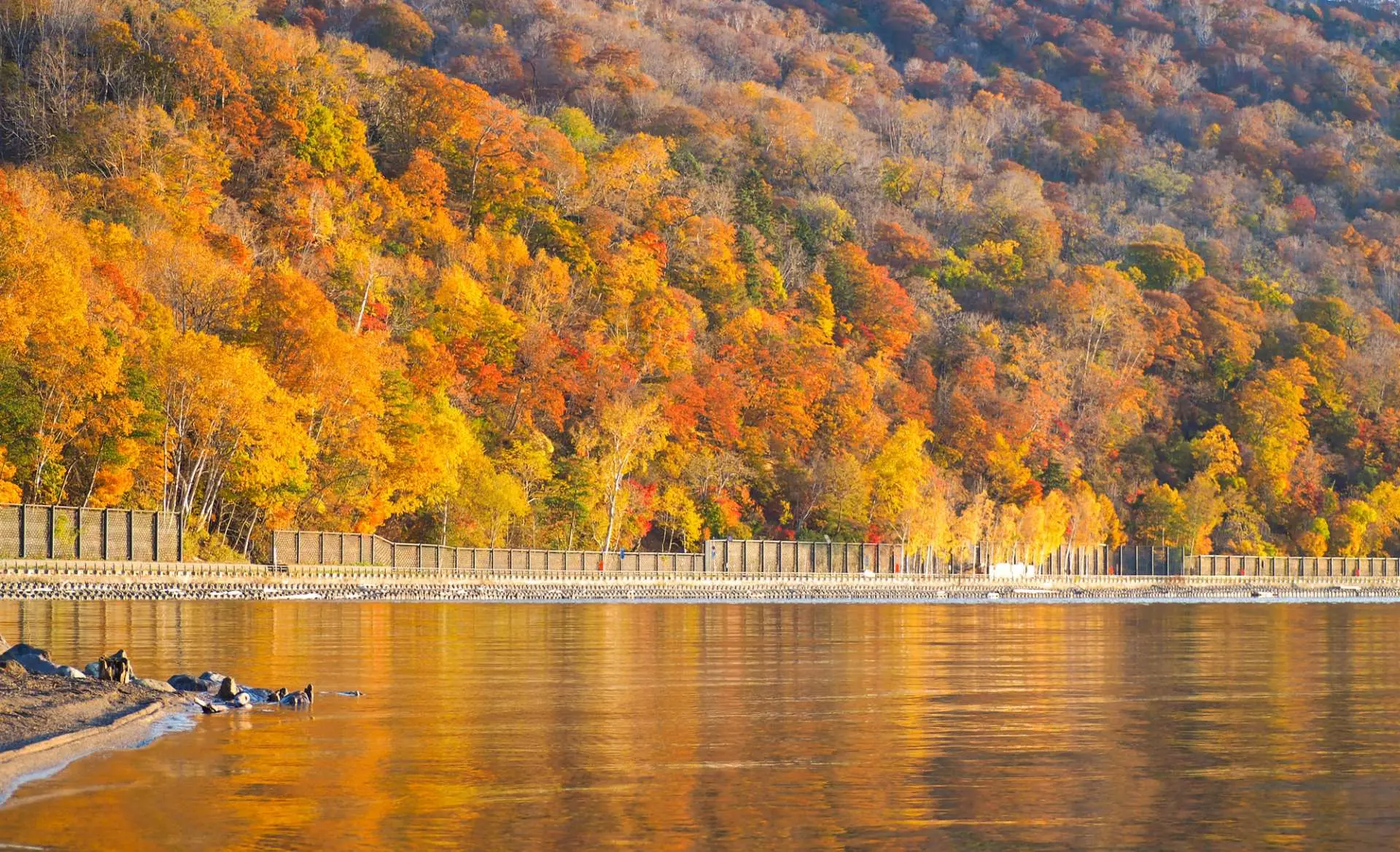
Shikotsu-Toya National Park is located in the southwestern part of Hokkaido. Its scale extends over a total area of 993 km². In addition to Lake Toya and Lake Shikotsu, two major caldera lakes (lakes formed when water collects in a crater), you can see various types of volcanoes and volcanic terrains, such as Mount Yotei, Mount Usu, and Mount Tarumae. There are many autumn leaves spots in the park, and the Noboribetsu Onsen Jigokudani and the area around Lake Shikotsu are particularly famous as autumn leaves spots.
- Best time to see the autumn leaves
- Mid to late October
- Name in Japanese
- 支笏洞爺国立公園
- Postal Code
- 066-0281
- Address
-
Shikotsu Onsen, Chitose City, Hokkaido
Google Maps - Telephone
- 011-299-1950(Hokkaido Regional Environment Office)
- Admission
- Free
- Holiday
- Open every day
- Directions
- About a 55-minute ride on Hokkaido Chuo Bus from the New Chitose Airport and get off at “Lake Shikotsu” station.
- Official Website
- Official Website (English)
Three Overwhelmingly Beautiful Autumn Foliage Spots in the Tohoku Region
What set’s Tohoku apart from the rest is the sheer scale of nature you’ll find here.
Mountains adorned with a veil of autumn leaves and beautifully colored valleys can be found in other regions too, but the all-encompassing vibrance here is one that can only be experienced in Tohoku.
Below are three autumn leaves spots that are known to be strikingly beautiful naturescapes.
2. [Aomori Prefecture] Oirase Gorge
The Oirase River flows out from the waters of Lake Towada. Part of the river, the section from Konoguchi on the banks of Lake Towada to Yakeyama, is a valley area of about 14km known as Oirase Gorge.
The gorge is designated as a national place of scenic beauty and a natural monument, offering splendid natural landscapes including crystal-clear streams, waterfalls of various shapes, and a variety of large and small rocks amongst the trees. The dual snapshot of waterfalls and streams, set against a backdrop of colored leaves is truly breathtaking, spawning exceptional views only available in autumn at spots like Sanran-no-Nagare, Ishigedo-no-Se, Ashura-no-Nagare, and Lake Towada.
There's also a nature trail, making it perfect for a stroll.
- Best time to see the autumn leaves
- Mid-October to early November

- Name in Japanese
- 奥入瀬渓流
- Postal Code
- 034-0301
- Address
-
Okuse, Towada City, Aomori
Google Maps - Telephone
- 0176-75-2425 (Lake Towada National Park Association)
- Closed
- Open every day
- Hours
- Walk anytime
- Admission
- Free
- Directions
- Take the JR Bus from JR Shin-Aomori Station or Hachinohe Station and get off at "Yakeyama".
- Official Website
- Official Website (English)
2. [Miyagi Prefecture] Naruko Gorge
Naruko Gorge is approximately 2.5 km long destination, lined with cliffs that tower at 100m. Deciduous broad-leaved trees such as maples and Mizunara thrive on the sharply cut white cliffs, creating a picture-esque sight when they turn crimson and gold in the fall each year.
If you cross the Ofukazawa Bridge, which spans Naruko Gorge, you’ll step into the immersive world up high, surrounded by the gorgeous scenery. Full of thrills and romance, you may even be lucky enough to catch a train as it passes through the gorge.
- Best time to see the autumn leaves
- Mid-October to early November

- Name in Japanese
- 鳴子峡
- Postal Code
- 989-6827
- Address
-
Shitomae to Hoshinuma, Naruko Onsen, Osaki City, Miyagi Prefecture
Google Maps - Telephone
- 0229-87-2050(Naruko Gorge Resthouse)
- Open period
- From Late April to Mid November(From Late November to Late April closed during the winter)
- Business Hours
- 9:00am - 4:00pm
- Admission
- Free
- Access
-
1) About a 60-minute walk from JR Naruko Onsen Station to the entrance on the Nakayama-daira side
2) About a 30-minute walk from JR Nakayama-daira Onsen Station to the entrance on the Nakayama-daira side
*During the autumn leaves season, a temporary bus "Autumn Leaves-go" operates from either Naruko Onsen Station or Nakayama-daira Onsen Station (please confirm operation / Miyako Bus 0229-22-1781) - Official Website
- Official Website (Japanese)
3. [Aomori Prefecture] Hakkoda Mountains
The Hakkoda Mountains, a general term for several mountains towering in the southern part of Aomori City, is one of the "100 Famous Japanese Mountains." When the autumn leaves are at their peak, the entire mountain range is dyed in autumn colors, creating a beautiful brocade pattern. The first snow often falls in late October, offering a unique experience to view autumn leaves in the snow.
Then take to the Hakkoda Ropeway, where a 360-degree panoramic view of autumn colors await.
- Best time to see the autumn leaves
- Late September to late October

- Name in Japanese
- 八甲田山
- Postal Code
- 030-0955
- Address
-
Fukazawa, Komagome, Aomori City, Aomori
Google Maps - Telephone
- 017-734-5153 (Aomori Tourist Information Center)
- Closed
- Open every day
- Hours
- Walk anytime
- Admission
- Free
- Directions
- From JR Aomori Station of any line, ride the JR Bus, get off at the Hakkoda Ropeway Ekimae Stop (The boarding place for the ropeway)
- Official Website
- Official Website (English)
Three Easy-to-Access Autumn Foliage Spots to Love in Kanto
While Kanto is often associated with urban areas, it actually has many great places to see autumn leaves. One of the biggest perks to chasing the autumn leaves in Kanto is how easy they are to get to from city centers, a delight for anyone to enjoy.
1. [Tokyo] Mt. Takao
Mt. Takao, located in Hachioji, Tokyo, is a 599m high mountain. It's widely sought out for its easy access and ease of climbing, drawing crowds of all ages both young and old. With about 3 million visitors per year, the peak boasts the highest number of climbers in the world.
Mt. Takao is also a well-known spot for autumn leaves in Tokyo, dazzling its visitors with views of gorgeous reds, yellows and greens in the fall.
Some of the trails up are low-difficulty climbs, meaning even novice hikers can enjoy stretching their legs as they take in the views of autumn leaves.
- Best time to see the autumn leaves
- Mid-November to early December

- Name in Japanese
- 高尾山
- Postal Code
- 193-0844
- Address
-
Takao-machi, Hachioji City, Tokyo
Google Maps - Telephone
- 042-664-7872
- Closed
- No holidays
- Hours
- Open 24 hours
- Access
- The trail entrance is about 5 minutes on foot from Takaosanguchi Station on the Keio Line
- Official Website
- Official Website (Japanese)
2. [Tokyo] Meiji Jingu Gaien
Meiji Jingu Gaien, the outer garden of Meiji Shrine founded in 1926. Visitors here will find the Meiji Memorial Picture Gallery, as well as the Meiji Jingu Stadium and centers for every sport, plus full on nature escapes to take in across all four seasons.
The famous avenue flanked with ginkgo tress stretches some 300 meters from Aoyama Street to the Meiji Memorial Picture Gallery, becoming a breathtaking tunnel of gold in the fall.
Once the autumn leaves come into season, the time for the Gaien Ginkgo Festival arrives, bringing with it a smorgasbord of tasty eats from across the world.
The gingko trees are also lit at night, making this an unforgettable chance to see illuminations in the full glory of fall.
- Best time to see the autumn leaves
- Mid-November to early December

- Name in Japanese
- 明治神宮外苑
- Postal Code
- 160-0013
- Address
-
1-1 Kasumigaoka-machi, Shinjuku-ku, Tokyo
Google Maps - Telephone
- 03-3401-0312
- Closed
- Depend on facilities
- Hours
- Depend on facilities
- Admission
- Free (charges apply for using facilities)
- Access
-
(1) JR Chuo/Sobu Line at Shinanomachi Station or Sendagaya Station
(2) Tokyo Metro Ginza Line at Gaiemmae Station or Aoyama-itchome Station
(3) Tokyo Metro Hanzomon Line at Aoyama-itchome Station
(4) Toei Oedo Line at Kokuritsu-Kyogijo Station or Aoyama-itchome Station
*For the nearest station to each facility, please check the information of the facility you plan to visit. - Official Website
- Official Website (English)
3. [Tokyo] Showa Kinen Park
This expansive park boasts an impressive size equivalent to almost 40 Tokyo Domes, featuring lush green lawns, fountains, sport courts, gardens home to flowers in bloom each season, and ponds filled with aquatic plants.
Inside you’ll also find a number of centers where you can learn about plants and nature together, along with a plenty of other events and programming all year long.
For two yellow-leaf spots, Ginkgo Avenue of Katara with 98 ginkgo trees lined up for about 300m, and Canal-side Ginkgo Avenue with 106 ginkgo trees lined up for about 200m are the way to go. There’s even a tunnel of two different strains of golden yellow glory to enjoy along a stroll.
- Best time to see the autumn leaves
- Late October to late November

- Name in Japanese
- 国営昭和記念公園
- Postal Code
- 190-0014
- Address
-
3173 Midori-cho, Tachikawa City, Tokyo
Google Maps - Telephone
- 042-528-1751
- Admission
-
Adults (15 and over) 450 yen; Children (under 15) free; Silver (65 and over) 210 yen
*Facilities are separately charged.
*There are free park entrance days (posted on the Official Website). - Parking
- Available at 900 yen
- Closed
- New Year’s Eve and Day; From The 3rd Monday To Friday Of January
- Opening Hours
-
March-October: 9:30 am to 5:00 pm
November-February: 9:30 am to 4:30 pm
April-September: 9:30 am to 6:00 pm (Saturdays, Sundays & Holidays)
*The Green Cultural Zone (free area) opens at 8:30 am.
From Spring Equinox Day to March 31, the Zone closes at 5:30 pm.
*Due to events or performances, the schedule is subject to change.
*Opening and closing hours may vary, depending on the facility. - Access
-
*All on foot:
(1) About 10 minutes (to the Akebono Entrance) or 15 minutes (to the Tachikawa Gate) from Tachikawa Station on the JR Chuo Line
(2) About 8 minutes (to the Akebono Entrance) or 13 minutes (to the Tachikawa Gate) from Tachikawa-Kita Station on the Tama Monorail
(3) About 2 minutes (to the Nishi Tachikawa Gate) from Nishi-Tachikawa Station on the JR Ome Line
(4) About 10 minutes (to the Akishima Gate) from Higashi-Nakagami Station on the JR Ome Line
(5) About 25 minutes (to the Tamagawa Josui Gate) or 20 minutes (to the Sunagawa Gate) from Musashi-Sunagawa Station on the Seibu Haijima Line - Official Website
- Official Website (English)
Hiker’s Delight at 3 Top Autumn Leaf Spots Along the Trails in the Chubu Region!
If you're in the Chubu region and want to enjoy the autumn leaves, why not do it while hiking? The region offers not only spots for serious hiking but also those where you can enjoy a leisurely stroll, making it a great option for novice climbers as well.
1. [Nagano Prefecture] Kamikochi
Kamikochi, one of Japan's most coveted mountain destinations, is recognized as a "special place of scenic beauty" and "special natural monument" due to its stunning landscapes.
From its well-maintained walking paths, visitors here are greeted with up close views of mountains as they tower over 3000 meters high, including Hotaka. It's also the starting point for several mountain trails, welcoming throngs of serious climbers doning large backpacks. Kamikochi is home to a multitude of breathtaking autumn foliage spots, particularly around Kappa Bridge, Myojin Pond, and Taisho Pond. Experiencing both real hiking and beautiful autumn leaves is a unique perk of Kamikochi in fall.
- Best time to see the autumn leaves
- Mid-October to late October

- Name in Japanese
- 上高地
- Postal Code
- 390-1516
- Address
-
Azumikamikochi, Matsumoto City, Nagano
Google Maps - Tel
- 0263-95-2433 (Kamikochi Information Center)
- Admission
- Free
- Regular Holidays
- None
- Hours of operation
- None specified
- Access
- One hour bus ride from Shin-Shimashima station on Matsumoto railways.
- Official Website
- Official Website (English)
2. [Aichi Prefecture] Korankei
Korankei is part of the Aichi Kogen Quasi-National Park, a valley about 1km long created by the Tomoe River. From Mount Iimori, standing at 254m above sea level, down along the river, a deciduous broadleaf forest spreads out, with about 4,000 maple trees coloring the area in fall.
During peak autumn season, visitors here can find the Korankei Momiji Festival, and at night a chance to glimpse the fantastical world created by the illuminated golden Mount Iimori and the golden trees reflected in the Tomoe River.
Other popular spots here include the Koran Bridge, offering 360-degree views of Korankei's autumn leaves, and the approach to the Kojakuji Temple, covered in trees that turn brilliant colors in fall.
- Best time to see the autumn leaves
- Mid-November to late November

- Name in Japanese
- 香嵐渓(こうらんけい)
- Postal Code
- 444-2424
- Address
-
Iimori, Asukecho, Toyota City, Aichi
Google Maps - Telephone
- 0565-62-1272(Toyota City Asuke Tourism Association)
- Closed
- Free to walk
- Business Hours
- Walk anytime
- Admission
- Free ※Fees are subject to change.
- Access
-
1) From Jyosui Station on the Meitetsu Toyota Line, change to the Toyota Oiden Bus Sanage Asuke Line and get off at the "Korankei" bus stop, a short walk away.
2) From Toyota City Station on the Meitetsu Mikawa Line/Toyota Line, change to the Meitetsu Bus Yanami Line bound for Asuke, get off at the "Korankei" bus stop, and walk a short distance.
3) From Higashi Okazaki Station on the Meitetsu Main Line, change to the Meitetsu Bus Okazaki/Asuke Line bound for Asuke, get off at the "Korankei" bus stop, and walk a short distance. - Official Website
- Official Website (English)
3. [Nagano Prefecture] Senjojiki Cirque
Stretching from the foot of Mount Hoken in the Central Alps, out over the cities of Komagane and Miyada in Nagano Prefecture, is a bowl-shaped valley eroded by glaciers 20,000 years ago.
Travelers and hikers from across Japan flock here to see the grandeur of dynamically changed landscapes all year around
This valley is known as a treasure trove of alpine plants, offering colorful autumnal grasses to see in fall.
Come here to see the sheer magnificence of autumn leaves in red, yellow, and orange as they paint the entire mountainside, seen from up above on the Central Alps Komagatake Ropeway.
- Best time to see the autumn leaves
- Late September to early October

- Name in Japanese
- 千畳敷カール
- Postal Code
- 399-4117
- Address
-
Akaho, Komagane City, Nagano
Google Maps - Telephone
- 0265-83-3107 (Chuo Alps Kanko Tourist)
- Holiday
- The ropeway is closed in case of stormy weather and for maintenance.
- Hours
- 8:00am - 5:00pm (varies according to the season)
- Admission
- Free to walk (accessible by bus and ropeway from Suganodai Bus Center; a round-trip ticket that includes both rides costs 4,200 yen)
- Directions
- About 30 minutes by local bus from Suganodai Bus Center to Shirabidaira Station, about 7 minutes and 30 seconds by Komagatake Ropeway, and a short walk from Senjojiki Station
- Credit Cards
-
Cards are accepted only at Suganodai Bus Center and Senjojiki Station
(VISA, JCB, Mastercard) - Website
- Official Website (Japanese)
Tired of the Same Old Places? Here are 3 New Recommended Autumn Leaf Spots in the Hokuriku Region!
The Hokuriku region is the prime destination for one-of-a-kind autumn leaf snapshots and angles, like from out the window of a trolley or gondola. If you’re already beyond the typical autumn leaf spots, its time to shake things up and check out what Hokuriku has in store.
1. [Toyama Prefecture] Kurobe Gorge
Kurobe Gorge is a sharp, V-shaped gorge, deeply carved by the erosion of the Kurobe River. The waters here originate from Washibadake in the central part of the Northern Alps, before flowing down the 3000m altitude and 86km distance between the Tateyama and Hida Mountain ranges.
The only access to this steep destination is by trolley train. As you sway on the trolley train, gaze out over the ever-expanding view of color contrast contrast woven by three types of trees: evergreen, deciduous, and yellow-leaved trees.
Along the line, you can even find scenic destinations like Sarutobikyo, a special natural monument, Okukane Bridge which spans the air 34m high above the Kurobe River streams, and Hito-Kui-Iwa, an awe-inspiring rock formation created by the sheer force of nature. A journey here is more than just a delight in gorgeous foliage, but also a mini excursion into the drama of breathtaking landscapes.
- Best time to see the autumn leaves
- Late October to mid-November

- Name in Japanese
- 黒部峡谷
- Postal Code
- 938-0293
- Address
-
11 Kurobekyokokuguchi, Kurobe City, Toyama
Google Maps - Telephone
- 0765-62-1011 (Kurobe Gorge Railway Customer Center)
- Period when the trolley is closed
- December to mid-April
- Trolley Train Operation Hours
- Depends on the season *For details, please refer to the timetable on the official website.
- Trolley Train Fare
-
Varies By Section Please Refer To The Official Website For Details.
Relaxed vehicles are charged extra. - Directions
- A short walk from Toyama Chiho Railway Unazuki Onsen Station
- Credit Cards
- Accepted
- Official Website
- Official Website (English)
2. [Niigata Prefecture] Yahiko Park
Yahiko Park, spreading over approximately 40,000 tsubo, offers a multitude of scenic spots where you can experience the lush, coveted vibes of Japan found near streams and waterfalls.
Visitors here will find a number of tree varieties across the grounds, meaning there’s plenty of picturesque nature to find each season.
In Momiji Valley, near the iconic Kangetsu Bridge from Yahiko Park, there are heaps of “Momiji” crimson trees and yellow-leaf varieties.
The shimmering luster of Kangetsu Bridge against the vermillion leaves is like none other.
The trees are even illuminated at night, making for even more magic to love after the sun sets.
- Best time to see the autumn leaves
- Late October to mid-November

- Name in Japanese
- 弥彦公園
- Postal Code
- 959-0323
- Address
-
667-1 Yahiko, Yahikomura, Nishikambaragun, Niigata
Google Maps - Telephone
- 0256-94-3154(Yahiko Tourism Association)
- Closed
- Free to walk
- Business Hours
- Walk anytime
- Admission
- Free
- Access
- A short walk from Yahiko Station on JR Yahiko Line
- Official Website
- Official Website (English)
3. [Niigata Prefecture] Naeba Dragondola
Naeba Dragondola, Japan's longest gondola, connects Naeba Highlands and Tashiro Highlands.
The gondola climbs a height of 430m in just 25 minutes, offering all the thrills of wide open views as you mount the skies.
In the fall, the trees along the way take on a wash of different colors, like the gorgeous emerald green at Lake Niike against a backdrop of shimmering autumn leaves.
At the coveted fall foliage spot, Pillar 14, travelers here are greeted with the delightful splendor of passing through the autumn mountains from the gondola.
- Best time to see the autumn leaves
- Mid-October to early November

Authentic Autumn in Japan Vibes Await! Top 3 Autumn Leaf Spots in the Kansai Region
Kansai is where you’ll find all the full-on Japan flair you envisioned, at the many historic, old-world buildings set against a wall of autumn leaves.
To help you find the best in gorgeous, Japanese aesthetic vibes, we’ve selected three spots that are bursting with elegant yet rustic beauty.
1. [Kyoto Prefecture] Mt. Otowa Kiyomizu-dera Temple
Opened in 778 and registered as a UNESCO World Heritage Site in 1994, Mt. Otowa Kiyomizu-dera Temple is home to over 30 structures and monuments, including national treasures and important cultural properties, within its 130,000 sq. meter grounds.
As autumn approaches, the trees here begin to shift towards a gorgeous red, making for a picturesque backdrop of autumn leaves for all the historic structures.
The view at the main hall especially, nicknamed "jump off the stage of Kiyomizu" (a Japanese idiom meaning "to take the plunge"), is where you’ll find the three-storied pagoda and trees behind it painted in a brilliant wash of vermillion so beautiful it can’ be missed.
- Best time to see the autumn leaves
- Late November to early December

- Name in Japanese
- 音羽山 清水寺
- Postal Code
- 605-0862
- Address
-
1-294 Kiyomizu, Higashiyama-ku, Kyoto City, Kyoto
Google Maps - Telephone
- 075-551-1234
- Holiday
- Open every day
- Business Hours
- 6:00am - 6:00pm
- Admission
- Adults 500 yen, Elementary/ Middle School Students 200 yen
- Directions
-
1) Ride the Keihan Main Line to Kiyomizu Gojo Station, then walk 25 minutes.
2) Ride the Kyoto Municipal Transportation Bureau (City Bus) Line 206 "Higashiyama-Dori Kitaoji Bus Terminal" or Line 100 "Kiyomizudera Gion Ginkakuji" from Keihan Main Line Nanajo Station, get off at "Gojo Zaka" bus stop, then walk 10 minutes. - Credit Cards
- Not accepted
- Official Website
- Official Website (Japanese)
2. [Kyoto Prefecture] Kodaiji Temple
A Rinzai Zen temple of the Kenninji school, Kodaiji is located at the foot of Kyoto's Higashiyama, to the northeast of the famous Hokanji Temple with its Yasaka Pagoda. Following the death of Toyotomi Hideyoshi, his widow Nene moved from Osaka to Kyoto and became a nun. In 1606, to mourn Hideyoshi and to serve as her own grave, she founded Kodaiji Temple, one of the most famous temples in the Higashiyama area. Although there are countless highlights within the grounds like the tea room designed by Sen no Rikyu and a garden designed by Kobori Enshu, the autumn leaves here are what really make Kodaiji famous. The gradient of colors created by approximately 1,000 maple trees is breathtaking. During the night light-up, you can enjoy a solemn and mystical landscape.
- Best time to see the autumn leaves
- Mid-November to early December

- Name in Japanese
- 高台寺
- Postal Code
- 605-0825
- Address
-
526 Shimokawaracho, Higashiyama-ku, Kyoto City, Kyoto
Google Maps - Telephone
- 075-561-9966
- Holiday
- Open every day
- Hours
-
9:00am - 5:30pm(Admission allowed until 5:00pm)
*During the special night visit period, until 10pm (Last entry at 9:30pm) - Admission
- Entry 800 yen
- Directions
-
1) From Keihan Main Line, Gion Shijo Station, walk 15 min.
2) From Hankyu Kyoto Line, Kyoto-kawaramachi Station, walk 20 min. - Credit Cards
- Not accepted
- Official Website
- Official Website (Japanese)
3. [Nara Prefecture] Nara Park
Nara is where you can enjoy truly grand, natural beauty as it weaves around the precious historic landmarks and cultural heritage sites like Kasuga Taisha, Kofuku-ji, Todai-ji, the Nara National Museum, and Shoso-in.
In addition to Kasugayama Primeval Forest (a special natural monument), the Nara deer, Nagi Forest in the precincts of Kasuga Shrine, Narano Yae-zakura cherry tree in Chisokuin Temple and the Loomis white-bellied woodpecker habitat are all designated as natural monuments.
As autumn arrives, the park transforms into a space where these same landmarks meld perfectly into a tapestry of brightly colored trees.
The entire grounds are planted with deciduous tree varieties, making for a perfect place to take in the views as you enjoy an autumn stroll.
- Best time to see the autumn leaves
- Late October to early December

- Name in Japanese
- 奈良公園
- Postal Code
- 630-0000
- Address
-
Kasugano-cho, Nara City, Nara Prefecture
Google Maps - Tel
- 0742-22-0375 (Nara Park Office)
- Admission
-
Free
*Please refer to the official website for information on admission fees for each facility. - Regular Closures
-
None
*Please check the official website for the regular closing days of each facility. - Access
- About 5 minutes walk from Kintetsu Nara Station
- Official Website
- Official Website (Japanese)
Serene spaces bathed in autumn hues! Top 3 Autumn Leaf Spots in the Chugoku Region
The Chugoku region is known for its autumn leaf spots where you can observe spectacular autumn hues in peaceful settings. If you want to enjoy the tranquil beauty of fall foliage, we recommend visiting the autumn leaf spots in the Chugoku region.
1. [Hiroshima Prefecture] Momijidani Park
Located on Miyajima Island in Hiroshima Bay, Momijidani Park is a walking path in a valley at the foot of Mount Misen.
In autumn, the park is washed in the color of some 700 different trees as they turn a deep shade of red.
Of the 700 trees, 560 are the “Iroha Kaede” variety, making for a striking contrast of bright red boughs set against the dazzling shades of green.
At the entrance, visitors are greeted with the unforgettable, glorious splendor of kaede and Momiji trees as they decorate the steps around the Momijibashi Bridge.
- Best time to see the autumn leaves
- Mid to late November

- Name in Japanese
- 紅葉谷公園
- Postal Code
- 739-0588
- Address
-
Miyajimacho, Hatsukaichi City, Hiroshima
Google Maps - Telephone
- 0829-44-2011(Miyajima Tourist Association)
- Closed
- Open every day
- Business Hours
- Walk anytime
- Admission
- Free
- Access
- About a 10-minute ride on the JR West Miyajima Ferry or the Miyajima Matsudai Kisen Ferry from JR Miyajimaguchi Station or Hiroshima Electric Railway Hirosima-Miyajimaguchi Station. Then, about a 15-minute walk from "Miyajima Sanbashi" (Miyajima Pier).
- Official Website
- Official Website (Japanese)
2. [Hiroshima Prefecture] Imakoyasan Mountain
Imakoyasan Mountain was established as a temple equivalent to the head temple of Koyasan, a sacred site of Shingon Esoteric Buddhism opened by Kobo Daishi (Kukai).
The temple once prospered with 7 halls and 12 sub-temples, but most were lost due to natural disaster and war. Today, the main deity of the Kannondo and the Lion Head of Niu Shrine found here are designated as cultural properties.
When the autumn leaves are at their peak, the entire Imakoyasan Mountain area changes color, allowing you to stroll the grounds beneath a picture-perfection snapshot of temples paired with autumn leaves.
- Best time to see the autumn leaves
- Early to mid-November

3. [Okayama Prefecture] Okutsu Valley
Okutsu Valley, a gorge in the upper reaches of the Yoshii River and designated as a national scenic spot, is said to have the "largest natural potholes in the East" formed over tens of thousands of years.
In addition to the potholes, the valley has various other attractions, collectively known as the "Eight Views of Okutsu Valley".
In autumn, maple, gingko, and other trees begin to change color, offering a fantastic brocade of autumn colors against the varied topography. At night, the autumn leaves are lit up, allowing for a different view from the daytime, at this spot of varied magnificence.
- Best time to see the autumn leaves
- Mid-October to early November

Countless Different Scenic Backdrops! 3 Selected Autumn Leaves Spots in the Shikoku Region
The Shikoku region is where you’ll find autumn leaves paired with a number of peculiar backdrops, like from a boat in an illuminated garden, or all together against sky and sea as the autumn leaves make striking contrast against the clear, beautiful river streams.
For autumn vibes that go beyond your textbook definition, check out the guide to Shikoku autumn foliage below.
1. [Kagawa Prefecture] Ritsurin Garden
Ritsurin Garden, was designed as an additional estate for the Matsudaira clan, the lord of Takamatsu, and stands today as one of the largest recognized “special places of scenic beauty” and cultural assets built as a garden after it was completed 300 years ago, a result of the continues work of successive feudal lords.
Once inside, visitors will find a circular garden that’s home to six ponds and 13 artificial hills, will strolling through this mosaic of sights nicknamed to boast a new view with each step.
During the autumn season the colorful boughs are illuminated, creating mystic reflections of the shimmering leaves across the park lake’s surface.
There’s even a Japanese-style wasen boat tour at the South Pond, where you can view the garden and lit-up autumn leaves from a boat, a simple must-try for the season.
- Best time to see the autumn leaves
- Mid-November to early December

- Name in Japanese
- 栗林公園
- Postal Code
- 760-0073
- Address
-
1-20-16 Ritsurincho, Takamatsu City, Kagawa
Google Maps - Telephone
- 087-833-7411
- Admission
- Adults 500 yen, Children 170 yen
- Closed
- Open year-round
- Hours
-
Mostly from sunrise to sunset
*Hours vary by season. Please check the official website for details. - Access
- About 3 minutes on foot from JR Ritsurin Koen Kitaguchi Station
- Official Website
- Official Website (English)
2. [Kagawa Prefecture] Kankakei Ropeway
Kankakei is a valley located on Shodoshima in Kagawa Prefecture, located at the center of Setonaikai National Park.
The rock formations created by volcanic activity approximately 13 million years ago, such as andesite and concretion, have created a spectacular view of towering odd rocks and stones due to long-term crustal movement and erosion.
The valley gorge stands as of Japan’s selected Top Three Beautiful Valleys in Japan, Japan Top 3 and Top 100 Scenic Views, as well as one of the Top 100 Natural Scenic Beauties of the 21st century.
Visitors here can take a ride up the ropeway that starts in the deep valley, taking in the swooping views out over the Seto Inland Sea and the valley of vibrant autumn leaves as you climb.
This is the only valley in Japan where you can see open skies, open seas and the grandeur of autumn leaves all at once.
- Best time to see the autumn leaves
- Early November to late November

- Name in Japanese
- 寒霞渓
- Postal Code
- 761-4433
- Address
-
327-1 Kankakedori, Shodoshima-cho, Shozu-gun, Kagawa Prefecture
Google Maps - Tel
- 0879-82-0904
- Business Hours
-
March 21st through October 20th 8:30 - 17:00. October 21st through November 30th 8:00 - 17:00. December 1st through December 20th 8:30 - 17:00. December 21st through March 20th 8:30 - 16:30.
※Ropeway departs in 12-minute intervals - Closed
- No regular closures. Check the official website before visiting.
- Ropeway Fee
-
[ Round Trip ] Adults 2,340 yen, Children 1,170 yen
[ One Way ] Adults 1,300 yen, Children 650 yen
※ Fares May Vary Depending On The Period. - Access
- 15 minutes by bus from Kusakabe Port towards Kountei (get off at the last stop)
- Official Website
- Official Website (Japanese)
3. [Ehime Prefecture] Omogo Gorge
This is a valley spread at the foot of Mt. Ishizuchi, known as a nationally designated scenic spot.
The waters here are so clear they’re known for being able to see straight to the riverbed, even from the distance of a far off walkway.
The emerald green-like clear streams offer a striking contrast against the autumn leaves, washed in a splendid color of red and yellow. The area is shrouded in an air of magic and mystique.
There are also spots where you can see waterfalls and strange rocks, offering a variety of spectacular views to find.
- Best time to see the autumn leaves
- Late October to mid-November

- Name in Japanese
- 面河渓(おもごけい)
- Postal Code
- 791-1710
- Address
-
Wakayama, Kumakogencho, Kamiukenagun, Ehime
Google Maps - Telephone
- 0892-21-1192(Kumakogen Tourism Association)
- Closed
- Free to walk
- Business Hours
- Walk anytime
- Admission
- Free
- Access
- About a 20-minute walk from the "Omogo" bus stop.
- Official Website
- Official Website (English)
Tried-and-True Classics, 3 Top Autumn Leaves Spots in the Kyushu Region!
Kyushu is another area where you can find picture-perfect classics like autumn leaves paired with temples and valleys.
What’s more, there are even rare spots like one where the entire area is washed with yellow autumn leaves that shimmer like gold.
Here are a few sites to consider if you’re planning a trip to Kyushu in the fall.
1. [Miyagi Prefecture] Takachiho Gorge
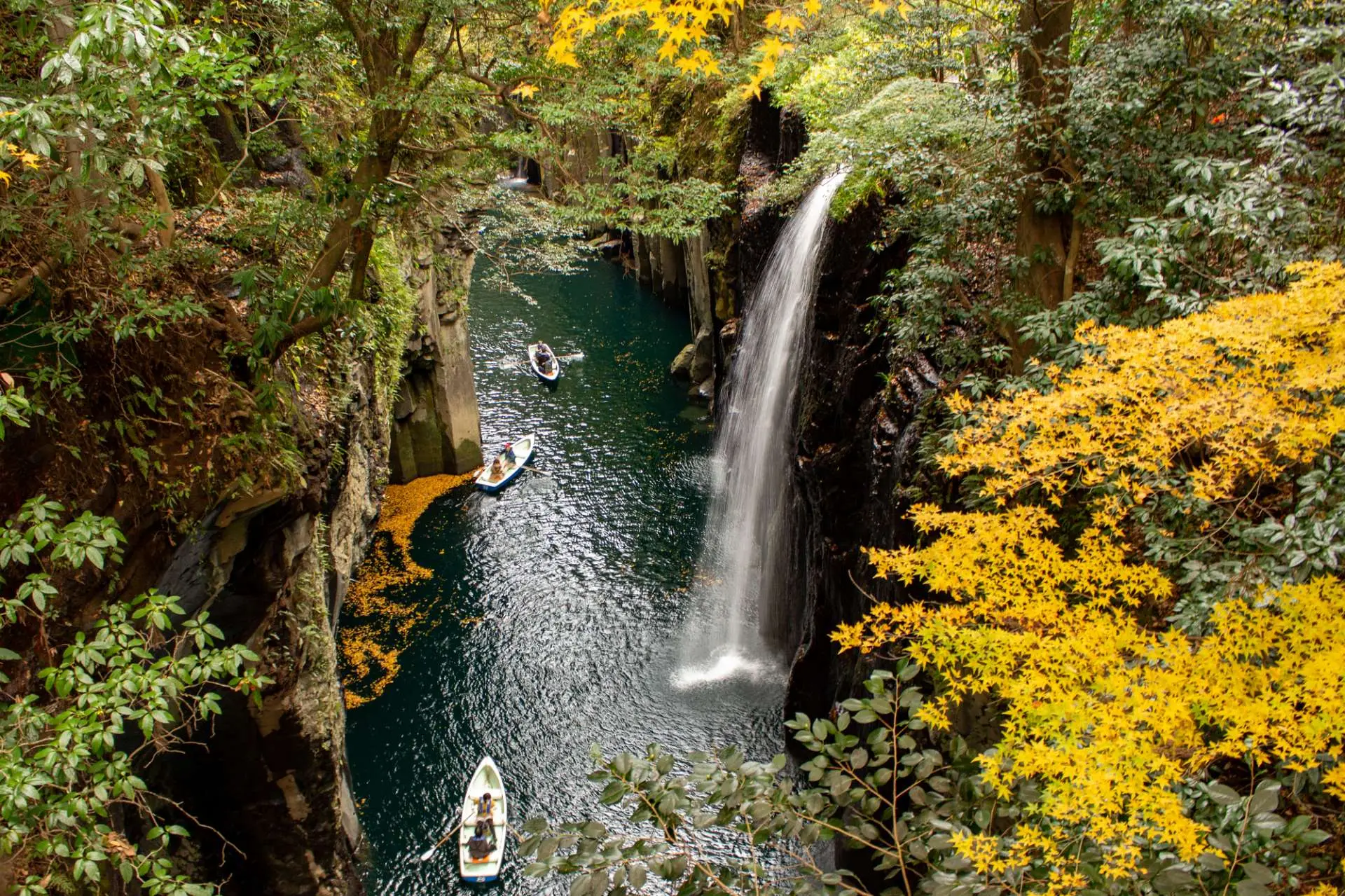
This V-shaped gorge was created by the Gokase River eroding the lava that flowed out from the eruption of Mt. Aso over tens of thousands of years.
The view of the cliffs, which reach as high as 100m and average 80m, extending for 7km is so magnificent Japan has designated this spot as a natural monument and a place of scenic beauty.
The biggest highlight is Manai Falls, which has been selected as one of the 100 best waterfalls in Japan. When the autumn leaves are in full season, the area around the waterfall also changes color, offering breathtaking views of waterfalls and autumn leaves that you can view from a boat.
There’s even more to see outside of Manai Falls, meaning you can enjoy your autumn stroll while taking the Takachiho Gorge promenade.
- Best time to see the autumn leaves
- Mid-November to late November
- Name in Japanese
- 高千穂峡
- Postal Code
- 882-1103
- Address
-
Mitai oshioi, Takachiho-cho, Nishiusuki-gun, Miyazaki
Google Maps - Tel
- 0982-73-1213 (Takachiho-cho Tourism Association)
- Boat Rentals
- 8:30am - 5:00pm (last rentals at 4:30pm)
- Access
- 7 minutes by car from Takachiho Bus Center
- Official Website
- Official Website (English)
2. [Fukuoka Prefecture] Taibaru's Ginkgo Leaves
The ginkgo grove spreading in the vineyards of Taibaru area, known as "Taibaru's Ginkgo Leaves", attracts many tourists when the autumn leaves are at their best. The ginkgo grove is privately owned, and access is allowed by the goodwill of the owner, so entry is prohibited outside the viewing period. When it's time for the leaves to fall, it looks as if a golden carpet was laid out beneath your feet.
- Best time to see the autumn leaves
- Mid-November to late November

3. 【Fukuoka Prefecture】Nomiyama Kannonji Temple
Located at the foot of Hoko-ritsu Mountain, Nomiyama Kannonji Temple is a distinguished monastery of the Koyasan Shingon sect, holding a status equivalent to that of a head temple.
This temple, with its miraculous virtues, attracts over a million visitors every year.
It also serves as a place of rigorous study for many monks. There are numerous points of interest, such as over 3,000 Mizuko Jizos, a Daishi Hall where Kobo Daishi is enshrined, and an Inari Shrine where Inari Daimyojin is worshipped. More than 1,000 maple and azalea trees each adorn the temple grounds and approach, creating a solemn atmosphere dyed in autumn colors when fall arrives. Among the many beautiful autumn leaves spots, a must-see is the approximately 1,000 white ekianthus planted behind the "Hyakukannon-do", which turn a vivid red.
- Best time to see the autumn leaves
- Late October to mid-November

- Name in Japanese
- 呑山観音寺
- Postal Code
- 811-2403
- Address
-
227-4 Hagino, Sasagurimachi, Kasuyagun, Fukuoka
Google Maps - Telephone
- 092-947-4423
- Business Hours
- 6:00am - 5:00pm
- Admission
- Free
- Access
- Approximately 15 minutes by car from JR Fukuhoku Yutaka Line's Sasaguri Station.
- Official Website
- Official Website (English)
What About Autumn Leaves in Okinawa?
Unfortunately, Okinawa is one spot where you won’t find gorgeous autumn leaves.
The climate conditions don’t lend themselves to deciduous tree varieties, which is why most of the trees here are different from mainland Japan.
If you’re goal is to catch the autumn leaves, a separate destination may be your best bet.
Frequently Asked Questions About Autumn Leaves in Japan
Q
When is the best time to see autumn leaves?
It varies by region, but many areas experience the peak of autumn leaves from early October to early December.
Q
What does "autumn leaves hunting" mean?
It refers to visiting autumn leaves spots during their peak and appreciating the autumn leaves.
Q
Can you tell me some famous places for autumn leaves?
Among numerous spots, the "Three Great Autumn Leaves Sites" in Japan - "Arashiyama" in Kyoto, "Nikko" in Tochigi, and "Yabakei" in Oita - are particularly famous.
Summary
Thus ends this roundup of all the buzz behind Japan’s autumn leaves, the best times to see them in each region, and a few carefully selected spot where you can catch them.
If you're planning to visit Japan to see the autumn leaves, we hope you’ll use this guide to kick off your travels.
If you do, you’re sure to find an unforgettable journey through all the glory of Japan’s autumn leaves.